
Best Vintage French Serveware & Table Setting Essentials
The French table is not a decorated surface. It is a prepared one. The distinction is small but consequential: decoration is added to a table to make it look a certain way; preparation is what is done to a table so that using it feels a certain way. The Parisian approach consistently prioritises the second over the first, which is why a genuinely Parisian table can look remarkably simple in a photograph and feel extraordinary to sit at.
This article covers seven table setting approaches, from the minimally set weekday lunch table with plain earthenware and a linen napkin to the fully dressed weekend dinner table with a complete ceramic service, mismatched glassware, and a loose flower arrangement. Each vignette describes a specific table context, what it requires in terms of serveware and textiles, and what to avoid. Every product in each Get This Look block is individually verified with a specific URL.
1. The Weekday Lunch: Plain Earthenware, Nothing Extra

The weekday lunch table is the one most consistently misunderstood in discussions of French table setting. It is frequently described as “casual” or “simple”, but both words miss what is actually being done: the weekday table is set with exactly the right things and nothing else. Two plates, two sets of flatware, two glasses, two napkins, and one central object. No placemat, no charger, no decorative element that is not also a functional one. The discipline is not austerity — it is precision about what a meal requires and a refusal to add anything that the meal does not.
The earthenware plate is the foundation of this table setting because its slightly irregular rim and warm, slightly rough surface reads as material rather than as product. Two plates that are clearly from the same maker but not perfectly identical — slightly different in their glaze tone, or slightly different in their rim width — read as acquired over time rather than purchased as a service.
→ The dining furniture this table sits on: Best French Vintage Dining Tables & Chairs
🛍️ Get This Look
Paint Colour: Benjamin Moore ‘Swiss Coffee’ OC-45 (warm flat) on walls — no colour on the table surface, the wood is the palette
Furniture: Simple walnut or oak dining table, no tablecloth; two mismatched dining chairs in warm wood tonesLighting: Natural afternoon light from a window as the only source; no candles at a weekday lunch table
Materials: Two plain white or off-white earthenware dinner plates (slightly irregular, handmade quality); simple stainless steel flatware; plain linen napkins in natural ecru
💡 Pro Tip
Set the napkin folded flat beside the plate rather than folded into a shape or placed in the glass. A napkin folded into a fan, a bishop’s hat, or any other decorative form reads as a restaurant convention that has no place at a Parisian dining table — and more importantly, it signals that the napkin is a decoration rather than something to use. A napkin folded in thirds and placed to the left of the plate reads as ready to be picked up.
⚠️ Avoid This
Avoid placing a placemat under the plate on a wooden dining table. A placemat introduces a decorative layer that reads as an attempt to protect the table from use, which is the opposite of the French domestic attitude toward dining furniture. A good walnut dining table acquires its character from use — rings, small scratches, the slight darkening of the wood where plates have been placed. These are the signs of a table that has been eaten at, which is the specific quality the Parisian dining room values.
The weekday lunch table set with two plain earthenware plates and a folded linen napkin is the French table at its most honest: prepared for the meal and nothing more.
2. The Dinner Party Start: White Service with Mismatched Glasses

🛍️ Get This Look
Paint Colour: Farrow & Ball ‘All White’ No.2005 (warm flat) on walls — no colour on the table itself
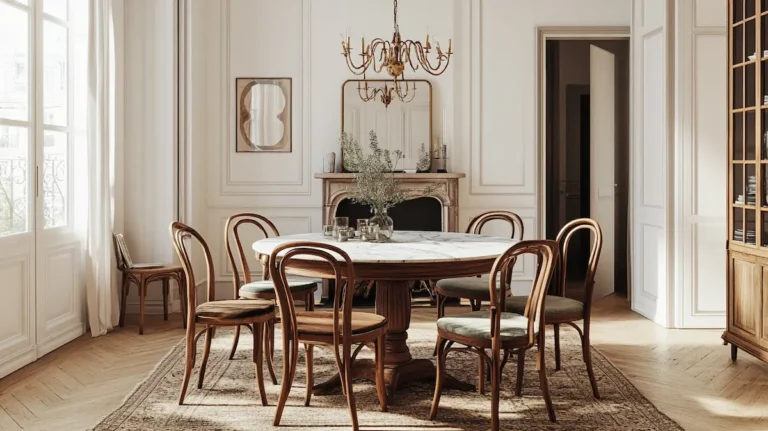
Furniture: Oval walnut dining table; mismatched dining chairs in warm wood tones; a sideboard visible in the background
Lighting: Three brass taper candlesticks grouped at the table centre as the primary dinner light; overhead dimmed to 20%
Materials: White ceramic dinner plates with simple rolled rim; plain silver flatware; mismatched clear wine and water glasses; brass taper candlesticksThe dinner party table in a Parisian apartment uses the same plates as the weekday lunch table — plain white ceramic with a simple rim — and distinguishes the occasion through the addition of candlelight, mismatched glasses, and a loose flower arrangement rather than through a different, more elaborate service. This is the approach that most clearly distinguishes the French table from the English or American formal dinner tradition, where occasion is marked by bringing out a “better” or more decorated service.
The mismatched wine and water glasses are a specific and recognisable element: each place setting has two glasses that are clearly not from the same set, but are in the same general register — plain, clear, simple in form. This is not an oversight; it is the French domestic version of the same principle that governs cushions and candlesticks: accumulated over time rather than purchased as a matched set.
💡 Pro Tip
Buy your dinner plates two or three at a time rather than as a complete service. A table set with six plates from the same maker but from different purchase moments — slightly different in glaze tone because they were fired in different batches — reads as a Parisian table; a table set with six plates from the same purchase moment reads as a service. The difference between “accumulated” and “purchased” is often a question of time, but it can be manufactured by buying small quantities more than once.
⚠️ Avoid This
Do not match the flower arrangement to the plate colour. White flowers on a white-plate table creates a table that reads as colour-coordinated, which is an interior design decision rather than a table setting decision — and in the Parisian vocabulary, colour coordination at the table reads as the kind of effort the host should not be seen to have made. A loose arrangement of whatever is seasonal is correct because it reflects the season rather than the plate.
A white service with mismatched glasses and candlelight reads as a Parisian dinner party because it marks the occasion through quality of atmosphere rather than through a change of tableware.
3. The French Ceramic Service: Jars Céramistes and the Provencal Register

🛍️ Get This Look
Furniture: Oval or rectangular walnut dining table; mismatched chairs in warm wood tones; linen runner only, no tablecloth
Lighting: Natural afternoon light from tall windows; two or three taper candles in simple holders for evening
Materials: Complete French ceramic service in warm ivory/ochre/terracotta glaze; aged silver flatware; plain clear glasses; terracotta herb pot at centre
The French ceramic service — a complete set of plates, bowls, serving dishes, and pitchers from a single maker in a warm, slightly rustic glaze — is the table setting that most directly references the French provincial tradition rather than the formal Haussmann-era Parisian one. Makers like Jars Céramistes, whose hand-thrown glazed stoneware has been produced in the Ain region since 1857, represent this tradition at its highest quality: warm, slightly irregular, clearly handmade, and designed to be used rather than displayed.
The specific visual quality of this table is the warmth of the ceramic tone — the ochre, terracotta, and cream glazes that sit in the same palette as the walnut dining table, the linen napkins, and the terracotta pot on the table centre. It reads as a palette rather than a colour scheme because every element is in a warm, natural, slightly imperfect material rather than in a coordinated set of specific colours.
→ How to source French ceramic serveware and kitchen pieces: Parisian Vintage Kitchen Ideas: Rustic Meets Refined
💡 Pro Tip
Build a French ceramic service gradually rather than purchasing a complete service at once. Jars Céramistes and similar makers sell individual pieces — adding two plates and a serving bowl each year over several years produces a collection that is coherent (same maker, same glaze) but not rigidly uniform (slight variations between production batches). This accumulative approach is both more authentic and more economical than buying a complete service at a single moment.
⚠️ Avoid This
Do not use a French ceramic service with formal white-glove flatware — the heavy, ornate silver service with multiple forks, fish knives, and formal soup spoons. The provincial ceramic registers at the informal-warm end of the French table tradition; pairing it with elaborate formal flatware creates a register clash that undercuts both elements. Simple aged silver or stainless flatware with plain handles is the correct companion.
A French ceramic service in warm ochre and ivory glazes is the table setting that most completely translates the Provencal domestic tradition into a Parisian apartment context — and the one that improves most visibly with each year of use.
4. The Linen Napkin as the Table’s Character: Fold, Tone, and Texture

The linen napkin is the single table element that most immediately communicates the texture register of the Parisian table, because it is the one element that is touched and handled during the meal rather than merely seen across the table. A pre-washed linen napkin in natural ecru — slightly rough, visibly woven, warm in tone — is a material encounter that begins before the first course and continues through the meal. A cotton-polyester or heavily pressed cotton napkin is the same gesture made in a cheaper material, and it reads as such.
The fold is as important as the fabric. A napkin folded into any decorative form reads as a hotel or restaurant convention; a napkin folded simply in thirds and placed on the plate or to the left of it reads as domestic. The Parisian table napkin is always the second option: it is there to be used, and its slightly rumpled quality after the first minute of the meal is the correct quality.
🛍️ Get This Look
Furniture: Walnut dining table; plain white dinner plate; aged silver fork — the frame is too close to see the full table arrangement
Lighting: Warm afternoon light from a window at a low angle, catching the texture of the linen weave; no artificial lightMaterials: Pre-washed 100% linen dinner napkin in natural ecru (45×45cm minimum); no embroidery, no trim, no pressed creases
→ The kitchen textiles that complement the table linen: Best Linen Tea Towels & Kitchen Textiles in French Style
💡 Pro Tip
Wash linen napkins and put them away while still slightly damp rather than pressing them. Linen dried and stored slightly damp has a soft, relaxed quality that is impossible to replicate by pressing: it falls where it falls when placed on a plate rather than holding the rigid crease of a pressed fold. This quality is the one that reads as natural rather than institutional.
⚠️ Avoid This
Avoid buying napkins in “linen look” cotton or cotton-linen blends. “Linen look” fabric has the visual surface of linen but not the specific handle — the slight natural roughness, the warmth, and the way it softens progressively with washing. Genuine 100% linen improves with every wash; cotton-linen blends plateau quickly.
The linen napkin is the least expensive and most immediately impactful material upgrade available for a Parisian table — because it is the one object every guest will hold in their hand.
5. The Cheese Course: A Board, Not a Plate

🛍️ Get This Look
Furniture: Same oval walnut dining table as the rest of the meal; small ceramic side plates remain at each place
Lighting: Three brass taper candlesticks as the primary light source; overhead completely off or very dim at this stageMaterials: Large round or oval wooden board (40–50cm); three to four cheeses of varied form; small ceramic ramekin with fig jam; fresh grapes and walnuts
The cheese course is where the French table setting most clearly diverges from a non-French formal tradition: rather than plating cheese individually, the French approach brings the cheeses to the table together on a board, where each guest serves themselves in whatever order and in whatever quantity they choose. The board is the serveware; its generous, abundant quality is the gesture.
The specific quality of a good French cheese board is variety of form: one soft, one semi-firm, one hard, one fresh goat cheese if available, each with its own visual and textural character. A board of four cheeses that are all the same type reads as a selection rather than a progression. The board should move from fresh to aged, from soft to hard, from mild to strong.
💡 Pro Tip
Bring the cheese board to room temperature at least one hour before serving — ideally two hours for a large piece of aged cheese. Cold cheese has both a different flavour and a different texture than room-temperature cheese: a brie served cold reads as firm and chalky; the same brie at room temperature reads as soft and complex. This requires no additional equipment, only time.
⚠️ Avoid This
Do not cut the cheeses before bringing the board to the table. Pre-cut cheese begins to dry at the cut surfaces within 30 minutes. The board should arrive with each cheese whole or with a single cut maximum; each guest cuts their own portion at the table. This is also the French social convention: the point of the cheese board is the act of choosing and cutting at the table together.
A cheese board on a wooden board at a candlelit Parisian table is the course that most completely embodies the French domestic attitude toward food: generous, informal, and focused entirely on the quality of what is on the board.
6. The Flower Arrangement as Table Object: Low, Loose, and Seasonal

🛍️ Get This Look
Furniture: Oval walnut dining table; linen runner in warm ecru; the table setting is otherwise as described in Vignet 2
Lighting: Two groups of brass taper candlesticks flanking the flower arrangement; overhead completely offMaterials: Low, wide ceramic bowl or wide-mouthed stoneware pitcher in warm white; seasonal flowers in two or three closely related tones; stems placed individually
The flower arrangement on a Parisian dining table follows a different logic from the flower arrangement in a florist’s window or in a formal centrepiece tradition. It is low enough not to block eye contact across the table — in practice, never taller than 20–25cm above the table surface. It is loose enough to read as placed rather than arranged, and it is seasonal enough to reflect what is actually available at the moment rather than what coordinates with the tablecloth.
The vessel matters as much as the flowers. A loose arrangement in a plain ceramic bowl or a wide-mouthed stoneware pitcher reads correctly; the same arrangement in a decorative, patterned, or elaborate vessel reads as a vase competing with the flowers. The vessel should disappear; the flowers should not.
→ The complete approach to Parisian flower styling at home: How to Style Flowers the Parisian Way at Home
💡 Pro Tip
Cut all flower stems at a 45-degree angle under running water immediately before placing them in the vessel, and remove any leaves that would sit below the water line. Both steps are basic flower care that extend the life of cut flowers by 30–50%, but they are also what distinguishes flowers that look fresh at the end of the evening from ones that begin to droop before the cheese course.
⚠️ Avoid This
Avoid buying a pre-made supermarket bouquet and placing it on the table in the florist’s wrapping or in its original shape. Remove the binding, cut each stem to the right length individually, and place stems one at a time into the vessel. The result from the same flowers is a loose, natural-looking arrangement rather than a formal, shop-assembled one.
The table flower arrangement in the Parisian tradition is measured by a single quality: does it look as though it was placed there by someone who knows about flowers, or does it look like a bunch from a shop? The investment is small; the difference is visible.
7. The Serving Dish: One Large Piece, Centre Stage

🛍️ Get This Look
Furniture: Oval walnut dining table; the guests’ dinner plates partially visible around the serving dish; a small ceramic sauce pitcher beside the main dish
Lighting: Three brass taper candlesticks as primary light; overhead dimmed to 10–20%; the cooking steam catches the candlelightMaterials: Large oval ceramic serving dish in warm ivory or ochre glaze (38–45cm length), oven-safe; small ceramic sauce pitcher in same glaze family
The serving dish is the piece of serveware that most clearly distinguishes the French approach to a shared meal from the plated approach: food is brought to the table in the dish it was cooked in, or in a ceramic serving dish of sufficient size to hold the complete dish for the table, and each guest serves themselves. The serving dish is a large, functional, beautiful object that earns its position at the centre of the table by being exactly the right size and material for what it contains.
The oval ceramic gratin or roasting dish — in warm ivory, ochre, or earth-toned glaze, large enough to hold a whole chicken or a gratin for six — is the serving piece most central to the French table tradition. Its slightly irregular glaze, the way the cooking heat has affected the surface near the edges, the small imperfection where the handle meets the body: these are the marks of a piece that is actually used rather than stored for display.
💡 Pro Tip
Bring the serving dish to the table directly from the oven rather than decanting the food into a cold serving dish. A dish brought directly from a 200°C oven to the table continues to cook gently for 5–10 minutes — the food stays at temperature longer and the steam visible at the table is part of the theatrical experience of a French shared meal. This requires a serving dish that is oven-safe; confirm this before purchasing.
⚠️ Avoid This
Do not use a serving dish that is too small for the dish it contains. A serving dish in which the food is piled high, or where there is no room to use a serving spoon without displacing food over the edge, reads as under-equipped. The correct serving dish for a French table is generous: the food should fill it to approximately two-thirds of its capacity.
The large oval serving dish at the centre of a French table is the object that most directly expresses the French attitude toward a shared meal: the food is the event, and the dish that holds it should be worthy of the position.
“The French table is set for the meal, not for the photograph. The difference is visible in every object on it.”
The serveware principles that run through all seven vignettes
Three material principles govern the Parisian table setting across all seven contexts. First: warm rather than white. Pure optical white reads as clinical and new; warm ivory, cream, ochre, and earth tones read as aged, material, and used. Second: handmade or handmade-quality rather than machine-uniform. Plates that are slightly irregular, glasses that are slightly mismatched, napkins with a visible weave rather than a uniform surface: each of these reads as accumulated rather than purchased as a set. Third: functional rather than decorative. Every object on a French table is there because it is needed.
→ The complete Parisian Vintage Chic Interior reference: Parisian Vintage Chic Interior: The Complete Style Guide
Disclaimer & transparency
This article was created with the assistance of AI tools and assembled and edited by a human editor. While care has been taken to ensure accuracy, I cannot personally verify every technical detail. The information provided here is intended as a general guide, not as professional or technical advice. Always verify compatibility with your specific devices and systems before purchasing or installing anything described in this article.
The images used in this article may be AI-generated and are intended for inspiration and illustrative purposes only. They do not necessarily depict the actual products linked or recommended in the article. Where possible, I have searched for similar or comparable products that match the items, features or ideas shown in the images. Please always refer to the linked product listing for the actual product, specifications and appearance.
Affiliate disclosure
This site participates in the Amazon Associates Programme. If you purchase through some of the links, at no extra cost to you, I may earn a small commission. I only recommend products I believe are genuinely suitable for the use case described. Not all links on this site are affiliate links or sponsored.