
Why Most Smart Homes Feel Chaotic
The promise of the smart home is simplicity: a home that manages itself, that requires less daily attention, that removes friction instead of adding it. The experience many people have is different — more apps, more notifications, more devices that work differently from each other, more moments of uncertainty about what will happen when you press a button or speak a command. This article examines why that gap exists, and what produces the calm smart home that the marketing describes.
The Promise vs the Experience: Why the Gap Exists
The smart home industry describes its products in terms of their best-case outcomes: seamless control, effortless automation, a home that anticipates your needs. This framing is not dishonest — these outcomes are possible. But they are not the automatic result of installing smart devices. They are the result of installing the right devices, configuring them deliberately, and maintaining them over time. The gap between the promise and the experience is the gap between what the marketing describes and what the setup actually requires.
Disclaimer & transparency
This article was created with the assistance of AI tools and assembled and edited by a human editor. While care has been taken to ensure accuracy, I cannot personally verify every technical detail. The information provided here is intended as a general guide, not as professional or technical advice. Always verify compatibility with your specific devices and systems before purchasing or installing anything described in this article.
The images used in this article may be AI-generated and are intended for inspiration and illustrative purposes only. They do not necessarily depict the actual products linked or recommended in the article. Where possible, I have searched for similar or comparable products that match the items, features or ideas shown in the images. Please always refer to the linked product listing for the actual product, specifications and appearance.
Affiliate disclosure
This site participates in the Amazon Associates Programme. If you purchase through some of the links, at no extra cost to you, I may earn a small commission. I only recommend products I believe are genuinely suitable for the use case described. Not all links on this site are affiliate links or sponsored.
What the marketing does not describe
The learning period: Every smart home configuration requires a learning period — a period of adjustment, calibration, and occasional frustration before the automations settle into reliable invisibility. This period is real and takes weeks, not hours. It is rarely described in product marketing.
The household friction: A smart home built by one technically confident person will almost certainly create friction for other household members who did not build it and do not understand how it works. Marketing shows individuals interacting with smart home devices; reality is often one person managing a system that the rest of the household navigates uncomfortably.
The maintenance overhead: Smart home devices require ongoing maintenance — firmware updates, occasional re-authentication, occasional troubleshooting when an ecosystem update changes how a device behaves. This overhead is small per device but accumulates with device count. A household with twelve smart devices has twelve points of potential maintenance at any given time.
"The smart home that marketing shows is the end state. The marketing rarely describes the path to get there — or what happens when the path is shorter than required."
→ How a smart home actually compares to traditional living when measured by daily experience rather than features: → Smart Home vs Traditional Living: What Actually Feels Better?
The Five Sources of Smart Home Chaos
Smart home chaos is not random. It comes from a small set of identifiable sources, each of which has a specific remedy. Understanding which source is responsible for a particular household’s experience of chaos is the prerequisite for fixing it.
Source 1: Fragmentation — too many brands, too many apps
The most common source of smart home chaos is what might be called fragmentation: a home in which each device category comes from a different manufacturer, runs through a different app, and cannot trigger or respond to devices from other manufacturers. The living room lights are Philips Hue. The plugs are Kasa. The thermostat is Nest. The doorbell is Ring. Each works. None of them knows the others exist without significant additional configuration.
Fragmentation is the natural result of purchasing devices for their individual merits rather than for their ecosystem coherence. The Philips Hue bulb is genuinely excellent; the Nest thermostat is genuinely excellent; the Ring doorbell is genuinely excellent. But individually excellent devices in incompatible ecosystems produce a home that is complicated to use and impossible for most household members to understand.
Source 2: Notification overload
Every smart home device, by default, is configured to send notifications. Every motion detection, every automation completion, every device coming online, every battery reaching 60%, every manufacturer tip, every status update. A household with eight smart home devices receiving default notifications from each generates a high-volume stream of alerts, the vast majority of which are noise rather than signal.
The effect is not just inconvenience. It is a persistent, low-level demand on attention — the need to process each notification well enough to decide whether it requires action. Over hours and days, this demand accumulates into a form of background stress that the smart home was intended to reduce.
Source 3: Automations that overstep
An automation that does too much, fires in unexpected conditions, or cannot be easily overridden by household members who did not create it is a source of unpredictable chaos. The lights that dim automatically while someone is still working. The away mode that fires when the first person leaves, not the last. The Good Night routine that triggers on a voice command spoken in a different context.
The chaos here is not from any single failure — it is from unpredictability. An automation that occasionally does the wrong thing in a way that cannot be predicted or explained is more disruptive than an automation that consistently fails and can be ignored.
Source 4: The single operator problem
Many smart home setups are effectively operated by one person — the technically confident household member who set everything up, knows all the voice command names, understands which app controls which device, and knows how to troubleshoot when something stops working. Everyone else in the household has an incomplete or no functional interface to the system.
The single operator problem creates two specific frictions. First, any situation that involves the non-operator household members attempting to use the smart home produces confusion, failed commands, and frustration. Second, the operator becomes the system’s support service — called upon whenever anything behaves unexpectedly, which is a reliable source of ongoing stress for them.
Source 5: The uncompleted build
The smart home that was never quite finished — the automations that were set up partially and left, the devices that were added and never configured, the integrations that were attempted and failed and left in an ambiguous state — produces a home where nobody is entirely certain what is currently active, what is inactive, and what simply does not work. This uncertainty is its own source of low-grade chaos: the home cannot be trusted, because its state is not fully known.
→ The specific mistakes that produce each of these five sources in practice: → Smart Home Mistakes That Create Stress

What a Calm Smart Home Actually Looks Like
The calm smart home is not the opposite of the smart home — it is not a home with no technology. It is a home where the technology is present, functioning correctly, and invisible in daily use. The specific characteristics that distinguish a calm smart home from a chaotic one are consistently the same across household types.
Characteristic 1: One ecosystem, used by everyone
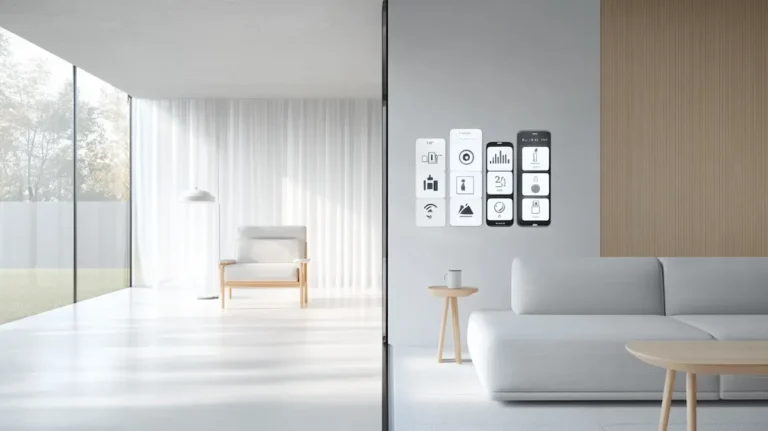
The calm smart home runs through one primary ecosystem app — Alexa, Google Home, or Apple HomeKit — that every household member can open and use without assistance. Device names are consistent and intuitive. Voice commands are predictable. Physical controls (buttons, switches) exist at the key locations in the home as universal fallbacks that work regardless of app access or voice command knowledge.
Characteristic 2: Notifications reduced to signal only
A calm smart home sends notifications that matter. Doorbell press. Entry point motion when no one is home. Water or smoke sensor trigger. Everything else — status confirmations, automation success messages, battery levels above 15%, manufacturer tips — is turned off. The home communicates through its outcomes, not through a constant stream of status updates.
Characteristic 3: Automations that run invisibly
The automations in a calm smart home have been built carefully, calibrated over two to four weeks, and adjusted until they produce the right outcome in all expected conditions. They fire consistently. They fail gracefully (toward normality, not toward unexpected states). They can be overridden by any household member through a simple, predictable method. After a few months, they are not consciously noticed at all — they are simply the way the home works.
Characteristic 4: A complete, known configuration
Every device in the home is either working correctly or has been removed. Every automation is either active and calibrated or has been deleted. The configuration is knowable — anyone with access to the ecosystem app can see the full state of the home’s smart devices. There are no half-built integrations, no abandoned setups, no devices in an ambiguous state.
"A calm smart home is not one that has perfect technology. It is one that has the right amount of technology, configured correctly, maintained actively, and usable by everyone who lives in it."

The Automation Quantity Problem
A specific subset of smart home chaos deserves its own section because it is almost universally underestimated: the problem of too many automations. The smart home that produces calm is not the one with the most automations — it is the one with the right automations, built one at a time, calibrated correctly, and maintained actively.
The automation quantity problem develops gradually. Each automation added is individually reasonable. The morning light ramp. The evening warm-down. The away mode. The Good Night routine. The focus mode. The guest mode. The weekend schedule override. The holiday mode. Each makes sense at the moment it is added. Together, they produce a system that is difficult to understand as a whole, where interactions between automations produce unexpected results, and where troubleshooting any single unexpected behaviour requires reviewing all of them.
The three signs that automation quantity has become a problem
- You are not sure which automations are currently active. If the question ‘what automations are running right now?’ cannot be answered without opening the app and reviewing the full list, the quantity has likely exceeded what can be maintained as a mental model.
- Unexpected behaviours cannot be attributed to a specific automation. When something unexpected happens — a light at the wrong level, a device switching off at an unexpected time — and the cause cannot be quickly identified, the automation set has become too complex to be understood.
- Household members have stopped trying to understand it. The practical test of automation complexity is whether household members actively engage with it or have given up trying to understand it. A smart home that non-technical household members have stopped using is one whose complexity has exceeded what serves the household.
→ The full case for building fewer automations more deliberately: → Over-Automation: When Smart Becomes Stressful

The Products That Produce Calm — and Why Most Do Not
The smart home product market is enormous and varied. The majority of products in it are technically functional. A small subset of them produces calm — not because of superior technology, but because of superior design philosophy: they are designed to integrate simply, to require minimal ongoing management, and to be usable by anyone in the household without instruction.
What distinguishes calm-producing devices
- Matter certification: Matter-certified devices work across all major ecosystems without ecosystem lock-in. This removes fragmentation at the source — each new Matter device can be added to the existing ecosystem rather than requiring a new app.
- Physical fallback controls: Devices that have a physical button or switch as a fallback — in addition to app and voice control — can be used by any household member regardless of app access or voice command knowledge. The physical fallback is the universal interface.
- Local processing capability: Devices and hubs that can process automations locally (without cloud dependency) continue to function during internet outages and are more reliable as a result. Reliability is the prerequisite for invisibility — an automation that occasionally fails cannot be trusted and cannot become invisible.
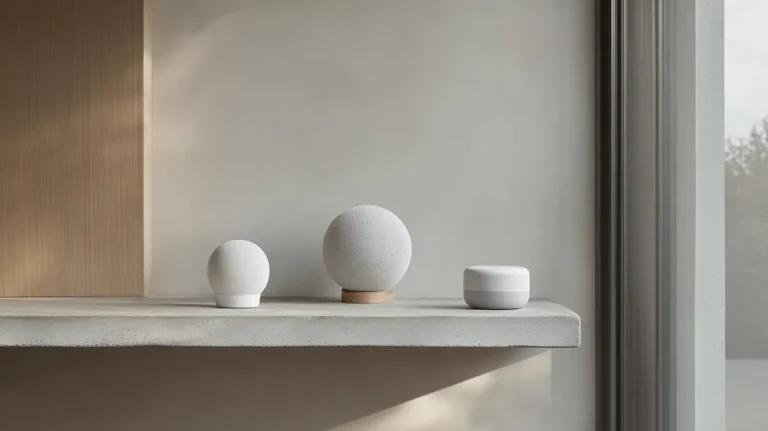
For a calm primary home hub with local processing — the Apple HomePod mini serves as the HomeKit hub that keeps automations running locally:
| → Apple HomePod mini — Smart Speaker + HomeKit Hub with Local Processing · Editorial recommendation — no commercial relationship The HomePod mini serves as the Apple HomeKit home hub, enabling HomeKit automations to run on the local network without cloud dependency. When the internet is down, HomeKit automations continue to fire. At 3.3 inches tall with a woven mesh design, it reads as a considered design object rather than a consumer device. Also functions as a Thread border router, supporting the growing range of Matter/Thread devices. Available in multiple colors including white, which integrates into minimal interiors without visual disruption. Why this product: The HomePod mini is included here specifically because its local processing capability addresses the reliability characteristic that distinguishes a calm smart home. HomeKit automations that run locally are more reliable than cloud-dependent alternatives — reliability is the prerequisite for the invisible automation that produces calm rather than noise. ~$99 / €99 · Via Apple Note: Requires an iPhone to set up. Full HomeKit functionality requires all devices to be HomeKit-certified. The HomePod mini is the hub that enables the local processing; without it (or an Apple TV 4K), HomeKit automations require a phone to be present at home. |
For a calm-producing bulb that removes fragmentation risk — the Tapo L535E works across all ecosystems:
| ⟶ TP-Link Tapo L535E — Matter Smart Bulb, 2,500K–6,500K Tunable White (2-Pack) · Affiliate link A Matter-certified smart bulb that works with Amazon Alexa, Apple HomeKit, Google Home, and SmartThings simultaneously. This cross-ecosystem compatibility directly addresses the fragmentation source of smart home chaos described in §2. One bulb type that works in any ecosystem removes the need for different lighting products for different platforms. At 1,100 lumens (brighter than most budget smart bulbs) with CRI >90, it covers the full relaxation-to-focus light range. No hub required. Why this product: The Tapo L535E is included here as the anti-fragmentation bulb — it is the specific product that prevents Source 1 of smart home chaos from compounding with each new lighting purchase. When all lighting in the home uses the same Matter-certified bulb, the ecosystem choice can change later without replacing bulbs. This is an affiliate link. ~€28 for 2-pack · Via Amazon Note: E26/A19 format — compatible with E27 European lamp sockets. Check fitting before ordering. The tunable white range (2,500K–6,500K) covers the daily light arc from warm amber evening to cool white focus mode. |

The Path from Chaos to Calm
If the smart home you currently have feels chaotic, the path to calm is not to remove everything and start over — it is to address the sources of chaos systematically, one at a time. The five sources described in §2 each have a specific remedy. Addressing them in order, from the most impactful to the most detailed, produces a measurable improvement in daily experience at each step.
| Source of chaos | Primary remedy | Time to fix |
| Fragmentation — too many brands/apps | Consolidate to one ecosystem; switch to Matter-certified devices for new purchases | Half-day to migrate existing devices to primary ecosystem |
| Notification overload | Disable all non-security notifications in every app | One session, 30–60 minutes across all apps |
| Automations that overstep | Audit active automations; fix conditions; add overrides; remove what doesn’t work | One session per automation (30 min); staggered over a week |
| Single operator problem | Share ecosystem access with all household members; add physical controls at key points | One session to share access; one hour to add physical buttons |
| Uncompleted build | Audit all devices: working, broken, or ambiguous; remove the last two categories | One focused afternoon |
None of these remedies is technically complex. The primary requirement is a focused session of deliberate attention — the same kind of attention that was not applied during the initial setup, which is why the chaos developed. The return on that attention is a home that functions consistently, that every household member can use, and that requires minimal ongoing management.
→ The complete guide to fixing a smart home that has accumulated too much complexity: → How to Fix an Overcomplicated Smart Home

Chaos Is Not Inherent to Smart Homes
The smart home does not inherently produce chaos. The specific smart home that most people build — incrementally, without a consistent ecosystem strategy, with default notification settings and uncalibrated automations — produces chaos reliably. But this is not a problem with the category. It is a problem with the process.
The calm smart home is built differently: one ecosystem, chosen deliberately and applied consistently. Devices added one category at a time. Automations built individually, tested over weeks, and calibrated before the next is added. Notifications reduced to signal. Physical controls added at the points of daily friction. The configuration maintained actively rather than left to accumulate errors.
The distance between a chaotic smart home and a calm one is almost always shorter than it appears from inside the chaos. The sources of the problem are identifiable. The remedies are practical. The result, for most households, takes a focused weekend to achieve and indefinitely improves daily life thereafter.