
Wall Treatments That Define Parisian Vintage Style
The walls of a Parisian interior are never neutral in the passive sense. They are not simply the surface against which furniture and objects are placed. They are an active element of the room — one that is treated with the same deliberateness as the choice of a rug or the placement of a mirror. The specific quality that makes a Parisian wall recognisable — its warmth, its depth, its sense of having accumulated meaning over time — is the result of specific decisions about paint tone, surface finish, what is hung, and how.
This article covers those decisions in practical terms. It addresses paint and surface treatments first, then panelling as an architectural element, then the mirror as a wall object, then the art arrangement as a cumulative practice. Each section describes what is consistently observable in well-documented Parisian interiors and what can be replicated with available products and approaches. No claims are made here about period accuracy or historical practice that cannot be verified by looking at the rooms themselves.
Disclaimer: This post may contain affiliate links. This means that if you click on one of these links and make a purchase, we may earn a small commission—at no extra cost to you.
All images featured in this article are AI-generated to illustrate the aesthetic and mood of the interior style. The products linked are carefully selected items that, in our view, most closely match the look and feel of these designs.
As an Etsy affiliate and Amazon Associate, we earn from qualifying purchases. We only recommend products we genuinely believe align with the style and atmosphere presented in our AI-created interiors.
The Parisian Wall: What Makes It Different
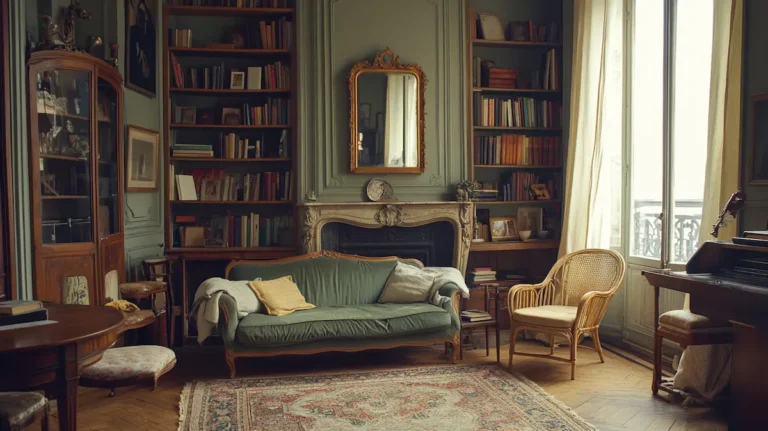
The most immediately distinctive quality of a Parisian wall is its tone. It is almost never bright white. The walls of genuine Parisian apartments tend toward off-white, warm grey, pale stone, dusty sage, or a very quiet muted tone in the rose or ochre family — tones that have warmth and depth rather than the cool brightness of a contemporary white interior.
The second distinctive quality is surface. Paint in a Parisian interior is typically applied in a flat or very low-sheen finish. The slightly matte, slightly absorbent surface of flat paint catches light softly and gives walls the quality of aged plaster rather than a fresh, bright surface. This quality is important: a high-sheen or satin finish reads as modern and clinical in a way that flat paint does not.
The third quality is the relationship between the wall and what is on it. A Parisian wall is never considered complete when it is freshly painted. The paint is the ground, not the destination. What accumulates on the wall — mirrors, frames, objects — is what gives it its character.
“A Parisian wall is not a backdrop. It is a surface in development — the paint is the beginning of a conversation that the mirrors, frames, and objects continue.”
→ The complete colour vocabulary of the Parisian vintage interior — specific tones, undertones, and how they work together: → The Essential Color Palette for Parisian Vintage Interiors
Paint: Tone, Finish, and the Specific Off-White
Choosing paint for a Parisian interior is primarily a question of tone and finish. The range of appropriate tones is relatively narrow — warmer and more muted than standard decorating whites — and the finish question is straightforward: flat or dead-flat, not satin or eggshell.
The off-white: warm undertones, not cool
The off-white that appears most consistently in Parisian interiors has warm, slightly yellowish or pinkish undertones rather than the cool, slightly blue-grey undertones of many standard decorating whites. This warmth is subtle — it is not a cream or an ivory, but a white that reads as warm rather than cold in natural light.
The practical test: hold the paint chip against a piece of aged linen or natural cotton. If the white reads as warm beside the linen, it is in the right territory. If it reads as cool and slightly blue beside the linen, it will produce a wall that fights the warm textile and wood tones of the room rather than supporting them.
Beyond white: the case for a muted colour
A significant proportion of Parisian interiors use a muted colour on at least one wall or in a specific room, rather than white throughout. The colours that appear most consistently are: very pale grey-green (the tone of aged sage), dusty rose at the palest register (barely perceptible as a colour from across the room), warm grey with a clear brown undertone (closer to stone than to cool grey), and the specific yellow-ochre of aged limestone at its lightest.
These colours work because they sit within the same warm, low-saturation register as the textiles, aged wood, and ceramic objects in the room. They do not contrast with the room’s palette; they extend it. A saturated or bright colour on a Parisian wall is rare and, when it appears, tends to be in a specific room — a library, a study, a bathroom — rather than in the main salon.
Finish: flat is correct
Flat paint — sometimes listed as dead-flat, chalky, or distemper-finish — is the correct finish for walls in a Parisian interior. The matte surface absorbs light rather than reflecting it, which produces the warm, slightly soft quality of aged plaster. It is less practical than eggshell in high-traffic areas (it marks more easily and is less washable), but this practicality concern is, in the Parisian approach, less important than the visual quality of the surface.
Limewash paint — which produces a characteristically variegated, slightly cloudy surface rather than a uniform flat tone — has become widely available in recent years and produces a wall surface that is particularly consistent with the aged-plaster quality of an old Parisian apartment. It is worth considering for a room where the wall surface is the primary visual treatment.

| → Farrow & Ball — Estate Emulsion in Off-White and Muted Tones |
| Farrow & Ball’s Estate Emulsion range is a flat-finish paint with a characteristically deep, chalky surface quality that is widely used in European period interiors. Relevant tones for a Parisian interior include: Pointing (a warm off-white with ochre undertones), Elephant’s Breath (warm grey-brown), Hardwick White (grey-green), Peignoir (pale dusty rose), and String (warm stone). Available in 2.5-litre and 5-litre tins. Ships to most of Europe and internationally. No affiliate relationship — included because the product is consistently cited in interior design contexts for this specific surface quality. From approx. €55 per 2.5-litre tin · Via Farrow & Ball Editorial note: Estate Emulsion is one of the most reliable ways to achieve the flat, warm, slightly chalky wall surface of a Parisian interior without period plaster. The tones listed above are the ones most consistent with the Parisian palette. If the price point is a concern, use it as a reference for undertone and finish and find a match in a more affordable range. |
Panelling: The Architectural Wall Treatment
Panelling — in its various forms — is one of the most characteristic features of the Parisian interior. In apartments built in the 19th and early 20th century, architectural panelling in the form of boiserie (carved and moulded wood panelling) is often present as an original feature. In apartments where it is not, the same visual effect is achieved through paint and applied moulding.
It is important to state clearly what this article covers and what it does not: genuine period boiserie is a fixed architectural feature that requires professional restoration if present and cannot be added without significant building work. What can be added — and what appears consistently in contemporary Parisian interiors of all budgets — is the visual language of panelling through two accessible methods: shadow-line painting and applied wooden moulding.
Shadow-line painting: panelling without woodwork
The most accessible panelling technique: a rectangle of the same paint colour as the wall, but applied in a slightly darker tone (typically 1–2 shades deeper on the same paint strip), creates the visual impression of a recessed panel without any physical woodwork. The effect is subtle and readable as architectural detail rather than as a decorative intervention.
The proportions that appear most consistently in Parisian interiors: vertical panels that divide the wall into thirds or quarters, each panel roughly 60–80 cm wide and occupying the full height between skirting board and cornice or picture rail. The shadow line itself is typically 2–4 cm wide and painted with a small brush or fine-line tape. This technique is entirely reversible and requires only paint, which makes it appropriate for renters and for spaces where a permanent installation is not practical.
Applied moulding: physical panelling at modest cost
Thin wooden moulding strips — typically 1–2 cm wide and 5–10 mm deep, sold in lengths at timber merchants and larger DIY retailers — can be applied directly to a plastered wall with appropriate adhesive and painted in the same tone as the wall. The result is a physical shadow line rather than a painted one: a faint three-dimensional relief that catches light differently through the day.
The moulding profile that reads most correctly in a Parisian context is simple and symmetrical — an ogee or a simple stepped profile, not the more elaborate mouldings associated with Victorian or Georgian interiors. The moulding should disappear into the wall colour rather than announce itself; it is an architectural detail, not a decorative one.

Wallpaper: Where It Belongs and Where It Does Not
Wallpaper in a Parisian interior is not absent, but it is used with specificity. It does not typically cover all four walls of a main salon — that approach produces a result that is decorative in a different register, closer to the English country house aesthetic than the Parisian one. Where wallpaper appears in a genuinely French interior, it tends to occupy one of three positions: a single accent wall, a small room (an entrance hall, a bathroom, a dressing room), or in a historic pattern that reads as an architectural surface rather than a decorative intervention.
The patterns that work
Three categories of wallpaper pattern are consistently present in well-documented Parisian interiors:
- • Toile de Jouy: the pastoral or classical figurative pattern printed in a single colour on a white or cream ground. Typically in blue, red, green, or black on white. It reads as specifically French and works on a single wall or in a contained room where it does not compete with an already complex textile arrangement.
- Stripe: a simple vertical stripe — narrow, in two closely related tones — makes a wall taller and reads as architectural rather than decorative. The most appropriate stripe for a Parisian interior is a muted, low-contrast combination: warm grey and off-white, pale sage and cream, stone and ivory.
- Botanical / floral: a loose, non-symmetrical botanical or floral print in a faded, muted palette. This category overlaps with the English aesthetic but works in a Parisian context when the palette is kept within the warm, dusty register of the interior rather than in bright or saturated tones.
What does not work: bold geometric patterns, contemporary graphic prints, and highly saturated colour combinations read as modern or Scandi in register rather than Parisian. The test is whether the wallpaper, if removed from its sample board and placed beside a piece of aged linen or a worn kilim, reads as belonging to the same material and tonal family.
| → Graham & Brown — Vintage and Heritage Wallpaper Collections |
| Graham & Brown’s heritage and archive-influenced ranges include toile, botanical, and soft-stripe patterns in the muted, aged-palette tones appropriate for a Parisian interior. The Fresco and Boutique collections are the most relevant. Available in paste-the-wall and paste-the-paper formats. Sold by the roll; coverage per roll varies. Ships across Europe and internationally. No affiliate relationship — included because the product range is widely available, consistently cited in interior design contexts, and offers reliable access to the specific pattern categories described above at accessible price points. From approx. €20 per roll · Via Graham & Brown Editorial note: The Boutique and archive-influenced ranges are the most appropriate starting point for a Parisian wallpaper application. Use in a single contained room (entrance hall, bathroom, small study) or on one wall only — not across all four walls of a salon. |
→ The complete guide to vintage-style wallpaper for a French interior — patterns, brands, and application: → Best Vintage-Style Wallpaper for a Parisian Interior

The Mirror as Wall Treatment
The large antique mirror is the most spatially powerful object available to the Parisian interior. Placed on the primary wall of a room — typically above a fireplace, on the wall opposite a window, or on the longest uninterrupted wall of a room without a fireplace — it changes the apparent depth and scale of the space in a way that no other single element achieves.
The visual logic is straightforward: a large mirror with a significant frame becomes part of the wall rather than an object hanging on it. The frame reads as architectural element — comparable in scale and presence to a window — and the reflecting surface adds depth and borrowed light. In a small room, this effect is considerable; in a large room, it adds a specific layered quality that windows alone do not produce.
What makes a Parisian mirror
The mirrors that appear most consistently in Parisian interiors share several qualities that are worth identifying specifically:
- • Scale: they are large. A mirror that reads correctly on a Parisian salon wall is typically at least 80–90 cm wide and 100–140 cm tall, often larger. A small mirror, however beautiful in isolation, does not function as a wall treatment; it functions as a decorative object.
- Frame: carved, gilded, painted, or in aged metal. The frame should have visual weight and presence. A frameless mirror or a mirror in a very thin metal frame does not play the same architectural role.
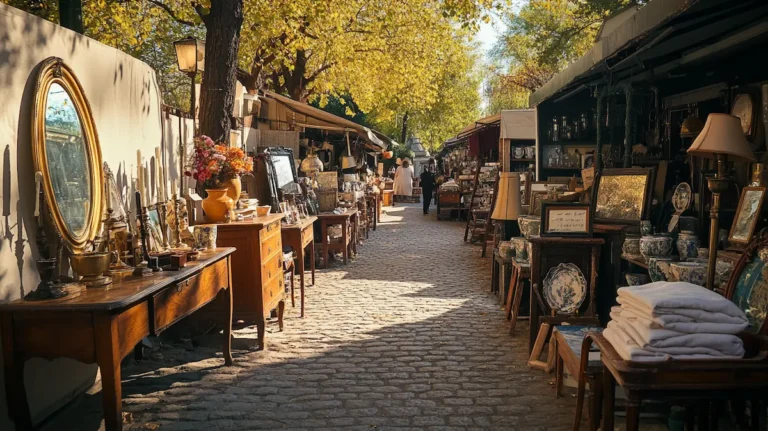
- Glass: ideally foxed or aged. The age-spotted, slightly uneven surface of a genuinely old mirror diffuses reflections rather than sharpening them, which produces the warm ambient quality that is specifically Parisian. A mirror with bright modern glass is reflective in a different, harder register.
- • Lean or hang: many Parisian mirrors lean against the wall rather than hanging from it. A large mirror leaning against a wall from the floor reads as deliberately placed rather than installed, which is consistent with the aesthetic logic of the accumulated interior.
→ The complete guide to antique and vintage mirrors for French interiors — sourcing, styles, and where to find them: → Best Antique & Vintage Mirrors for French Interiors
| ➶ Antique & Vintage Gilded Wall Mirrors — Etsy Specialist Sellers |
| A curated search for antique and vintage gilded mirrors on Etsy — the most accessible online channel for period mirrors in the scale and frame quality appropriate for a Parisian wall. Filter by size (minimum 80 cm wide) and by frame type (gilt, carved, Louis Philippe, Napoleon III, Empire) to find pieces in the correct register. Many sellers are based in France and the UK and source directly from brocantes and estate clearances; shipping is typically available to most of Europe and the US. €120 – €600 depending on period and condition · Via Etsy Editorial note: The antique gilded mirror is the single most impactful wall object available for a Parisian interior. Even one genuinely period piece — placed above a fireplace or leaning against the primary wall — transforms the character of the room. Prioritise scale and the quality of the foxed glass over frame perfection; minor repairs to gilding are far less significant than the wrong size or the wrong glass quality. |

→ The specific practice of styling what sits below and beside the mirror — the Parisian mantelpiece arrangement: → How to Style a Mantelpiece the Parisian Way
Art and Prints: The Parisian Wall Arrangement
The way art is displayed in a Parisian interior is as distinctive as any other element of the aesthetic. It does not follow the convention of a single important piece centred on a wall at eye height. It follows a different logic — one of accumulation, variety of scale, and the deliberate avoidance of alignment — that produces the wall arrangement most characteristic of a genuinely French interior.
The gallery wall: Parisian vs. contemporary
The Parisian wall arrangement and the contemporary gallery wall are superficially similar but fundamentally different. The contemporary gallery wall tends toward a planned, symmetrical arrangement of same-toned frames in a deliberate composition. The Parisian arrangement is genuinely accumulated: each piece arrived at a different time, in a different frame, from a different source. The frames are varied — gilded, dark wood, simple oak, a piece pinned without a frame at all. The sizes are varied. The spacing is uneven.
The result is a wall that reads as the record of a life spent looking and collecting, rather than as a designed installation. This quality cannot be fully replicated by purchasing a set of coordinated frames and filling them simultaneously; it requires genuine accumulation over time. However, the starting point — a varied collection of genuinely different pieces, placed without the constraint of alignment — is achievable immediately.
What to hang: the Parisian print vocabulary
The categories of image that appear most consistently in well-documented Parisian wall arrangements:
- Old maps: particularly of France, Paris, or regions with personal significance. The aged paper tone and the graphic language of cartography are both consistent with the Parisian interior palette.
- Botanical prints: whether genuine antique prints from scientific publications or quality reproductions, botanical illustration in the muted palette of aged paper reads correctly in a Parisian context.
- Small oil paintings: landscape, interior, or portrait subjects in modest frames. Not necessarily important paintings — the brocante oil painting of an anonymous landscape is often more useful in a wall arrangement than a significant work.
- Pages from antique books or publications: an engraving removed from a damaged 19th-century book, a page of sheet music, an advertisement from an old magazine — these ephemeral pieces, pinned or placed in simple frames, read as specifically Parisian in their lightness and their reference to the city’s print culture.
- Photography: black-and-white documentary photography, particularly of Paris or French subjects, sits comfortably in a Parisian wall arrangement when framed simply and placed at a modest scale.
How to hang: the Parisian approach
The practical rules that produce the characteristic Parisian wall arrangement:
- Begin with the largest piece and place it first. Everything else responds to it.
- Vary the frame materials deliberately: one gilded frame, one dark wood, one simple pale oak, one or two pieces unframed or pinned directly.
- Avoid alignment. No two pieces should share a top edge, a bottom edge, or a centreline.
- Allow pieces to be close together. A gap of 4–6 cm between frames reads as an arrangement; a gap of 20–30 cm reads as isolated pieces.
- Mix framing with leaning. One or two pieces leaning against the wall or against other frames adds the provisional quality of the accumulated interior.
- Include at least one piece without a frame: a photograph pinned directly, a page torn from a book, a postcard.
→ The complete guide to Parisian vintage artwork and prints — what to look for, where to find it: → Best Parisian Vintage Artwork & Prints for Your Walls

| ➶ Antique French Prints, Maps & Botanical Art — Etsy Specialist Sellers |
| A curated search for antique and vintage prints, maps, and botanical illustrations on Etsy — the most accessible online channel for the paper elements of a Parisian wall arrangement. The search covers original antique prints from French publications, old maps of Paris and French regions, botanical illustrations from scientific publications, and pages from 19th-century illustrated books. All suitable for framing or pinning directly. Filter by ‘antique’, ‘French’, and ‘original’ for genuine pieces; ‘reproduction’ for quality prints at lower price points. €8 – €120 depending on age and subject · Via Etsy Editorial note: Genuine antique prints — even modest ones from damaged books or publications — have a specific paper tone and print quality that reproduction prints do not replicate. One or two genuine pieces in a wall arrangement change the character of all the prints around them, including reproductions. Budget for at least one genuine antique piece in any wall grouping. |
Objects on Walls: Beyond Frames
A Parisian wall is not limited to framed pieces and mirrors. Objects — three-dimensional pieces that project from the wall surface — appear regularly in well-documented French interiors and contribute the tactile quality that flat images cannot provide.
What kinds of objects
The wall objects that appear most consistently in Parisian interiors are modest in scale and specific in character:
- Small sculptural pieces: a plaster relief, a decorative medallion, a small carved fragment of architectural detail. These read as collected rather than purchased for the purpose of wall decoration.
- Antique keys, locks, or hardware: grouped on a wall or hung from a simple hook, these objects — clearly functional in a previous life — have the quality of the recovered and repurposed.
- Dried botanicals: a bundle of dried lavender, a stem of dried allium, a pressed botanical study pinned directly to the wall or framed in a simple glass mount.
- Fabric fragments: a piece of old toile, a fragment of tapestry, a section of embroidered cloth — hung from a simple wooden pole or pinned directly, without the formality of a picture frame.
The logic of these objects on the wall is the same as the logic of the brocante shelf: they are evidence of attention paid over time. Each piece was found and placed deliberately; none of it was purchased as a set or installed as decoration in the conventional sense.
| ➶ Command Large Picture Hanging Strips — Amazon |
| Damage-free adhesive picture hanging strips suitable for hanging frames and lightweight objects on plastered walls without drilling. Each pair of strips holds up to 3.6 kg. Available in packs of 8, 14, and 20 pairs. Suitable for plaster, drywall, and painted surfaces. Residue-free removal. For the Parisian wall arrangement approach — which involves building up and adjusting a grouping of frames over time — removable hanging strips allow pieces to be repositioned without leaving holes, which is particularly useful in rented spaces. Approx. €12 – €18 per pack · Via Amazon Editorial note: The Parisian wall arrangement is built incrementally — a piece added, assessed, moved, a new piece introduced. Removable strips make this iterative approach practical without committing to fixed positions. Use for frames up to approximately 2–3 kg; for heavier pieces (mirrors, large oil paintings), use appropriate wall fixings. |

The Wall as a Record of Attention
The Parisian wall treatment described in this article does not arrive complete. It develops over months and years as paint is applied, pieces are found, frames are acquired, and objects are placed and reconsidered. The wall is always, in the best sense of the phrase, in progress.
The paint provides the ground. The panelling detail — whether shadow-line or applied moulding — gives the wall architectural depth. The mirror brings light and spatial scale. The art arrangement records the accumulation of looking. The objects contribute the tactile quality of a life lived with attention to things.
None of these elements requires significant expenditure. The most impactful — paint tone, shadow-line panelling, a single large mirror — are achievable at relatively modest cost. The art arrangement is built piece by piece, print by print, frame by frame, over time. The wall that results is the wall of someone who has been paying attention. That quality is not available for purchase; it is available only through the practice.
“The Parisian wall is never finished. It is always a record of the most recent decision, alongside all the ones that came before it.”
→ The architectural and stylistic context for all of these wall treatments — where they come from and how they developed: → The History of Parisian Interior Style (From Haussmann to Now)
→ The full Parisian Vintage Chic Interior approach — the context for everything in this article: → Parisian Vintage Chic Interior: The Complete Style Guide