
Best Velvet Furniture for a Parisian Vintage Home
Velvet in a Parisian interior is never the dominant material — it is the accent. A room upholstered entirely in velvet reads as opulent in a different register from the Parisian one. A room with a primary linen sofa and one velvet accent chair, or two velvet cushions on a natural settee, reads as layered and warm. The difference is in the proportion: velvet earns its place precisely because it is restrained, chosen, and placed with intention against the linen, wood, and aged metal that form the room’s base.
This guide covers the velvet furniture types that work in a Parisian vintage interior, in what proportions, and where to source them — from genuine restored vintage pieces to accessible new options in the correct material register. All observations are based on directly observable qualities of the pieces described.
| ⚠ Note on vintage listings: The specific Etsy listings in this article feature genuine vintage reupholstered pieces that may sell. If a listed piece is gone, the same seller offers comparable current stock in the same style — check their shop page directly. New-production velvet options in the editorial section are available continuously. |
The Velvet That Works: Tone, Finish, and the Faded Quality
Not all velvet is appropriate for a Parisian interior. The specific quality that places velvet correctly in a French room is the faded, slightly dusty register of fabric that has some age — or has been manufactured to appear so. This is observably different from the saturated, richly coloured velvet of a maximalist interior. The faded quality is the quality that allows velvet to sit comfortably beside natural linen, aged wood, and old brass without creating a sharp contrast of register.
The correct colour register
The velvet tones most consistently present in documented Parisian interiors are: sage green (faded, slightly grey in undertone), dusty rose (at the palest, most muted end of the pink family), warm ochre or gold (faded, warm, not bright), forest green (aged, slightly compressed pile), and warm grey-blue. These tones share a common quality: they are low in saturation and warm in undertone. They look as though they have been in the room for years, which is precisely the effect required.
What does not work: saturated, bright velvet in primary or jewel tones (royal blue, crimson, emerald green, purple). These shades shift the piece into a different aesthetic register and compete with the warm palette of linen, kilim, and aged wood rather than sitting within it.
Washed vs. standard velvet
Washed or crushed velvet — with an intentionally irregular pile direction that gives the surface a matte, slightly varied quality — is more consistent with the Parisian aesthetic than standard flat-pile velvet. Standard flat velvet has a uniform, slightly reflective surface that reads as formal; washed or crushed velvet has the specific matte depth that reads as aged. When shopping for new velvet furniture or cushion covers, look for descriptions that include ‘washed’, ‘crushed’, or ‘vintage-finish’ to identify this quality.
“Velvet in the Parisian interior is present not to announce itself but to complete the room. The correct velvet piece is the one whose absence you notice rather than whose presence you do.”
→ How velvet fits into the broader textile layering logic of a Parisian interior: → The Art of Layering Textures in a Parisian Interior
Type 1: The Velvet Accent Armchair — The Parisian Room’s Warmth Note
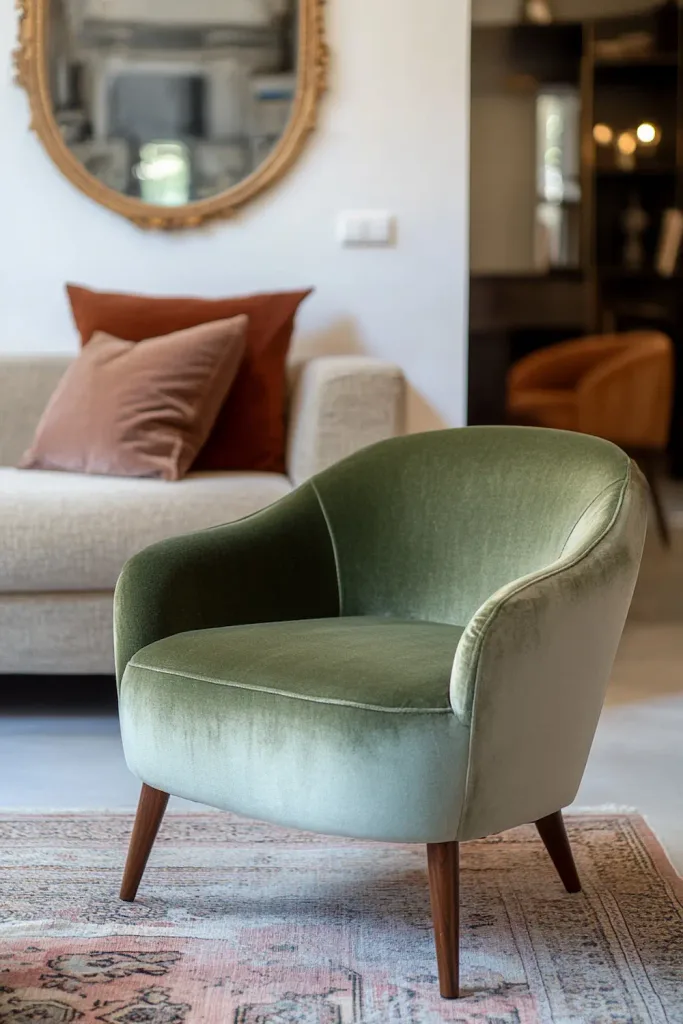
The velvet accent armchair is the single most consistent velvet furniture application in a Parisian interior. It appears in virtually every well-documented French salon of the 20th century: a compact, low armchair in a faded velvet tone, typically in beech or walnut frame with visible legs, placed beside the primary linen sofa or at a slight angle to the main seating arrangement.
Its role is specific and distinct from the sofa’s. The sofa is the room’s anchor; the velvet accent chair is the room’s warmth note. It provides the rich, light-absorbing surface quality that linen cannot — velvet’s pile catches light from slightly different angles simultaneously, creating a depth of tone that a flat-woven fabric lacks. One velvet armchair in a room of linen changes the entire register of the room’s textile vocabulary.
What to look for
• Frame: visible wooden legs in beech, walnut, or teak are the most consistent. The specific mid-century French form — tapered legs, slightly angled back, compact seat — is the most versatile across different room contexts.
• Upholstery: a single-colour velvet in one of the tones described in Section 1. Avoid printed or patterned velvet for this piece; the pattern competes with the kilim and other textiles in the room.
• Scale: smaller is better in most Parisian rooms. A chair of 58–68 cm width and seat height of 40–45 cm from the floor is the correct scale for an accent piece. A large, over-scaled armchair reads as the room’s primary seating rather than as an accent.
• Condition: a restored vintage frame with new velvet upholstery is preferable to an untouched vintage frame with very worn original fabric. The frame is the period quality; the velvet can be specified correctly through re-upholstery.
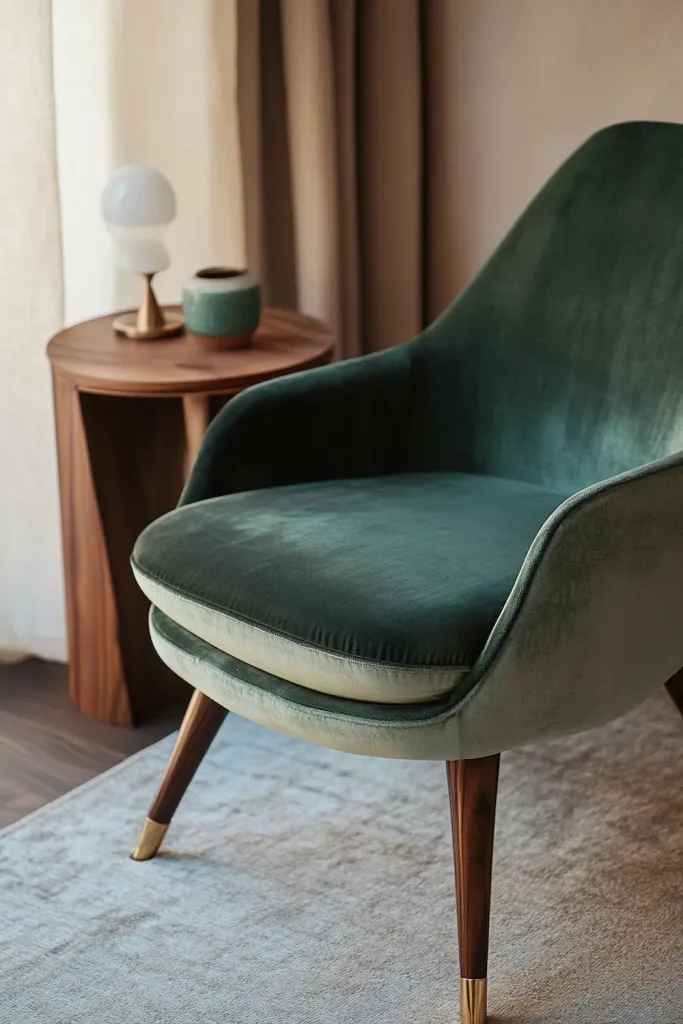
| ➶ Vintage Mid-Century Armchair in Green Velvet with Brass Finishes — Etsy |
| A genuine 1960s mid-century armchair professionally restored and reupholstered in green velvet with brass finishing details. Original beech wood frame in vintage teak finish, sanded and secured with high-quality oil to expose the wood grain. Upholstery: Green Velvet. Dimensions: W 58 cm × H 80 cm × D 68 cm. Seat height: 36 cm. The seller (identified in reviews as Dominik) is described by multiple buyers as honest and responsive, with high-quality upholstering. Reviews specifically mention well-packed delivery and excellent craftsmanship. Ships to Europe; UK buyers should contact the seller first regarding Brexit delivery. Note: this is a one-of-a-kind piece — if this listing has sold, the same seller offers comparable pieces in other velvet tones (green, pink, gold) — search ‘Vintage Armchair Mid Century Green Velvet’ on Etsy to find current comparable stock. Price listed in the Etsy shop — check current listing · Etsy · Note: This is the exact chair type described in this section: genuine 1960s frame, visible wood grain, compact scale, green velvet in the correct faded-tone register. Multiple buyer reviews confirm quality of upholstery and accurate listing description. The brass leg detail is the specific period feature most consistent with the Parisian interior context described in this article. |
| ➶ Vintage Mid-Century Armchair in Pink Velvet with Brass Finishes — Etsy |
| The same professionally restored 1960s mid-century frame from the same seller, reupholstered in pink velvet — the dusty rose tone most consistent with the Parisian textile palette. Original beech wood frame in vintage teak finish. Dimensions: same as the green version (W 58 cm × H 80 cm × D 68 cm). Buyer reviews on this listing describe the chair as beautiful and the seller as delivering personally to customers within Poland, with communication described as great throughout. Ships to Europe. One buyer specifically notes: ‘I bought a first chair in green and I liked so much that I bought it also in pink for my mother.’ Note: if this specific listing has sold, search the same Etsy seller’s shop for current pink-velvet mid-century chair stock. Price listed in the Etsy shop — check current listing · Etsy Editorial note: The pink velvet version of this chair is the dusty rose accent piece that works in a Parisian interior alongside natural linen and aged brass. The same frame and quality standard as the green version. Buying two of these chairs (one in green, one in pink, or one in each) from the same seller creates the varied velvet accent arrangement most consistent with the Parisian interior — neither piece matches the other, but both belong to the same material and tone family. |
Type 2: The Velvet Footstool and Ottoman — The Floor-Level Accent
The velvet footstool — a small, upholstered piece at coffee-table height or lower, used as a footrest beside a reading chair or as a secondary surface — is one of the most versatile velvet applications in a Parisian interior. Its scale is modest enough that it does not compete with the primary seating, but its material richness contributes significantly to the room’s textile depth.
In a Parisian reading corner — the compact arrangement of one armchair, a floor lamp, and a side table described in the layout article — a velvet footstool completes the zone by providing the specific low surface that allows the corner to function as a genuinely comfortable sitting place. It also contributes the velvet’s characteristic light-absorbing quality at floor level, which is the level where the kilim and bare floorboards are doing most of the room’s grounding work.
Forms: square, rectangular, or oval
A small square or rectangular velvet footstool (40–50 cm wide, 35–45 cm tall) on simple turned or tapered wooden legs is the most consistent form for a Parisian interior. Oval forms also work, particularly in rooms with curved furniture. Large round poufs in velvet — without legs — read as more boho than Parisian; the specific Parisian form has visible legs that lift the piece visually from the floor.
Velvet tufting: yes or no
A lightly tufted top surface — where the velvet is pulled into a button pattern — adds a period quality to the footstool that is consistent with the 19th-century strand of the Parisian interior. A flat velvet top reads as more contemporary. Either works, but tufting adds the period reference that makes the piece more directly Parisian in character.
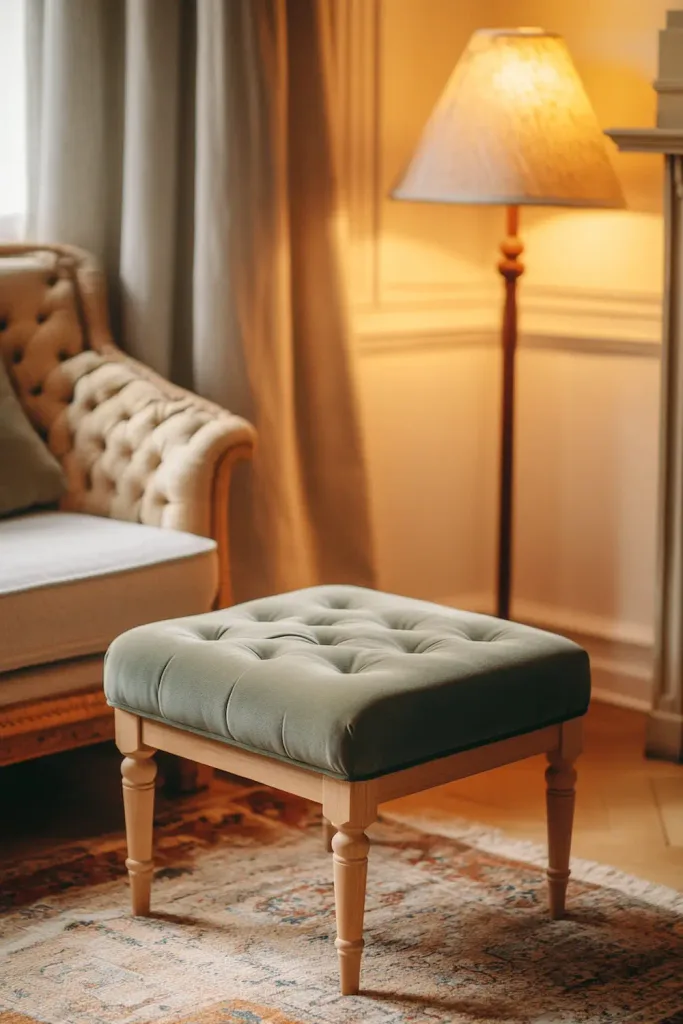
| ➶ Upholstered Velvet Footstool — BoucleCottage (Etsy) |
| A handcrafted velvet footstool from BoucleCottage, an Etsy seller based in the United Kingdom with 26 favourites on this listing and outstanding buyer reviews. Reviewers describe the product as ‘beautiful’, ‘high quality’, and ‘classic’, and praise the seller for exceptional communication and service, including bespoke customisation. The seller offers velvet options; the footstool is available in a range of velvet tones. Ships from the UK. One buyer note: ‘Absolutely beautiful product — probably the best customer service I’ve ever come across. They did a bespoke product for us and there was a teeny error which they rectified immediately.’ This seller also offers comparable footstools in ticking fabric; specify velvet when ordering. Price listed in the Etsy shop — check current listing · Etsy · BoucleCottage (ships from UK) Editorial note: BoucleCottage is particularly noted for bespoke options and exceptional communication. If you want a specific velvet tone — sage, dusty rose, ochre — contact the seller before ordering to confirm availability. The reviews on this listing reflect a seller who takes the quality of each piece seriously; the bespoke customisation option makes this the most flexible velvet footstool source in the Etsy UK market. |
Type 3: The Tufted Velvet Settee — The Formal Parisian Statement
The carved gilt settee upholstered in tufted velvet — described in the sofa article as the most formally Parisian seating option — is where velvet is used in its most classical application in the French interior. This is not an everyday sofa; it is a statement piece, appropriate as a secondary seating element in a large salon, in an entryway, or as the primary seating in a formal study or dressing room.
The tufting — a button-and-fold technique that creates a diamond pattern on the upholstery surface — is specifically associated with the 19th-century French interior and is the technique most often seen on period carved gilt frames. The combination of carved gilded wood frame and tufted velvet upholstery is one of the most recognisable visual signatures of the Parisian vintage aesthetic.
Velvet tone for tufted settees
Dusty rose, warm grey, and sage velvet are the tones most consistent with the Parisian register for tufted settees. These tones allow the tufting pattern to be visible without the upholstery competing with the gilt frame. Very dark tones (navy, black, dark green) can also work in a room with strong architectural presence; bright tones do not.
New vs. vintage frame
For a tufted velvet settee, the frame quality is the primary criterion. A genuine period gilt frame (19th or early 20th century) with new tufted velvet upholstery is the most desirable combination: the period frame brings the aged quality, and the new velvet can be specified in the correct tone. A new reproduction frame with period-quality velvet is a valid alternative at a lower price point; what does not work is a period frame with bright, synthetic velvet, which reads as a restoration that has prioritised cost over quality.
→ The complete guide to sofas and settees in the Parisian style: → Best Vintage-Style Sofas for a Parisian Living Room
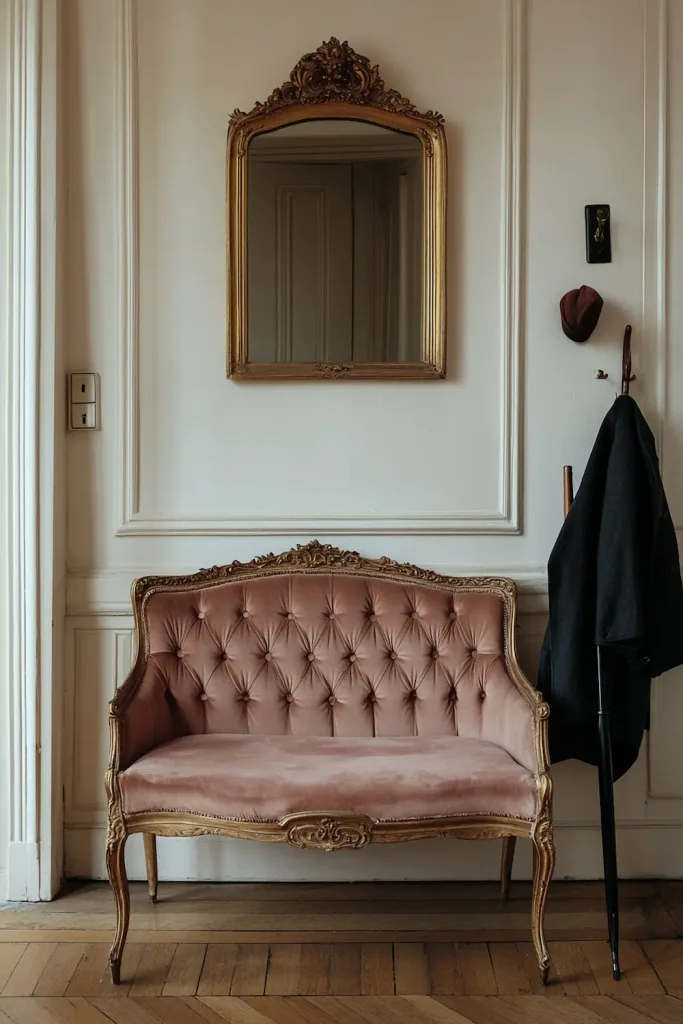
| → Chairish — Vintage French Velvet Furniture (Armchairs, Settees, Footstools) |
| Chairish maintains a consistently updated selection of genuine vintage French velvet furniture across all three types described in this article: velvet accent armchairs (bergere, fauteuil, and mid-century restored pieces), tufted gilt settees, and velvet footstools and ottomans. The French Seating category with velvet filter applied is the most direct route. Pieces have detailed seller condition notes and multiple photographs. Ships primarily within the US; international shipping available from selected sellers. The offer system allows price negotiation below the listed price — standard practice on Chairish. No affiliate relationship — included because it is the most consistently stocked curated US marketplace for this specific category. Variable — approx. $200 – $2,500 depending on type and condition · Via Chairish · Editorial note: For US buyers looking for genuine vintage velvet French chairs, Chairish is the most reliable channel. Filter the French Chairs category by ‘velvet’ for the most relevant results. The offer system is active — making an offer 10–20% below the listed price is normal and frequently accepted, particularly on pieces that have been listed for more than a month. |
Type 4: Velvet Cushion Covers — The Accessible Entry Point
For rooms where a new velvet furniture piece is not in the immediate plan, velvet cushion covers are the most accessible and highest-return way to introduce the velvet accent layer. Two or three velvet cushion covers on a linen sofa change the textile surface of the entire room for a modest investment and with zero structural commitment.
The velvet cushion cover works in this role because it introduces the pile surface at the most visible and touchable point of the primary seating: the surface where the eye first lands and where a person’s hand rests. A velvet cushion cover beside a linen cushion cover on the same sofa demonstrates the material contrast that is the core of the Parisian layering logic at small scale.
Tone mixing for velvet cushions
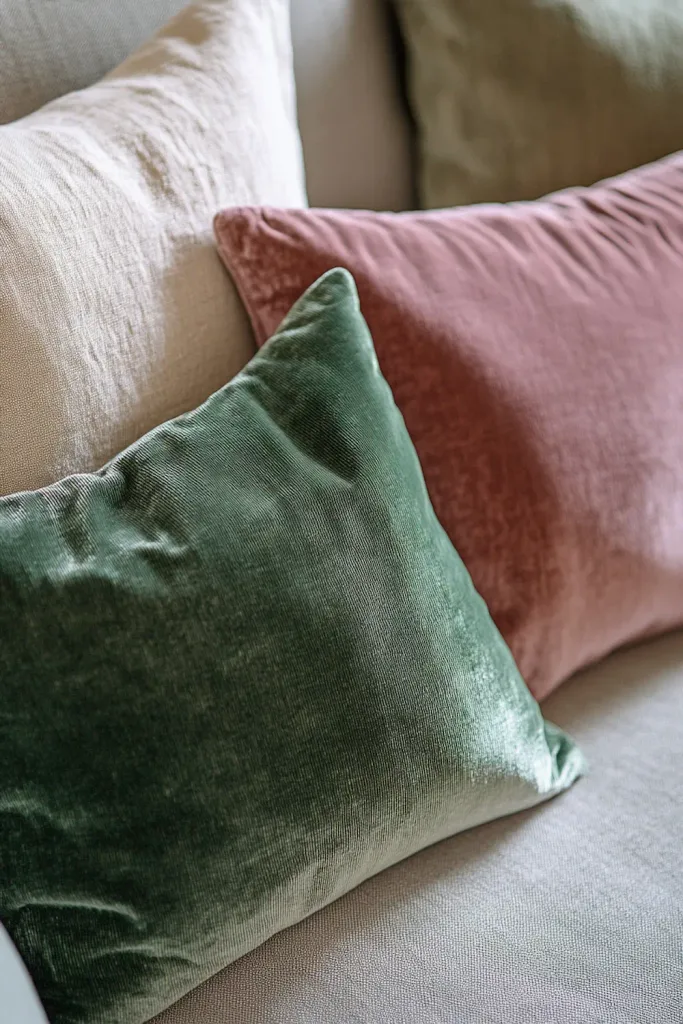
The most effective velvet cushion arrangement in a Parisian interior uses two or three covers in related but not identical tones. Sage and dusty rose. Ochre and warm grey. Forest green and faded blue. The variation within the warm, muted register creates depth; matching velvet cushions in the same tone read as a set, which is precisely the quality to avoid.
Size: vary the sizes
A standard 45 × 45 cm or 50 × 50 cm velvet cushion cover is the primary size. A smaller 30 × 50 cm lumbar cushion in a different but related velvet tone provides the variation of scale that prevents the cushion arrangement from reading as uniform. Two standard covers and one lumbar is a consistently effective Parisian cushion arrangement.
The New Option: Accessible Velvet Pieces in the Correct Register
Not every room has access to specialist vintage sourcing or the budget for a restored period piece. Several contemporary retailers produce velvet furniture and cushion covers in the tones and finishes described in this article — available immediately, at accessible price points, and in the correct material register for a Parisian interior.
What to look for in new velvet pieces
The criteria are the same as for vintage pieces: muted, low-saturation tones in the sage/dusty rose/ochre/warm grey family; a washed, crushed, or vintage-finish velvet rather than standard flat-pile; and, for furniture pieces, visible wooden legs rather than a platform base. Many contemporary retailers now offer velvet in these finishes; the quality varies, but the material register is available in the mid-price range.
La Redoute Intérieurs — Velvet Armchairs in Muted Parisian Tones
La Redoute Intérieurs is a French home furnishings brand available online across Europe, the US, and internationally, with a velvet seating range that consistently includes the muted, low-saturation tones most appropriate for a Parisian interior — sage, dusty rose, warm grey, and ochre.
The brand’s Scandinavian-influenced French aesthetic produces armchairs with visible legs, compact proportions, and velvet in a washed or textured finish that reads as consistent with the layered Parisian interior. The Feston armchair and the Céleste chair range are the most relevant current options; availability varies by country, so filtering by ‘velvet’ and ‘armchair’ in the chairs category will show current stock in your region. Ships to most of Europe and internationally.
Price: From approx. €199 for an armchair Via: La Redoute
Editorial note: La Redoute is a French brand available in significantly more markets than many European furniture retailers, including the UK, Netherlands, Belgium, Germany, Scandinavia, and the US. For buyers who cannot access Maisons du Monde, La Redoute provides the closest equivalent in velvet armchair quality and tone selection for a Parisian interior context.
How Much Velvet Is Enough: The Proportion Rule
The most common error with velvet in a Parisian interior is using too much of it. The restrained use of velvet as an accent material within a linen-dominant room is what gives it its richness; when velvet becomes the dominant textile, the room loses the contrast that makes the velvet valuable.
A practical working proportion: in a room whose primary seating is in linen or natural cotton, velvet should occupy no more than one-third of the visible textile surface. One velvet armchair in a room with a linen sofa is correct. One velvet armchair and two velvet cushions on the linen sofa is at the upper limit. One velvet sofa, two velvet chairs, and velvet cushions on all of them is too much: the room reads as a velvet interior rather than as a Parisian interior that uses velvet as an accent.
The sequencing approach
If building the room’s textile layer from scratch, introduce velvet in this sequence: first, one or two velvet cushion covers on the primary linen sofa. Assess. If the room still feels as though it could carry more velvet warmth, add one velvet accent chair. If after that the room still feels unresolved, a velvet footstool in the reading corner adds the final floor-level accent. Stop there. The room now has velvet at three heights and three scales — cushion, chair, footstool — which is the full Parisian velvet vocabulary expressed in one room.
“Stop adding velvet when the linen is still clearly the dominant material. The moment the velvet begins to compete with the linen for visual dominance, there is already one piece too many.”
→ The complete Parisian vintage living room approach — where velvet fits within the full room: → Complete Parisian Vintage Living Room Makeover Guide
→ The proportional logic of velvet within the Parisian furniture vocabulary: → Parisian Vintage Furniture: What to Look For
Sourcing Summary: Vintage, Restored, and New
• Genuine vintage velvet armchair: physical brocante, Selency (Europe), Chairish (US). Budget: €80–350 at brocante for a piece needing re-upholstery; €250–900 for a restored piece via Selency.
• Restored mid-century velvet chair (like the Etsy listings above): €350–700 via specialist Etsy sellers. Ships within Europe.
• New velvet armchair in the correct register: €249–499 via Maisons du Monde or comparable retailers. Immediately available.
• Velvet footstool (vintage or handmade): €80–280 via Etsy UK specialists (BoucleCottage and similar) or Selency.
• Velvet cushion covers: €12–40 per cover via Etsy or high-street retailers. Most accessible and most immediately impactful starting point.