
How Crafted Minimalism Works for Small Homes
Why structure, not reduction, makes small spaces feel calm and livable
Small homes expose weak design choices faster than large ones.
Every object matters.
Every layout decision is felt.
Every visual mistake becomes louder.
That’s why many small homes feel either cluttered — or uncomfortably empty.
Crafted Minimalism offers a different approach.
Instead of trying to make small spaces look larger, it focuses on making them work better, feel calmer, and support daily life without visual strain.
This article explains why Crafted Minimalism is especially effective for small homes, and why it succeeds where both maximalism and extreme minimalism often fail.
Why small homes amplify design problems
In large homes, poor design can hide.
In small homes, it can’t.
Problems like:
- unclear storage
- awkward circulation
- decorative overload
- lack of hierarchy
don’t just reduce comfort — they actively create stress.
Small spaces demand clarity.
Crafted Minimalism is built on clarity by design, which makes it particularly suited to compact living.
Crafted Minimalism is not about owning less
One of the biggest misconceptions is that Crafted Minimalism equals extreme reduction.
Especially in small homes, this belief often leads to:
- empty rooms
- impractical furniture
- constant rearranging
Crafted Minimalism doesn’t start with removing things.
It starts with asking:
“What needs to work here, every day?”
Once that’s clear, reduction happens naturally — without discomfort.
Structure matters more than square meters
Small homes don’t suffer from lack of space.
They suffer from lack of structure.
Crafted Minimalism prioritizes:
- predictable layouts
- clear zones
- stable furniture placement
This reduces cognitive load.
When your body understands how a space works, it relaxes — regardless of size.
This systemic thinking becomes especially clear when spaces are broken down room by room, as shown in
Crafted Minimalism by Room Overview.

Visual calm is more important than visual openness
Many small-space strategies focus on visual tricks:
- mirrors
- white walls
- open shelving
These can increase perceived size — but often increase mental noise.
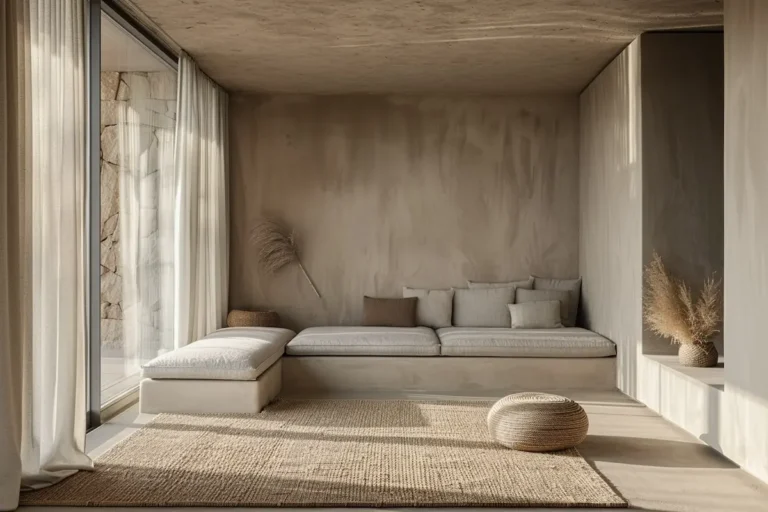
Crafted Minimalism prioritizes visual calm over visual openness.
That means:
- fewer competing materials
- limited color variation
- repetition instead of contrast
A calm visual field feels larger than a visually chaotic open space.
Furniture weight creates stability
Lightweight furniture is often recommended for small homes.
But too much visual lightness can feel unstable.
Crafted Minimalism uses visual weight intentionally:
- solid tables
- grounded seating
- fewer but more substantial pieces
This anchors the space.
When furniture feels stable, the room feels safe — even when it’s small.

Fewer transitions, fewer decisions
Small homes often suffer from constant micro-decisions:
- where to put things
- what surface is free
- what belongs where
Crafted Minimalism reduces this by:
- assigning clear functions
- limiting surface use
- repeating storage logic
When fewer decisions are required, the space feels easier — not restrictive.
This is especially visible in compact apartments designed with this approach, explored further in
Crafted Minimalism Small Apartment.
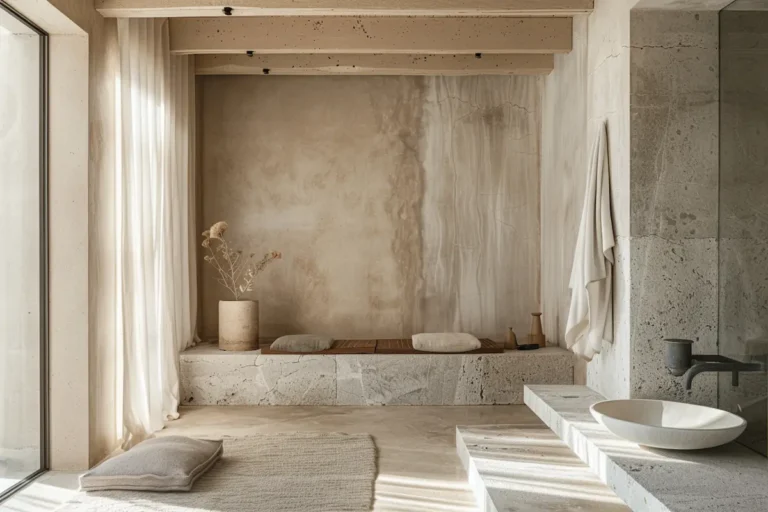
Materials matter more in small spaces
In small homes, materials are closer to the body.
You:
- touch them more
- see them more often
- notice wear faster
Crafted Minimalism favors materials that:
- age well
- don’t rely on surface perfection
- gain character over time
This prevents the space from feeling “used up” too quickly.

Small homes need emotional warmth, not decoration
Adding decoration is a common response to small-space discomfort.
But decoration often:
- competes for attention
- reduces clarity
- increases maintenance
Crafted Minimalism builds warmth through:
- material tone
- light quality
- proportion
The result is warmth that doesn’t crowd the space.
Light defines how small spaces are experienced
Light is not an accessory in small homes — it’s structural.
Crafted Minimalism uses light to:
- define zones
- soften edges
- enhance depth
Rather than flooding spaces with uniform light, it layers light gently.
This creates atmosphere without reducing clarity.

Storage that doesn’t dominate the space
Storage is unavoidable in small homes — but it doesn’t need to be visually loud.
Crafted Minimalism integrates storage by:
- aligning it with architecture
- repeating materials
- avoiding contrast
When storage disappears visually, the space feels larger and calmer.
Why small homes benefit most from long-term thinking
Small homes leave little room for mistakes.
Trend-driven choices age quickly and feel oppressive in compact spaces.
Crafted Minimalism avoids trend signals, which means:
- fewer future updates
- less visual fatigue
- more emotional stability
Over time, this makes small homes feel more generous, not smaller.

Small doesn’t mean temporary
One of the most important mindset shifts is this:
Small homes are often treated as temporary —
which leads to temporary design decisions.
Crafted Minimalism treats small homes as complete environments.
That shift:
- increases care
- improves quality
- enhances daily experience
And paradoxically, it often makes people feel less desire to “upgrade” later.
Final thoughts
Crafted Minimalism works for small homes because it doesn’t fight their limitations.
It works with them.
By focusing on:
- structure
- material honesty
- visual calm
it creates spaces that feel:
- stable
- warm
- livable
Small homes don’t need more tricks.
They need better thinking.
Where to go next
To see how these principles translate into practice, continue with:
- Crafted Minimalism by Room Overview
- Crafted Minimalism Small Apartment
Together, these articles show how small spaces can feel calm — not constrained.