How Crafted Minimalism Adds Warmth
Why warmth in minimal interiors is not about softness, but about intention
Minimalism is often associated with coldness.
Bare rooms. Hard surfaces. Emotional distance.
Yet people who live in Crafted Minimalist interiors often describe their homes as warm, grounded, and welcoming.
This isn’t accidental.
Crafted Minimalism doesn’t add warmth through decoration.
It builds warmth through structure, material honesty, and sensory balance.
This article explains how Crafted Minimalism adds warmth without losing clarity, and why this warmth feels deeper and more lasting than surface-level coziness.
Why minimalism is often perceived as cold
Minimalism earned its “cold” reputation for a reason.
Many minimalist interiors focus on:
- visual reduction without sensory balance
- smooth, processed surfaces
- neutral colors without tonal depth
- sharp contrasts and empty space
The result is clarity — but often at the cost of comfort.
Crafted Minimalism takes a different path.
Instead of asking what can be removed, it asks:
“What must be present for a space to feel human?”
This shift changes everything.
Warmth is not softness — it’s stability
Warmth is often confused with softness:
- plush textiles
- rounded shapes
- layered accessories
While these can feel cozy, they don’t always create lasting warmth.
Crafted Minimalism defines warmth as emotional safety.
That comes from:
- predictable layouts
- grounded materials
- visual calm
- sensory coherence
When a space feels stable, the body relaxes — and that relaxation is experienced as warmth.
This idea is central to the Crafted Minimalism Design Principles.
Material warmth: weight, texture, and aging
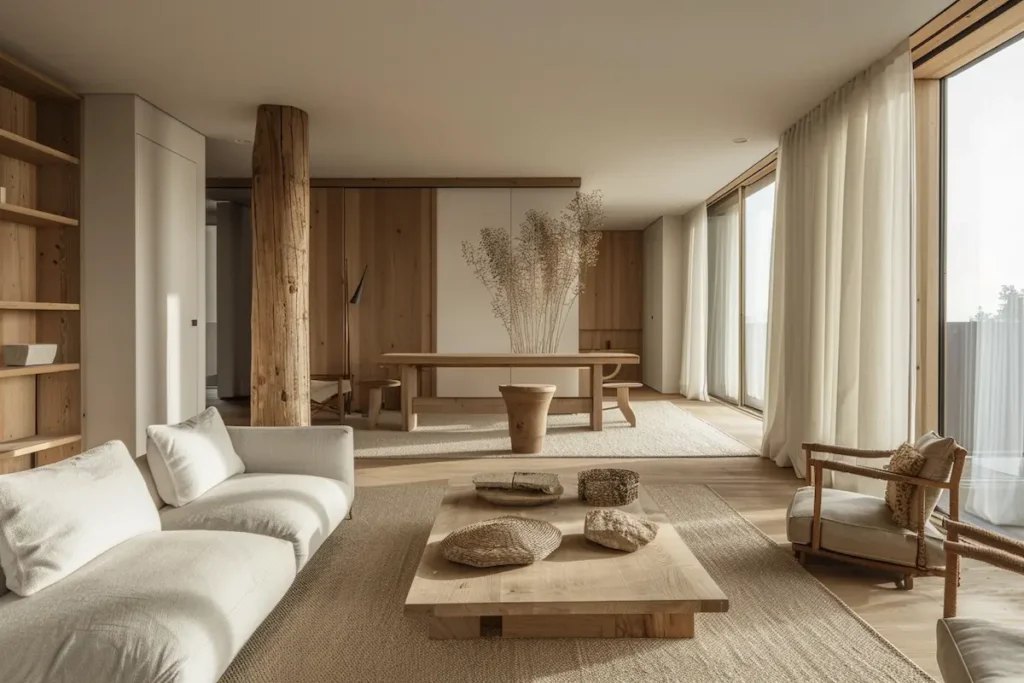
One of the strongest sources of warmth in Crafted Minimalism is material choice.
Not decorative materials — but structural ones.
Crafted Minimalism favors:
- solid wood over veneers
- stone over composites
- ceramics over plastics
These materials feel warm not because they are soft, but because they:
- have visual weight
- show texture
- age visibly over time
Wear becomes part of the story, not a flaw.
This is why handcrafted objects often feel warmer than mass-produced ones — a difference explored further in Handmade vs Mass Production.
Warmth through restraint, not abundance
Counterintuitively, warmth increases when visual noise decreases.
Too many elements compete for attention.
The nervous system stays alert.
Crafted Minimalism reduces visual competition by:
- limiting the number of materials
- repeating forms
- establishing hierarchy
When the eye knows where to rest, the space feels calm — and calm is experienced as warmth.
This is one reason why the style resonates so strongly today, as explained in
Why Crafted Minimalism Is Popular in 2026.

Color warmth without heaviness
Crafted Minimalism doesn’t rely on “warm colors” in the traditional sense.
Instead of bold hues, it uses:
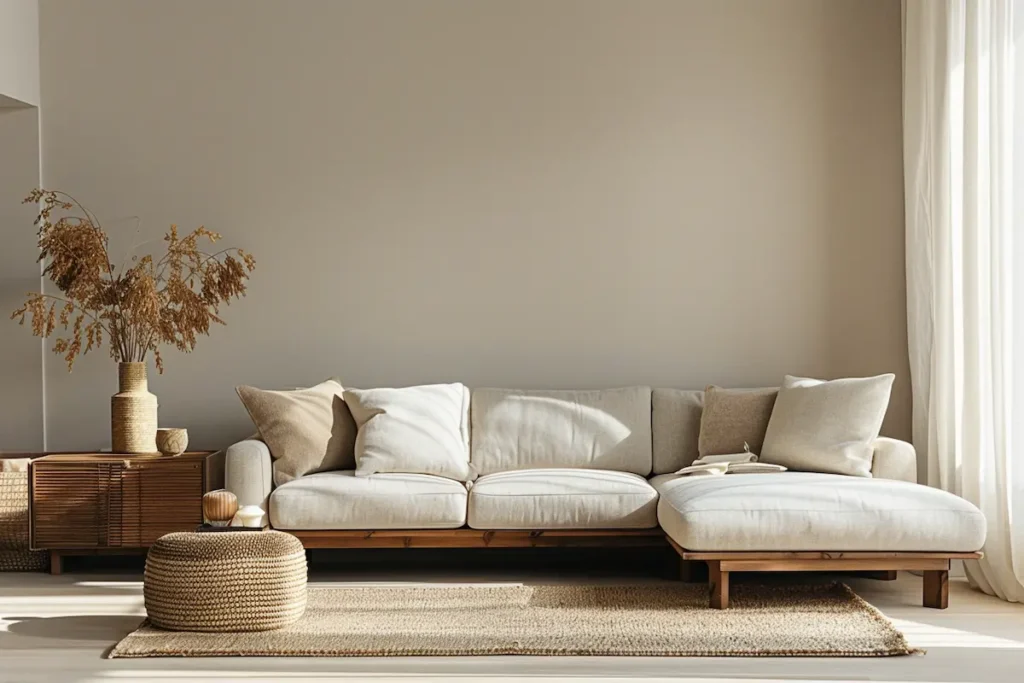
- warm neutrals
- earthy undertones
- tonal layering
Warmth comes from depth, not saturation.
A beige with warmth feels different from a cold beige.
A grey with brown undertones feels calmer than a blue-grey.
Color choices are deliberate and contextual — explored more deeply in
Color Palettes for Crafted Minimalism.
Light as a warmth amplifier
Light plays a decisive role in how warmth is perceived.
Even warm materials feel cold under harsh lighting.
Crafted Minimalism uses light to:
- soften edges
- enhance texture
- create rhythm
Common strategies include:
- indirect lighting
- layered light sources
- warm color temperatures
Light doesn’t decorate the space — it reveals it.
For a deeper dive, see
How Light Shapes Crafted Minimalism.

Why warmth in Crafted Minimalism feels calm, not cozy
Traditional coziness often relies on:
- softness
- enclosure
- visual density
Crafted Minimalism offers warmth without enclosure.
It avoids:
- cluttered surfaces
- heavy layering
- visual compression
The result is a space that feels warm and breathable.
This balance is explored further in Warm Minimalism Without Coldness.
Warmth here doesn’t trap you.
It supports you.
Warmth through craftsmanship and imperfection
Perfect surfaces often feel sterile.
Crafted Minimalism intentionally includes:
- subtle irregularities
- hand-finished textures
- visible joinery
These elements signal human presence.
The brain recognizes:
“This was made. This has intention.”
That recognition creates emotional warmth — even in a visually restrained space.
This connection between imperfection and warmth runs deeper than it first appears. Wabi-Sabi in Crafted Minimalism explores where that philosophy comes from and how it shapes the style.
Why warmth here lasts longer than trends
Many interiors feel warm at first — and then quickly feel dated.
That’s because their warmth depends on:
- trends
- styling
- novelty
Crafted Minimalism builds warmth into:
- the layout
- the materials
- the light
Because these elements don’t rely on fashion, the warmth doesn’t fade.
This explains why people often describe these interiors as feeling increasingly comfortable over time.
Warmth as belonging, not decoration
Ultimately, warmth in Crafted Minimalism is about belonging.
Not about impressing.
Not about decorating.
But about creating a space that:
- absorbs daily life
- feels familiar quickly
- doesn’t demand attention
Final thoughts
Crafted Minimalism adds warmth not by softening minimalism —
but by humanizing it.
It replaces cold precision with:
- material honesty
- sensory balance
- emotional stability
The warmth it creates is not decorative.
It’s structural.
And that’s why it lasts.
Where to go next
To deepen your understanding of warmth within Crafted Minimalism, continue with:
- Crafted Minimalism Design Principles
- Why Crafted Minimalism Is Popular in 2026
- Handmade vs Mass Production
- Color Palettes for Crafted Minimalism
- How Light Shapes Crafted Minimalism
- Warm Minimalism Without Coldness
Together, these articles form a complete picture of how warmth is designed — not added.