Wabi-Sabi in Crafted Minimalism
Why Wabi-Sabi resonates with Crafted Minimalism
Wabi-Sabi is often mentioned alongside minimal interiors, but the connection goes deeper than shared aesthetics. At its core, Wabi-Sabi offers an alternative to perfection — one that values impermanence, irregularity, and quiet presence. These ideas resonate strongly with people who feel that conventional minimalism can become too rigid or emotionally distant.
Crafted Minimalism responds to that same tension. While it maintains clarity, restraint, and structure, it softens those qualities through material honesty and subtle variation. Where traditional minimalism may aim for visual control, Crafted Minimalism allows materials to behave more naturally — to age, shift, and carry traces of use.
The appeal of Wabi-Sabi within this context is not about adopting a Japanese aesthetic or recreating a specific visual language. It is about recognizing that calm does not require perfection. In fact, perfection often creates pressure: to maintain, to preserve, to correct.
Wabi-Sabi introduces acceptance. Crafted Minimalism translates that acceptance into a contemporary interior framework that still works for daily life. Together, they offer a way of living with fewer objects, fewer adjustments, and less visual tension — not by removing character, but by allowing it to exist quietly within the materials themselves.
What Wabi-Sabi actually means (beyond aesthetics)
Wabi-Sabi is often misunderstood as a visual style defined by rough textures, earthy colors, or aged objects. In reality, it is a philosophy rooted in acceptance — of impermanence, incompleteness, and natural change. It describes a way of seeing, not a way of decorating.
At its core, Wabi-Sabi acknowledges that nothing remains fixed. Materials weather, surfaces mark, and forms shift over time. Rather than resisting this process, Wabi-Sabi embraces it. Patina is not damage. Variation is not error. These qualities are signs of life.
In interior contexts, this philosophy is frequently reduced to aesthetics. Objects are chosen to look imperfect, while the underlying approach remains rigid and controlled. This contradiction is why many Wabi-Sabi-inspired spaces feel staged rather than calm.
Within Crafted Minimalism, Wabi-Sabi functions differently. Its value lies not in copying visual cues, but in adopting a mindset of tolerance. Materials are allowed to age. Objects are allowed to carry traces of use. Perfection is not the goal — coherence is.
Understanding Wabi-Sabi beyond surface appearance is essential. It sets the foundation for choices that feel grounded over time, rather than curated for a moment. In this way, Wabi-Sabi informs Crafted Minimalism without overtaking it, guiding how materials are selected, used, and lived with.
Where Wabi-Sabi and Crafted Minimalism overlap
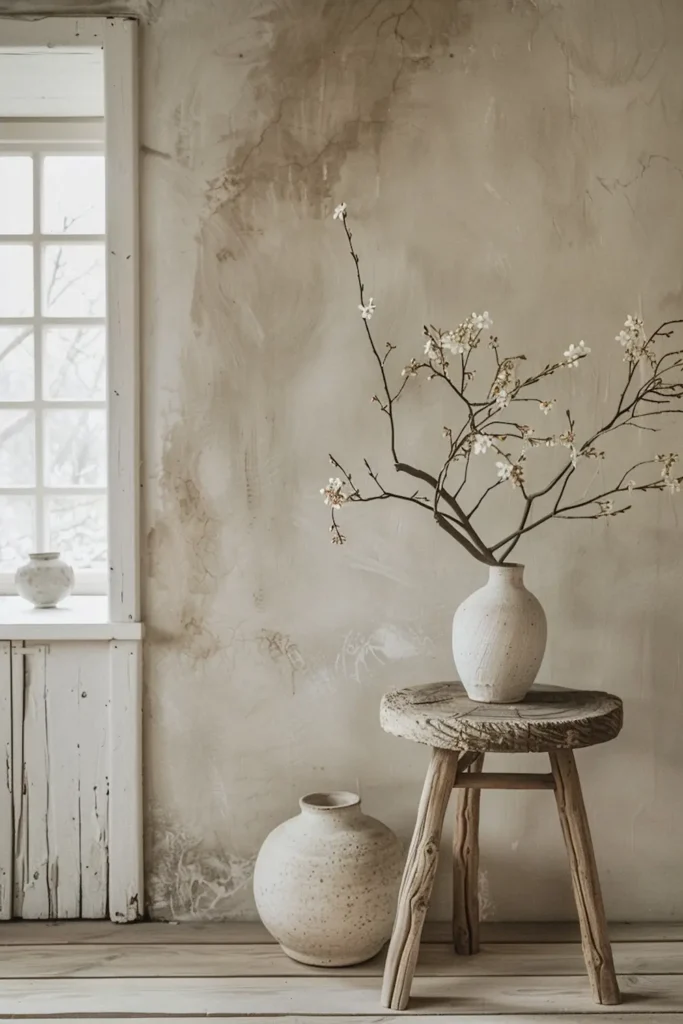
Wabi-Sabi and Crafted Minimalism meet at a shared respect for material honesty. Both reject artificial perfection and favor surfaces that reveal how they were formed, used, and aged. This overlap is not stylistic, but structural.
In both approaches, materials are allowed to behave naturally. Wood is not forced into flawless uniformity. Ceramics are not corrected into symmetry. Stone is appreciated for its weight and variation rather than polished into anonymity. These choices reduce visual pressure because nothing is trying to perform or impress.
Another point of overlap is restraint. Neither Wabi-Sabi nor Crafted Minimalism relies on decoration to create meaning. Calm emerges from what remains when unnecessary layers are removed. Objects are chosen for presence rather than impact.
Where this overlap becomes especially relevant is in everyday living. Both approaches understand that interiors must tolerate change. Surfaces will mark. Objects will shift. Use will become visible. Instead of resisting this reality, both philosophies accommodate it.
This shared foundation explains why Wabi-Sabi principles translate so naturally into Crafted Minimalism. The latter provides structure and clarity, while the former contributes acceptance and softness. Together, they form interiors that feel composed without feeling controlled — calm not because they are perfect, but because they are allowed to be real.
Where Crafted Minimalism departs from traditional Wabi-Sabi
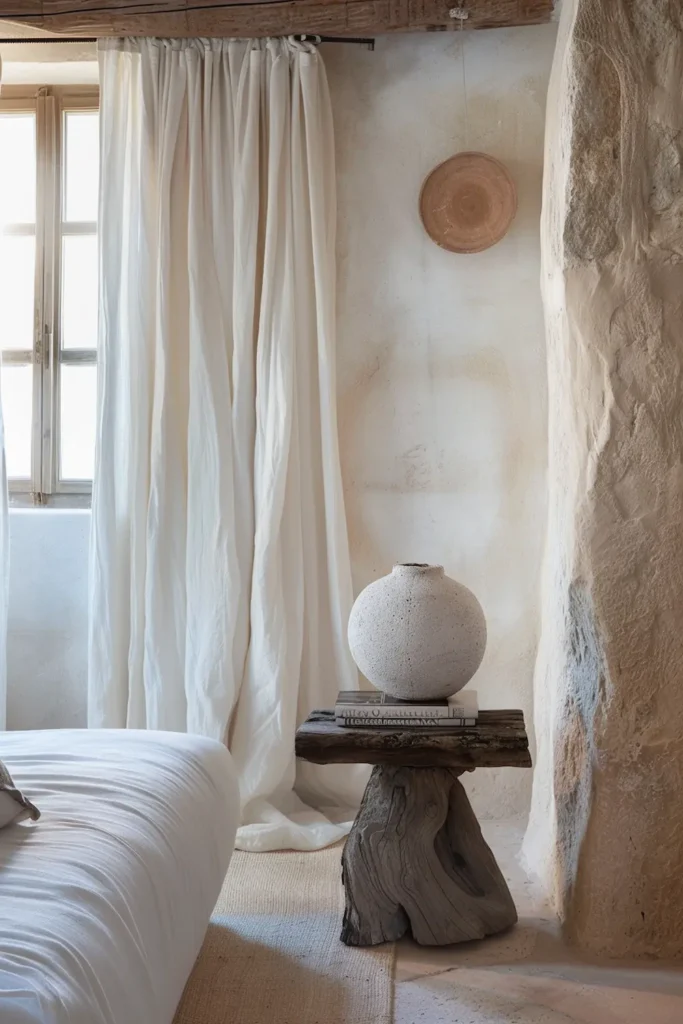
While Wabi-Sabi and Crafted Minimalism share foundational values, they diverge in how those values are applied to daily living. Traditional Wabi-Sabi is contemplative by nature. It accepts ambiguity, asymmetry, and softness — sometimes at the expense of clarity or structure. Crafted Minimalism takes a different stance.
Crafted Minimalism introduces intentional structure. Forms are clearer, layouts more deliberate, and functions more defined. Imperfection is allowed, but it is contained. Materials age and vary, yet the overall composition remains legible. This makes Crafted Minimalism better suited to modern life, where homes must support work, movement, and routine without visual friction.
Another key difference lies in restraint. Traditional Wabi-Sabi interiors can feel layered, intuitive, and emotionally rich, but they may also drift toward visual density if not carefully balanced. Crafted Minimalism reduces this risk by limiting objects and emphasizing material presence over symbolic meaning.
Rather than leaning into poetic irregularity, Crafted Minimalism focuses on practical calm. It asks how materials behave over time, how they respond to use, and how they contribute to stability. Wabi-Sabi provides the philosophical softness; Crafted Minimalism translates it into a framework that remains functional, clear, and quietly resilient.
This departure does not reject Wabi-Sabi — it refines it for contemporary living.
Sustainability through imperfection and longevity
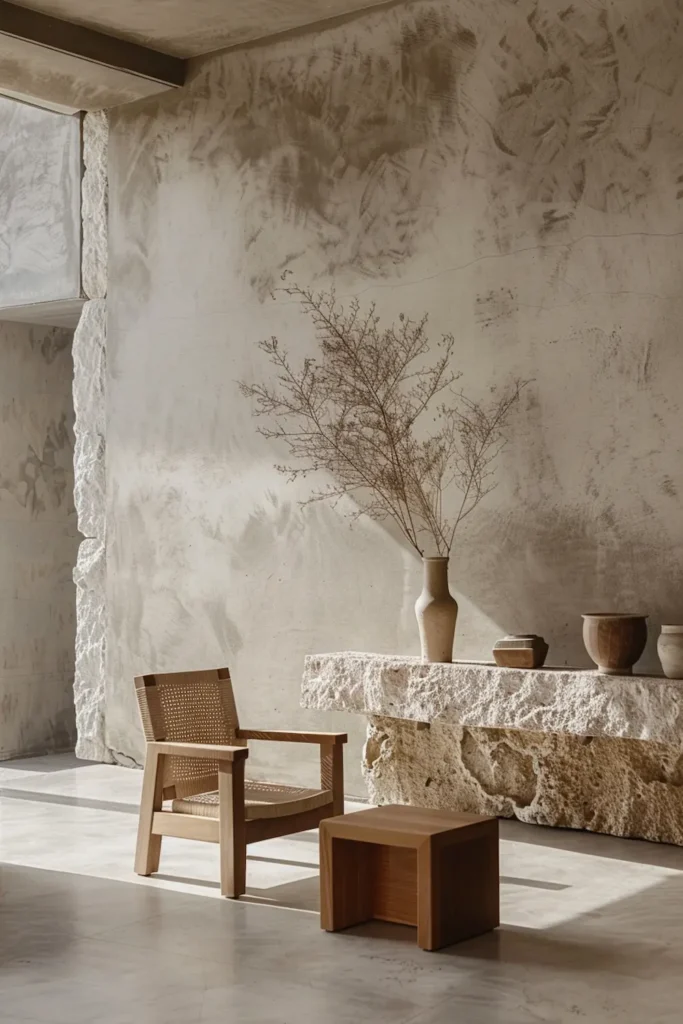
Sustainability within Wabi-Sabi and Crafted Minimalism is less about certifications and more about how materials age and remain relevant. Imperfection plays a central role in this. When materials are allowed to mark, soften, and change, wear becomes part of their value rather than a reason for replacement.
Perfect surfaces demand control. Once damaged, they feel compromised. Imperfect materials behave differently. A ceramic bowl that already carries variation absorbs signs of use naturally. Raw wood deepens in tone instead of showing flaws. Stone develops character rather than looking worn. This tolerance for life extends an object’s usable lifespan — both physically and emotionally.
Crafted Minimalism builds on this idea by combining acceptance with structure. Imperfection is not chaotic; it is framed. This reduces the urge to update or replace items simply because they no longer look new. Calm is preserved through continuity rather than constant renewal.
This perspective aligns closely with Is Crafted Minimalism Sustainable, where sustainability is defined through longevity, repairability, and emotional durability rather than surface-level eco claims. In this context, Wabi-Sabi contributes a mindset, while Crafted Minimalism provides a practical system for living with it over time.
True sustainability emerges when objects are chosen to age — not to be replaced.
Product type: Handmade ceramic vessels with natural glazing
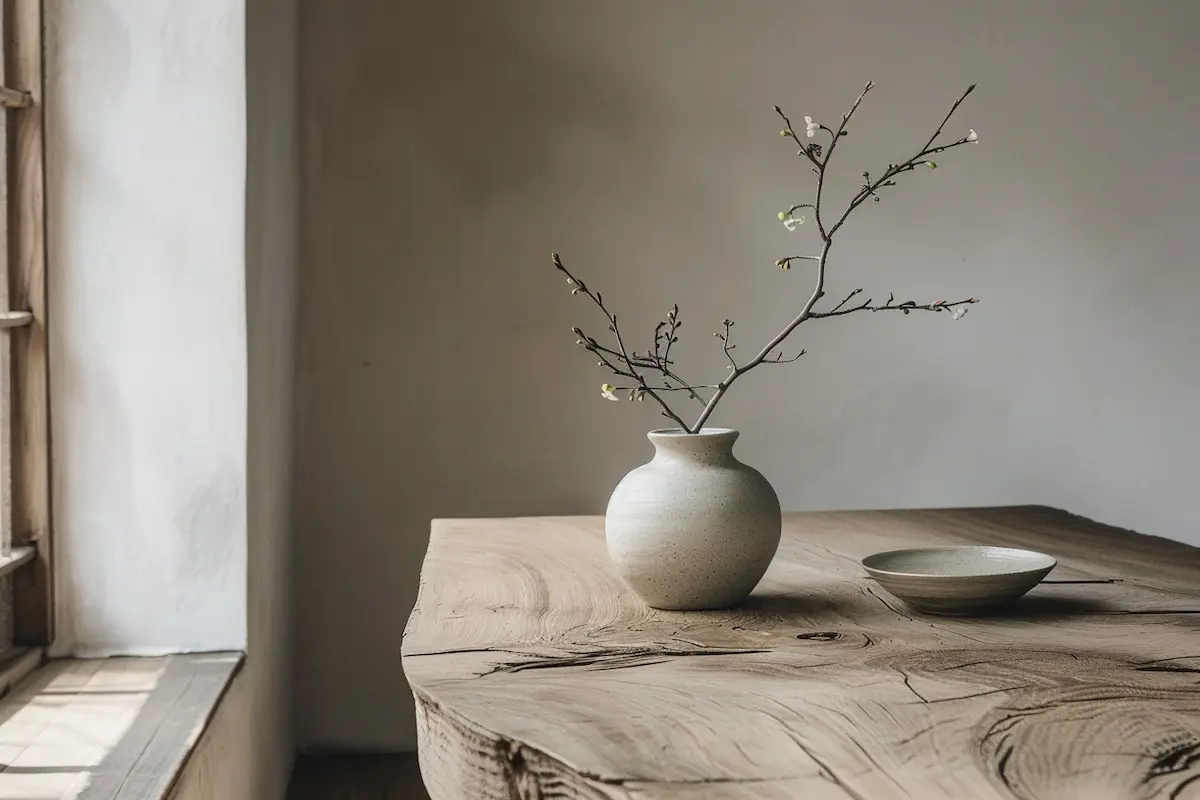
Handmade ceramic vessels are one of the most direct ways Wabi-Sabi translates into Crafted Minimalism. Their value lies in the glazing process: uneven pooling, subtle color shifts, and small surface variations that occur naturally through heat and hand movement. These qualities cannot be standardized — and that is precisely why they feel calm.

Within Crafted Minimalism, ceramic vessels work best when treated as functional objects with presence, not decorative clusters. One bowl or vessel placed on a raw wood table or stone surface is often enough to anchor a space visually. The material holds interest without demanding attention.
Because the surface already carries depth, there is no need to add styling elements around it. The object feels complete on its own — quietly expressive, grounded, and resilient over time.
This approach is explored further in Ceramics as Statement Pieces, where restraint allows material character to take the lead.
Product type: Raw wood furniture with visible aging
Raw wood furniture expresses Wabi-Sabi through time rather than finish. Visible grain, knots, and subtle movement in the wood reveal a material that continues to live and respond to its environment. Small cracks, tonal shifts, or softened edges are not defects — they are signs of use and continuity.
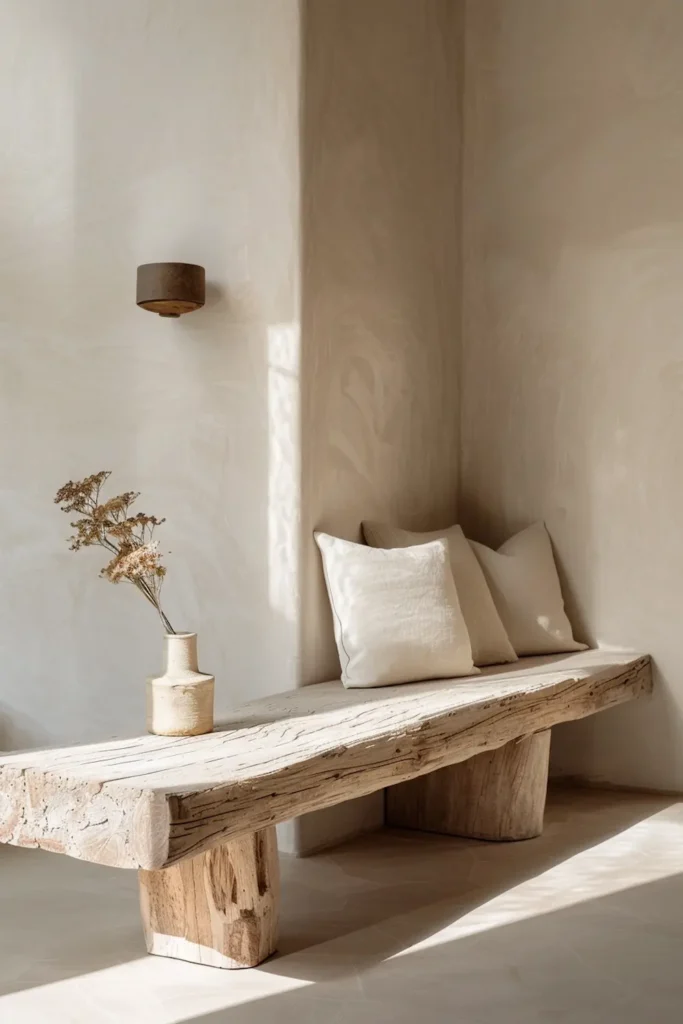
Within Crafted Minimalism, raw wood works best when the form remains simple and the surface is allowed to speak. A table, bench, or low storage piece made from solid wood does not require decorative styling. Its presence is structural rather than ornamental.
As the material ages, it deepens rather than deteriorates. The surface becomes more familiar, not less refined. This makes raw wood furniture especially suited to interiors that value longevity and calm over novelty or visual perfection.
For a deeper understanding of this material approach, see Why Raw Wood Is Essential.
Explore a solid wood bench where visible grain, weight, and natural aging give the material a quiet, grounding presence.
Product type: Stone or clay surfaces with natural variation
Stone and clay express Wabi-Sabi through weight and quiet irregularity. Subtle mineral shifts, pores, and tonal variations create depth without pattern or contrast. These surfaces are not meant to be visually active; they slow the eye by offering stability rather than detail.
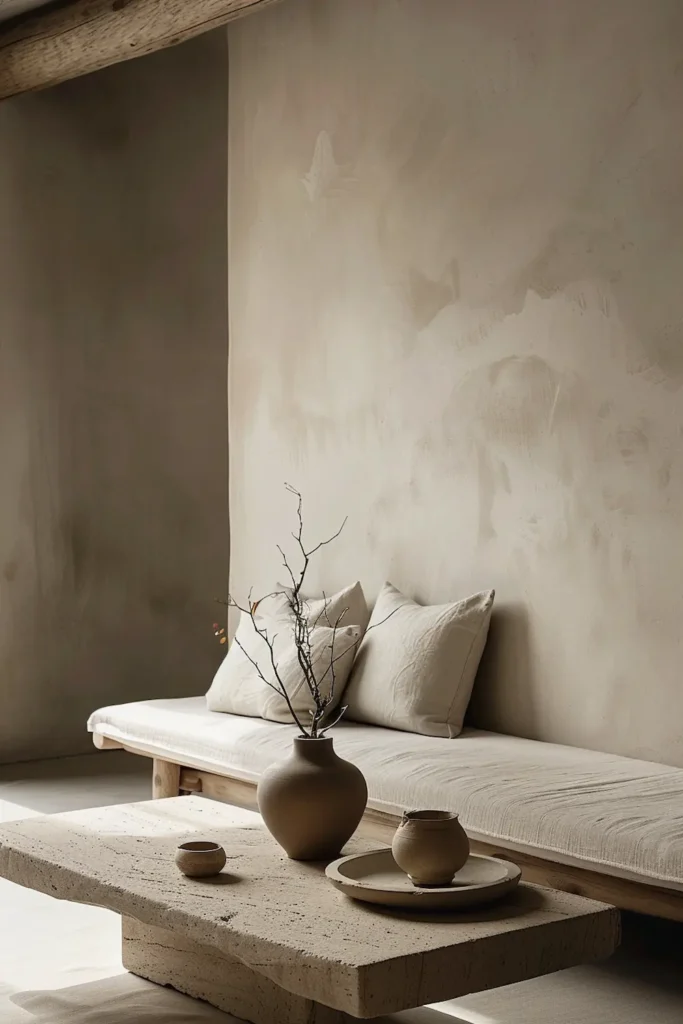
Within Crafted Minimalism, stone and clay work best as low, grounded elements—coffee tables, side tables, trays, or plinths—where their mass anchors the space. A honed or matte finish absorbs light, preventing glare and keeping the surface calm throughout the day.
Because these materials carry presence on their own, they rarely need objects placed on top. Their role is not decorative, but structural: to introduce stillness and visual gravity through material honesty.
Product type: Handwoven natural textiles (linen, wool, cotton)
Handwoven natural textiles express Wabi-Sabi through irregular rhythm rather than pattern. Small variations in thread thickness, weave tension, and surface texture create softness without visual noise. These materials absorb light instead of reflecting it, which helps a space feel quieter and more grounded.
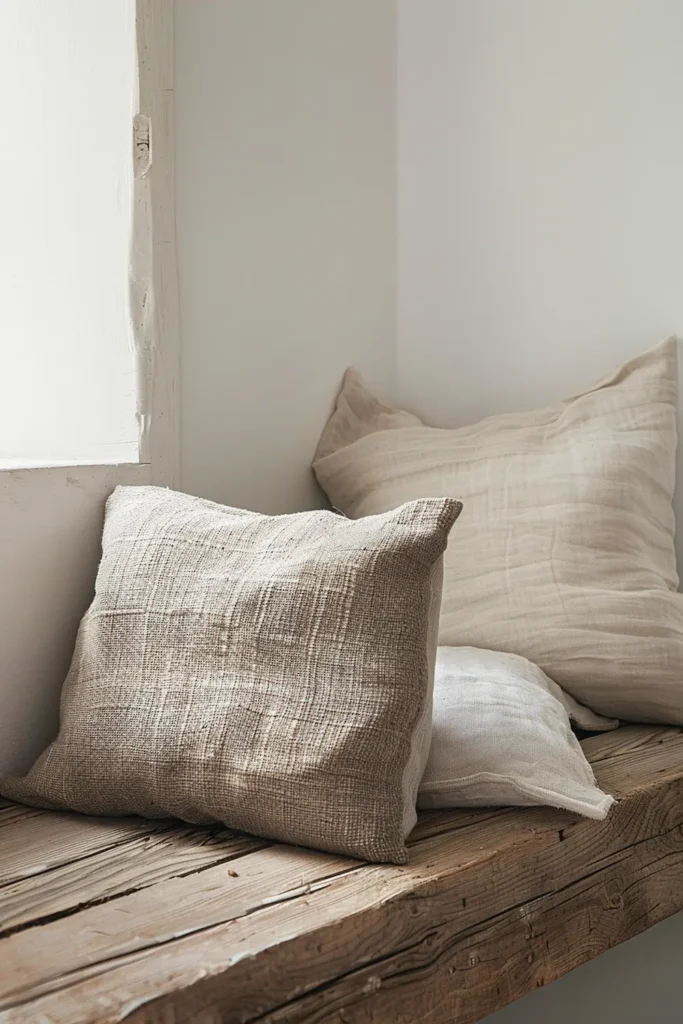
Within Crafted Minimalism, handwoven textiles work best when used sparingly: a single cushion, throw, or upholstered surface is often enough. Linen, wool, and cotton age gently, becoming softer over time without losing integrity. Their texture replaces the need for layering or decorative accents.
Because the making process remains visible in the weave, these textiles feel complete on their own. They support calm by reducing contrast, adding warmth, and allowing materials—not styling—to shape the atmosphere.
Explore a natural linen pillow where subtle texture and softness add warmth without visual noise.
Product type: Handmade lighting as quiet imperfection
Handmade lighting brings Wabi-Sabi into Crafted Minimalism through how light interacts with material. Ceramic, clay, or mouth-blown glass soften light naturally, diffusing it unevenly and reducing harsh contrasts. Small variations in thickness or surface texture subtly shape the glow, making the light feel calmer and more atmospheric.
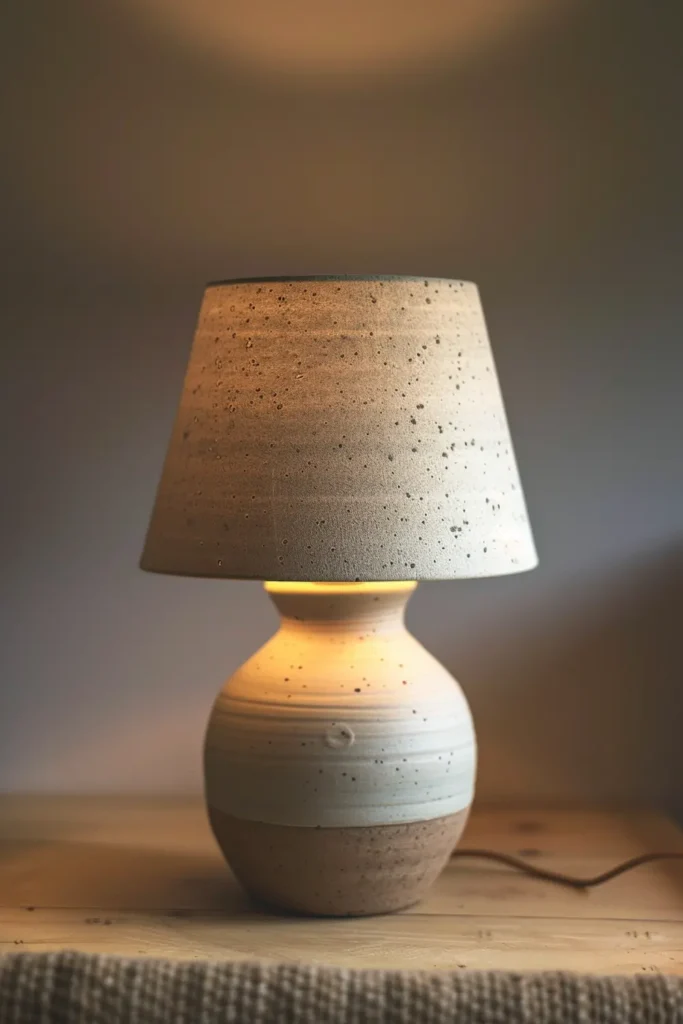
Within Crafted Minimalism, handmade lighting works best when the form remains restrained and the material does the expressive work. The lamp becomes part of the spatial structure rather than a focal object. Used as ambient lighting—on a side table, low shelf, or above a dining surface—it supports the space without directing attention.
Rather than illuminating perfectly, handmade lighting settles the room. It accepts irregularity and turns it into warmth, reinforcing the sense that the interior is meant to be lived in, not controlled.
Common mistakes when applying Wabi-Sabi in interiors
One of the most common mistakes when applying Wabi-Sabi is treating it as an aesthetic shortcut. Rough textures, aged finishes, and muted colors are added without considering restraint or structure. The result often feels cluttered rather than calm.
Another frequent error is forcing imperfection. Chipped edges, distressed surfaces, or overly weathered objects can feel staged when they lack a functional reason to exist. Wabi-Sabi values natural change, not manufactured wear.
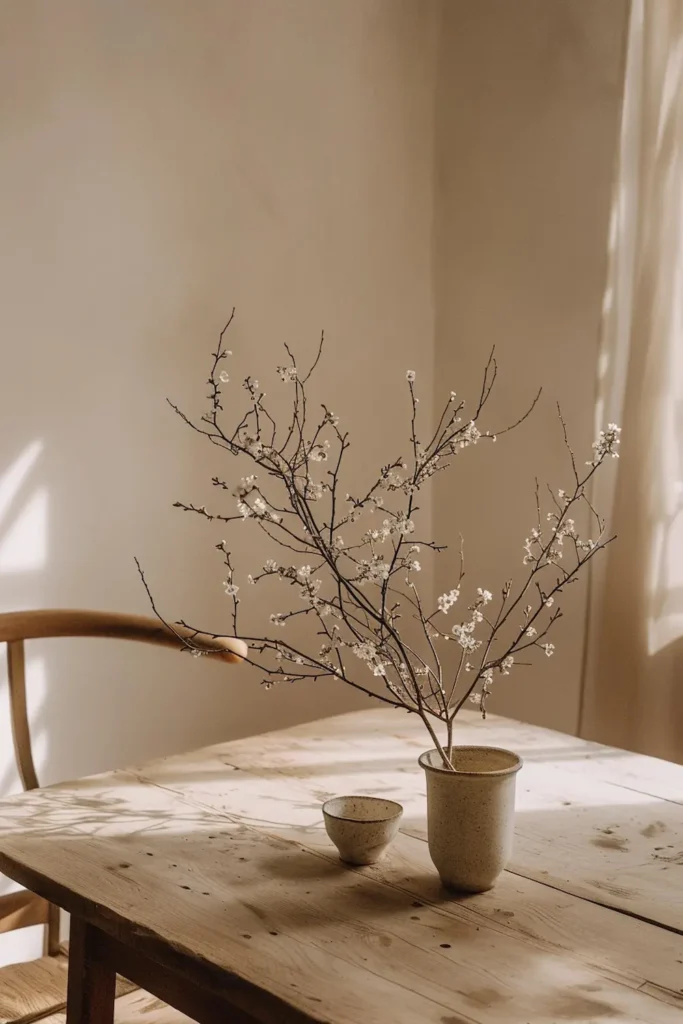
There is also a tendency to over-collect. Multiple “imperfect” objects grouped together compete for attention and dilute the quiet presence each could hold on its own. In Crafted Minimalism, fewer pieces with clear material integrity create more calm than many expressive items.
Finally, Wabi-Sabi is often applied without considering daily life. Interiors still need clarity, durability, and ease of use. Crafted Minimalism corrects this by framing imperfection within intentional layouts and functional choices—allowing materials to age naturally without sacrificing coherence.
Living with imperfection in a modern home
Living with imperfection does not mean lowering standards or accepting inconvenience. Within Crafted Minimalism, it means choosing materials and objects that tolerate life without demanding constant correction. Scratches, marks, and softening surfaces are no longer problems to solve, but signs that a space is being used as intended.
This shift has a practical effect on daily living. When objects are not expected to remain pristine, the pressure to protect, style, or update them disappears. The home becomes easier to inhabit. Decisions slow down. Visual tension fades.
Modern homes often prioritize efficiency and control, which can unintentionally create fragility. Crafted Minimalism counterbalances this by allowing materials to absorb time. Raw wood deepens, ceramics patinate, textiles soften. These changes do not disrupt the interior; they reinforce its continuity.
Living with imperfection is ultimately about trust — trusting materials to age well, and trusting yourself not to intervene constantly. The result is an interior that feels stable, familiar, and calm, not because it resists change, but because it has room for it.
That sense of ease and familiarity is closely connected to how warmth is built into the style itself. How Crafted Minimalism Adds Warmth explores how structure and material choice — not decoration — create that lasting sense of comfort.
Conclusion: Wabi-Sabi as foundation, not decoration
Wabi-Sabi is most powerful when it is not treated as a visual layer, but as a foundational attitude toward materials and time. Within Crafted Minimalism, this philosophy becomes practical. Imperfection is not added for effect; it is allowed to exist where it naturally belongs.
By choosing materials that age visibly and tolerate use, interiors become calmer over time rather than more fragile. Objects remain relevant because they are not tied to perfection or trend cycles. They carry continuity instead of requiring replacement.
Crafted Minimalism does not copy Wabi-Sabi — it translates it. Structure replaces excess. Function replaces symbolism. What remains is an interior that feels composed, grounded, and quietly resilient.
Wabi-Sabi, in this context, is not decoration. It is the permission to let materials attachments and spaces settle into themselves — and to trust that calm emerges when nothing is forced to stay perfect.