
Handmade vs Mass Production (and why it matters in Crafted Minimalism)
In Crafted Minimalism, objects are not judged solely by how they look, but by how they came into being. Two pieces can appear similar at first glance — same color, same shape, same size — yet feel completely different in a space. The difference is often invisible: it lies in the way they were made.
Mass-produced objects are designed for efficiency. They prioritize speed, uniformity, and transport. Every surface is optimized to look consistent, predictable, and easily repeatable. This perfection may photograph well, but in real interiors it often creates subtle tension. The eye scans quickly, recognizes repetition, and moves on, leaving the space feeling flat or strangely restless.
Handmade objects behave differently. Their variation is not a flaw, but a consequence of material and process. Slight changes in form, surface, or finish slow perception. The object feels more settled, more present, and less demanding of attention.
Within Crafted Minimalism, this distinction matters deeply. Calm does not come from reducing objects alone, but from choosing things that carry their own weight. When an object is well made, fewer additions are needed around it. Production becomes a design factor — one that directly influences how a space feels, ages, and supports everyday life.
What “handmade” and “mass production” really mean
The terms handmade and mass produced are often used loosely, but within Crafted Minimalism they describe fundamentally different relationships between material, maker, and outcome.
Handmade does not simply mean that human hands were involved at some point. It refers to a process where decisions are made in response to the material itself. Grain direction influences joinery, clay responds to pressure and heat, fabric tension shapes the weave. Variation is not corrected away; it is managed with intention. As a result, no two pieces are identical — and that difference remains visible.
Mass production, by contrast, is built around predictability. Materials are selected for consistency, ease of processing, and transport efficiency. Surfaces are often coated, compressed, or engineered to eliminate variation. The goal is not material expression, but control. Every object should look the same, regardless of context.
This difference matters visually. Uniformity creates repetition, and repetition accelerates how the eye scans a space. Variation slows perception. It introduces micro-pauses that make objects feel present rather than interchangeable.
Within Crafted Minimalism, handmade does not mean rustic or imperfect for effect. It means that material behavior is allowed to influence the final form. Mass production suppresses that behavior. Handmade works with it.
Understanding this distinction is essential, because later product choices in this article are not judged by appearance alone — but by whether the making process supports calm, longevity, and material honesty.
Visual repetition vs human variation
Visual calm is not created by simplicity alone, but by how predictable a surface is. When materials repeat themselves too perfectly, the eye accelerates. It scans, categorizes, and moves on. This creates subtle mental activity, even in interiors that appear minimal.
Mass-produced objects rely on repetition. Identical dimensions, identical finishes, identical textures. While this consistency supports efficiency, it removes depth. The surface becomes immediately readable, leaving nothing for the eye to linger on.
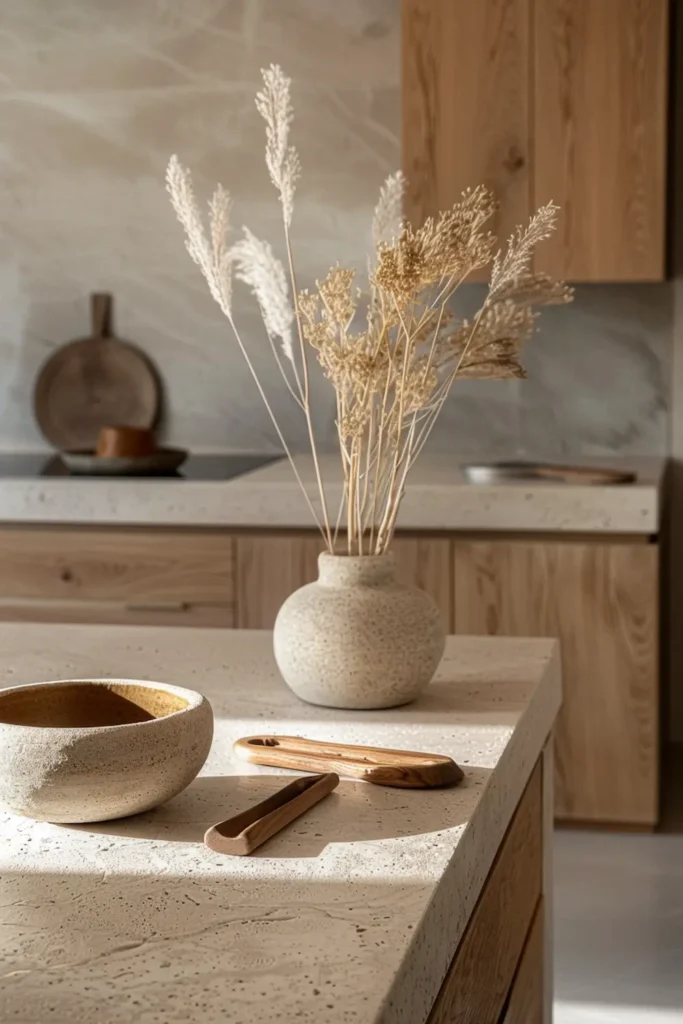
Human variation works differently. In handmade objects, repetition is interrupted just enough to slow perception. Slight changes in thickness, tone, edge, or texture introduce micro-pauses. The eye does not rush. It settles.
Within Crafted Minimalism, this slowing effect is essential. Calm interiors are not empty; they are less demanding. Variation embedded in materials reduces the need for visual compensation through styling or decoration.
This is why handcrafted materials often feel quieter, even when they are visually richer. Their variation is distributed across the surface rather than concentrated in patterns or objects. Nothing calls for attention — everything supports presence.
When visual repetition is reduced, the space feels more stable. Fewer elements are required to create balance, because the materials themselves already hold it.
Why mass production often undermines calm interiors
Mass production is optimized for efficiency, not for lived experience. Materials are selected for predictability, transport, and speed of assembly. Surfaces are flattened, coated, or engineered to behave the same way every time. While this creates visual consistency, it often removes the very qualities that make an interior feel settled.
Perfect uniformity accelerates perception. When every edge, tone, and texture repeats without variation, the eye reads the surface instantly and moves on. This creates subtle restlessness, even in minimal spaces. To compensate, decoration is added — cushions, objects, layers — introducing clutter to solve a problem created by the material itself.

Another issue is surface fragility. Many mass-produced finishes rely on coatings to look “finished.” Scratches, dents, or wear interrupt the surface abruptly, which makes spaces feel high-maintenance and precious. Calm interiors require materials that tolerate life, not resist it.
This is why mass production often works against the goals of Crafted Minimalism. Calm is not achieved by removing objects alone, but by choosing materials that carry depth without intervention. When surfaces already hold presence, fewer additions are needed.
These dynamics connect closely to Using Texture Without Clutter, where material-embedded texture replaces styling, and to How Materials Create Calm, which explores how surface behavior influences perception over time. In both cases, the lesson is the same: when materials do less visually, spaces feel more at ease.
The sustainability question (more than eco labels)
Sustainability is often reduced to certifications, recycled content, or production claims. While these factors matter, within Crafted Minimalism sustainability is primarily about how long something remains relevant and usable.
Mass-produced objects are frequently designed for replacement. Trends shift, finishes date quickly, and materials are optimized for cost rather than longevity. Even when labeled “sustainable,” many products are not intended to age visually or structurally. Once wear appears, replacement feels inevitable.

Handmade objects operate differently. Because variation and imperfection are already part of the material, signs of use integrate rather than interrupt. A ceramic bowl develops patina instead of looking damaged. Solid wood deepens in tone rather than showing flaws. This tolerance for life significantly extends an object’s usable lifespan.
Sustainability, in this sense, is not about purity — it is about continuity. Fewer replacements mean fewer decisions, less waste, and a calmer relationship with the interior over time.
This perspective is explored in more depth in Is Crafted Minimalism Sustainable, where longevity, repairability, and emotional durability are shown to matter more than short-term eco claims. In Crafted Minimalism, the most sustainable object is often the one you never feel the need to replace.
Product type: Handmade ceramic bowl or vessel (presence through imperfection)

A handmade ceramic bowl or vessel demonstrates the difference between crafted and mass-produced objects immediately. The value lies in the surface: subtle asymmetry, uneven glazing, and slight variations in thickness that reflect human touch rather than mechanical control.
Within Crafted Minimalism, these pieces work best when treated as functional objects with presence, not decoration. A single bowl placed on a raw wood table or stone surface carries enough visual weight to replace multiple styled accessories. Its texture is perceived slowly, without demanding attention.
Because the material already holds variation, there is no need to group or layer ceramics. One piece is enough. The calm comes from restraint — and from allowing the making process to remain visible rather than perfected away.
This approach is explored further in Ceramics as Statement Pieces, where material honesty replaces decorative excess.
Explore handmade ceramic bowls where subtle variation and natural glazing give each piece a calm, grounded presence.
Product type: Handmade solid wood furniture (weight, joinery, and trust)

Handmade solid wood furniture reveals its value through weight and construction, not through finish. Visible grain direction, expressed joinery, and subtle variation in tone show how the material was worked rather than corrected.
Within Crafted Minimalism, this type of furniture creates calm because it feels structurally reliable. The piece does not rely on styling or accessories to feel complete. Its presence anchors the space, reducing the need for additional objects nearby.
Unlike engineered furniture designed to look consistent, handmade solid wood carries small irregularities that slow perception. The eye lingers instead of scanning. Over time, signs of use integrate naturally into the surface, reinforcing trust rather than fragility.
Used as tables, benches, or low storage, handmade wood furniture replaces visual noise with stability. It is not meant to impress — it is meant to hold the room together quietly.
Explore a solid wood coffee table crafted with visible grain and natural edges, where the material itself carries presence and calm.
Product type: Handwoven textiles (linen, wool, cotton)
Handwoven textiles introduce calm through irregular rhythm, not pattern. Small variations in thread thickness, tension, and weave break visual repetition in a way that feels organic rather than decorative. The surface is never perfectly uniform, which slows the eye and softens the space.

Within Crafted Minimalism, these textiles work best when they replace synthetic upholstery or overly smooth fabrics. Linen, wool, and cotton absorb light and sound, reducing sharp contrasts without requiring layering. A single handwoven textile — used as upholstery, a throw, or a cushion — is often enough.
The key is restraint. When textiles already carry texture through their making, additional accessories become unnecessary. The material does the work quietly, supporting calm rather than competing for attention.
Product type: Natural stone surfaces (weight as quiet authority)
Natural stone introduces calm through mass and stillness. Its surface does not invite constant interaction or visual scanning. Instead, it holds the eye in place. Subtle mineral variation, pores, and tonal shifts add depth without contrast or pattern.

Within Crafted Minimalism, stone works best in smaller but structurally meaningful elements: side tables, coffee tables, trays, or low pedestals. These pieces ground a space visually, especially when paired with raw wood or natural textiles. Because stone carries its own presence, it rarely needs objects placed on top of it.
The key is finish. Honed or matte stone absorbs light rather than reflecting it, allowing the material to remain calm and contained. Used with restraint, natural stone replaces decoration with stability.
Product type: Handmade lighting elements (material meets atmosphere)
Handmade lighting elements reveal one of the clearest differences between crafted and mass-produced objects. The distinction is not in brightness, but in how light is carried by the material. Ceramic, stone, or mouth-blown glass soften light naturally, reducing glare and harsh shadows.

Within Crafted Minimalism, handmade lighting works best when the form remains simple and the material does the expressive work. Slight irregularities in shape or surface break the uniform spread of light, creating a calmer, more atmospheric glow. The lamp becomes part of the spatial structure rather than a visual statement.
Placed above a table, beside seating, or as a low ambient source, handmade lighting reinforces material calm. It does not dominate the space — it settles into it, supporting the interior quietly rather than directing attention.
Common misconceptions about handmade
One of the most persistent misconceptions about handmade objects is that they are inherently decorative. In reality, craftsmanship becomes most effective when it replaces decoration rather than adding to it. Handmade does not mean expressive, rustic, or visually dominant — it means material-led.
Another misunderstanding is that handmade pieces are fragile or impractical for daily life. The opposite is often true. Because handcrafted objects are not dependent on thin coatings or engineered finishes, wear integrates naturally instead of disrupting the surface. Patina becomes part of the object’s character rather than a flaw.
There is also the assumption that handmade always means informal or traditional. Within Crafted Minimalism, craftsmanship is applied through restrained forms and contemporary proportions. The calm comes from how the material behaves, not from nostalgic references.
Finally, many people equate handmade with excess — too many objects, too much texture, too much story. True craftsmanship requires restraint. One well-made piece can do more than several styled elements. Handmade succeeds when it simplifies decisions, not when it multiplies them.
Choosing fewer, better-made things
Crafted Minimalism is not about replacing everything with handmade objects. It is about changing the criteria by which things are chosen. When production quality becomes part of the design decision, quantity naturally decreases.
Well-made objects reduce doubt. They do not need constant adjustment, styling, or replacement to feel right. This creates a quieter relationship with the interior: fewer decisions, fewer upgrades, fewer moments of visual friction. Calm emerges not from restraint alone, but from confidence in what is already present.
Mass-produced objects often rely on novelty to stay relevant. Handmade pieces rely on material integrity. Because they age gradually and visibly, they remain familiar instead of outdated. Over time, this continuity supports a more stable living environment.
Choosing fewer, better-made things is therefore not a moral position, but a practical one. It aligns with how Crafted Minimalism approaches sustainability, longevity, and daily use. When objects are selected for how they are made — not just how they look — the interior requires less effort to maintain and feels settled for longer.
Conclusion: choosing how things are made
The difference between handmade and mass production is not aesthetic — it is experiential. How something is made determines how it behaves in a space, how it ages, and how much attention it demands over time.
Within Crafted Minimalism, production becomes a quiet design choice. Handmade objects slow perception, reduce repetition, and tolerate everyday life without losing coherence. They do not ask to be styled or replaced. They simply remain.
Choosing handcrafted pieces is therefore not about nostalgia or exclusivity. It is about selecting materials and objects that support calm through integrity rather than perfection. When fewer items are chosen with intention, the interior requires less effort to feel complete.
Crafted Minimalism is not about owning less for its own sake. It is about trusting fewer, better-made things to carry the space — and letting production quality do the work quietly.