
How to Style a Mantelpiece the Parisian Way
The mantelpiece is the most compositionally demanding surface in a Parisian interior. It is framed by architecture, elevated above the room, and visible from almost every angle. It is also the surface most likely to reveal the difference between a room that has been decorated and a room that has been lived in. A mantelpiece that has been arranged — in the sense of consciously composed — reads as arranged. A mantelpiece that has accumulated, through genuine attention and genuine use over time, reads as Parisian.
This article is about how to produce the second quality, deliberately. It covers the mirror above the mantelpiece as the foundational element, the logic of object selection and placement on the shelf, the role of candlelight, how to introduce natural and dried botanicals, and what to remove. All observations are based on what is directly visible in well-documented Parisian interiors. No aesthetic judgement is presented as historical fact.
The Mantelpiece as the Room’s Focal Point
In most rooms that have one, the fireplace and its surround function as the room’s primary focal point: the element toward which the seating arrangement faces, the surface that receives the greatest visual attention, and the object that most clearly anchors the room’s character. This focal-point status is why the mantelpiece is worth treating with particular care.
The surface area of a standard mantelpiece shelf is modest — typically 10–20 cm deep and 100–180 cm wide — which means that every object placed on it is clearly visible and clearly legible as a choice. There is no possibility of hiding a thoughtless object behind a larger one, as there is on a bookshelf or a console. The mantelpiece is an exposed surface, and it reads accordingly.
The Parisian approach to this exposure is not to carefully compose and maintain a fixed arrangement. It is to populate the surface with objects that are genuinely present for reasons other than display — objects that are used (the candlestick that is regularly lit), found (the stone brought back from a particular walk), or meaningful (the small bronze that belonged to someone) — and to edit that population over time until the surface reads as the record of a person who pays attention, rather than as an installation.
Disclaimer: This post may contain affiliate links. This means that if you click on one of these links and make a purchase, we may earn a small commission—at no extra cost to you.
All images featured in this article are AI-generated to illustrate the aesthetic and mood of the interior style. The products linked are carefully selected items that, in our view, most closely match the look and feel of these designs.
As an Etsy affiliate and Amazon Associate, we earn from qualifying purchases. We only recommend products we genuinely believe align with the style and atmosphere presented in our AI-created interiors.
“A mantelpiece that looks arranged is a mantelpiece that has been arranged too recently. The surface needs time — and the willingness to remove as well as to add — before it reads as genuinely Parisian.”
The Mirror: The Non-Negotiable Foundation
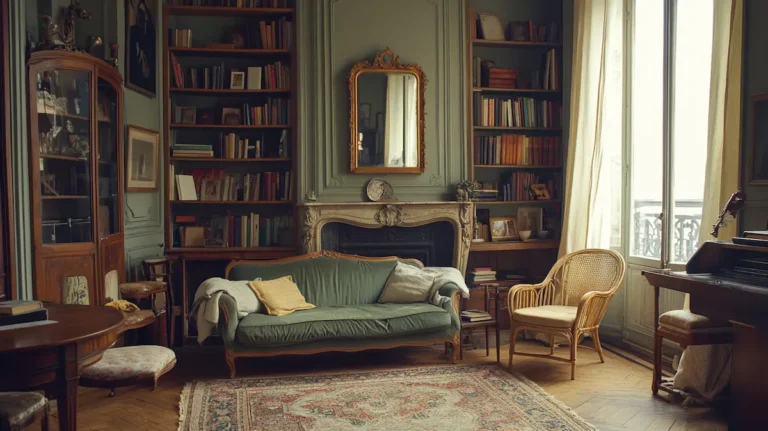
The large mirror above the mantelpiece is, in the Parisian interior, the foundational element of the entire room. It is present in the overwhelming majority of well-documented Parisian salons that have a fireplace, and its absence is conspicuous in a way that the absence of almost any other single element is not.
The visual logic is practical: the mirror above the fireplace borrows light from the window opposite, reflects the room back into itself (creating apparent depth), and provides the vertical anchor that prevents the mantelpiece arrangement from reading as a collection of objects on a shelf. With a large mirror above it, the mantelpiece becomes a composition. Without one, it is a surface with things on it.
Scale: the mirror should be significant
The most consistent error in mirror placement above a fireplace is choosing a mirror that is too small for the wall. A mirror that is narrower than the fireplace opening reads as a decorative object; a mirror that is wider than the opening and occupies a substantial portion of the wall above reads as architectural. For most standard fireplaces, this means a mirror of at least 70–80 cm wide. Larger is usually better, up to the point where the mirror is as wide as the mantelpiece shelf itself.
Frame: period quality over period accuracy
The frames that appear most consistently above Parisian mantelpieces are carved and gilded, in oval or rectangular forms with some decorative moulding. The gilding does not need to be pristine — in fact, a mirror with worn gilding, areas of red bole showing through, or minor repairs to the frame reads as more genuinely placed than a mirror in perfect condition. The aged frame is evidence of the object’s own history.
A frameless mirror, or a mirror in a very thin contemporary metal frame, does not play the same architectural role. It can work in a room where the overall aesthetic is more contemporary, but in a Parisian vintage context, the frame is as important as the glass.
The foxed glass: an effect that cannot be faked convincingly
The age-spotted, slightly uneven surface of genuinely foxed mirror glass diffuses reflections in a warm, soft way that modern mirror glass does not. When a foxed mirror above a mantelpiece reflects candlelight, the result is a warm, slightly impressionistic glow rather than a sharp reflection. This quality is observable and specific. New mirrors manufactured to simulate foxing exist, but the effect is visually different from the genuine article — typically too uniform and too deliberate in its distribution. A genuine antique mirror with even moderate foxing is preferable to a reproduction.
→ The complete guide to sourcing antique and vintage mirrors for French interiors — styles, periods, and where to find them: → Best Antique & Vintage Mirrors for French Interiors

| ➶ Antique Gilded Mantelpiece Mirrors — Etsy Specialist Sellers |
| A curated search for antique and vintage gilded overmantel mirrors on Etsy — the most accessible online channel for period mirrors in the scale and frame quality appropriate for above a Parisian fireplace. Filter by width (minimum 70 cm) and by frame description (gilt, carved, Louis Philippe, Napoleon III, Empire, Rococo) to find pieces in the correct register. Sellers based in France, Belgium, and the UK typically source directly from period apartments and estates; shipping to most of Europe and the US is usually available. Confirm the presence of foxed or aged glass in the seller description or by asking directly. €180 – €750 depending on size and period · Via Etsy Editorial note: Prioritise scale and glass quality over frame perfection. A large mirror with foxed glass and a frame in need of minor repair is more useful in a Parisian interior than a smaller mirror in perfect condition. The frame can be repaired; the scale of the glass and the quality of the foxing cannot be changed after purchase. |
Candlesticks: The Most Important Objects on the Shelf
Of all the objects that appear on a Parisian mantelpiece, candlesticks are the most consistently present and the most functionally important. They are not purely decorative: they are used. Candles are lit regularly in Parisian interiors as a genuine light source at evening, and the candlesticks on a mantelpiece are where that light originates.
This functional status is what distinguishes candlesticks from decorative objects in the mantelpiece arrangement. A candlestick with a half-used taper, or one that has been recently lit and carries the slight darkening of use at the top of the holder, reads as a living object. A matching pair of unused candlesticks in perfect condition reads as decoration.
Pairs, asymmetry, and height variation
Candlesticks on a Parisian mantelpiece are almost never a perfectly matched pair at the same height. The most consistent arrangement is two or three candlesticks of different heights — one taller, one or two shorter — in the same or related materials, positioned with asymmetry rather than symmetry. A pair of identical candlesticks placed at exactly equal distances from the centreline reads as formal; two candlesticks of different heights, one slightly closer to the mirror than the other, reads as placed.
Materials: brass, bronze, iron, painted enamel
The candlestick materials most consistent with the Parisian aesthetic are aged brass, darkened bronze, wrought iron, and painted enamel. These materials share a common quality: they all age in a way that improves their appearance. Brass that has not been polished regularly acquires the warm, slightly dark tone of used metal. Iron develops a fine patina. Painted enamel chips at the edges in a way that adds rather than subtracts from its character.
Avoid: chrome, highly polished silver plate, and contemporary matte black steel. These materials read as modern in a register inconsistent with the Parisian vintage aesthetic, and they do not age in the same enriching way.
Candle colour and scale
Taper candles on a Parisian mantelpiece are typically in ivory, cream, or uncoloured beeswax tones. Coloured candles — other than at the very palest, most muted register — read as decorative in a way that is inconsistent with the functional quality of Parisian candlesticks. The candle is a light source first and an object second. It should be proportionally scaled to the candlestick: a taper that is too short for the holder looks unused; one that is the correct length for the holder and has been burned halfway down reads as inhabited.

| ➶ Aged Brass Taper Candlesticks — Amazon |
| A set of brass taper candlestick holders in varied heights — typically sold in sets of two or three at 15 cm, 20 cm, and 28 cm — with a deliberately aged, unlacquered brass finish that develops a warm patina with handling rather than remaining uniformly bright. Standard taper candle diameter fitting (approximately 22 mm). Available in several aged finishes; unlacquered or antique-finish options are the most consistent with the Parisian aesthetic. Pair with ivory or natural beeswax taper candles. Approx. €18 – €45 for a set of two or three · Via Amazon Editorial note: Buy candlesticks at different heights rather than matching pairs. A set of two or three at varied heights can be arranged with the asymmetry that reads correctly on a Parisian mantelpiece. Unlacquered brass will age with handling; lacquered brass will remain uniformly bright. For the Parisian aesthetic, unlacquered is preferable. |
Ceramics and Found Objects: The Texture Layer
Beyond the mirror and the candlesticks, the Parisian mantelpiece is populated with a selection of small objects that provide texture, variety of material, and the specific quality of having been collected rather than purchased for the mantelpiece. These objects are typically modest in scale — they do not compete with the mirror or the candlesticks — and varied in material: ceramic beside bronze beside stone beside glass.
What kinds of objects belong
The objects that appear most consistently on Parisian mantelpieces share a quality of restraint: they are not primarily decorative in the conventional sense, but rather functional objects at rest, or found objects that earn their place through material quality alone.
- Small ceramics: a hand-thrown bowl in cream or grey, a small vase in earth-toned glaze, a ceramic pot that functions as a vessel for small objects. The irregularity of hand-thrown forms — the slight asymmetry of the rim, the uneven distribution of glaze — reads correctly beside aged brass and foxed glass.
- Bronze and iron objects: a small sculptural piece, a worn inkwell, a decorative paperweight, a fragment of architectural metalwork. Objects that were made for a purpose other than display carry the specific quality of having lived a life before arriving on the mantelpiece.
- Stones and natural objects: smooth river stones, a single interesting pebble, a fragment of white coral or a piece of limestone. Natural objects provide material contrast with the carved and cast pieces around them without requiring any frame or surface treatment.
- Books: a small stack of two or three books — older hardbacks in muted spines rather than bright paperbacks — can function as a small plinth to vary the height of an object placed on top, or simply as objects in their own right.
- A small framed piece: a small painting, a photograph, or a print in a simple frame, leaning against the mirror rather than hung, provides the paper layer of the arrangement and connects the mantelpiece to the wall treatment above it.
What does not belong
The following categories of object consistently disrupt a Parisian mantelpiece arrangement:
- Matching sets purchased together and clearly displaying their common origin — a ceramic trio from the same range, a set of three identically finished vases.
- Objects that are primarily decorative without any implied function or history — ornamental figurines, purely decorative glass pieces with no practical form.
- Too many objects of the same material weight — all ceramic, or all metal, without the contrast of a natural object or a piece of paper.
- Symmetrical arrangements where each side of the centreline mirrors the other exactly.
→ The complete guide to decorative objects for a Parisian mantelpiece — specific pieces, sourcing, and what to look for: → Best Decorative Objects for a Parisian Mantelpiece

| → Selency — Curated Vintage Objects for the Mantelpiece |
| Selency is a French online vintage marketplace used extensively by interior designers and private collectors for sourcing the specific category of small decorative object that belongs on a Parisian mantelpiece: bronze inkwells, ceramic vessels, small sculptural pieces, period clocks, and decorative metalwork. The curation is stronger than most general vintage platforms — sellers pass a quality review before listing — and the selection leans toward the 19th and early 20th century, which is precisely the period most consistent with the Parisian mantelpiece aesthetic. Ships across Europe. No affiliate relationship — included because no honest guide to sourcing Parisian mantelpiece objects can omit it. Variable by item · Via Selency Editorial note: Use the decorative objects and bronze categories as the primary sourcing channel for the non-ceramic elements of a mantelpiece arrangement. The inkwell, the small sculptural piece, the period clock — Selency consistently carries pieces in this category at fair prices, with better quality control than a general marketplace. |
Botanicals: Living and Dried
Plant material — whether living flowers, potted plants, or dried stems — is present on almost every Parisian mantelpiece that has been observed in situ. It provides the one quality that no object of stone, metal, or ceramic can provide: the texture and scale of something organic, something alive or recently alive, something that changes.
Fresh flowers: one stem, one vase
The Parisian approach to flowers on a mantelpiece is consistently minimal. Not an arrangement in the florist sense — not a designed composition of multiple stem types in a vase — but one or two stems of a single flower type in a simple vase, placed as an object rather than as a centrepiece. A single peony in a narrow ceramic vase. A stem of white ranunculus in an old glass bottle. A branch of cherry blossom in a tall earthenware vessel.
This restraint is both aesthetic and practical. A single stem changes the mantelpiece without dominating it. It adds colour at a specific point — the point where the organic contrasts most effectively with the ceramic, bronze, and stone around it — without pulling the eye away from the arrangement as a whole.
Dried botanicals: permanence and texture
Dried stems and botanicals appear on Parisian mantelpieces as a permanent layer rather than a seasonal one. Their texture — the papery quality of a dried hydrangea head, the sculptural form of a dried allium, the warm straw colour of a dried grass stem — contributes to the mantelpiece in the same way as a ceramic or a bronze: as a material presence that does not require regular replacement.
Dried botanicals are best placed in simple vessels — a narrow ceramic vase, an old glass bottle, a small earthenware pot — at a scale that reads correctly beside the candlesticks and ceramic objects. A large, overstuffed bundle of dried flowers reads as countryside rather than Parisian; a single dried stem or a small cluster of two or three in the correct vessel reads as placed.
→ The complete guide to styling flowers and botanicals in the Parisian manner — choices, vessels, and placement: → How to Style Flowers the Parisian Way at Home
| → Petersham Nurseries — Seasonal Cut Flowers and Dried Botanicals |
| Petersham Nurseries is a London-based nursery and lifestyle brand known for its carefully curated selection of seasonal cut flowers, potted plants, and dried botanical arrangements in the muted, natural palette consistent with a Parisian interior. The dried botanical range — including alliums, grasses, thistles, and seed heads in warm and neutral tones — is particularly relevant for mantelpiece styling. Available in-store (Richmond and Floral Street, London) and online for UK delivery. No affiliate relationship — included because the product selection and aesthetic philosophy are consistently aligned with the Parisian botanical approach described in this article. Variable by item · Via Petersham Nurseries Editorial note: Use the dried botanical range as the reference point for the specific scale and colour register of plant material appropriate for a Parisian mantelpiece. The alliums, thistles, and neutral-toned grasses in the Petersham range are the most directly applicable. For readers outside the UK, use as a visual reference and source equivalent dried stems from local florists or specialist dried flower suppliers. |

Art on and Around the Mantelpiece
The mantelpiece mirror is the primary artwork of the fireplace wall. But secondary art — a small painting leaning against the mirror, a print propped against the candlestick, a postcard or fragment of paper tucked into the mirror frame — extends the arrangement vertically and provides the paper layer that ceramics and metals alone cannot.
Leaning rather than hanging
The characteristic Parisian approach to art on the mantelpiece is to lean rather than hang. A small painting or framed print leaning against the mirror, or leaning against the wall between two candlesticks, reads as provisional and placed rather than installed. This quality of provisionality is important: it suggests that the piece arrived recently, or might move again, or is being considered. It is the opposite of the hung and centred picture.
This approach also allows art to be changed without leaving marks. A different print can be substituted for a seasonal or mood change. The ease of the change is part of the aesthetic logic.
What to lean
The most appropriate pieces for mantelpiece leaning: a small oil or watercolour painting in a dark or gilded frame (typically 20–40 cm in the longest dimension); a botanical print or old map in a simple frame; a framed photograph in a thin metal or wooden frame; a single postcard or photograph propped unframed against the candlestick or the mirror. The variety of framing materials — one gilded, one dark wood, one unframed — contributes to the accumulated quality of the arrangement.
→ The complete guide to Parisian vintage artwork and prints — what to look for and where to source it: → Best Parisian Vintage Artwork & Prints for Your Walls
| ➶ Vintage French Prints & Small Oil Paintings for Mantelpiece Leaning — Etsy |
| A curated search for small vintage and antique prints, botanical illustrations, and oil paintings on Etsy — the most accessible channel for the specific scale and character of piece that works leaned against a mantelpiece mirror. Filter by size (under 40 cm in the longest dimension) and by subject (botanical, landscape, portrait, French) for the most relevant results. Original antique prints from French publications — even modest engravings from damaged books — are preferable to reproductions for this specific application because their paper tone and print quality read correctly beside aged brass and old ceramic. €12 – €180 depending on medium and period · Via Etsy Editorial note: For mantelpiece leaning, scale and frame character matter more than subject. A small painting in a worn dark frame reads correctly in almost any arrangement; a large print in a modern frame does not. Prioritise pieces under 35 cm in the longest dimension with frames that have some age or character. |

The Mantelpiece Without a Fireplace
Not all rooms have a working fireplace, and not all rooms with a chimney breast have an original mantelpiece. The absence of a fireplace does not mean the absence of the visual anchor that a mantelpiece provides. Two approaches are worth considering.
A false mantelpiece surround
A standalone mantelpiece surround — without a functioning grate — can be placed against any wall to create the visual structure of a fireplace wall without the practical element. These are available from architectural salvage dealers and specialist retailers, typically in marble, painted wood, or stone. A surround placed against the wall with an empty grate opening (or a grate opening used to display candles or firewood) reads as a genuine architectural feature from any normal viewing distance.
The practical requirements: the surround should be fixed securely to the wall and, if the interior of the grate is exposed, should be styled consistently with the mantelpiece — a simple arrangement of large candles in the grate opening reads correctly and adds to the visual logic of the piece.
A console table as mantelpiece substitute
A console table — narrow, placed against a wall, ideally under a large mirror — performs many of the same visual functions as a mantelpiece: it creates a vertical axis on the wall, provides a surface for the objects that populate a Parisian interior, and anchors the room’s focal-point logic. The styling approach is identical to that described in this article. The console table is the urban apartment’s practical equivalent of the fireplace surround.
→ How the mantelpiece and console table fit into the broader Parisian wall treatment: → Wall Treatments That Define Parisian Vintage Style

The Edit: Removing Until the Surface Reads
The final and most important step in Parisian mantelpiece styling is always removal. The instinct when arranging any surface is to add — to fill the available space with objects that are each interesting or beautiful in isolation. The result of following this instinct is a surface that is crowded rather than composed, where no single object has room to read clearly.
The Parisian mantelpiece is characterised not by the quantity of objects it holds but by the quality of the space between them. Each object should have a visible relationship with its neighbours — a conversation of material, height, and scale — and sufficient space around it to be legible as itself. When the surface becomes crowded, the objects begin to cancel each other out rather than contributing to a whole.
The editing practice
After placing the objects, stand back to the doorway — the point from which the mantelpiece will most often be seen — and assess the arrangement. Ask: is there one object whose absence would improve rather than diminish the surface? Remove it. Assess again. Repeat until removing any further object would clearly diminish the whole. The correct number of objects for most mantelpieces is fewer than you would expect: typically five to eight pieces including the candlesticks, plus the leaning art and the botanical element.
The objects that are removed in this process are not wasted. They go into rotation elsewhere in the room, on a bookshelf, or into storage. A mantelpiece that changes — that gains and loses objects over time as they are moved, replaced, or supplemented by new finds — is a mantelpiece that is alive in the Parisian sense.
“The final step is always to remove one object more than you think you should. The surface will thank you.”
→ How the mantelpiece arrangement connects to the broader texture and layering approach of a Parisian interior: → The Art of Layering Textures in a Parisian Interior
→ The full aesthetic context for everything described in this article: → Parisian Vintage Chic Interior: The Complete Style Guide