
Parisian Apartment Layout Tips (Even in Small Spaces)
The Parisian apartment is not, by default, a large space. The city’s Haussmann buildings divide their floor plans into rooms of particular proportions — tall ceilings, long windows, relatively modest footprints — and the chambres de bonne in the upper floors are smaller still. The French have been living well in compact spaces for centuries. The result is a specific and transferable intelligence about how to arrange a room so that it feels complete, rather than merely full.
This article is about that intelligence. It covers the principles of spatial arrangement that produce the characteristic Parisian feeling of a room that breathes — not despite its limitations, but in honest conversation with them. The principles apply equally to a 25-square-metre studio and a 90-square-metre apartment. The scale changes; the logic does not.
For the broader context of the aesthetic these principles serve, the category pillar article covers the full Parisian Vintage Chic Interior approach. What follows assumes you are ready to work with what you have.
Disclaimer: This post may contain affiliate links. This means that if you click on one of these links and make a purchase, we may earn a small commission—at no extra cost to you.
All images featured in this article are AI-generated to illustrate the aesthetic and mood of the interior style. The products linked are carefully selected items that, in our view, most closely match the look and feel of these designs.
As an Etsy affiliate and Amazon Associate, we earn from qualifying purchases. We only recommend products we genuinely believe align with the style and atmosphere presented in our AI-created interiors.
The Parisian Relationship with Space: What Is Actually Different
The French do not treat small apartments as a problem to be solved. They treat them as a condition to be inhabited well. This orientation produces different decisions at every stage of furnishing and arrangement, and the difference is visible in the result.
The Anglo-American approach to a small space tends toward maximisation: more storage, more furniture, more built-in solutions, more mirrors-to-create-the-illusion-of-space. The Parisian approach tends toward selection: fewer objects, each chosen more carefully, with space between them treated as a positive quality rather than a void to be filled.
The practical consequence is that the Parisian small apartment typically contains fewer pieces of furniture than its equivalent in other design traditions — but each piece is better, more proportionally correct, and more deliberately placed. The room does not feel sparse; it feels considered. The distinction matters because it defines the method: the work is not in adding, it is in selecting and editing.
“The Parisian approach to a small space is not to make it feel larger. It is to make it feel completely inhabited by exactly what belongs there.”
→ The psychological logic behind why less genuinely feels more in a French interior: → The Psychology of French Chic: Why Less Feels More
The Founding Principle: Proportion Before Decoration
Before any object enters a room, the Parisian approach requires an honest assessment of the room’s proportions. Ceiling height, window size and placement, floor area, and the fixed architectural elements — doors, radiators, alcoves, fireplaces — together determine what the room can hold and how it should be arranged.
The most consistent error in small-space decoration is choosing furniture at the wrong scale. A sofa that is 10 centimetres too long for a room does not simply take up 10 centimetres of space; it changes the proportion of everything around it. The room reads as overcrowded not because it contains too many objects but because the primary piece is slightly too large for the wall against which it sits.
How to read your room’s proportions
Before buying or arranging anything, take the following measurements and write them down:
- Total floor area and the usable floor area (excluding fixed obstructions)
- Ceiling height — this determines the maximum height of standing furniture and the scale of any overhead light fitting
- Window dimensions and sill height — which walls receive natural light, and at what angle through the day
- The width and height of each doorway — this is the physical constraint on what furniture can enter the room at all
- The exact dimensions of each wall, including any protrusions, alcoves, or built-in elements
With these measurements known, draw a simple floor plan to scale — even a rough sketch on squared paper is sufficient. Place furniture at scale on the plan before moving anything physically. The most important furniture placement decisions are made on paper, not in the room.

The Anchor Piece: Starting from the Right Point
Every Parisian room is arranged around a single anchor piece — typically the largest or most significant item of furniture in the space. In a living room, this is the sofa or settee. In a bedroom, the bed. In a dining area, the table. The anchor piece determines the arrangement of everything else, and the first decision in any layout is its placement.
The anchor piece rules
The anchor piece should face the room’s primary focal point: a fireplace, a large window, or — in its absence — the longest uninterrupted wall. It should sit at a distance from the wall that allows air to circulate behind it (in a small space, even 5–10 centimetres is sufficient) and that creates a clear route through the room.
In a Parisian interior, the anchor piece is almost always placed on the floor rather than against the wall. Furniture pushed hard against walls — the instinct in small spaces — actually makes a room feel smaller, because it defines the perimeter and leaves the centre empty. A sofa placed 15 centimetres from the wall, with a low table in front of it, creates a conversation zone that makes the room feel complete rather than provisional.
Scale: the most important single decision
The anchor piece must be proportionally correct for the room. In practical terms: in a room under 20 square metres, a sofa longer than 180 centimetres will dominate the space. In a room of 25–35 square metres, a two-seater of 160–200 centimetres is typically correct. Above 35 square metres, a three-seater or a chaise configuration becomes proportionally available.
The height of the anchor piece matters as much as its length. In a room with a ceiling under 250 centimetres, a high-backed sofa reads as heavy and enclosing. A low-profile settee — back height of 70–75 centimetres from the floor — allows the eye to travel over it and makes the room feel taller.

| ➶ Vintage Low-Profile French Settee — Etsy Specialist Sellers |
| A curated search for vintage and antique French settees and small sofas on Etsy — the category that most reliably produces the low-profile, correctly-scaled anchor piece for a small Parisian interior. Filter by ‘French’, ‘Louis Philippe’, ‘Empire’, or ‘Directoire’ style for the most period-accurate results. Prioritise pieces with original or early upholstery frames; re-upholstery cost should be factored into the purchase price. €180 – €850 depending on period and condition · Via Etsy Editorial note: The settee — rather than a full three-seater sofa — is the proportionally correct anchor piece for most rooms under 35 square metres. Its scale allows the room to breathe. Look for pieces with legs (not a platform base) which lift the visual weight of the piece from the floor. |
The Circulation Route: Space as Architecture
In any well-arranged room, the path through the space is as important as the objects within it. The Parisian interior treats the circulation route — the natural path the eye and body take from entrance to window, from sofa to bookshelf, from one zone to another — as a structural element of the design.
The practical requirement is simple: in any room, there should be a clear, unobstructed path of at least 75 centimetres width between any two points that are regularly used. In a small space, this often means accepting that certain furniture arrangements are not available, regardless of how they would look in isolation.
The two-zone principle for small living spaces
A Parisian living room, however small, typically contains two distinct zones: a seating zone (organised around the anchor piece) and a secondary zone (a reading chair, a writing surface, a dining area in a studio). The two zones should be distinguishable through furniture arrangement alone, without any physical division of the space.
In practice, this means the seating zone furniture faces inward toward its own centre (sofa and chairs angled toward a table or fireplace) and the secondary zone furniture faces a different direction or orientation. The eye reads this differentiation as two rooms rather than one, even when the total floor area is 30 square metres.
“A room with two distinct zones, each clearly defined, feels twice the size of the same room with the furniture pushed to the walls and the centre empty.”
The entry point: the first impression
In a small Parisian apartment, the entrance to the main room is often the most important square metre of the entire floor plan. What is visible from the door determines the first impression of the space — and the first impression is almost always the one that persists.
The classic Parisian solution: place the room’s most beautiful single object directly in the sightline from the entrance. A large mirror on the far wall. A significant painting. A distinctive lamp. The eye is drawn across the room before the mind has registered its size. The room reads as having depth before it reads as having limitations.
→ The specific approach to arranging the entrance and entryway in a Parisian interior: → The Perfect Parisian Vintage Entryway

Light: The Element That Changes Everything
In any small apartment, light is the most powerful spatial element available. The French relationship with natural light is specific: it is not maximised and celebrated in the Californian manner, but managed and shaped. Curtains, shutters, the placement of mirrors, and the choice of artificial light sources together determine whether a room feels enclosed or open, warm or clinical, inhabited or transient.
Natural light: work with what the room has
Begin by mapping how the light moves through the room across the day. A north-facing room receives cool, indirect light at all times — which is actually the condition preferred by many Parisian interiors, because it is even, gentle, and flattering to warm materials. A south or west-facing room receives strong direct light in the afternoon which can bleach surfaces and create harsh contrasts.
The furniture arrangement should respond to this. Place reading chairs near windows, but not directly in the path of strong direct afternoon sun. Place the anchor piece perpendicular to windows rather than directly facing them, to avoid the silhouetting effect that makes sitters appear as outlines rather than people.
Mirrors: depth and borrowed light
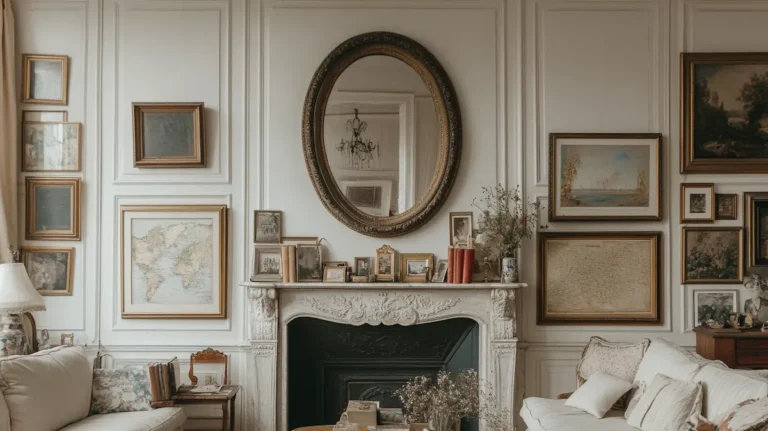
The large antique mirror is the single most spatially effective object in the Parisian interior’s toolkit. Placed on the wall opposite a window, it doubles the apparent depth of the room and reflects natural light back into areas that would otherwise be dim. The foxed glass of a genuinely old mirror diffuses this reflection rather than intensifying it, producing the warm, ambient quality that new mirrors do not replicate.
In a small room, one large mirror is more effective than multiple small ones. Position it so that it reflects the room’s best feature — typically the window, the garden or courtyard, or the most carefully arranged corner of the space.
| ➶ Antique-Style Large Wall Mirror with Gold Resin Frame — Amazon |
| A large rectangular wall mirror in an ornate resin frame with aged gold finish, designed to replicate the scale and presence of a period Parisian mirror. The frame has deliberate distressing on the outer edges. Not a genuine antique, but proportionally and visually correct for a Parisian interior wall that has not yet found its period piece. Wipe-clean glass; Via Amazon Editorial note: Use this as a bridge piece while searching for a genuinely foxed antique mirror through brocante channels. Its scale and frame profile are correct; the glass will not have the warmth of an old mirror, but the spatial effect of depth and borrowed light is available at a fraction of the brocante price. |
Artificial light: layers, not overhead
The most consistent error in small-space lighting is relying on a single central overhead light source. Overhead light — especially from a ceiling-mounted fitting in the centre of the room — flattens surfaces, creates harsh shadows, and makes a room feel institutional rather than inhabited.
The Parisian approach uses three or more light sources at different heights: a floor lamp in a corner, a table lamp on a surface, a small reading lamp beside a chair. None of these is on the ceiling. The result is a room that reads as warm and inhabited in the evening, where each zone has its own light level and each object casts its own shadow.
| ➶ Vintage French Table Lamp — Etsy Specialist Sellers |
| A curated search for vintage French table lamps and bases on Etsy — the category that produces the most characteristically Parisian artificial light source. Look for pieces with ceramic or brass bases, original or period-appropriate shades in linen or silk, and a scale that relates correctly to the surface on which the lamp will sit. A lamp base of 25–40 cm height with a shade of 30–40 cm diameter is correct for most occasional table surfaces. €45 – €220 depending on period and base material · Via Etsy Editorial note: The table lamp is the most consistently present light source in a Parisian interior. Its warm, directed light defines the zone around it as inhabited. A vintage base with a new linen shade is an entirely legitimate combination and often more proportionally correct than a fully period piece. |
→ How to layer textures and materials to reinforce the spatial zones created by lighting: → The Art of Layering Textures in a Parisian Interior
Storage: The Parisian Approach to What Is Not Visible
The Parisian interior does not rely on built-in storage to maintain its visual composure. The French live in apartments where the walls are not their own to modify, where built-ins are rarely architecturally available, and where the beauty of the room is not contingent on having resolved every practical problem. The result is a different relationship with visible storage — and a different definition of what needs to be stored at all.
Edit before you store
The first principle of Parisian storage is not about furniture or organisation systems. It is about volume. Before addressing how to store things, address how many things need to be stored. The Parisian apartment does not accommodate a surplus of objects. Objects that are not regularly used and not beautiful enough to be displayed have no natural place in the interior. They are given away, or kept elsewhere.
This editing practice is not asceticism — Parisian interiors are famously layered and object-rich. The objects present are numerous; what is absent is surplus. The distinction is between things that have been chosen and things that have simply accumulated without decision.
The bookshelf as primary storage and display
The open bookshelf is the most characteristically Parisian storage solution. It serves simultaneously as a library, a display surface, and a room divider when placed perpendicular to a wall. In a small space, a single deep bookshelf along one wall provides significant storage without the visual weight of a closed cabinet.
The arrangement of objects on a Parisian bookshelf follows a consistent logic: books fill two-thirds to three-quarters of the shelf space, with the remaining space used for objects of varying height — a small ceramic, a framed photograph leaning against the books, a bronze candlestick. The books are not organised by colour (a trend that produces a beautiful shelf and an unusable library); they are organised by subject or size, with spines outward.
Trunks, ottomans, and dual-purpose furniture
In a small space, every piece of furniture that provides storage without reading as storage furniture earns its place doubly. A vintage trunk at the foot of the bed stores linens and seasonal clothing while serving as a bench surface. An ottoman with a lift-off top provides seating, surface space, and interior storage. A console table with a lower shelf holds books and objects while defining the entry zone.

| ➶ Vintage-Style Wooden Storage Trunk / Blanket Box — Amazon |
| A solid wood storage trunk with metal corner reinforcements and a flat lid, suitable for use as both a storage piece and a seat or surface. Via Amazon Editorial note: The vintage trunk is one of the most consistently useful dual-purpose pieces in a small Parisian interior: it stores a full season’s worth of clothing or linens, provides a generous surface, and reads as a character piece rather than a storage unit. Choose a natural or dark wood finish that relates to the floor tone. |
The Studio Apartment: A Room That Does Everything
The studio apartment — a single room that serves as bedroom, living room, and often dining room — is the most demanding layout challenge the Parisian approach addresses, and the one it handles best. The French have been living in chambres de bonne of 15–25 square metres for generations. The solutions that have emerged from this necessity are specific, practical, and directly transferable.
Zone definition without walls
In a studio, the challenge is not to divide the space physically — which in a small room produces a corridor rather than two rooms — but to define zones through furniture arrangement, rug placement, and light. Three zones are typically needed: sleeping, sitting, and a surface for work or eating.
The sleeping zone should be the furthest from the entrance, with the bed placed along the wall that receives the most indirect light (typically the wall perpendicular to the main window). A low screen or a high bookshelf placed perpendicular to the room can provide a degree of visual separation without closing off the space.
The sitting zone is defined by the anchor piece (a small settee or a pair of chairs) and a rug. The rug is the single most important zone-defining element in a studio: it anchors the furniture arrangement and makes the seating area read as a separate room within the room, even when it is separated from the sleeping area by only 2 metres.
The bed as design object
In a studio apartment, the bed is visible for most of the waking hours spent in the space. It must, therefore, read as a design object rather than a utilitarian piece. The Parisian solution is a bed that is made every morning, covered with a single high-quality throw or bedspread, and arranged with two or three cushions. Not a hotel arrangement — more considered than that — but a bed that reads as intentional when viewed from the sitting zone.
A bed frame with a strong graphic silhouette — a simple iron frame, a low wooden platform, an upholstered headboard in a single muted tone — reads better in a studio than an elaborate or highly decorative piece. The simpler the frame, the more the bedspread and cushions can carry the textile interest.
→ The complete approach to the Parisian bedroom — layout, textiles, and atmosphere: → Complete Parisian Vintage Bedroom Makeover Guide

→ How the same Parisian principles work for renters who cannot make permanent changes: → Parisian Vintage Interior for Renters (No Permanent Changes)
The Living Room: Specific Arrangements That Work
The Parisian salon, however modest in scale, is the room that receives the most deliberate arrangement. It is the room that is presented to the world, that reflects the owner’s eye and taste, and that bears the greatest visual weight of the interior as a whole. The following arrangements are the ones that appear most consistently in genuinely Parisian interiors of all sizes.
The conversation arrangement
The most classic Parisian salon layout: the anchor piece (settee or sofa) faces the fireplace or primary wall, with one or two chairs placed at an angle on either side, creating a roughly U-shaped conversation zone. A low table of 40–45 cm height occupies the centre. The rug defines the zone perimeter — it should extend at least 60 cm beyond the front legs of the sofa and ideally under the front legs of all pieces in the arrangement.
The reading corner
The Parisian reading corner is almost always in a corner: a single armchair or rattan chair, a floor lamp placed to its rear, a small side table for a cup or a book, and a footstool or low ottoman. It does not require much space — a 120 × 120 cm corner is sufficient — but it must be complete. A reading corner without a lamp is not a reading corner; it is a chair in a corner.
The dining-in-the-salon arrangement
In apartments where the kitchen is separate and small, the dining table often lives in the salon. The Parisian solution is a table that serves double duty: large enough for four at meals, small enough to feel like a working surface or display at other times. A round table of 90–100 cm diameter is ideal for this purpose in a room of 20–35 square metres — it seats four at meals and reads as a feature piece at other times.
→ The complete room-by-room approach to a Parisian vintage living room: → Complete Parisian Vintage Living Room Makeover Guide

| ➶ Vintage Kilim Rug — Etsy Specialist Sellers |
| A curated search for vintage and antique kilim rugs on Etsy — the most consistently present zone-defining floor element in a Parisian interior. A kilim of 150 × 200 cm or 160 × 230 cm is the correct scale for defining a seating zone in a room of 20–35 square metres. The worn, faded quality of a genuinely old kilim contributes the same patina logic as aged furniture: use is evidence of authenticity, not a defect. €95 – €380 depending on age and condition · Via Etsy · Editorial note: The kilim is the Parisian interior’s primary zone-definition tool. Its pattern, however complex, grounds the furniture above it and defines the seating arrangement as a complete zone. A new plain-weave rug performs the same spatial function but lacks the material warmth and accumulated quality of a genuine vintage piece. |
The Ongoing Work: A Room Is Never Finished
The well-arranged Parisian apartment is not a project completed on a single day of rearrangement. It is the result of continuous attention: the willingness to move a piece that is almost right to see if it is better somewhere else, to remove an object that is competing with its neighbours, to let a surface remain empty for a season while waiting for the correct piece to arrive.
The spatial principles in this article are stable; their application is always provisional. The room changes with the light, with new finds, with the accumulated evidence of how the space is actually used rather than how it was imagined. The best Parisian interiors always show evidence of this ongoing conversation between intention and reality.
The full context for the aesthetic that these spatial principles serve is in the category pillar. The specific room-by-room applications are in the companion articles. The work itself belongs, as always, to the room and the person who inhabits it.
“The room is never finished. It is always, in the best sense, in the process of becoming more itself.”
→ The complete Parisian Vintage Chic Interior guide — the aesthetic context for everything in this article: → Parisian Vintage Chic Interior: The Complete Style Guide