
Parisian Vintage Chic Interior: The Complete Style Guide
There is a type of interior you never forget. You step inside and it smells of beeswax, old paper, and something vaguely floral. The light falls differently than anywhere else — low and golden, filtered through tall windows and sheer linen. Furniture from three different centuries coexists without argument. A gilded mirror is chipped in two corners and that is precisely what makes it irreplaceable. This is Parisian Vintage Chic. Not a style you purchase. A style you build — sometimes over decades.
This guide is the foundation of everything you want to know about Parisian Vintage Chic Interior design. What it truly is. Where it comes from. Which elements define it, which philosophy underpins it, and how to apply it — whether you live in a Haussmann apartment in Paris or a modern flat in any city in the world. Every section goes deep, and wherever a topic deserves its own dedicated article, you will find a direct link to that deeper exploration.
What Is Parisian Vintage Chic? Definition and Character
Ask ten people what Parisian Vintage Chic means and you will get ten different answers. That is itself revealing: the style is easier to feel than to define. And yet there are consistent qualities that appear across every authentic Parisian interior — qualities that together form a coherent and replicable aesthetic.
Parisian Vintage Chic is an interior design style rooted in the classical Parisian bourgeois aesthetic, enriched with the timeless quality of vintage furniture, objects with history, and an unapologetically personal taste. It is the visual expression of a specific outlook on life: that beauty lives in the everyday, that quality always outranks quantity, and that a home should tell stories — not just look good in photographs.
What it is
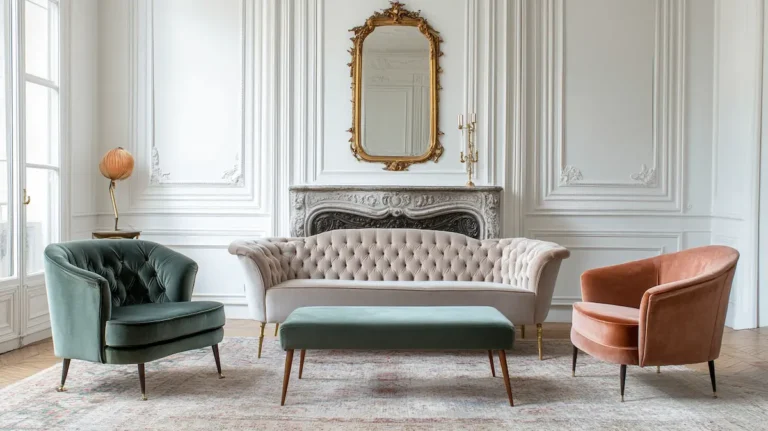
Parisian Vintage Chic is layered. A living room in this style might contain an Aubusson rug from the 1950s, a sofa with wooden legs and linen upholstery, velvet cushions, a marble fireplace mantel with an asymmetric arrangement of objects, a chandelier that casts light that is never harsh, and on the walls a mix of framed botanical prints, an oil painting, and perhaps one contemporary work. That sounds busy. But when done well it feels like calm. Like character. Like home.
It is also a style of the imperfect. A cracked plaster cornice that has never been repaired because it has become beautiful in its own right. A walnut chest of drawers with a scratch that is fifty years old. A Persian rug whose border shows the light wear of a life well lived. Those are not flaws — they are the marks of time, and they give the interior its authenticity.
What it is not
Parisian Vintage Chic is not chaos. It is not a ‘keep everything’ aesthetic disguised as vintage appreciation. Every object in a well-executed Parisian interior is intentional. There is always a reason something is where it is — even if that reason does not seem systematic at first glance.
It is not nostalgia decor. The difference between a Parisian interior and a grandmother’s living room is subtle but critical: the Parisian room has a point of view. Someone is making choices, creating tension, combining old with new deliberately. The nostalgic room simply is — without an editorial spine.
And it is certainly not a catalog style. You cannot assemble Parisian Vintage Chic from a single store or a single collection. The style demands time, selectivity, and a trained eye.
→ Want the full definition with every style element unpacked? → What Is Parisian Vintage Chic? (Style Guide for Beginners) goes deep on every aspect of the style, including the most common misconceptions.

The Historical Roots: From Haussmann to Today
You cannot truly understand Parisian Vintage Chic without its historical context. This is not a style that was invented — it is a style that accumulated, layered over a century and a half of architecture, politics, art, and bourgeois life in Paris.
The Haussmann transformation (1853–1870)
Everything begins with Baron Georges-Eugène Haussmann. Commissioned by Napoleon III, he transformed Paris from a medieval labyrinth into the broad, luminous, coherent city we know today. His boulevards, his uniform limestone façades, his standardized building heights — all of these created a physical container that defines Parisian aesthetics to this day.
The Haussmann apartments he introduced had a specific character: high ceilings (typically 3.2 meters or more), oak herringbone parquet, plaster crown moldings, tall windows with wrought-iron balcony railings, and a systematic room sequence — representative rooms facing the boulevard, private rooms facing the courtyard. That architecture demands a particular kind of interior. It thrives on tall furniture, art hung high, curtains that fall from ceiling to floor.
It is not a coincidence that so many Parisian Vintage Chic interiors look so unmistakably Parisian: the architecture itself is directing the style.
Belle Époque and Art Déco: the golden decades (1870–1940)
The seventy years between the Paris Commune (1871) and the Second World War represent the goldmine of Parisian Vintage Chic. In this period, Paris produced furniture, objects, textiles, and artworks of a quality that has not been matched since.
The Belle Époque (roughly 1871–1914) brought the rich bourgeois aesthetic: sumptuous fabrics, gilded accents, the first Art Nouveau furniture with its organic lines, and the conviction that the home was an expression of its owner’s civilization and taste. This is where the Parisian belief originates that an interior should mean something.
The Art Déco period (1920–1940) added an entirely different layer: geometry, lacquer, exotic woods, and a modernist gaze that collided — and sat together in productive tension — with the richer Belle Époque heritage. Many of the vintage anchor pieces that appear in Parisian interiors today are Art Déco: heavy leather club chairs, lacquered secretaires, geometric side tables.
Post-war refinement (1945–present)
After the liberation of Paris in 1944, a period of rebuilding and refinement began. Prosperity returned, but the aesthetic had shifted. Less ornament, more quality in the essential. The Parisian intellectual and artist — the true carriers of the style — lived in apartments where one good painting was worth more than ten decorative objects.
In the decades that followed — the sixties, seventies, eighties — the idea of deliberate mixing really took root. Vintage pieces combined with modern design, mid-century icons alongside antiques, found objects beside artworks. This is the Parisian Vintage Chic we recognize today: not one era, but all eras simultaneously, held together by a strong curatorial instinct.
→ The full historical exploration, from Haussmann to the contemporary Parisian stylist: → The History of Parisian Interior Style (From Haussmann to Now)

The Five Pillars of Parisian Vintage Chic
Beyond history and philosophy, five concrete pillars define what Parisian Vintage Chic actually looks and feels like. Understand and apply these, and you have the foundation.
Pillar 1: Layering
A Parisian room has depth. Not physical depth, but visual depth — there is always more to discover than the first glance reveals. A shelf does not hold one object but a composition. A wall does not carry one painting but an arrangement that has grown over years. A coffee table holds not just a vase but also a stack of books, a small sculptural object, a candle.
This layering is not accumulation — it is composition. Every element in a layer relates to the others. The color of a cushion echoes the tone of the rug. The scale of a painting corresponds to the height of the sofa below it. The layering is deliberate, even if it looks effortless.
Pillar 2: Imperfection as quality
This may be the hardest principle to accept for those trained on the flawless aesthetics of contemporary interior magazines: in a Parisian room, flaws are part of the beauty. The marble mantelpiece has a hairline crack that has been there for thirty years. The back of the armchair is slightly faded from decades of use. The border of the Persian rug shows the gentle wear of a life well lived.
The distinction is important: imperfection as quality applies to patina on good pieces. A cheap piece of furniture that is damaged is simply damaged. A quality piece that has survived time has character. One is a problem. The other is a story.
Pillar 3: Curatorial thinking
Every Parisian Vintage Chic interior has a curator. That is the person living in it. They decide what comes in, what stays, and what must go. This curatorial selectivity is precisely what gives the style its clarity amid all its layers.
In practice, curatorial thinking means not buying everything you find beautiful — only what truly belongs. It means having the courage to let something go even when it was expensive or emotionally loaded. And it means the patience to wait for the right piece rather than filling a gap with something mediocre.
Pillar 4: Timelessness over trend
Parisian Vintage Chic does not follow trends. It is — in the best sense — immune to the noise of the moment. While the rest of the world shifted from Japandi to maximalism to quiet luxury and back again, the Parisian aesthetic remained itself. That is not stubbornness. That is confidence.
The pieces that define a Parisian interior are ones you will still love in ten years. The color palettes are timeless. The principles of composition and layering always apply. This also makes Parisian Vintage Chic economically wise: you invest in things you will not want to replace in five years.
Pillar 5: Personality as a design element
This is the most distinctive pillar, and the hardest to copy: an authentic Parisian Vintage Chic interior is personal. Not personal as in filled with family photographs, but personal as in: you immediately see who lives here.
The books on the shelf are books someone actually reads. The paintings on the wall were bought because they moved someone, not because they match the sofa. The objects on the mantelpiece have a story — a journey, a discovery, an heirloom. Without this personality, a Parisian Vintage Chic interior is a stage set, not a home.
→ The five pillars explored through specific style elements and practical applications: → What Is Parisian Vintage Chic? (Style Guide for Beginners)
The Color Palette: Warm, Restrained, Never Boring
The Parisian color palette is one of the most misunderstood aspects of the style. It is frequently described as ‘neutral’ or even ‘boring’ — and that is a fundamental misreading. The Parisian palette is not neutral. It is restrained. There is a significant difference.
The base layer: warm whites and their relatives
The foundation of almost every Parisian interior is a warm, off-white tone. Not the sharp, blue-tinged white of contemporary architecture, but a cream, an ivory, a blanc cassé, or the iconic ‘couleur de Paris’ — a shade that radiates warmth and flatters daylight. On a Parisian morning, when the light enters low and silken through tall windows, a wall in this tone becomes alive in a way that pure white never can.
Good reference points: Farrow & Ball All White (warmer than the name suggests), String, Elephant’s Breath, or Cornforth White. The key is warmth. If in doubt, add warmth.
The middle layer: warm greys and taupes
Above the off-white base come the warm greys and taupes so characteristic of the Parisian palette. Gris de lin, warm greige, deep taupe — these are the tones of Parisian rooms that you glimpse through lit windows on a November evening and think: how is it that this looks so right?
These colors do not impose themselves. They recede and make everything placed against them more beautiful. They act as a neutral field that gives vintage furniture, art, and objects the space to speak without competing with the wall.
The accents: deep and full
And then there are the accents. Because a Parisian room always has accents — without them it would simply be beige. Those accents are never pastel, never ‘colorful’ in a cheerful sense. They are deep. Full. Adult.
Vert anglais — a dark English green with a grey undertone. Bordeaux that resembles a good glass of wine. Deep navy. Aubergine. Warm ochre as a note in a cushion or a vase. And everywhere, at every accent level: gold. Not the glittering gold of cheap accessories, but the matte, oxidized gold of gilded mirrors, brass light fixtures, and bronze figurines.
“Color in a Parisian Vintage Chic interior is like harmony in a well-composed perfume: you only notice it when it is absent.”
What to absolutely avoid
- Cold white. A sharp, blue-tinged white turns any interior into a waiting room. When in doubt: warm it up.
- Warmth-free beige. There is a subtle but fatal difference between warm beige and cold beige. The first is Parisian. The second is a mistake.
- Too many colors at once. The palette works because it is coherent. Two or three colors in different intensities, supported by neutral tones — that is all you need.
- Trend colors. Millennial pink, sage green as a trend, terracotta as a hype — as soon as a color becomes ‘trending,’ it stops being Parisian.

The Philosophy of Restraint: Why Less Feels Like More
There is a paradox at the heart of Parisian Vintage Chic. The style is layered, rich, full of objects and furniture and art — and yet it feels calm. Restful. Clear. How can that be?
The answer lies in a philosophical principle the French call restraint — a quality of deliberate holding back. Not the removal of everything, as in minimalism, but the refusal to include what does not belong. The discipline to stop before you have gone too far. The wisdom to recognize when a room is complete.
Restraint versus minimalism
Minimalism says: remove until nothing more can be taken away. Restraint says: only add what truly belongs here. That is a profound difference. A minimalist room has five objects and feels empty. A room with restraint has twenty objects and feels exactly right — because every one of those twenty has earned its place.
In practice, restraint is an active principle, not a passive one. It requires constant assessment, selection, and release. It means the discipline not to buy a wonderful vintage piece because there is already a wonderful piece in that spot and room for only one. It means the courage to let go of something you have carried with you for years.
The psychology of the Parisian room
Neuroscientists have confirmed what Parisian interior designers have known for two centuries: that visual coherence has a calming effect on the brain. A room with many objects that all share relationships — in color, material, scale, or period — is processed differently by the brain than a room with many unrelated objects.
This is why a well-composed Parisian Vintage Chic interior feels restful despite its richness. The eye finds connections, transitions, echoes everywhere it travels. The brain does not have to work to understand the room — it can simply be in it.
Buy less, choose better
Restraint also has a practical dimension that directly affects how you shop and how you build a room. In a world of fast furniture and seasonal home collections, the most radical thing you can do is this: buy less, but choose better.
That one piece you saw at a brocante that is absolutely right — and that costs perhaps three hundred euros — is always a better investment than three eighty-euro pieces that are ‘fine.’ The Parisian woman who furnishes her apartment buys one thing per season and thinks about it for a long time. The result is a room that is better in ten years than it is today.
“The best is the enemy of the good. But in the Parisian interior, the reverse holds: the good is the enemy of the best. Wait for the best.”
→ The full psychological and philosophical underpinning of French Chic aesthetics: → The Psychology of French Chic: Why Less Feels More
Parisian Vintage Chic vs. French Country: What Is the Difference?
This is the most frequently made mistake: confusing Parisian Vintage Chic with French Country, also known as Provence style or French farmhouse. They share a French DNA and a love of vintage furniture, but in character, color, atmosphere, and application they are fundamentally different.
The essence of the difference
Parisian Vintage Chic is urban and refined. It is the style of people who live in apartments, who know art, who have opinions about color and composition. French Country is rural and organic. It is the style of plastered walls, ceramic floor tiles, lavender fields, and large oak tables at which an entire village can sit.
Parisian Vintage Chic has tension — between old and new, between rough and refined, between the intellectual and the sensual. French Country has warmth — between the land and the people who live on it, between seasons and materials that come from the earth.
| Element | Parisian Vintage Chic | French Country / Provence |
|---|---|---|
| Atmosphere | Urban, intellectual, refined | Rural, warm, organic |
| Colors | Cream, warm grey, deep accents (vert anglais, bordeaux, navy) | Lavender, ochre yellow, terracotta, soft blue |
| Walls | Plastered white/cream, boiserie paneling, high ceilings | Rough plaster, sometimes Provençal painted tones |
| Furniture | Louis XV/XVI, Art Déco, multi-period mix | Robust Provençal, oak, handcrafted |
| Fabrics | Velvet, silk, linen, Morocco leather | Linen, cotton, jute, gingham, ticking stripe |
| Flooring | Oak herringbone parquet, Persian rugs | Terracotta tiles, stone floors, wide-plank wood |
| Lighting | Chandeliers, table lamps, wall sconces | Candles, wrought-iron pendants, rustic lanterns |
| Objects | Gilded mirrors, bronze sculptures, leather-bound books | Pottery, ceramics, flower pots, wicker baskets |
| Overall feeling | Curated, elegant, intellectual | Cozy, seasonal, grounded |
Neither style is superior — they are simply different. And they are not entirely incompatible: in the Provence itself you often see a hybrid, where a Parisian owner furnishes a holiday home with a blend of Parisian refinement and Provençal warmth. But as foundations they are two separate universes.
The reason this distinction matters: if you want to create Parisian Vintage Chic but unconsciously import elements of French Country — the wrong tones, the too-rustic furniture, the lavender accents — you lose the specific tension and refinement that makes the style so recognizable.
→ A detailed comparison with practical do’s, don’ts, and visual examples: → Parisian Vintage vs French Country: What’s the Difference?
Furniture, Textures and Objects: How to Choose Well
The most frequent question about Parisian Vintage Chic is: which furniture do I need? The answer is not as simple as a list, because it is not about a specific period or style — it is about quality, proportion, and the capacity of a piece to coexist with other pieces.
The anchor pieces
Every Parisian Vintage Chic interior has anchor pieces — furniture or objects that define the room and around which everything else is organized. These are typically:
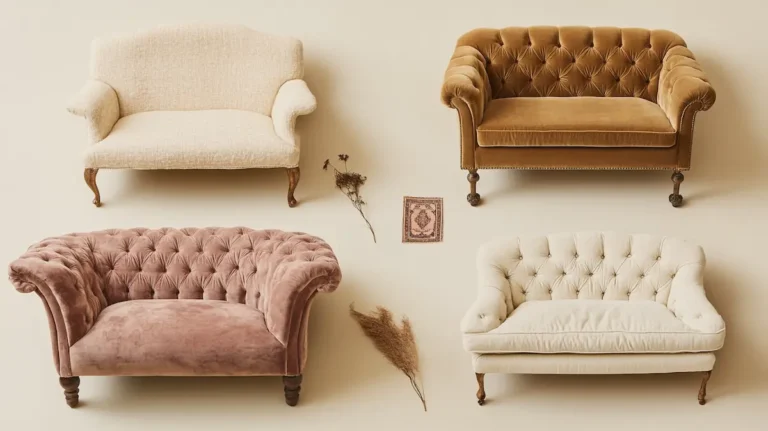
- A sofa with character: not the standard flat-pack sofa but a piece with visible wooden legs, good proportions, and a fabric that will age beautifully. Linen, velvet, or a tightly woven cotton in a neutral tone.
- A vintage armchair: ideally in the Louis XV style (curved legs, organic form) or Louis XVI (straighter legs, more geometric). Re-upholstered in linen, velvet, or a subtle pattern.
- A marble fireplace mantel: when the architecture provides one, this is the absolute anchor of the room. Everything in the living room organizes itself around the fireplace.
- A large mirror: preferably with a gilded frame, imposing in scale. Not as decoration, but as an architectural element that creates space and returns light.
- A chest of drawers or secretary: in walnut, cherrywood, or a lacquered Art Déco model. Functional and aesthetically essential in equal measure.
Textures: layered but coherent
Texture in a Parisian Vintage Chic interior is at least as important as color. The eye travels through a room via texture: from the smooth sheen of a velvet cushion to the rough warmth of a linen throw, from the cool marble of a side table to the soft nap of an Aubusson rug.
The key is that all these textures share a temperature: warm. Velvet, linen, aged leather, natural wool, worn cotton — they all belong to the same family. Cold, hard, synthetic textures are out of place. Chrome and glass can appear in small doses, but never as the dominant material.
Objects: earned, not accumulated
The objects in a Parisian room are its most personal element — and the element that most clearly reveals the curatorial hand behind the interior. They are not bought in a shop as a ‘set.’ They arrive one by one, over years, from very different places and contexts.
A small bronze sculpture from a Saturday brocante. A ceramic bowl inherited from a grandmother. A travel souvenir that has survived four apartments because it has never lost its rightness. A cluster of books on a subject someone actually cares about. These objects make the room impossible to copy — because they are specific to one person.

Training Your Parisian Eye: How to Really See
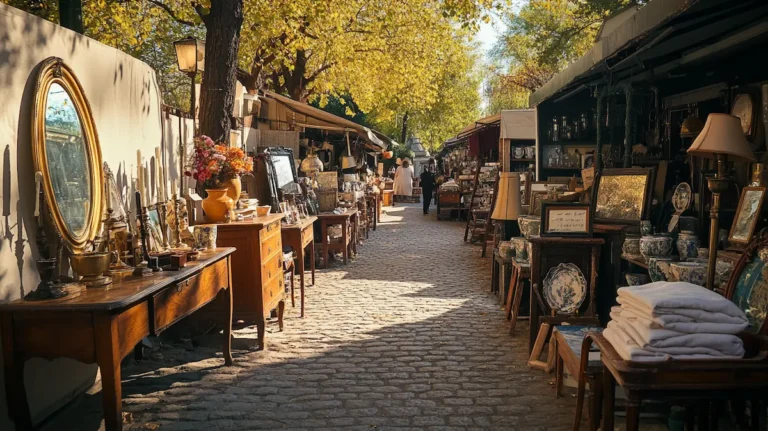
Parisian Vintage Chic is not learned from a catalog. It is developed by looking, studying, and practicing. Paris is the best school for this: the Marché aux Puces de Saint-Ouen, the antique dealers of the 6th arrondissement, the everyday apartments you glimpse through lit windows on a winter evening.
But you do not need to go to Paris to train your eye. You need to cultivate a specific kind of attention — one that notices quality, proportion, patina, and compositional logic wherever it appears.
What to look at
- The proportions of a piece of furniture: are the legs in the right relationship to the seat height? Does the back feel too high or exactly right? Does the scale of the whole piece relate to the space it will occupy?
- The quality of materials: real wood versus veneer, genuine patina versus artificial aging, natural fabric versus synthetic. With time, the difference becomes visible at a glance.
- Compositional logic on a shelf or mantelpiece: how does the arrangement balance? What are the points of visual rest? Where is the eye led?
- How light behaves in a room: where does it enter, how does it move through the day, which materials absorb it and which reflect it?
- The relationship between colors across a room: which tones echo each other, which create tension, and which simply do not belong?
Where to practice
The best places to train a Parisian eye are brocantes, antique fairs, and auction previews — not to buy, but to look. Handle things. Notice weight, construction, the way a drawer slides. Look at what is genuinely old and what is merely trying to look old. Over time, you develop an instinct that works faster than conscious analysis.
Museums and galleries are equally useful — not for interior design directly, but for training compositional thinking. How does a painting fill its frame? How does a sculpture relate to the space around it? These are the same questions you ask when arranging a bookshelf or a mantelpiece.
The one essential habit
The single most useful habit for developing a Parisian eye is this: every time you are about to buy something for your home, wait. Sleep on it. If after three days it still feels right — and specifically right for the place where you intend to put it — then buy it. If the certainty has faded even slightly, do not.
This habit does two things: it prevents the accumulation of mediocre pieces, and it makes the pieces you do acquire feel truly chosen. Both are essential to a Parisian interior.
→ The complete guide to developing a Parisian eye for design — from brocante shopping to compositional thinking: → How to Develop a Parisian Eye for Interior Design

Room by Room: Parisian Vintage Chic in Every Space
Applying Parisian Vintage Chic to specific rooms requires understanding both the universal principles of the style and the particular demands of each space. Here is a room-by-room guide.
The living room
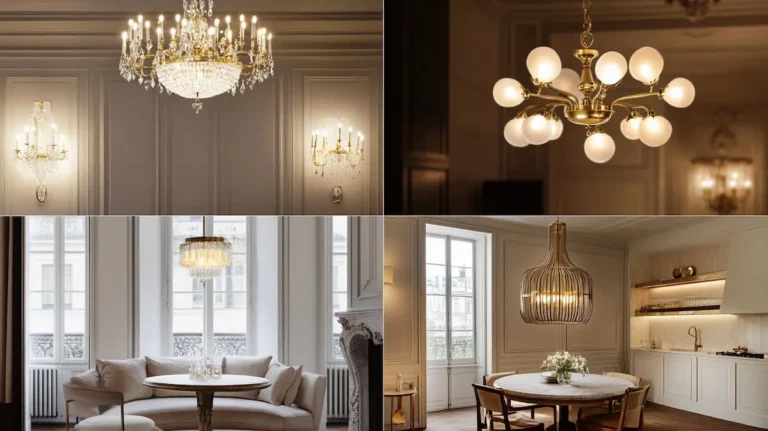
The living room is the centerpiece of the Parisian apartment — the room where the style is most fully expressed. Its key elements: one or two dominant anchor pieces of furniture (a sofa, a statement armchair), a rug that anchors the seating area, a fireplace or focal wall with a mirror, layered lighting (chandelier plus table lamps, never overhead only), and walls that carry art with intention.
The sofa faces the fireplace if there is one. The coffee table is at the right height and scale — not too large, not too small. Books are everywhere, but arranged, not piled randomly. Flowers or a potted plant introduce organic life. The overall feeling is one of inhabited elegance: a room that has been thought about, but that is also genuinely used.
The bedroom
The Parisian bedroom is a cocoon. The bed is a statement — large, with a prominent headboard, upholstered or in beautiful wood. Curtains run from ceiling to floor, ideally in linen or silk that moves gently. There is a dressing table or vanity. On the walls hangs art that the inhabitant finds inspiring — not art that ‘goes with’ the room. Books are on the nightstands, on the floor, on a small shelf.
The color palette in a Parisian bedroom tends to be even more restrained than the living room: deeper tones on the walls (a soft grey-green or a dusky rose), white or ivory bedlinen, warm accent lighting that is never overhead. The room should feel like a sanctuary — private, quiet, and entirely one’s own.
The kitchen
The Parisian kitchen is functional but never merely functional. Open shelves with earthenware, copper pans hanging from a hook, a marble or stone countertop, herbs in small pots on the windowsill. It is a workspace that is also beautiful to be in — a room where cooking feels like a pleasure rather than a chore.
In terms of style, the Parisian kitchen keeps the same palette as the rest of the apartment: warm whites, wood tones, natural materials. It avoids the clinical look of stainless steel and instead reaches for aged brass hardware, ceramic knobs, and surfaces with texture and warmth.
The entryway
The entryway is the first thing a visitor sees — and in a Parisian apartment, it is treated with the same care as any other room. A large vintage mirror (gilded frame, ideally), a console table or narrow chest on which objects are arranged, a hook or stand for coats. Small, but curated. It sets the tone for everything that follows.
The bathroom
The Parisian bathroom combines the practical with the aesthetic. White tiles with black accents or a subtle pattern, a freestanding bath when possible, brass or aged gold fittings, soft towels folded as in a good hotel. A mirror with character rather than a box-store standard. A single beautiful object — a ceramic soap dish, a small oil painting — to declare that even here, beauty matters.

The Ten Commandments of Parisian Vintage Chic
These are the principles that experienced practitioners of the style apply instinctively. For those building a Parisian interior from scratch, they serve as a practical checklist.
1. Buy slowly and intentionally Every piece that enters your home should be considered. There is no rush. A room built over five years is always better than one assembled in a weekend.
2. Choose quality over quantity. One genuinely good piece is always worth more than three adequate ones. This applies to furniture, objects, fabrics, and art alike.
3. Let pieces from different periods coexist. A Louis XVI chair next to a mid-century lamp next to a contemporary cushion — this is the Parisian mix. Fear of mixing periods is the enemy of character.
4. Warm every surface. Cold whites, synthetic fabrics, and chrome finishes have no place in a Parisian interior. Warmth is achieved through materials, color temperature, and light.
5. Never match. Harmonize. Matching sets are the opposite of Parisian. The goal is coherence, not uniformity. Colors and materials should resonate with each other, not repeat.
6. Treat imperfection as a feature. The crack in the plaster, the worn rug border, the faded fabric — these are not problems to solve. They are the marks of a life being lived.
7. Light with layers. No single overhead light source. Always: a chandelier or ceiling light for ambient glow, table lamps for warmth, a reading light for function. Three sources minimum.
8. Make the mantelpiece or focal wall a composition. It is the gravitational center of the room. It should be arranged with care: asymmetry, varying heights, negative space, and at least one personal object.
9. Add one personal, irreplaceable object to every room. Something that cannot be bought in a shop. Something that has a story. Without this, the room remains a set.
10. Know when to stop. The Parisian interior is never finished in the sense of being complete — but it always has a moment when it is right. Learn to recognize that moment.
The Most Common Mistakes — And How to Avoid Them
The style is inviting but has its pitfalls. These are the errors made most often by those who attempt Parisian Vintage Chic without a solid understanding of its principles.
Buying everything at once
A Parisian interior is not assembled in a weekend. It grows. Buying a complete room’s worth of furniture in a single shopping trip — even from good sources — almost always produces a result that looks forced rather than evolved. Buy one thing at a time, live with it, and let the next piece suggest itself.
Matching instead of harmonizing
The matching sofa-and-armchair set, the coordinated cushion collection, the deliberately unified color scheme — these are the enemies of the Parisian interior. The style thrives on productive tension between pieces. An armchair that does not quite ‘match’ the sofa but that resonates with it in some harder-to-define way is almost always more interesting.
Confusing French Country with Parisian
Importing elements of French Country into a Parisian interior — the lavender tones, the overly rustic furniture, the farmhouse textures — dilutes the urban refinement that defines the style. Know the difference and choose your references accordingly.
Mistaking old for good
Not everything that is old is a good vintage find. A cheap piece of furniture that is simply old is not a vintage anchor — it is just old. The criterion is not age but quality: was this a well-made piece when it was new? Does it have the structural and aesthetic integrity to anchor a room?
Over-decorating
More objects does not mean more Parisian. The curatorial principle is absolute: only what belongs. When a room starts to feel busy or visually loud, something needs to come out, not go in. The ability to remove is as important as the ability to add.
Treating it as a fixed destination
The Parisian interior is never done. It is always in a state of slow, deliberate evolution. Treating it as a project to be completed — and then feeling disappointed when it does not feel ‘finished’ — misunderstands the nature of the style. It is a practice, not a project.
Conclusion: A Style That Grows With You
Parisian Vintage Chic is ultimately not an interior style in the conventional sense. It is a way of living that happens also to express itself through furniture, objects, and rooms. It is the conviction that quality belongs in daily life, that beauty lives in the everyday and the imperfect, that old and new can coexist with grace, and that a home should be so specifically yours that no one else could have made it.
It is also a style that is never complete in the way a renovation project is complete. A Parisian Vintage Chic interior evolves with its inhabitant. A new piece arrives from a brocante. Something goes because it no longer belongs. A painting moves from one room to another. A new arrangement emerges on the mantelpiece. The room is always slightly different from what it was, and always becoming more itself.
“The most beautiful Parisian interior is one that tells you who lives there — not who they want to appear to be.”