
The Crafted Minimalist Hallway: 6 Timeless Entryway Styles with Shop-the-Look Picks
The hallway is often treated as a purely functional space — a place to pass through, not a place to design. Yet within Crafted Minimalism, the hallway is one of the most meaningful rooms in the home. It is the transition between outside and inside, movement and stillness, chaos and calm.
A well-designed crafted minimalist hallway doesn’t rely on decoration. Instead, it sets the tone through material choice, proportion, and restraint. Natural textures, sculptural forms, and intentional negative space work together to create a quiet sense of arrival. Even the smallest hallway can feel grounded and refined when every element earns its place.
In this article, I explore six distinct Crafted Minimalism hallway styles, each built around a different material story — from soft stone and warm wood to sculptural plaster and rustic European textures. These styles are not abstract concepts. Each one is designed to be recreated, using carefully selected furniture, lighting, and accessories that appear directly within the visual inspiration.
For every style, I recommend three to four specific products and explain exactly why I chose them: how they support the materials, reinforce the mood, and keep the space both functional and calm. This approach allows you to move beyond inspiration and confidently translate a look into your own home.
If you’d like a broader view of how Crafted Minimalism works throughout the home, you can explore the full room-based approach here:
→ Crafted Minimalism by Room Overview
And because accessories play a crucial supporting role — never dominant, always intentional — you’ll also find guidance on selecting the right finishing elements here:
→ Accessories in Crafted Minimalism
Let’s begin with the hallway — the quiet introduction to everything that follows.
Disclaimer: This post may contain affiliate links. This means that if you click on one of these links and make a purchase, we may earn a small commission—at no extra cost to you.
All images featured in this article are AI-generated to illustrate the aesthetic and mood of the interior style. The products linked are carefully selected items that, in our view, most closely match the look and feel of these designs.
As an Etsy affiliate and Amazon Associate, we earn from qualifying purchases. We only recommend products we genuinely believe align with the style and atmosphere presented in our AI-created interiors.
Style 1 — Soft Stone Entryway
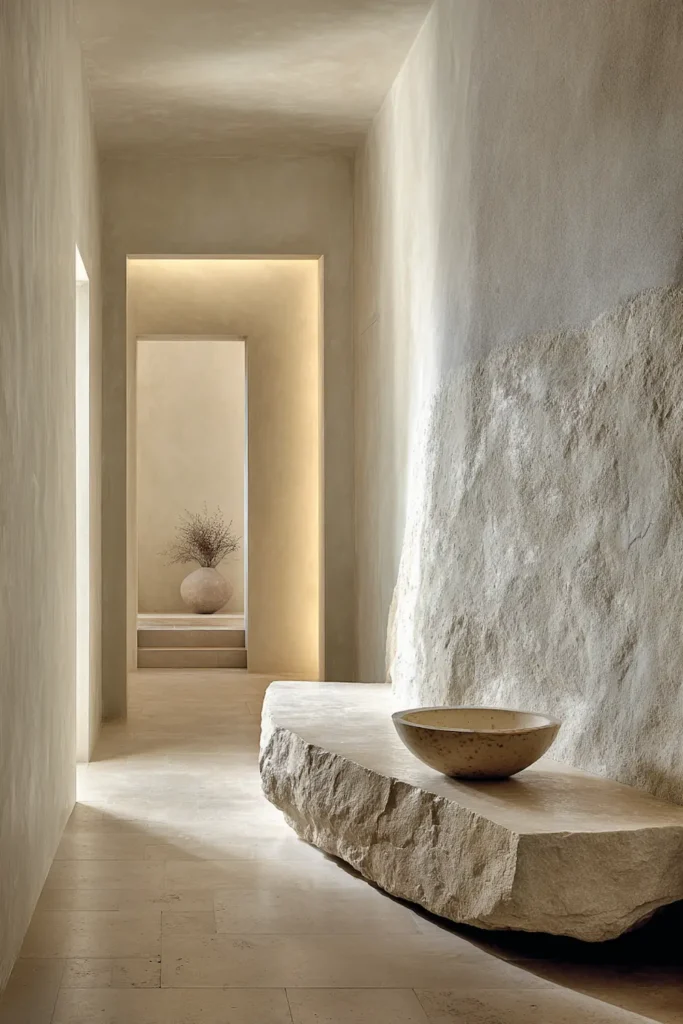
Calm, architectural, and grounded
A Soft Stone hallway is one of the purest expressions of Crafted Minimalism. This style is quiet, architectural, and deeply rooted in material integrity. Rather than relying on decoration or color contrast, the atmosphere is created through mass, texture, and restraint.
Stone brings a sense of permanence to a space that is often treated as temporary. In a hallway — a room you pass through rather than linger in — this grounding quality is especially powerful. Soft stone surfaces slow the pace. They absorb light rather than reflect it sharply, creating a calm transition between outside and inside.
This style works beautifully in both modern homes and older European buildings. Whether you’re working with real travertine, limestone, or high-quality stone alternatives, the goal remains the same: a sculptural, almost monastic simplicity that still feels warm and livable.
Material & Color Direction
The palette stays deliberately restrained:
- Warm off-white, sand, and light beige
- Subtle tonal variation rather than contrast
- Matte finishes over polished surfaces
Textures do the heavy lifting here. Lime plaster walls, honed stone floors, and tactile ceramics ensure the space never feels flat — even with very few objects present.

Curated Product Selection (Shop the Look)
Below are four core pieces that define this style. Each one is chosen not as decoration, but as a structural contributor to the space.
1. Sculptural Stone Bench
Why this piece works:
The Pericia Bench is a perfect example of how stone can feel both architectural and refined. Its low, grounded profile immediately anchors the hallway, while the softly rounded edges prevent the material from feeling cold or severe. This balance is essential in a Soft Stone entryway, where mass and calm must coexist.
What makes this bench especially suitable for Crafted Minimalism is its monolithic presence. Rather than standing on visible legs, the bench reads as a solid volume — almost like a sculpted plinth. This creates visual continuity with lime plaster walls and stone flooring, allowing the hallway to feel intentional and cohesive rather than styled.
I chose this bench because it doesn’t try to be furniture in the traditional sense. It feels architectural first, functional second — exactly what you want in a space that sets the emotional tone of the home. The natural stone finish subtly reflects light, revealing texture without introducing contrast, while the generous proportions keep the space grounded and calm.
Placed along a wall or centered beneath soft, indirect lighting, the Pericia Bench becomes more than seating. It becomes a quiet statement piece — one that defines the hallway without overwhelming it. rather than legs or detailing. The simplicity allows the material itself to speak.
2. Minimal Wall-Mounted Stone or Plaster Shelf
Why this piece works:
In a Soft Stone entryway, storage should never feel like an added layer — it should feel carved into the space itself. This limestone floating shelf achieves exactly that. Its clean silhouette keeps the hallway visually calm, while the chiseled edge introduces subtle irregularity that prevents the look from becoming too polished.
What makes this shelf especially suitable for Crafted Minimalism is the way it balances precision and imperfection. The floating installation maintains architectural clarity, but the hand-worked stone edge adds a tactile, almost geological quality. It feels less like a piece of furniture and more like a continuation of the wall material.
I chose this shelf specifically because it allows for functional minimalism. It offers just enough surface for essentials — keys, a single ceramic vessel, or a folded linen — without encouraging clutter. By keeping the shelf shallow and visually lightweight, the floor remains unobstructed, which is crucial in hallways where space and flow matter.
Paired with lime plaster walls or other mineral finishes, this limestone shelf reinforces the core idea of the Soft Stone style: fewer objects, richer materials, and every element earning its place through texture rather than decoration. keeping materials consistent strengthens the architectural calm.
3. Hand-Carved Wooden Bowl
Why this piece works:
In a hallway dominated by stone and mineral surfaces, one organic element is essential to prevent the space from feeling austere. This hand-carved wooden bowl from Papua New Guinea introduces warmth, history, and human touch — without breaking the minimalist language.
What makes this piece especially powerful in a Soft Stone entryway is the contrast it provides. The bowl’s irregular shape and visible hand-carving marks soften the architectural rigidity of stone, creating a quiet dialogue between raw material and craftsmanship. It doesn’t compete with the stone elements; it complements them by adding depth and emotional texture.
I chose this bowl specifically because it feels authentic rather than decorative. Its slightly imperfect form and deep, natural patina suggest use and age — qualities that align beautifully with the timeless nature of stone. Placed on the limestone floating shelf, it becomes a focal point without demanding attention.
This is not a bowl meant to be filled or styled. It works best when left almost empty, allowing the material itself to speak. In Crafted Minimalism, restraint is what gives objects meaning — and this piece embodies that principle perfectly.
4. Soft Indirect Wall Lighting
Why this piece works:
Lighting is what ultimately brings a Soft Stone hallway to life. Stone and plaster rely on shadow and gradation to reveal their texture — and that only works when the light source is soft, indirect, and intentional. This wall light does exactly that.
What I look for in lighting within Crafted Minimalism is restraint. This fixture doesn’t try to become a statement object. Instead, it functions as an architectural tool, gently washing light across the wall surface rather than projecting it outward. The result is a calm glow that enhances the lime plaster and stone finishes without creating harsh contrast.
I chose this specific light because of its minimal profile and warm diffusion. It disappears visually when turned off, yet adds depth and atmosphere once illuminated. Placed above the stone bench or along the length of the hallway, it subtly emphasizes material texture and proportion — two core principles of the Soft Stone style.
In a space where objects are kept to a minimum, lighting becomes one of the most powerful design elements. This fixture supports the overall composition quietly, allowing the materials to remain the focal point while guiding the eye through the space.
When to Choose This Style
The Soft Stone Entryway works especially well if:
- Your hallway is narrow or windowless
- You want a timeless, hotel-like calm
- You prefer material depth over decoration
It’s a style that doesn’t shout — and that’s exactly why it lasts.
Style 2 — Warm Wood & Shadow Hallway
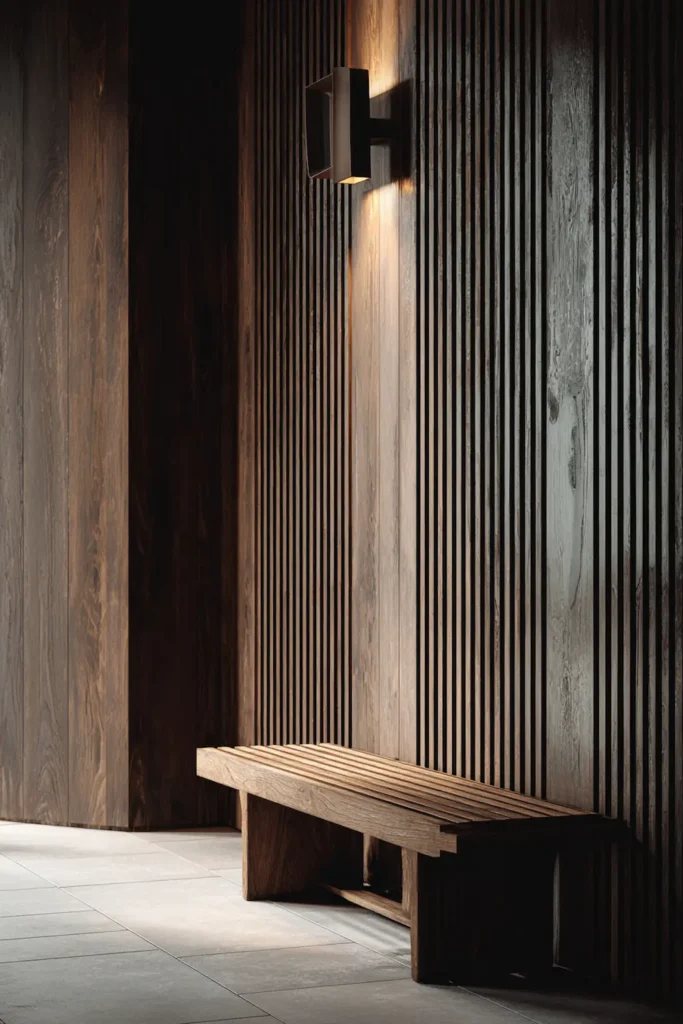
Intimate, rhythmic, and quietly dramatic
Where Soft Stone feels calm and architectural, the Warm Wood & Shadow Hallway is more intimate and enveloping. This style is built around rhythm, depth, and contrast — not through color, but through shadow and material layering.
Dark wood has the ability to slow a space down. In a hallway, this creates a sense of pause rather than passage. Vertical slats, paneled walls, and rich wood tones absorb light instead of reflecting it, allowing shadows to become an active part of the design. The result is a hallway that feels grounded, warm, and quietly luxurious.
This style works particularly well in homes where the hallway connects multiple rooms. Instead of feeling like a leftover corridor, it becomes a moment of compression — a deliberate transition that makes the spaces beyond feel lighter and more open.
Material & Color Direction
The palette here is restrained but deep:
- Walnut, smoked oak, or dark-stained ash
- Warm brown, cocoa, and charcoal tones
- Matte finishes with visible grain
Texture is essential. Flat, glossy wood would break the mood. Instead, subtle grain, slatted repetition, and natural variation create visual interest without ornament.

Curated Product Selection (Shop the Look)
These pieces focus on rhythm, warmth, and subtle contrast, without introducing visual noise.
1. Slatted Wood Wall Paneling or Accent Wall
Why this piece works:
Vertical wood slats are the backbone of this style. They introduce rhythm and depth while maintaining minimalism. The repetition creates movement, while the dark tone absorbs light, allowing shadows to define the space.
I deliberately choose narrow, evenly spaced slats rather than wide planks. This keeps the look refined and architectural, avoiding anything too rustic or heavy. In narrow hallways, slatted walls also visually elongate the space, drawing the eye upward.
2. Minimal Wooden Bench in a Dark Finish
Why this piece works:
Unlike the stone bench in Stijl 1, this bench blends into the environment rather than standing apart. A low-profile wooden bench in walnut or smoked oak reinforces continuity and keeps the hallway cohesive.
I prefer benches with:
- Clean, rectangular forms
- Minimal or hidden joints
- No visible ornamentation
The bench should feel almost built-in — more architectural element than furniture piece.
3. Cylindrical Wall Light — Focused Vertical Lighting
Why this piece works:
In a Warm Wood & Shadow hallway, lighting isn’t meant to flatten the space — it’s meant to shape it. This cylindrical wall light does exactly that. Its vertical form reinforces the rhythm of slatted wood walls, while the up-and-down light distribution creates controlled shadow rather than even illumination.
What makes this fixture especially suitable for this style is its architectural restraint. The clean cylinder shape feels intentional and modern, without introducing visual noise. When placed between vertical wood slats or along a paneled wall, the light subtly accentuates depth and texture, allowing shadows to become part of the composition.
I chose this light because it directs attention to the material, not to itself. The warm glow highlights wood grain and surface variation, while the focused beam keeps the hallway intimate and grounded. Unlike diffused ambient lighting, this type of fixture preserves contrast — a key characteristic of the Warm Wood & Shadow aesthetic.
Used in repetition along a hallway wall, these lights create a quiet cadence: light, shadow, material. The result is a space that feels intentional and calm, yet rich in atmosphere — exactly what this style is designed to achieve.ntain functionality while preserving the calm, shadow-driven aesthetic.
4. Linear Indirect Wall Light — Subtle Background Glow
Why this piece works:
Where the cylindrical wall light creates rhythm and focus, this linear wall light provides quiet continuity. In a Warm Wood & Shadow hallway, not every light source should demand attention. This fixture exists to support the space rather than define it.
I chose this light because of its low visual profile and indirect output. The slim, linear form allows it to disappear against dark wood paneling when turned off, while the soft glow it produces gently lifts shadows without erasing them. This is crucial in a style that relies on contrast and depth rather than brightness.
Placed along the upper edge of a wall, beneath a slatted panel, or subtly washing down a vertical surface, this light helps guide movement through the hallway. It adds atmosphere and orientation without competing with the architectural lighting used elsewhere.
What makes this piece especially effective is how it balances the composition. The cylindrical lights punctuate the space; this linear fixture connects those moments into a cohesive whole. Together, they create a layered lighting scheme that feels intentional, calm, and quietly luxurious — exactly what Warm Wood & Shadow is about.
For a broader look at how wall art functions within the style, Wall Art in Crafted Minimalism covers what to look for and why scale and texture matter.
When to Choose This Style
The Warm Wood & Shadow Hallway is ideal if:
- Your hallway feels long or transitional
- You want warmth without softness
- You appreciate contrast created through light and material rather than color
It’s a style that feels intentional and grounded — a quiet statement rather than a visual introduction.
Stijl 3 — Japanese–European Hybrid Entryway
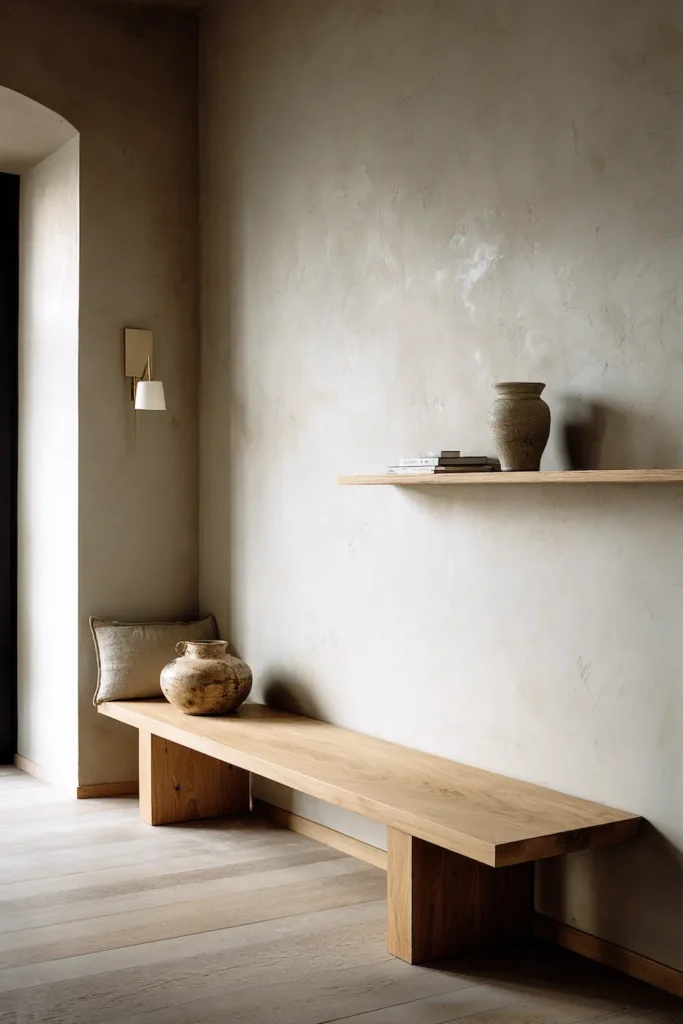
Stijl 3 — Japanese–European Hybrid Entryway
Serene, grounded, and intentionally human
The Japanese–European Hybrid entryway blends the calm restraint of Japanese interiors with the material depth and architectural grounding of European design. This style is not about emptiness, but about intentional quiet — where every surface and object has a reason to exist.
Unlike softer Japandi spaces that lean heavily on pale woods and visual lightness, this hybrid approach introduces weight and structure. Low furniture, mineral walls, and sculptural lighting work together to create a hallway that feels emotionally warm yet spatially disciplined.
This is a style designed for people who appreciate minimalism with soul — not decorative, not rigid, but quietly expressive through material choice and proportion.
Material & Color Direction
- Light to mid-tone wood with visible grain
- Mineral wall finishes with soft texture
- Sculptural accents with human imperfection
- Warm off-white, light clay, muted beige, soft shadow tones
The palette remains restrained, but never flat. Texture replaces contrast.
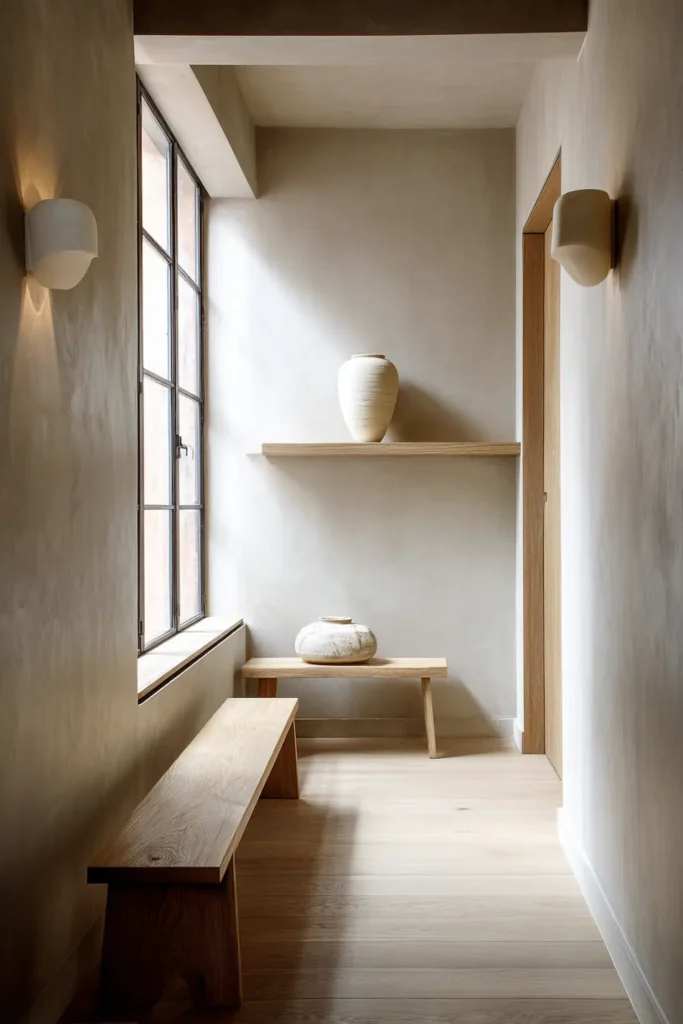
Curated Product Selection (Shop the Look)
1. Modern Wood Bench — Rockefeller 1925
by Bertu Home
Why this piece works:
This bench sets the foundation for the entire entryway. Its low, elongated form aligns beautifully with Japanese spatial principles, while the solid wood construction and subtle detailing ground the space in European craftsmanship.
I chose this bench because it feels quietly architectural. It doesn’t demand attention, yet it provides visual weight and emotional anchoring — exactly what a hallway needs. The visible wood grain adds warmth without becoming rustic, making it ideal for a hybrid style that values restraint with presence.
Placed against a mineral wall, the bench creates a calm horizontal line that slows the space down and invites a moment of pause.
2. Limewash Wall Finish — Mykonos
Why this piece works:
Walls are not a background in this style — they are an active material layer. The Mykonos limewash finish introduces soft movement and tonal variation without pattern or color contrast.
I chose this finish because it reflects light gently, creating depth without visual noise. The slightly chalky, mineral surface pairs naturally with wood and ceramic, reinforcing the sense of calm continuity throughout the hallway.
This type of wall treatment is essential in a Japanese–European hybrid space: it adds character without decoration and allows the room to feel finished even with very few objects present.
3. Half-Sphere Wall Sconce
Why this piece works:
Lighting in this style should feel soft, intentional, and sculptural. The half-sphere wall sconce achieves this by combining a simple geometric form with diffused light that gently washes the wall.
I chose this sconce because it echoes Japanese design principles — rounded, understated, and calm — while still feeling contemporary enough for a European setting. The light doesn’t project outward aggressively; instead, it creates a subtle glow that enhances the limewash texture and softens the overall composition.
Used singly or in repetition, this fixture adds atmosphere without disrupting the visual quiet of the space.
4. Sculptural Ceramic Floor Vase — Postmodern People
Why this piece works:
Every crafted minimalist hallway benefits from one object that introduces human presence. This sculptural ceramic floor vase does exactly that.
Its slightly irregular form and expressive silhouette contrast beautifully with the controlled lines of the bench and walls. I chose this piece because it feels intentional rather than decorative — more like a quiet art object than an accessory.
Placed on the floor rather than on furniture, it maintains openness while adding vertical interest. Whether left empty or holding a single branch, it reinforces the idea that imperfection and restraint can coexist.
Why This Style Works So Well in Hallways
- It feels calm without feeling empty
- It balances softness and structure
- It translates easily to both modern and older homes
- It allows materials — not decor — to define the space
This is a hallway that doesn’t announce itself. It simply welcomes you in, quietly and confidently.
Stijl 4 — Sculptural Modern Hallway
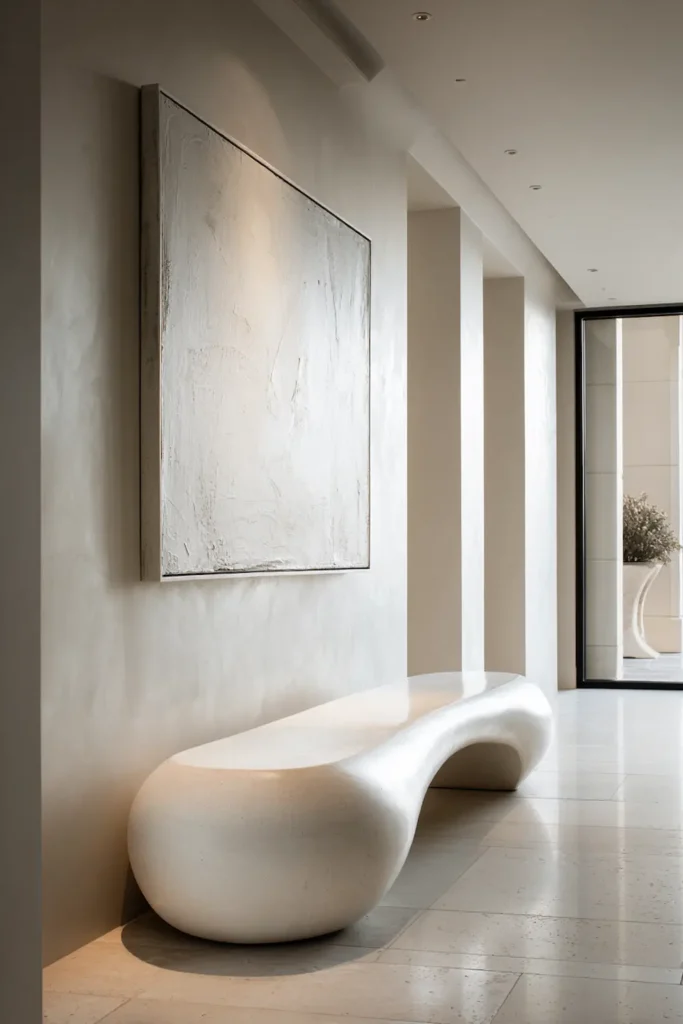
Gallery-like restraint with bold, tactile forms
The Sculptural Modern hallway is the most expressive style within Crafted Minimalism — yet also the most restrained. Rather than relying on warmth or texture alone, this style is built around form, scale, and negative space.
It takes cues from galleries and contemporary architecture, where objects are given room to exist on their own. In a hallway, this approach works surprisingly well. The space remains transitional, but the experience becomes intentional — almost curated.
Instead of many small details, this style uses fewer, larger elements. Each object functions as a sculptural presence, carefully positioned so the hallway feels composed rather than styled.
Material & Color Direction
- Plaster or smooth mineral walls
- White, off-white, soft grey, muted taupe
- Cool-toned wood or stone underfoot
- Minimal color, maximum form
Contrast comes from shape, not palette.
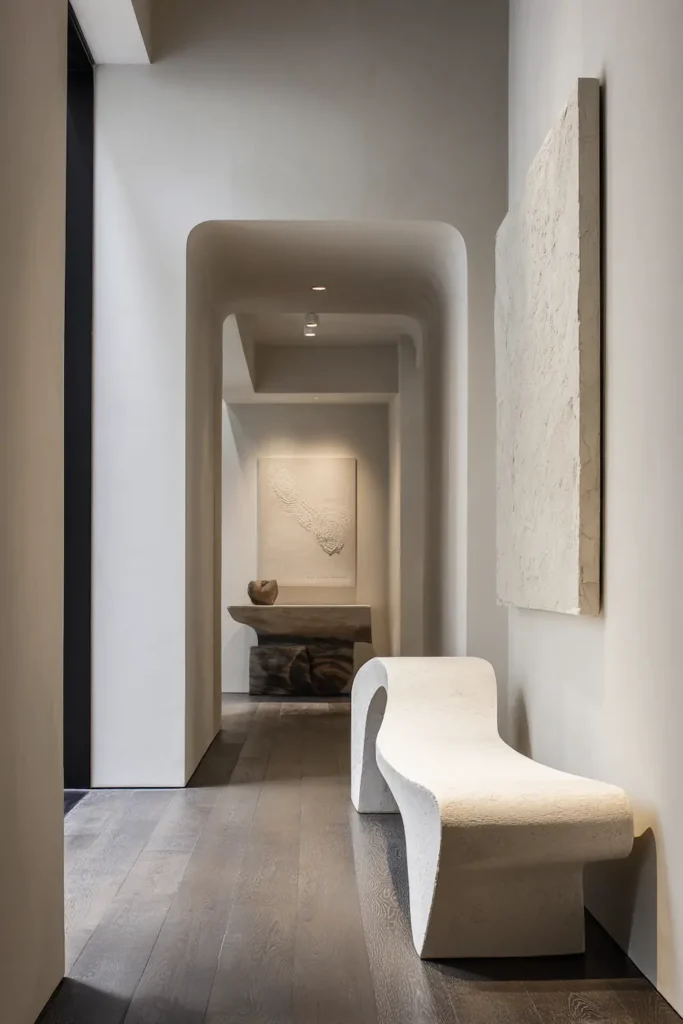
Curated Product Logic (why these work together)
1. Sculptural Fibreglass Bench
This bench functions as an art object first and seating second. Its fluid, almost architectural form immediately establishes the gallery-like tone of the space.
I chose this piece because fibreglass introduces a contemporary edge that stone or wood cannot. It feels modern, bold, and intentional — exactly what this style requires. Against a neutral wall, the bench becomes a focal point without adding visual noise.
This is the kind of piece that doesn’t need styling around it. Space is its styling.
2. Large White Textured Abstract Artwork
In a Sculptural Modern hallway, art should feel structural, not decorative. This large-scale textured artwork acts almost like a surface rather than an image.
I chose this piece because it adds depth without narrative. The texture catches light and shadow subtly, echoing the plaster walls while remaining distinct. Its scale is crucial — smaller art would feel tentative in a style that depends on confidence.
Placed above or near the bench, it anchors the composition vertically.
3. Cream Upholstered Bench
While the fibreglass bench introduces structure, this upholstered bench brings softness and tactility into the space. In a hallway, this balance is important — too much hardness can feel uninviting.
The cream fabric keeps the palette calm and cohesive, while the upholstered form contrasts beautifully with sculptural art and hard surfaces. This piece grounds the space emotionally without disrupting its modern clarity.
Used opposite the fibreglass bench or further down the hallway, it adds rhythm and variation.
4. Cool-Toned Engineered Wood Flooring
The floor is the silent stabilizer of this style. This cool, ashy wood floor tone provides warmth without pulling the space toward rustic or cozy.
I chose this flooring because it allows sculptural pieces to stand out while keeping the overall atmosphere livable. It supports the gallery aesthetic without making the hallway feel cold or institutional.
In Sculptural Modern interiors, the floor is not a backdrop — it’s a calm, continuous plane that connects everything.
Why This Style Works in a Hallway
- It thrives on negative space
- It feels curated, not decorated
- It elevates transition spaces into experiences
- It balances art and function effortlessly
This is a hallway that doesn’t try to be cozy. It tries to be clear — and that clarity is what makes it powerful.
Stijl 5 — Rustic European Hallway
Authentic, time-worn, and quietly refined
The Rustic European hallway is rooted in material honesty. This style doesn’t aim for perfection — it values patina, texture, and the quiet beauty of age. Within Crafted Minimalism, this is the style that feels the most lived-in, yet still deeply intentional.
Rather than layering decor, the atmosphere is built through surfaces: weathered wood, mineral plaster, hand-thrown ceramics. Each element carries visible history, allowing the hallway to feel grounded and timeless rather than styled or trend-driven.
This is minimalism that embraces imperfection — not as an aesthetic choice, but as a reflection of real European interiors where materials evolve over time.
Material & Color Direction
- Aged wood with visible wear
- Mineral wall finishes with depth and movement
- Soft, earthy neutrals: warm greys, muted beige, clay, stone
- Matte finishes throughout
Contrast is subtle. Nothing should feel new or glossy. The goal is quiet cohesion, not visual drama.
Curated Product Selection (Shop the Look)
1. Weathered Wood Bench
Why this piece works:
This bench defines the Rustic European hallway. Its worn surface, softened edges, and visible grain immediately introduce a sense of history. Unlike polished or sculptural benches, this piece feels collected rather than designed — which is exactly what this style requires.
I chose this bench because it feels functional first, aesthetic second. It invites use without demanding attention. Placed along a plastered wall, it anchors the hallway and establishes a calm, grounded rhythm.
This is the kind of piece that looks better with time — not despite its imperfections, but because of them.
2. Metallic Mineral Plaster Finish
Why this piece works:
Walls play an active role in this style. This metallic mineral plaster introduces subtle variation and depth without reading as decorative. The finish catches light gently, creating movement that changes throughout the day.
I chose this plaster because it bridges rustic and refined. It retains the rawness of traditional European wall finishes while adding just enough luminosity to prevent the hallway from feeling heavy or dark.
Used sparingly — ideally on a single wall or recessed area — it elevates the space while staying true to the material-first philosophy.
3. Handcrafted Ceramic Vase — Jexa
by McGee & Co.
Why this piece works:
Every Rustic European hallway benefits from one quiet, human object. The Jexa vase provides exactly that. Its hand-formed shape and muted glaze introduce softness and imperfection, balancing the heavier architectural elements.
I chose this piece because it feels collected, not styled. It works beautifully empty or with a single branch — never arranged, never decorative. Its role is to suggest presence, not to fill space.
Placed on the bench or directly on the floor, it adds warmth without clutter.
4. Textured Venetian Plaster Finish
Why this piece works:
This finish reinforces the core of Rustic European minimalism: surface over styling. Venetian plaster brings softness, depth, and subtle movement, allowing walls to feel complete without added objects.
I chose this finish because it reflects traditional European craftsmanship while remaining understated. Its texture works beautifully with aged wood and ceramic, creating a cohesive material story throughout the hallway.
This type of wall treatment allows the space to remain minimal while still feeling rich and layered.
Why This Style Works So Well in Hallways
- It embraces age and imperfection
- It feels timeless rather than designed
- It relies on materials instead of decor
- It creates calm through authenticity
The Rustic European hallway doesn’t try to impress. It simply exists with confidence, grounded in materials that tell their own story.
How to Choose the Right Crafted Minimalist Hallway Style
Choosing a Crafted Minimalist hallway style isn’t about selecting the most striking look — it’s about identifying the style that brings the most calm to your specific space. Hallways amplify design decisions. What works beautifully in a large living room can feel overwhelming or disjointed in a narrow passageway.
The first distinction to make is between visual preference and spatial suitability. You might be drawn to sculptural forms or bold contrasts, but if your hallway is small, dark, or heavily used, a quieter material-driven style will often feel more refined in daily life. Crafted Minimalism values longevity over impact — a space should feel right every time you pass through it, not just impressive at first glance.
Light plays a decisive role. Hallways with limited natural light benefit from lighter materials such as soft stone, limewash, or pale plaster finishes, which reflect light gently and create openness. Darker styles, like Warm Wood & Shadow or Sculptural Modern, work best when balanced with architectural lighting and enough wall space to let materials breathe.
The age and character of your home also matter. Older European buildings often pair naturally with Rustic European or Soft Stone styles, where texture and patina feel authentic. Newer homes or renovated interiors tend to suit Sculptural Modern or Japanese–European Hybrid approaches, where clean lines and controlled contrast feel intentional rather than forced.
Most importantly, resist the temptation to mix multiple styles within the hallway itself. Crafted Minimalism works best when one dominant material story sets the tone. Consistency creates calm — and calm is what makes a hallway feel truly crafted.
Final Thoughts: Designing a Hallway That Sets the Tone
A hallway doesn’t need to impress. It needs to settle.
Within Crafted Minimalism, the hallway is not treated as a decorative afterthought, but as the first material statement of the home. It introduces pace, texture, and intention. Whether you gravitate toward soft stone, warm wood, sculptural forms, or time-worn European materials, the goal remains the same: clarity over excess.
What makes a crafted minimalist hallway successful is not the number of elements, but the quality of decisions. Fewer materials, chosen with care. Objects that feel grounded rather than styled. Light that reveals texture instead of competing with it. When these choices align, the hallway becomes calm — and calm is what allows a space to feel timeless.
If you’re designing your hallway as part of a larger interior vision, it helps to see how material language carries through the rest of the home. You can explore how Crafted Minimalism translates room by room in the Crafted Minimalism by Room Overview. And when it comes to finishing touches, remember that restraint matters most — a principle explored further in Accessories in Crafted Minimalism.
Ultimately, the most refined hallways are not the most elaborate ones. They are the ones that feel intentional every single day — quietly welcoming you home, without ever asking for attention.