Best Linen Curtains for a French Vintage Interior
Of all the single changes available in a room, floor-length linen curtains hung correctly have the most transformative effect on proportion and atmosphere. They make ceilings appear taller, windows appear larger, and the room acquire a specific gravity — the weight and warmth of natural fabric falling from ceiling height to floor — that no other single textile decision produces. In a Parisian interior, the curtain is not window dressing. It is an architectural element.
This article covers everything required to choose, hang, and source the correct linen curtain for a French vintage interior: the fabric quality that matters, the tones that work, the hanging method that is non-negotiable, and the heading choices that read as either Parisian or not. Specific sourcing options are provided for each type, matched to the images throughout.
The Fabric: What Pre-Washed Linen Actually Means
The most important decision in a linen curtain is not the colour, the heading, or the length. It is the fabric. Specifically: whether the linen has been pre-washed or not.
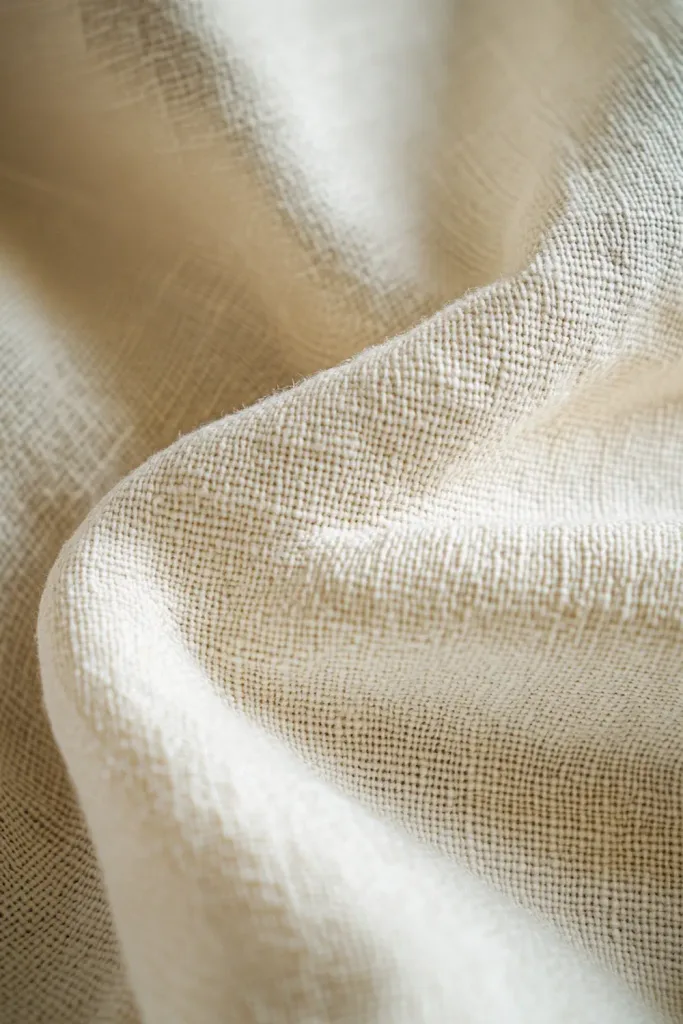
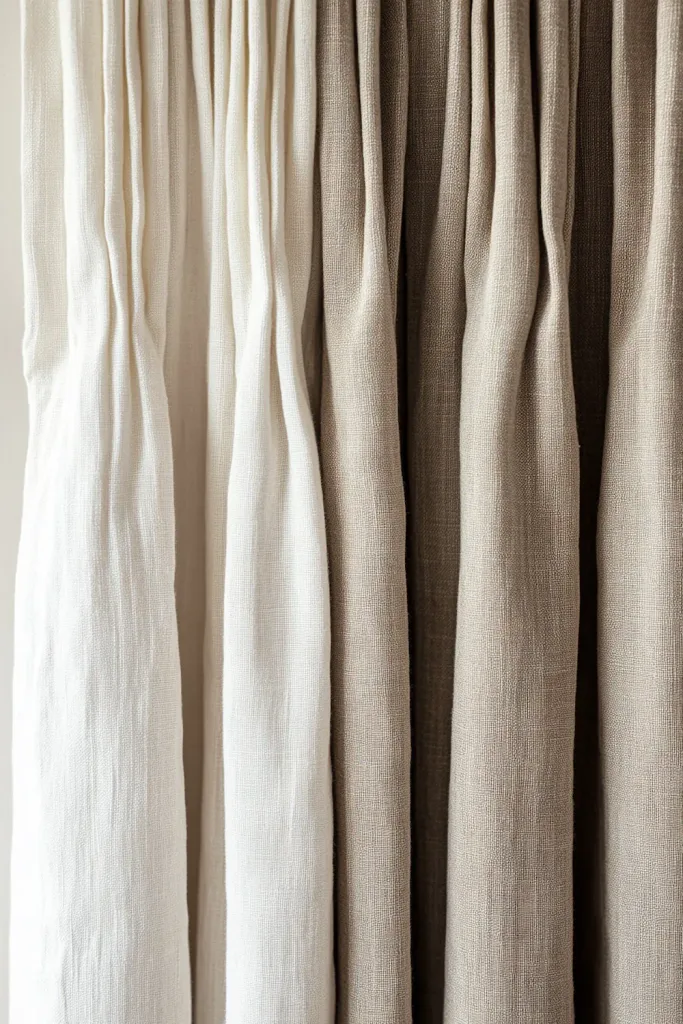
Unwashed or new-washed linen is stiff, slightly crisp, and hangs in angular folds that read as formal and slightly starched. Pre-washed linen — fabric that has been washed before being made into the curtain, or fabric described as ‘softened’, ‘stonewashed’, or ‘washed linen’ — is soft, slightly rumpled, and hangs in deep relaxed folds from the first day of hanging. It reads as inhabited. This distinction is the difference between a curtain that looks like it was installed yesterday and one that looks like it has been in the room for years.
The specific surface quality of pre-washed linen — slightly irregular in weave, with individual threads of slightly varying thickness, the overall surface nubby and warm rather than smooth and flat — is the material that relates correctly to the aged wood, antique brass, and natural textiles of a Parisian interior.
Weight: heavier is better for floor-length curtains
A heavier linen — typically described as 200 g/m² or above — hangs in the deep, uniform folds characteristic of a well-hung Parisian curtain. Lighter linens (below 160 g/m²) tend to move more with air currents and hang in shallower, less consistent folds. For floor-length curtains, the extra weight makes a visible difference in how the fabric falls and how it pools at the floor. When a listing does not specify weight, contacting the seller to confirm is worth doing.
Unlined vs. lined
Unlined linen curtains transmit natural light softly and show the warm quality of the fabric in the most direct way: when afternoon light comes through an unlined linen curtain, the fabric glows warm amber and the room’s light takes on the specific warmth of light filtered through a natural material. Lined curtains provide more privacy and better thermal insulation. For the Parisian aesthetic, unlined is typically preferable when privacy allows; when lining is needed, a privacy or thermal lining rather than blackout preserves the fabric’s light-transmitting quality.
| ➶ Natural Washed Linen Curtains — Custom Length, Softened — ForestandLinen (Etsy) |
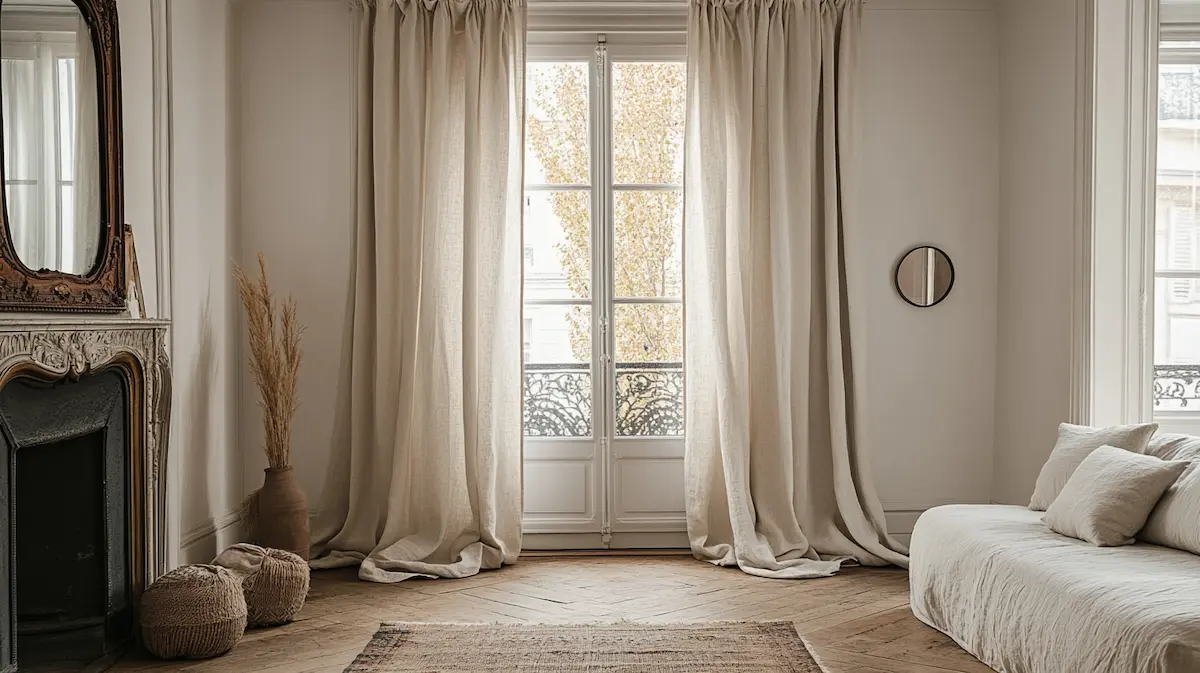
| Handmade natural washed linen curtains from ForestandLinen, an Etsy Star Seller with consistently 5-star reviews, on-time shipping, and quick communication. 100% natural linen, midweight at 205 g/m² — the weight that produces deep, relaxed folds for floor-length curtains. OEKO-TEX® 100 certified. Rod pocket heading. Available in custom lengths and widths. The ‘natural’ colour option produces the specific ecru tone shown in Images 1 and 3 of this article: warm, slightly irregular, unmistakably linen. Sold as individual panels; select 2 in the cart for a pair. Buyers describe the fabric as ‘soft, washed linen feel’ and note the quality consistently. Price listed in the Etsy shop — check current listing · Etsy · ForestandLinen · Star Seller · 205 g/m² · Editorial note: This is the fabric and tone shown in Images 1 and 3: natural ecru, pre-washed, 205 g/m² weight that produces the relaxed deep folds of a correctly hung Parisian linen curtain. Order in custom length — measure from the rod to the floor and add 3–5 cm for the pool. Rod pocket heading is the simplest option; specify other heading types in notes to the seller if required. |
The Tone: Natural Ecru vs. Stone vs. Off-White
Linen curtains for a Parisian interior come in a narrow range of correct tones. The most versatile is natural ecru — the specific warm, slightly golden tone of undyed or lightly processed linen. It reads as warm against off-white walls, relates to the natural linen of a settee or bed linen, and transmits afternoon light in a warm amber tone.
Stone or warm beige — a tone slightly darker and more golden than ecru — is the second most appropriate option. It provides more warmth in a room that needs it: a north-facing room, a room with a cool wall colour, or a bedroom where the curtains will be partially closed for much of the day. Stone-tone linen reads as more deliberate and slightly more formal than natural ecru; in a bedroom with dark walnut furniture and a sage green wall, it is often the stronger choice.
What to avoid
Bright white linen curtains read as cool and crisp in a way inconsistent with the Parisian aesthetic. They fight the warm palette of aged wood, natural textiles, and aged brass rather than supporting it. Coloured linen curtains — in dusty blue, sage green, or a muted rose — can work in specific contexts (a room with a strong wall colour that the curtain tone needs to relate to), but are more advanced choices that require careful consideration of the complete room palette.
| → Cultiver — Pre-Washed Linen Fabric in Natural and Stone Tones |
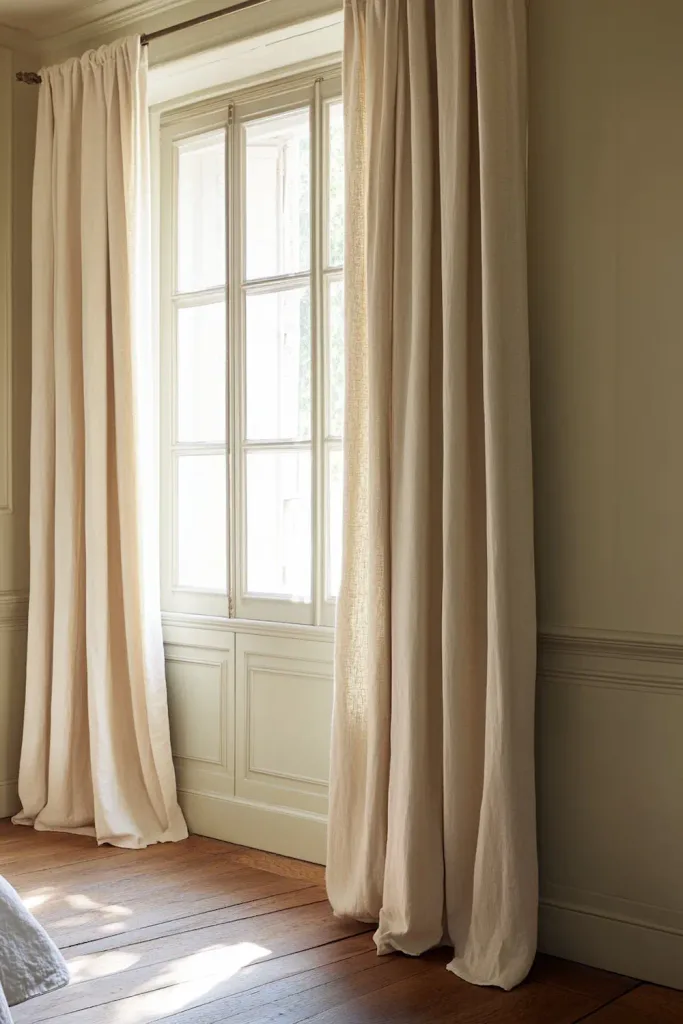
| Cultiver is a specialist linen fabric brand offering pre-washed linen by the metre in natural, stone, and muted tones — including the stone/warm beige tone shown in Image 4. The fabric is available for curtain-making: order by the metre, have cut to your required drop plus hem allowance, and either sew yourself or commission a local curtain maker. The pre-washing process produces the softened, slightly rumpled quality of well-used linen from the first day. Ships internationally. No affiliate relationship — included because Cultiver is the most consistently cited specialist source for the specific pre-washed linen quality described in this article. From approx. €18 per metre · Via Cultiver Editorial note: Use Cultiver fabric for the stone tone shown in Image 4 — the warm beige that reads as slightly more golden than natural ecru. For a floor-length curtain pair in a standard Parisian window (250 cm drop, 140 cm wide), you will need approximately 5–6 metres per panel depending on heading fullness. The natural and stone tones are the most directly applicable to a Parisian context. |
The Most Important Decision: Where to Hang the Rod
The rod height is the single most impactful decision in a curtain installation. More than the fabric, more than the heading, more than the colour — the position of the rod determines whether the curtain reads as an architectural element or as a window dressing.
The correct position for a Parisian interior: mount the rod as close to the ceiling as possible, ideally within 8–15 cm of the ceiling cornice or the ceiling itself. At this height, the curtain falls from near the ceiling to the floor, creating the specific vertical proportion that makes the room feel taller and the window feel larger. A rod mounted at standard window-frame height — the default position in most instructions — produces a curtain that reads as a window dressing, not an architectural element. The visual difference is immediate and significant.
Rod extension: how far beyond the window
The rod should extend 20–30 cm beyond the window frame on each side. This allows the curtains to hang beside the window when open, rather than partially covering it. The result: the full window is visible when the curtains are open, which maximises natural light and makes the window read as a larger, more architectural opening. A rod that extends only to the window frame forces the curtain fabric to hang in front of the glass and reduces both the light and the visual effect.
The practical measurement
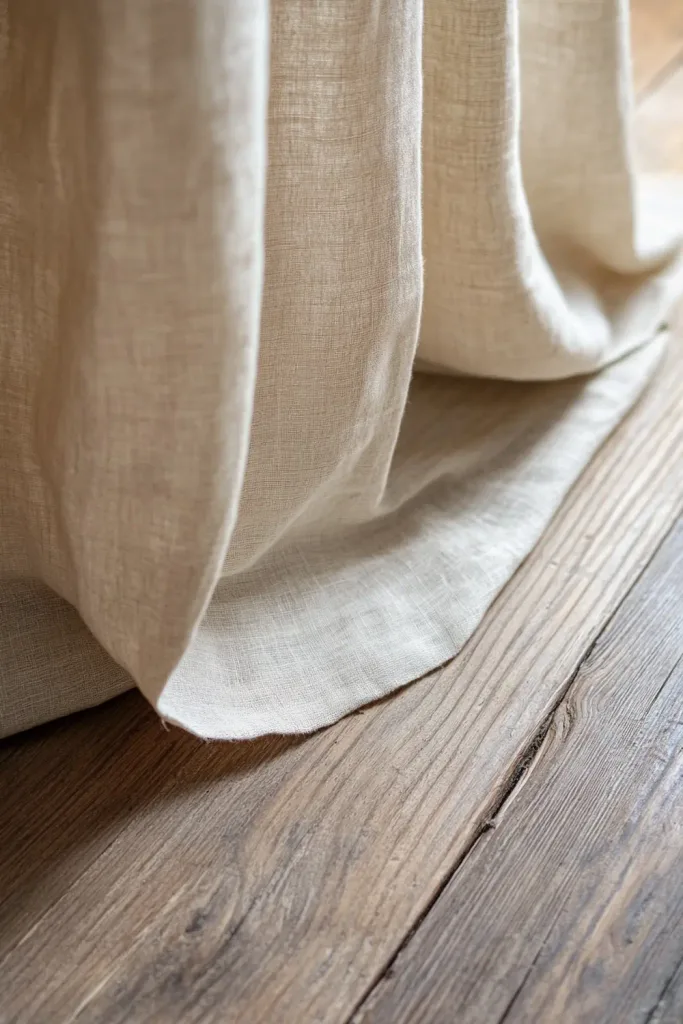
To determine the curtain drop: measure from the top of the rod ring to the floor, then add 3–5 cm for the pool. This produces the specific slightly-longer-than-floor-length measurement that creates the relaxed pool visible in Image 6 of this article. A curtain hemmed to exact floor length is also acceptable; a curtain that stops 2–4 cm above the floor reads as too short and breaks the vertical line.
The Heading: Pinch Pleat vs. Rod Pocket vs. Rings
The heading — the way the curtain is attached to the rod — determines the fold pattern of the fabric and the visual character of the curtain at the top. Three heading types are consistent with the Parisian aesthetic; each produces a different visual result.
Pinch pleat: the most formally Parisian
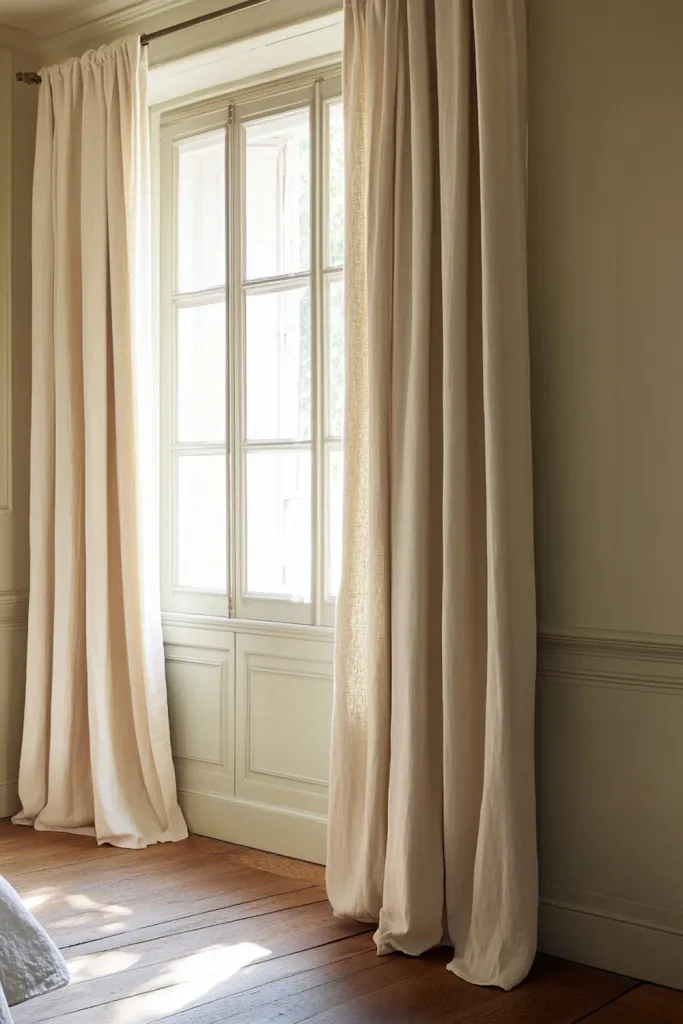
The pinch pleat heading — where small groups of fabric are gathered and pinched together at regular intervals along the top — creates deep, formal folds that cascade consistently from top to floor. It is the most specifically period-French of the three heading types and the most architecturally formal. In a room with painted panel mouldings, carved furniture, and a period mirror, pinch pleat reads as the correct heading choice. It requires a curtain track or hooks on rings rather than a simple rod pocket.
Rod pocket: the most relaxed
The rod pocket heading — where a channel at the top of the curtain slides directly onto the rod — produces a more casual, slightly gathered effect at the top. It is the simplest to install and the most versatile. In a Parisian interior that leans toward the relaxed contemporary end of the French aesthetic, rod pocket reads as appropriate. In a more formally period room, it reads as slightly too casual. It does not allow the curtain to be drawn easily without removing it from the rod; for curtains that are opened and closed daily, a hook-and-ring or track system is more practical.
Brass rings with hooks: the middle option
Simple brass rings on a rod, with the curtain attached via hooks sewn into the top, produce a clean, slightly informal heading that falls between pinch pleat and rod pocket in visual character. The brass rings relate to the brass hardware of the room (the candlesticks, the sconces, the cabinet pulls), which gives this option a specific material coherence in a Parisian context. The curtains slide easily for opening and closing. This is the option shown in Image 2 of this article.
| ➶ Linen Curtains with Pinch Pleat Heading — Custom Size, Star Seller (Etsy) |
| Handmade linen curtains with a classic pinch pleat heading from an Etsy Star Seller — the formal Parisian heading type shown on the left in Image 5. Made from medium weight 100% natural linen fabric. Available unlined, with privacy lining, or with blackout lining. Custom sizes available: contact the seller. Width per panel: 53” (135 cm). The pinch pleat top creates the deep, regular formal folds that read as specifically French and period-appropriate. Curtain hooks included. Buyers describe the quality as high and the measurements as accurate. Price listed in the Etsy shop — check current listing · Etsy · Star Seller · pinch pleat · custom size available Editorial note: This is the pinch pleat heading type shown in Image 5 and described in this section. For the Parisian interior with painted panel mouldings and period furniture, the pinch pleat heading reads as the most formally correct choice. Order in custom length: measure from the top of the hook to the floor and add 3–5 cm for the pool. The unlined option is recommended for rooms where privacy allows — the natural linen quality is most visible without lining. |
Natural Ecru in the Salon: The Classic Application
The most consistently photographed and most widely referenced Parisian curtain application is the salon: natural ecru linen curtains, floor-length, hung from near the ceiling, framing a tall window with the kilim and linen settee of the room visible through their open width. This is the arrangement shown in Image 3 of this article.
In this context, the curtains do three things simultaneously: they make the ceiling appear taller (by creating an uninterrupted vertical line from near the ceiling to the floor), they frame the window as an architectural feature (by extending beyond the window frame on each side), and they introduce the warm, slightly rough texture of natural linen as a large-scale surface against the flat-painted wall.
The relationship with the linen settee
In a room with a linen-upholstered settee or sofa, the natural ecru linen curtain should be in a related but not identical tone. If the settee is in natural linen, the curtains in a slightly warmer ecru are correct. If the settee is in a very warm stone-tone linen, curtains in natural ecru provide the cooler counterpoint. The two linens should read as belonging to the same material family without being a matched set.
| ➶ Custom Linen Curtain Panel — Natural, Washed, Floor-Length — Etsy |
| A custom-size natural linen curtain panel in washed pre-washed linen — the correct natural ecru tone and softened fabric quality for the salon arrangement shown in Image 3. This is the rod pocket version of the same ForestandLinen quality: 100% natural linen, midweight, OEKO-TEX® certified, custom length and width. For a Parisian salon pair (two panels for one window), order two individual panels of the correct width. The natural colour is the specific warm ecru tone of undyed linen that reads correctly against off-white walls and beside a natural linen settee. Confirm current custom size options with the seller at time of order. Price listed in the Etsy shop — check current listing · Etsy · ForestandLinen · Star Seller Editorial note: For the salon arrangement in Image 3: order two panels at the correct width for your window (each panel typically 135–150 cm wide for a standard Parisian window) and at floor-length plus 3–5 cm for pool. The natural colour is the specific ecru shown in the image. Rod pocket heading for a simple clean installation; specify pinch pleat in notes if the more formal heading is preferred. |
The Floor Pool: Deliberate Length and What It Communicates
The slight pool of fabric at the floor — where the curtain is cut 3–8 cm longer than the floor-to-rod measurement, allowing it to rest loosely on the floor — is one of the most specific visual qualities of the Parisian curtain. It reads as deliberate. It signals that the curtain was chosen to be precisely this length, not cut to a convenient standard.
The correct pool is modest: 3–5 cm of fabric lying loosely on the floor is the Parisian register. A pool of 15–30 cm reads as theatrical and romantic in a different register; a curtain that stops 2–4 cm above the floor reads as too short. The specific quality of a 3–5 cm pool in pre-washed linen is visible in Image 6 of this article: the fabric rests in a single soft fold, not piled dramatically, not straining to reach the floor.
How to achieve the correct pool
The standard approach: measure from the top of the ring or the rod pocket to the floor, then add 4 cm. Specify this total measurement as the curtain length when ordering. On a level floor, this produces a consistent pool across the full width of the curtain. On an uneven floor (which most Parisian apartments have), the pool will vary slightly across the width — this natural variation is correct and preferable to a curtain that has been hemmed to floor length to compensate for the unevenness.
Accessible New Options: IKEA and La Redoute
Not every buyer has access to or budget for custom-made Etsy curtains. Two widely available retail options produce results consistent with the Parisian linen curtain aesthetic at accessible price points and immediate availability.
IKEA DYTAG and AINA
IKEA’s DYTAG curtains (100% linen in natural and beige tones) and AINA curtains (linen blend) are among the most consistently recommended accessible linen curtain options in French interior design contexts. Both are available in lengths up to 300 cm, which makes them suitable for rooms with ceiling heights up to approximately 280–290 cm when hung correctly with a short pool. The DYTAG in natural is the closest to the ecru tone shown in Images 1, 2, and 3. The AINA in beige is closer to the stone tone of Image 4.
The key to making IKEA linen curtains read as Parisian is the hanging method: rod mounted near the ceiling, rod extending well beyond the window frame, curtains to the floor with a pool. On a standard IKEA curtain hung at window-frame height with standard width, the result does not read as Parisian. On the same curtain hung from near the ceiling with a ceiling-height bracket and the correct length, the result is significantly closer.
| → IKEA DYTAG — 100% Linen Curtains in Natural and Beige |
| IKEA’s DYTAG range offers 100% linen curtains in natural and beige tones at accessible price points, in lengths up to 300 cm. The natural colour is the closest IKEA linen option to the ecru shown in this article’s images. Available in IKEA stores and online across Europe, the US, and many other markets. The curtains are sold as individual panels; buy two for a pair per window. Note that IKEA curtains are not pre-washed in the same way as the Etsy options — washing before hanging is recommended to soften the fabric slightly. No affiliate relationship — included because IKEA provides the most widely available accessible entry point for 100% linen curtains in the correct tone and length. From approx. €49 per panel · Via IKEA Editorial note: The DYTAG in natural is the most directly applicable IKEA option. Machine wash before hanging to soften the fabric. Hang from a rod mounted as close to the ceiling as possible, with the rod extending at least 20 cm beyond the window frame on each side. Order in the 300 cm length and pool on the floor; this is typically the correct approach for standard Parisian ceiling heights of 250–290 cm. |
| → La Redoute Intérieurs — Linen Curtains in Natural and Stone Tones |
| La Redoute Intérieurs is a French home furnishings brand available in 26+ countries with a linen curtain range in natural, ecru, stone, and warm beige tones — the specific palette described in this article. Several ranges are described as ‘washed’ or ‘stonewashed’ linen, which produces the pre-softened quality described in Section 1. Available in custom and standard lengths. Ships across Europe and internationally. No affiliate relationship — included because La Redoute is a French brand whose curtain aesthetic is directly aligned with the Parisian interior context and whose product is widely accessible internationally. From approx. €45 per panel · Via La Redoute Editorial note: Filter by material (lin for linen) and by colour (naturel, ecru, pierre) for the most applicable options. The ‘washed linen’ or ‘lin lavé’ options are preferable to standard linen for the softened quality described in this article. For a Parisian result: order in the longest available length and hang from a rod mounted near the ceiling, extending beyond the window frame. |
Practical Notes: Care, Shrinkage, and Ironing
A few practical points that apply to all linen curtains, regardless of source:
Pre-washing before hanging
Linen shrinks when first washed — the amount varies by fabric and manufacturer, but 3–5% linear shrinkage is commonly described for linen textiles. For pre-washed curtains (the Etsy options in this article are listed as pre-washed), this shrinkage has already occurred. For curtains that are not described as pre-washed, washing before hanging is recommended to avoid the curtain shrinking after it is cut to length and hung. Check the seller’s specific care and shrinkage guidance before ordering.
Ironing: never or always
Pre-washed linen curtains are designed to be hung without ironing — the slight rumple of washed linen is the quality that makes them read as Parisian rather than formal. A freshly ironed linen curtain loses the softened quality and reads as crisp and new. If the curtain develops an uneven crease after washing, hanging it while still slightly damp and allowing gravity to pull the folds straight is the correct approach.
Long-term care
Linen fades and softens over time in a way that improves rather than diminishes its quality in a Parisian interior. The ecru tone of natural linen exposed to years of afternoon light through a window softens to a warm, slightly varied tone that no new curtain has. For this reason, washing linen curtains only when necessary — rather than seasonally — and avoiding heavy detergents preserves both the fabric and its quality.
“The correctly hung linen curtain — near the ceiling, floor-length, pre-washed — is the single change with the highest visual return in any Parisian interior. It costs two drilling holes. The result changes the entire proportion of the room.”
→ How linen curtains fit within the complete texture layering approach: → The Art of Layering Textures in a Parisian Interior
→ How curtain tone relates to the Parisian colour palette: → The Essential Color Palette for Parisian Vintage Interiors
→ Curtains in the complete Parisian vintage living room: → Complete Parisian Vintage Living Room Makeover Guide
→ Curtains in the complete Parisian vintage bedroom: → Complete Parisian Vintage Bedroom Makeover Guide