Best Parisian-Style Rugs: Aubusson, Persian & More
The rug is the room’s most spatially important single object. More than any piece of furniture, more than the curtains or the wall colour, the rug defines the seating zone, grounds the arrangement above it, and sets the textural and chromatic register for everything in its vicinity. In a Parisian interior, the rug does all of this while also introducing a specific quality: the accumulated warmth of age and use. A faded kilim that has been walked on for thirty years carries a quality that no new rug — however well made — replicates.
This article covers the four rug types that appear most consistently in Parisian interiors, with specific sourcing options for each, the single most important practical rule for rug use (scale), and how to use each type correctly. All observations are based on what is directly visible in documented Parisian interiors.
The Single Most Important Rule: Scale
Before addressing any specific rug type, there is one practical rule that applies universally and that is violated in more rooms than any other single design decision: the rug must be large enough to sit under at least the front legs of all pieces in the seating arrangement, and ideally under all four legs of every piece.
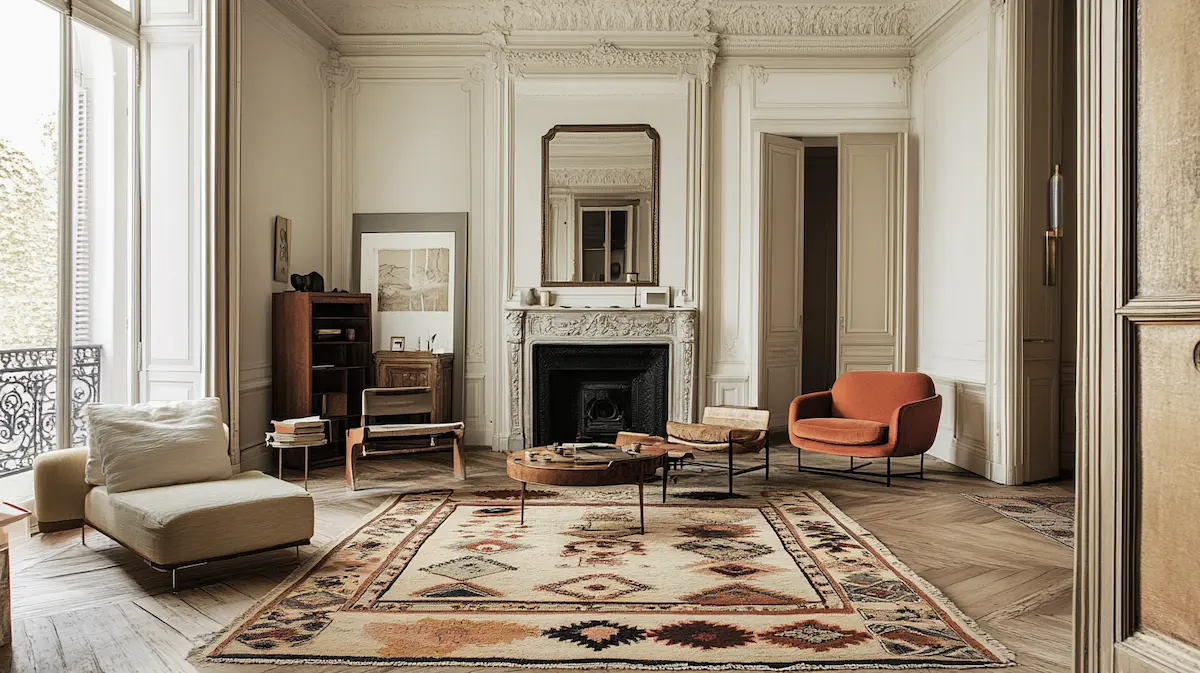
A rug on which only the coffee table sits, with all four legs of the sofa and armchairs on the bare floor around it, does not define a zone. It is a decorative object placed in the centre of the room. A rug of the correct scale — under the front legs of the sofa and the armchairs, with the coffee table centred on it — defines the seating arrangement as a complete zone and makes the room feel composed rather than provisional.
Practical size guide
For a salon with a 2–3-seater sofa and one or two armchairs: a minimum of 200 × 300 cm. For a dining table with four chairs: a minimum of 240 × 340 cm (the chairs should remain on the rug when pulled out for sitting). For a bedroom under a double bed: 160 × 230 cm extending beyond both sides and the foot of the bed. These are practical minimums derived from observation, not precise rules — larger is almost always better.
“The under-scaled rug is one of the most consistent and most correctable errors in any interior. The solution is almost always to go one size larger than feels necessary.”
→ How the rug anchors the complete Parisian vintage living room arrangement: → Complete Parisian Vintage Living Room Makeover Guide
Type 1: The Vintage Kilim — The Most Consistently Parisian Rug
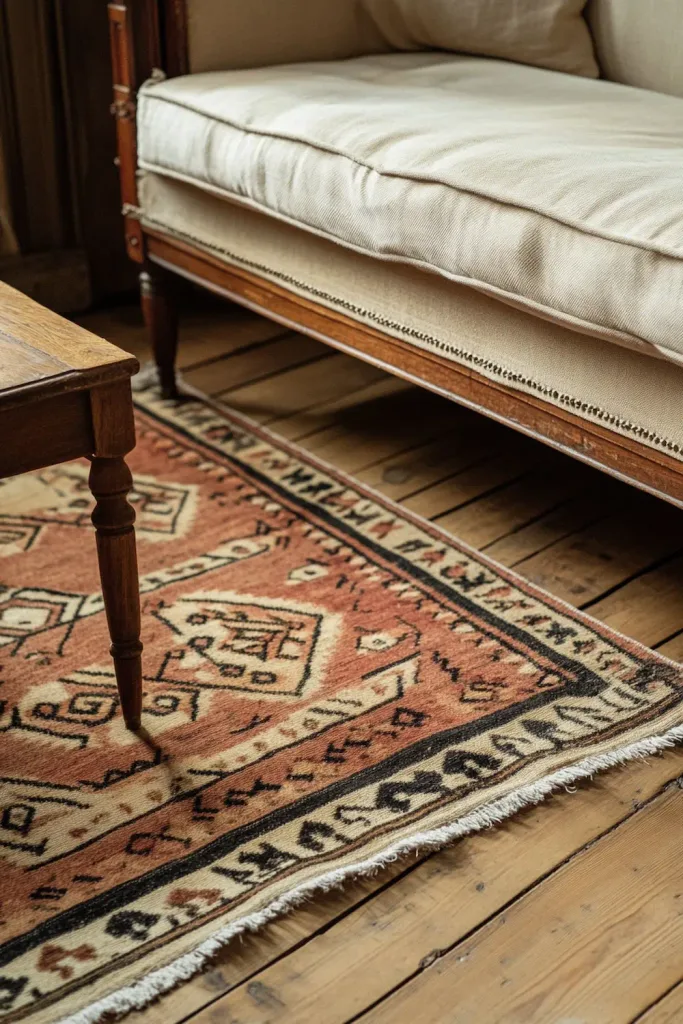
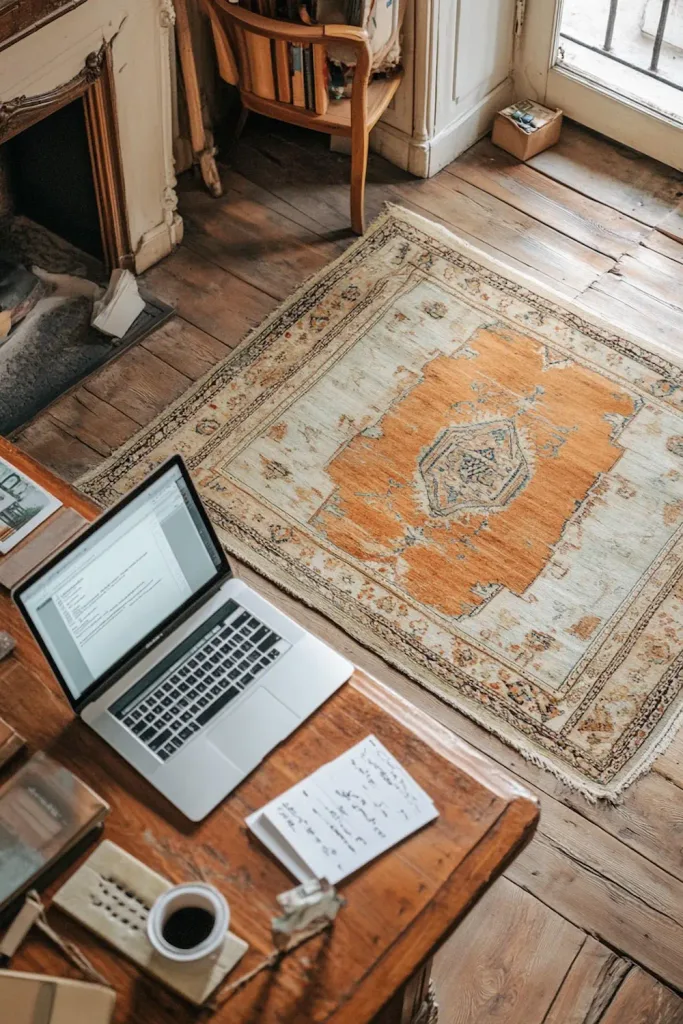
The vintage kilim — a flat-woven rug with a geometric pattern in warm, faded tones — is the rug type that appears most consistently in documented Parisian interiors of all price points and all periods. Its flat-woven structure sits cleanly under furniture. Its geometric pattern provides visual interest without pictorial complexity. And the faded, reduced quality of a genuinely old kilim — the specific warm tones of wool dyed with vegetable dyes and exposed to decades of light and use — is the quality most consistent with the Parisian material vocabulary.
The kilim works in a Parisian interior because it recedes rather than dominates. A kilim in warm ochre, faded terracotta, and ivory geometric pattern reads as a warm, complex ground texture beneath the furniture above it — not as the room’s primary visual statement. Its pattern is visible and interesting at close range; at room distance, it reads as a warm field of colour.
What to look for: the faded palette
The kilim tone that works best in a Parisian context is the faded register: ochre rather than bright yellow, terracotta rather than vivid orange, ivory rather than white. This reduction of saturation is what allows the kilim to sit comfortably beneath a linen sofa, a rattan chair, a walnut coffee table without competing with any of them. A brightly coloured new kilim or a freshly made reproduction in saturated tones fights the room rather than supporting it.
Origin: Turkish, Caucasian, and Afghan flat-weaves
Kilims from Turkey, the Caucasus region, and Afghanistan are the types most commonly found in Parisian interiors. All three share the geometric pattern vocabulary and the flat-weave construction appropriate for this context. The specific design language varies — Turkish kilims tend toward more angular geometric forms, Caucasian pieces are often bolder in scale, Afghan kilims more repetitive in pattern — but all three work equally well in a Parisian salon. The key criterion is the palette and the age; origin is secondary.
| ➶ 7×10 Antique Terracotta Kilim Rug — 200×300 cm, Handwoven Afghan Wool (Etsy) |
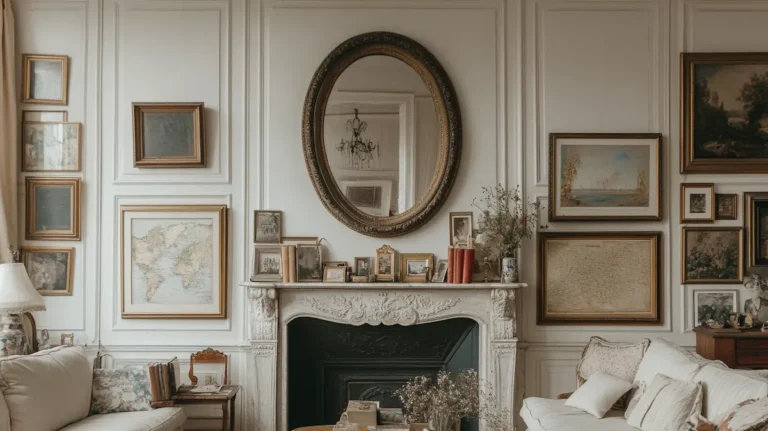
| A large handwoven 200×300 cm kilim in antique terracotta tones from Bokhara Vintage Rugs on Etsy — the correct scale and palette for the Parisian salon seating arrangement shown in Image 1. Made in Maimana, Afghanistan. 100% wool pile and foundation. Hand-woven flat-weave construction. Dyed with organic vegetable and fruit dyes (as stated by the seller). Pet-friendly, easy to maintain with a vacuum cleaner. Each rug photographed in natural daylight without editing; colours may appear slightly different in different lighting conditions. Note: as a handwoven piece, minor colour variations and slight size differences are inherent to the craft. Price listed in the Etsy shop — check current listing · Etsy · Bokhara Vintage Rugs · 200×300 cm Editorial note: This is the correct scale (200×300 cm) and palette (terracotta, ochre, warm tones) for a Parisian salon kilim. The flat-weave construction sits cleanly under furniture. Vegetable-dyed wool produces the warm, slightly muted palette most consistent with the Parisian interior. Verify the current listing photographs closely to confirm the specific colour palette before ordering — kilim tones can vary between pieces. |
Type 2: The Aubusson-Style Flatweave — The Specifically French Option
The Aubusson flatweave is the most specifically French of all rug types in this article. The term ‘Aubusson’ refers to a style of flatwoven carpet with a classical or floral pattern — medallions, garlands, scrolling floral borders — in a soft pastel palette of rose, sage, ivory, and warm gold. The style is associated with the decorative arts of the French interior, and its visual language — the scrolling border, the central medallion, the soft floral motif — is directly related to the carved and gilded furniture, the silk upholstery, and the period mirror frames of the same tradition.
An Aubusson-style flatweave reads as specifically Parisian in a way that a kilim or a Persian rug does not: it is the native rug language of the French interior. In a room with a carved gilt settee, a period mirror, and painted panel mouldings, an Aubusson flatweave is the most contextually correct floor covering available.
A note on the term ‘Aubusson’
The word ‘Aubusson’ is used in the contemporary market to describe rugs in the Aubusson aesthetic — that is, flatwoven rugs with classical French decorative motifs in soft pastel tones — regardless of where they were made. Genuine antique Aubusson rugs from France are rare and expensive. Contemporary Aubusson-style rugs are produced in various countries and sold at widely varying price points. This article uses ‘Aubusson-style’ to describe the aesthetic category, not a specific geographic or historical origin.
The palette: dusty rose, sage, ivory
The Aubusson palette that works in a Parisian context is the muted, slightly faded version of the classical palette: dusty rose rather than vivid pink, warm sage rather than saturated green, ivory rather than white. The same principle applies as with the kilim: the faded, low-saturation version is the version that recedes appropriately beneath the room’s furniture and textiles. A brightly coloured Aubusson in saturated rose and green reads as decorative in a different register.
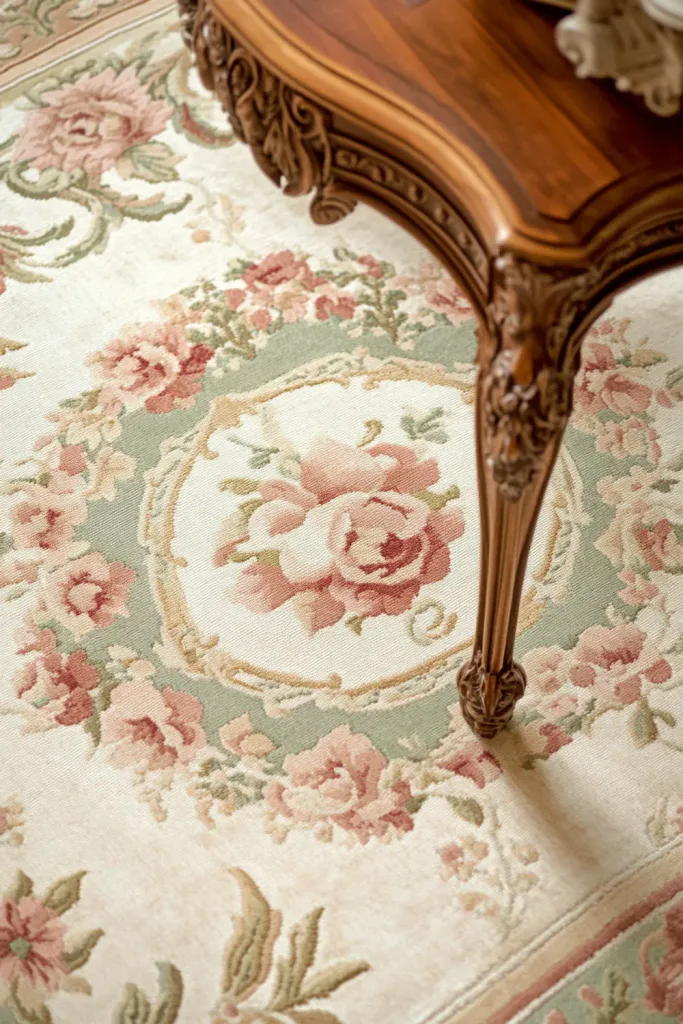
| ➶ French Aubusson Floral Rug — 18th-Century Style, Celadon & Blush Rose (Etsy) |
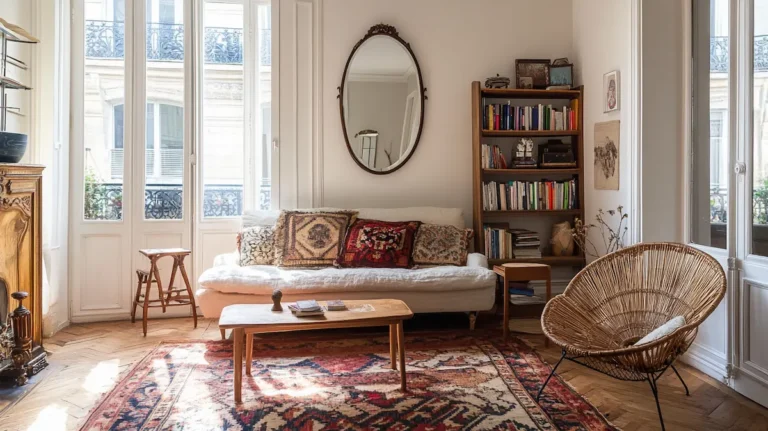
| An Aubusson-style rug inspired by an 18th-century French design — the specific flatweave floral medallion type shown in Image 2. A gentle celadon ground with bouquets of blush, rose, and ivory flowers framed by gilded scrollwork and floral medallions. The palette is soft and muted: dusty rose, warm sage green, ivory — the exact register described in this section. Louis XV château-style. Available in multiple sizes. The seller describes it as a faithful reproduction of a French woven masterpiece. Confirm size availability with the seller before ordering. Price listed in the Etsy shop — check current listing · Etsy Editorial note: This is the most directly applicable Aubusson-style rug available on Etsy: celadon ground, blush and rose floral bouquets, scrollwork border, flatweave construction. The palette is the specific muted, dusty register most consistent with the Parisian interior. Confirm the size and exact palette from the listing photographs before ordering; Aubusson-style tones can appear differently in different screen settings. |
| → Chairish — Genuine Antique and Vintage Aubusson Flatweave Rugs |
| Chairish maintains a consistently strong selection of genuine antique and vintage Aubusson and Aubusson-style flatweave rugs, with detailed condition notes and multiple photographs per piece. The French Rugs and Aubusson categories on Chairish are the most productive for this type. Prices vary considerably depending on age and condition. The offer system allows negotiation. Ships primarily within the US; international shipping from selected sellers. No affiliate relationship — included because Chairish provides the most reliable US-market access to genuine period Aubusson pieces with accurate provenance information. Variable — approx. $400 – $8,000+ depending on age and size · Via Chairish Editorial note: For buyers who want a genuine antique Aubusson rather than a reproduction: Chairish is the most reliable US channel. Filter by ‘Aubusson’ and ‘French’. The offer system is standard practice — an opening offer of 10–20% below the listed price is normal. Condition notes on Chairish are typically accurate; always request additional photographs if the condition is not fully clear from the listing. |
Type 3: The Worn Vintage Persian — Patina as Quality
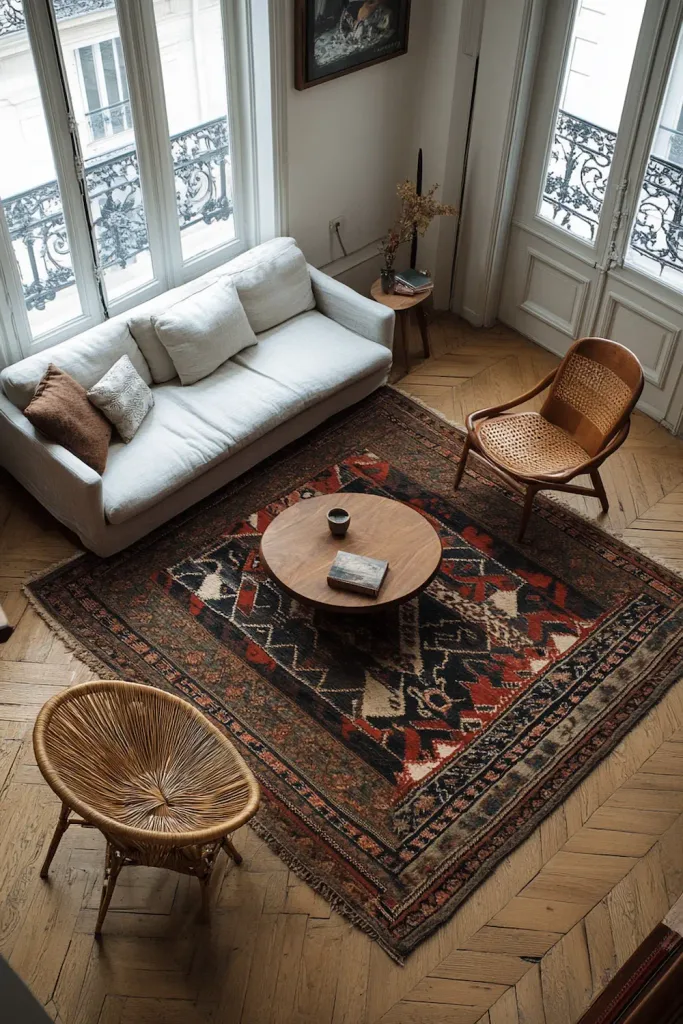
The worn vintage Persian pile rug — with its compressed, reduced pile, faded palette of deep red, blue, and ivory, and intricate medallion or border pattern still legible through decades of use — is the rug type that contributes the most specific quality of accumulated time in a Parisian interior. Its worn areas are not defects. They are evidence of a life lived with the rug, and that evidence is precisely what gives it its power in the room.
The worn Persian works in a Parisian interior in a reading corner, a library, or a bedroom — positions where it is visible but not the room’s primary seating area rug. In a main salon, a very worn Persian can compete visually with the furniture above it because its worn areas attract the eye; in a reading corner or study, the same quality reads as appropriate and characterful.
What to look for: wear in the right places
The wear patterns on a genuinely old Persian rug follow logical use patterns: the central field where most foot traffic occurs, the areas near doorways, the central medallion where the rug is most exposed. This wear is consistent and follows the geometry of the rug’s use. Reproductions that simulate age often have irregular or artificially distributed wear that does not correspond to any plausible use history. The genuine article has wear that makes sense.
Pile height: what the worn rug communicates
A genuinely worn Persian pile rug has compressed pile in the high-traffic areas and slightly higher pile at the edges and in the pattern areas that were less walked on. This variation in pile height — observable when light rakes across the surface at a low angle — is the specific quality that gives the worn Persian its characteristic visual texture. A uniformly low pile throughout reads differently: more as a low-pile rug than as a worn one.
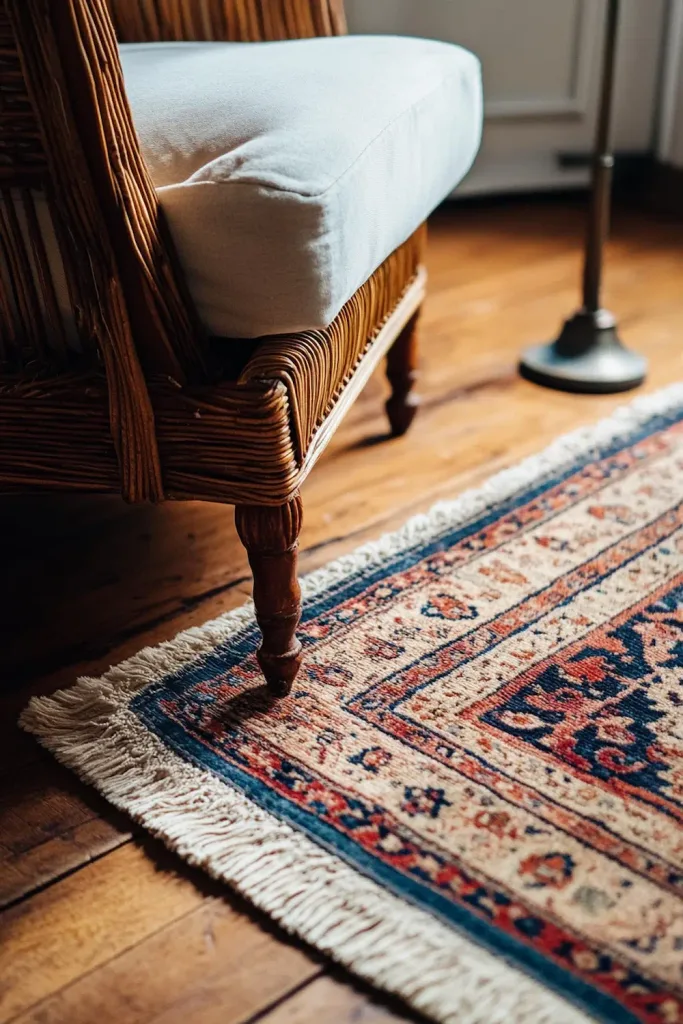
| ➶ Oriental Persian Style Faded Vintage Coral Red 7×10 ft Rug — NatalyaInteriors (Etsy) |
| A hand-knotted area rug in faded vintage coral red with geometric medallion border pattern — the worn vintage Persian type shown in Image 3. Seller: NatalyaInteriors, based in Iowa City. The faded coral red palette and the geometric medallion design produce the specific visual quality of a vintage Persian that has been in a room for decades. 7×10 ft (approximately 210×300 cm). Hand-knotted construction. The ‘faded vintage’ finish in the listing description indicates a deliberately aged appearance consistent with the Parisian worn-rug aesthetic. Note: as a hand-knotted rug, minor variations in pattern and colour are inherent; verify the current listing photographs to confirm the specific faded coral tone. Price listed in the Etsy shop — check current listing · Etsy · NatalyaInteriors · approx. 210×300 cm · Editorial note: This is the hand-knotted worn Persian type shown in Image 3: faded coral red with geometric medallion, vintage-finish construction. The scale (7×10 ft ≈ 210×300 cm) is correct for a reading corner or study in a Parisian interior. Confirm the specific faded tone from the listing photographs; coral red and terracotta can read differently on different screens. |
Type 4: The Natural Jute Rug — The Practical Layer
The jute rug — a flat-woven or loosely woven rug in undyed natural jute fibre, warm honey-gold in colour — is the fourth rug type consistent with the Parisian interior, and the most practical. It appears primarily as a runner in hallways and bedroom corridors, or as a secondary rug in a room that already has a kilim or Persian as its primary zone-definer.
Jute’s visual quality is specific: the natural undyed fibre has a warm, slightly golden tone that is consistent with the room’s material vocabulary of aged wood, natural linen, and aged brass. Its surface texture — the open, slightly irregular weave of natural jute — provides the material warmth of a natural fibre floor covering without the visual complexity of pattern. It recedes into the floor, contributing warmth without drawing the eye.
Where jute belongs in a Parisian interior
The jute runner in a Parisian hallway or bedroom corridor is one of the most immediately effective and least expensive improvements available in those spaces. A corridor of bare floorboards is cold and acoustically harsh; the same corridor with a natural jute runner is warm, quiet, and inhabited. The runner should extend the full length of the corridor, stopping just short of the doorframes at each end.
As a secondary rug under a bed, jute provides the tactile warmth underfoot on the side of the bed where most contact occurs, without competing with a more complex rug in the adjacent room. Two pieces of jute — one on each side of the bed — at a width of 60–80 cm is a common Parisian bedroom arrangement where the budget does not extend to a full bedroom rug.
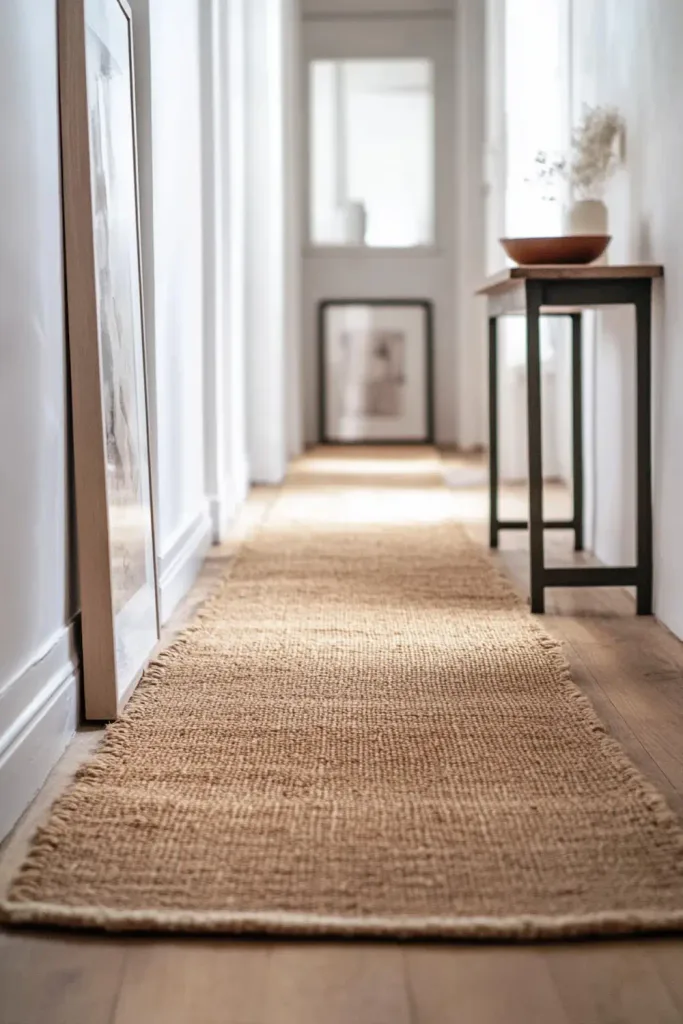
| → La Redoute Intérieurs — Natural Jute Runners and Flat-Weave Rugs |
| La Redoute Intérieurs is a French home furnishings brand available online in more than 26 countries, with a range of natural jute runners and flat-weave rugs in undyed or lightly dyed natural tones. The jute runner category is the most relevant to the Parisian corridor and bedroom use described in this section. Available in multiple lengths and widths; the 70 cm width is the most practical for most Parisian hallways. Ships across Europe and internationally. No affiliate relationship — included because La Redoute provides the most widely available European retail access to natural jute runners at accessible price points. From approx. €35 for a runner · Via La Redoute · https://www.laredoute.com/ppdp/cat-tapis-naturels.aspx Editorial note: The natural jute runner from La Redoute is the most practical and accessible starting point for the Parisian corridor and bedroom arrangement described in this section. The undyed natural tones are correct; the accessible price point makes it possible to cover a long hallway without significant investment. For a more textured surface quality, look for jute described as ‘braided’ rather than flat-woven; both work in a Parisian context. |
The Faded Quality: Why Vintage is Better Than New
A quality that runs through all four rug types described in this article — the kilim, the Aubusson, the Persian, and even the jute — is the preference for age and fading over freshness and saturation. This preference is not arbitrary; it follows directly from the material logic of the Parisian interior.
The Parisian interior is built from materials that have aged in specific ways: the foxed mirror glass, the worn walnut, the faded velvet, the softened linen. A rug that has also been through this process — whose colours have been reduced by decades of light exposure, whose pile has been compressed by decades of use, whose fringe has been trimmed and retrimmed over the years — belongs naturally in this material context. A new rug, however well chosen, carries the uniformity of a piece that has not yet been lived with.
This is why the faded palette is the correct choice for every rug type in this article, and why the worn or antique piece is preferable to a reproduction wherever sourcing allows. The reduction of colour that comes from genuine age is not a loss of quality; in the Parisian context, it is the definition of it.
“A faded kilim is not a worn-out kilim. It is a kilim that has been in a room long enough to become part of it. That is the quality the Parisian interior requires.”
→ How the rug fits within the complete Parisian texture layering approach: → The Art of Layering Textures in a Parisian Interior
→ How rug tone relates to the Parisian colour palette: → The Essential Color Palette for Parisian Vintage Interiors
Sourcing: Where to Find the Right Rug
Physical brocante and vide-grenier
The physical flea market remains the best sourcing channel for genuine vintage kilims and worn Persian rugs at fair prices. Rugs are regularly underpriced at brocantes and vide-greniers because they are difficult to transport and intimidating to buyers without a specific use in mind. A buyer who arrives with a measuring tape, a floor plan, and clear knowledge of what they are looking for will consistently find better pieces at lower prices than any online channel.
Selency for European buyers
Selency is the most productive European online channel for genuine vintage kilims, Aubusson-style flatweaves, and vintage Persian rugs at fair prices. The rugs and tapis categories are well-stocked with pieces from French apartment clearances and specialist dealers. Filter by material (laine for wool, plat pour tapis for flatweave) and by period for the most relevant results.
| → Selency — Vintage French Rugs (Kilims, Aubussons, Persians) |
| Selency is a French online vintage marketplace with a consistently updated selection of vintage kilims, Aubusson-style flatweaves, and worn vintage Persian rugs from French apartment clearances and specialist dealers. The tapis and couvre-sol categories are the most relevant. Filter by material (‘laine’ for wool flat-weaves, ‘kilim’ for flat-woven geometric pieces) and by size. The offer function allows negotiation below the listed price. Ships across Europe; international shipping on request. No affiliate relationship — included because Selency is the most accessible European channel for genuine vintage rugs at fair prices. Variable — typically €45 – €800 depending on type and size · Via Selency Editorial note: For European buyers, Selency is the most productive starting point for genuine vintage kilims and worn Persian rugs. Search ‘kilim’ for flat-woven geometric pieces; ‘tapis persan’ or ‘tapis d’orient’ for pile rugs. The offer function is active and expected — for pieces listed for more than a month, an offer 15–25% below the listed price is reasonable and frequently accepted. |
Etsy specialist sellers
Etsy has a strong and continuously updated selection of vintage kilims, Aubusson-style rugs, and faded Persian pieces from specialist sellers in Turkey, Afghanistan, India, and the US. The three specific Etsy listings in this article represent the specific types and palette described — if any has sold, searching the same seller’s shop or using the same search terms will produce comparable current inventory. Vintage rugs on Etsy are one-of-a-kind pieces that sell and rotate continuously.
Rug Care: What to Do and What to Avoid
A few practical points about rug care that apply across all four types described in this article:
• Vacuuming: flat-woven kilims and Aubusson-style rugs should be vacuumed without a beater bar, using suction only. The beater bar can damage flat-woven structures. Pile rugs (Persian, knotted) can be vacuumed with a beater bar at low suction.
• Rotation: if a rug is exposed to direct sunlight from a window, rotating it 180° annually ensures that any fading is even rather than one-directional. In a Parisian interior, the patina of even, overall fading is preferable to the damage of partial sun bleaching.
• Spills: blot rather than rub. Rubbing spreads the spill and can damage pile. For genuine antique rugs or hand-knotted pieces, professional cleaning is preferable to home washing.
• Underlays: a non-slip underlay beneath any rug on a hard floor serves two purposes: it prevents the rug from sliding, and it adds a small amount of cushioning underfoot. Thin felt underlays are the most appropriate for flat-woven kilims; rubber-backed felt for pile rugs on smooth floors.
• Professional cleaning: genuine antique or vintage rugs — particularly hand-knotted Persians and genuine Aubusson flatweaves — should be professionally cleaned rather than machine washed. The fibres, dyes, and structure of genuinely old rugs are often not suited to machine washing. Confirm cleaning requirements with the seller at the time of purchase.
These guidelines are general and based on commonly observed care practices for the rug types described. For specific care requirements, always consult the seller or a specialist rug cleaner.
→ The sofa and seating arrangement that the rug will sit under: → Best Vintage-Style Sofas for a Parisian Living Room
→ The complete Parisian Vintage Chic Interior guide: → Parisian Vintage Chic Interior: The Complete Style Guide