Best Decorative Objects for a Parisian Mantelpiece
The mantelpiece is the most spatially privileged surface in a Parisian room. It sits at eye level, centred on the room’s primary architectural feature, and whatever is placed on it is read more carefully than objects anywhere else in the space. In a genuinely Parisian apartment it is rarely empty and rarely overcrowded; it carries a specific selection of objects that look as though they arrived one at a time and found their positions over years rather than being arranged in an afternoon.
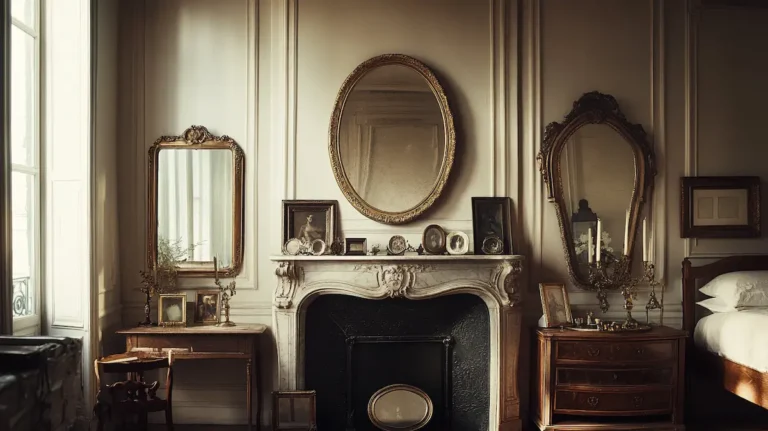
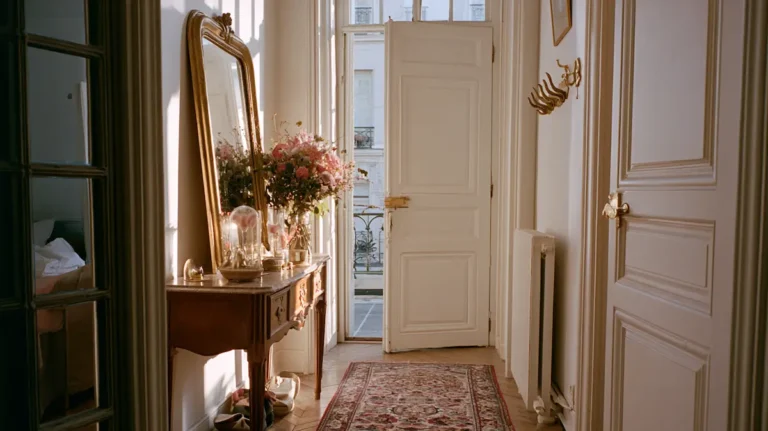
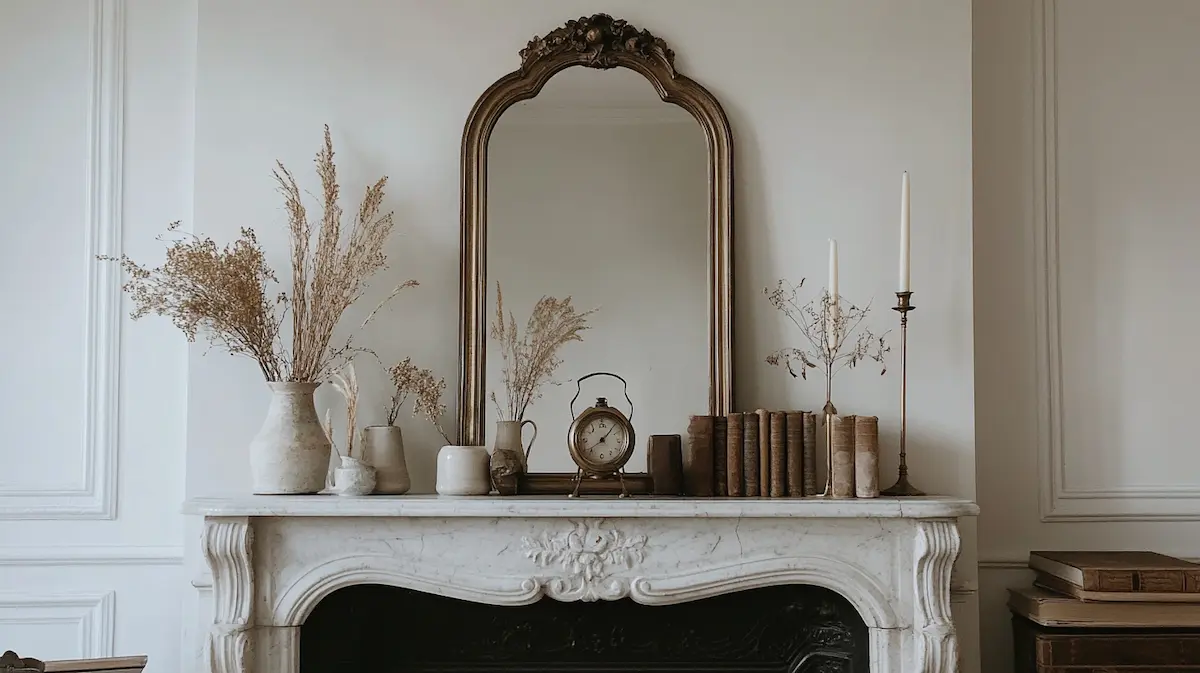
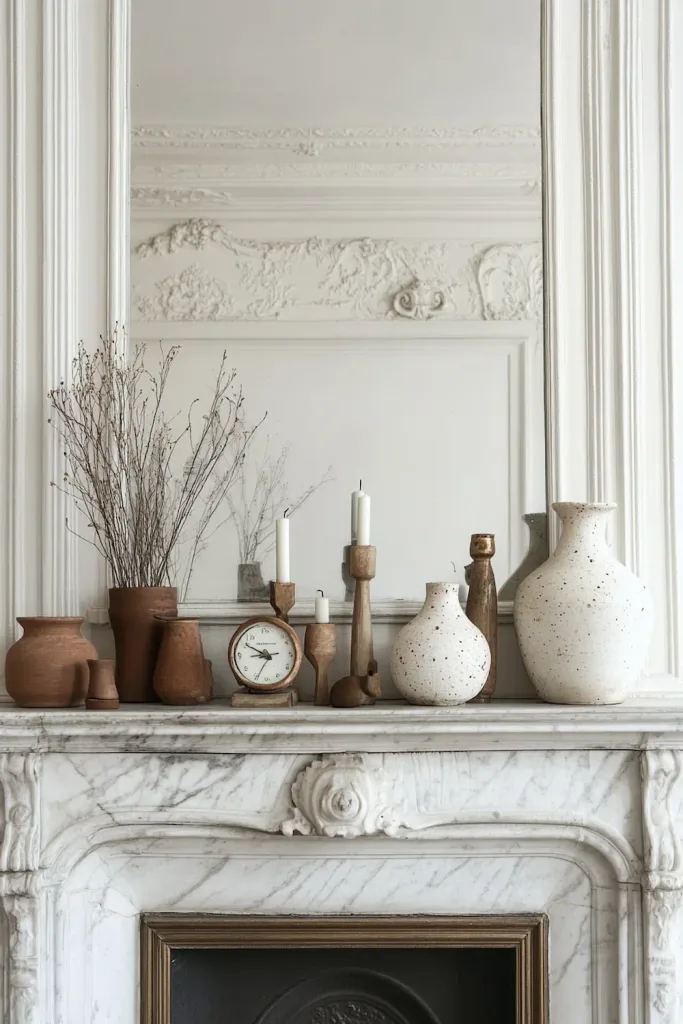
This article covers the six object categories most consistently present on documented Parisian mantelpieces, the composition principle that governs how they are placed together, and specific sourcing for each. The seven photographs in this article show real arrangements across different registers of the same vocabulary: from the simpler, more rustic grouping of terracotta pots and wooden candlesticks to the more classically formal arrangement of a bronze clock, gilt mirror, and brass taper holders. Both are correct; both follow the same underlying logic.
The Composition Principle: Asymmetry and Negative Space
The composition principle that governs a Parisian mantelpiece is the same one that governs the Parisian wall arrangement: objects are placed asymmetrically, with deliberate negative space on at least one side, and with varying heights that create a visual movement across the shelf rather than a flat row of objects all the same height.
The cluster, not the row
Objects on a Parisian mantelpiece are typically grouped rather than evenly distributed across the full shelf width. A cluster of objects — candlesticks, a vase, a clock, a small stack of books — occupies two thirds of the shelf, and the remaining third is left intentionally bare, the plain marble surface visible. This bare section is not an absence waiting to be filled; it is part of the composition. It provides the breathing room that makes the cluster read as deliberate rather than crowded.
Height variation: the key to visual movement
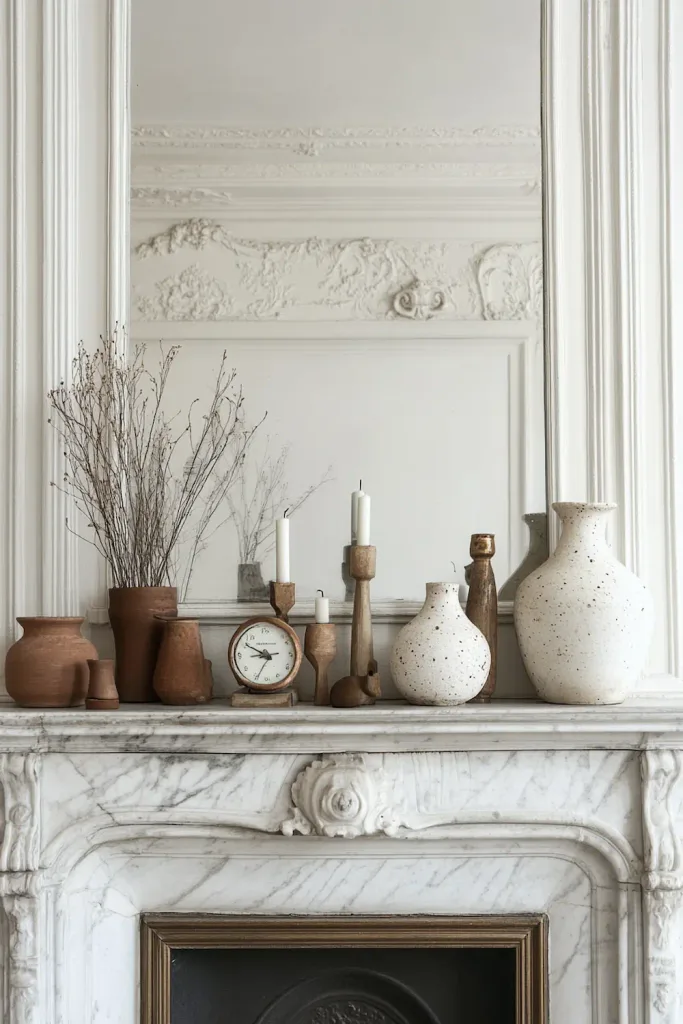
Within the cluster, objects of visibly different heights create the movement that makes the arrangement interesting at a glance: a tall candlestick beside a lower ceramic vase beside a medium-height clock beside a low stack of books, each at a different elevation. A row of objects all at the same height reads as a line rather than a composition. The hero image of this article demonstrates this clearly: the arrangement reads from left to right as a movement of heights, not a flat register.
The mirror as background, not object
When a mirror is present above the mantelpiece — whether hung or leaning, as discussed in Section 4 — it functions as the composition’s background rather than as one of its objects. It reflects the cluster in front of it and doubles the apparent depth of the room at that point. The objects placed in front of it should be spaced to take advantage of their reflection: a single ceramic vase placed in front of a mirror at a slight angle appears as two vases, which increases the richness of the grouping without adding a second object.
“The Parisian mantelpiece is not styled. It is accumulated. The objects arrived at different moments, from different places, and found their position together over time. The arrangement looks like this because it is this.”
→ The complete guide to styling a Parisian mantelpiece, including fireplace and wall context: → How to Style a Mantelpiece the Parisian Way
Brass Candlesticks: Mismatched, Tarnished, Different Heights
Brass candlesticks are the object category most consistently present on documented Parisian mantelpieces. Their warm metal tone relates to all the other warm materials in the room — aged wood, natural linen, foxed mirror glass, dried botanical stems — and their vertical presence provides the height variation that gives the arrangement its movement.
The mismatched group, not the symmetrical pair
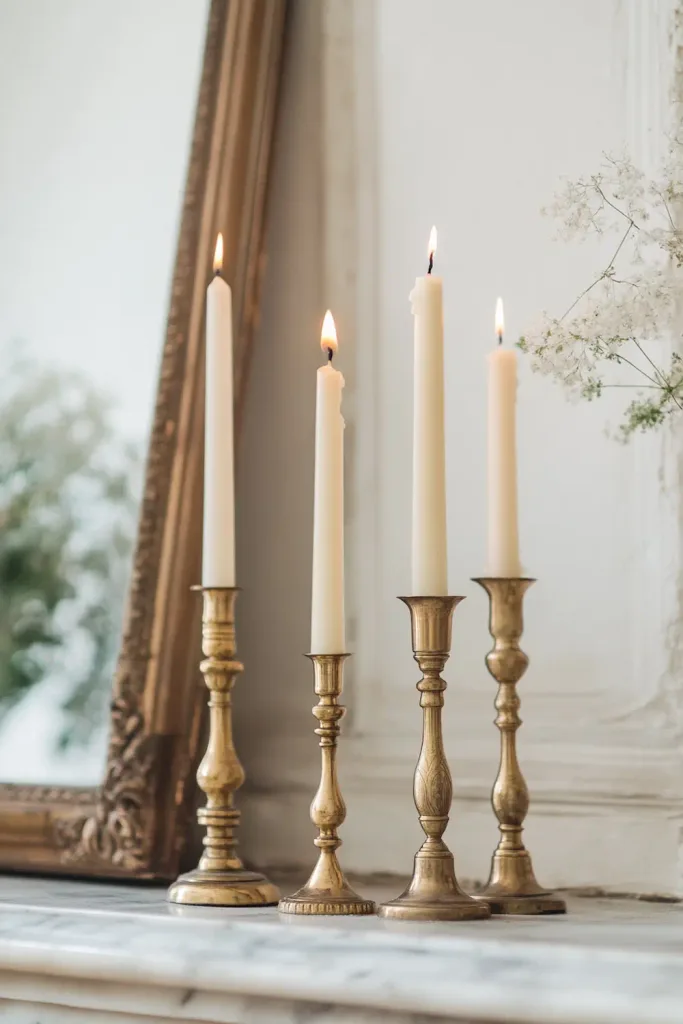
The key principle of the Parisian brass candlestick arrangement is that they are not placed as a symmetrical pair flanking a central object. This is the conventional arrangement — one candlestick on each side, same height, same design — and it reads as formal and institutional. The Parisian arrangement places three or four candlesticks of different heights and slightly different designs grouped together at one side of the shelf, as shown in Image 6. The asymmetry of the group itself is one of the visual signatures of the arrangement.
Tarnished, not polished
The brass patina that reads correctly in a Parisian context is warm and slightly tarnished, not polished to a mirror finish. A highly polished brass candlestick reads as new and as recently purchased; a candlestick with the warm, slightly uneven patina of genuine age and use reads as a piece that has been in the room long enough to become part of it. This is why genuinely vintage brass — available from Etsy sellers, brocantes, and vide-greniers — is consistently preferable to new reproduction brass for this application.
| ➶ Vintage Brass Candlesticks — Mismatched, Sold Separately, Your Choice (Etsy · Star Seller) |
| A large collection of individual vintage and antique solid brass candlesticks, sold separately from a Star Seller who consistently earns 5-star reviews with on-time shipping and quick replies. Each piece is a genuine vintage find with warm patina, tarnish, and signs of use consistent with age — the specific quality shown in Image 6. Multiple heights and designs available from the same shop, allowing you to build a group of three to five mismatched pieces (as described in this article) by selecting from the dropdown menu and combining shipping. Condition of each piece is individually described. Buyers describe arriving pieces as ‘beautiful’, ‘perfect for what I was looking for’, and ‘exactly as described’. Ask the seller to message photographs of specific pieces together before purchase, which they accommodate. Price listed in the Etsy shop — check current listing per piece · Etsy · Star Seller · sold separately, combine shipping |
Weathered Ceramic Vessels: The Organic Layer
Weathered ceramic vessels — stoneware vases with a chalky, slightly matte surface, speckled or worn in tone, in cream, warm stone, or terracotta — provide the organic, material warmth of the mantelpiece arrangement. They relate visually to the aged plaster walls of a Parisian apartment and to the natural, dried botanical material they often hold. Their imperfect surface — slightly uneven in glaze, with visible texture from the clay and the kiln — is the specific quality that makes them read as considered objects rather than as decorative accessories.
Speckled cream and warm terracotta: the two Parisian registers
The seven photographs in this article show both registers clearly. Image 1 shows a mix of terracotta-toned pieces on the left side and large speckled cream/white pieces on the right — both on the same shelf, both correct. Image 3 shows two speckled cream stoneware vases as a focused pair. Image 5 shows a single small chalky cream vessel with allium stems beside a foxed mirror. All three are different scales of the same vocabulary: organic, warm, slightly imperfect surface, muted tone.
Dried rather than fresh
The botanical material in the vases on a Parisian mantelpiece is almost always dried rather than fresh. This is directly observable in all seven photographs in this article: dried grasses, dried allium heads, bare branches, dried gypsophila — never a fresh-cut bouquet. The reason is practical as much as aesthetic: dried material is permanent, requires no water, and develops a warm, slightly bleached tone over time that deepens the relationship with the aged palette of the rest of the room. Fresh flowers introduce a vivid colour and a short lifespan that is inconsistent with the accumulated, unchanged quality of a Parisian mantelpiece.
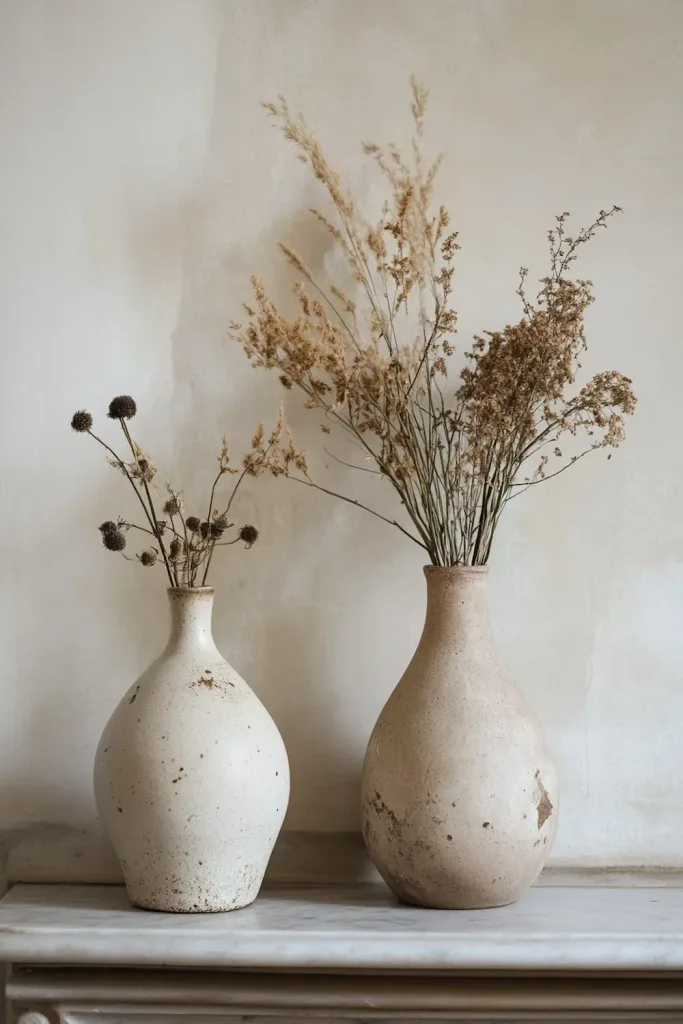
| ➶ Sandy Speckled Handmade Ceramic Vase — ALICJACERAMICS (Etsy) |
| A handmade wheel-thrown ceramic vase in sandy speckled stoneware, ships from Warren, VT. 304 favourites. The sandy speckled surface and warm cream tone of this piece is the specific aesthetic shown in Image 3 of this article — the chalky, slightly imperfect stoneware surface that reads as an organically aged object rather than a decorative accessory. Each piece is individually handmade and therefore slightly different in shape and surface from the listing photographs, which is consistent with the handmade quality described in this section. Sold individually — for a two-vase grouping as in Image 3, order two from the same seller to ensure a related but not identical pair. Price listed in the Etsy shop — check current listing · Etsy · ALICJACERAMICS · handmade stoneware Editorial note: This is the speckled cream stoneware vase type shown in Image 3. For the two-vase arrangement shown, order two pieces: the slight variation between individual handmade pieces is an advantage here, producing the related-but-not-identical pair visible in the photograph. Fill with dried grasses, allium heads, or bare dried branches — not fresh flowers, which would introduce a colour and a lifespan inconsistent with the arrangement. |
The Mirror: Leaning, Not Hung
The mirror above a Parisian mantelpiece is, in most documented Parisian interiors, leaning against the wall rather than hung from it. This is a specific and recognisable choice: it reads as provisional, as placed rather than installed, and it introduces the slight angle that allows the mirror to reflect the room from a position slightly closer to the viewer.
The Parisian mantelpiece mirror is typically large enough to extend above the fireplace surround and to reflect a significant portion of the room behind the viewer — the windows, the chandelier, the opposite wall. A small mirror perched on the shelf reads as a picture; a large mirror leaning against the wall above the mantelpiece reads as an architectural element.
Foxed and gilt: the Parisian mirror type
The mirror glass most consistent with the Parisian mantelpiece is foxed — with visible dark, cloudy patches at the edges of the glass where the silver backing has deteriorated over time. This foxing is not a defect; it is the specific visual quality of very old mirror glass, and it adds the depth and warmth to the reflection that new, perfectly clear mirror glass cannot replicate. The frame is typically gilt — aged, slightly worn gilt rather than bright new gold — as shown in Image 5 of this article. The large arched mirror in Image 7 (the hero) shows a related but more formal version: an arched gilt mirror with elaborate carved cornice, placed against an off-white panelled wall.
Safety: securing a leaning mirror
A large mirror leaning on a mantelpiece shelf must be secured against tipping. A simple anti-tip strap anchored discreetly to the wall behind the mantelpiece is the correct approach — this preserves the leaning visual quality while eliminating the genuine tipping risk of an unsecured heavy object. This is particularly important on a marble mantelpiece where the shelf surface is smooth and the mirror can slide.
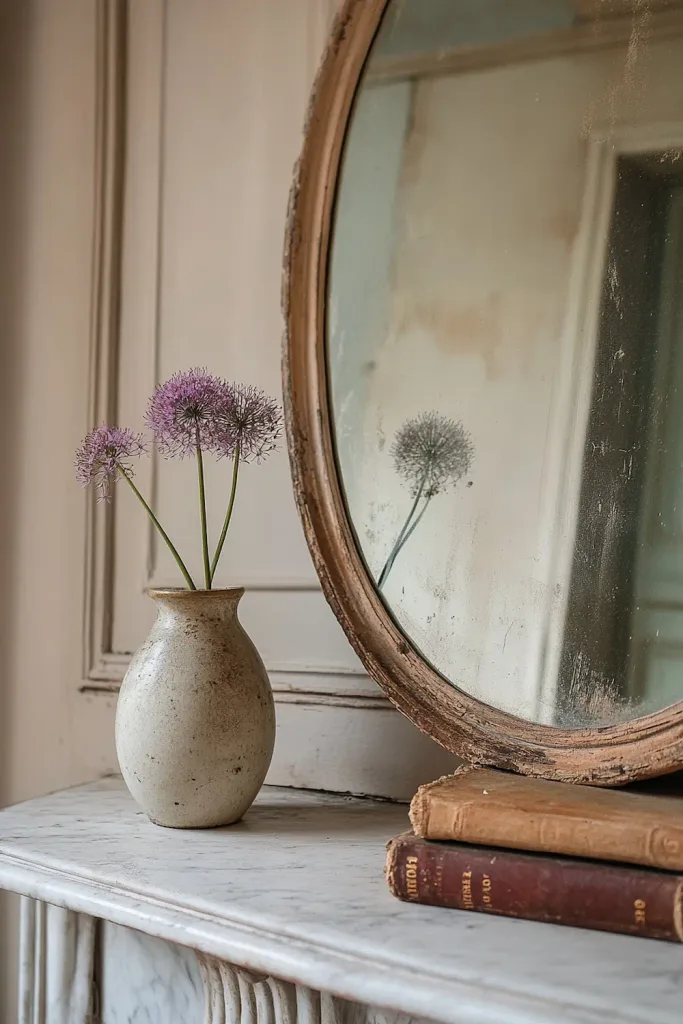
→ Sourcing the right mirror for this position: → Best Antique & Vintage Mirrors for French Interiors
| → Chairish — Antique and Vintage Foxed Mirrors in Gilt Frames |
| Chairish carries a strong and regularly updated selection of antique and vintage mirrors with gilt frames and foxed glass — the specific mirror type shown in Image 5 of this article. The Antique Mirrors category, filtered by gilt or gold frame and by oval or rectangular shape, is the most productive search. Detailed condition photographs show the extent of foxing and the frame wear, which are the two most important quality indicators for this type. Ships within the US; international shipping varies by seller. No affiliate relationship — included because Chairish is the most reliable single source for genuinely foxed gilt mirrors with accurate condition documentation, since the extent of foxing is only assessable from detailed close-up photographs, which Chairish consistently provides. Variable — approx. $200 – $1,500 depending on age and size · Via Chairish Editorial note: For the leaning-mirror arrangement: look for a mirror at least 80 cm tall and wide enough to extend beyond the fireplace opening on each side when leaning. Oval and arched-top shapes are the most specifically Parisian; rectangular is also appropriate. Filter by ‘foxed’ in the description search or look for listings that specifically mention foxing in the condition notes. Always confirm the dimensions against your mantelpiece width before purchasing. |
The Antique Mantel Clock: Off-Centre, Not Dominant
The mantel clock is one of the most specifically period-French objects available for a Parisian mantelpiece. A dark patinated bronze or spelter case with classical figural or ornamental detail, an aged ivory clock face with Roman numerals, and a general scale of approximately 20–30 cm tall — this is the type shown in Image 4 of this article: placed off-centre (not in the exact middle of the shelf) with a single brass candlestick on its left and a small stack of books on its right.
Off-centre, not centred
The conventional mantelpiece clock placement is dead-centre, flanked by two symmetrical candlesticks. This reads as formal and as a traditional arrangement. The Parisian approach places the clock off-centre, typically toward one side of the cluster, with the remaining objects grouped around it rather than flanking it symmetrically. This is directly visible in Image 4: the clock is placed toward the centre-right of a shelf that extends further to its left, creating an asymmetry consistent with the composition principle described in Section 1.
The clock face: aged ivory, Roman numerals
The clock face most consistent with the Parisian aesthetic has an aged ivory or warm cream tone rather than bright white, with Roman numerals rather than Arabic. A clock face in bright white with clean black numerals reads as contemporary; the aged ivory with Roman numerals reads as period-appropriate.
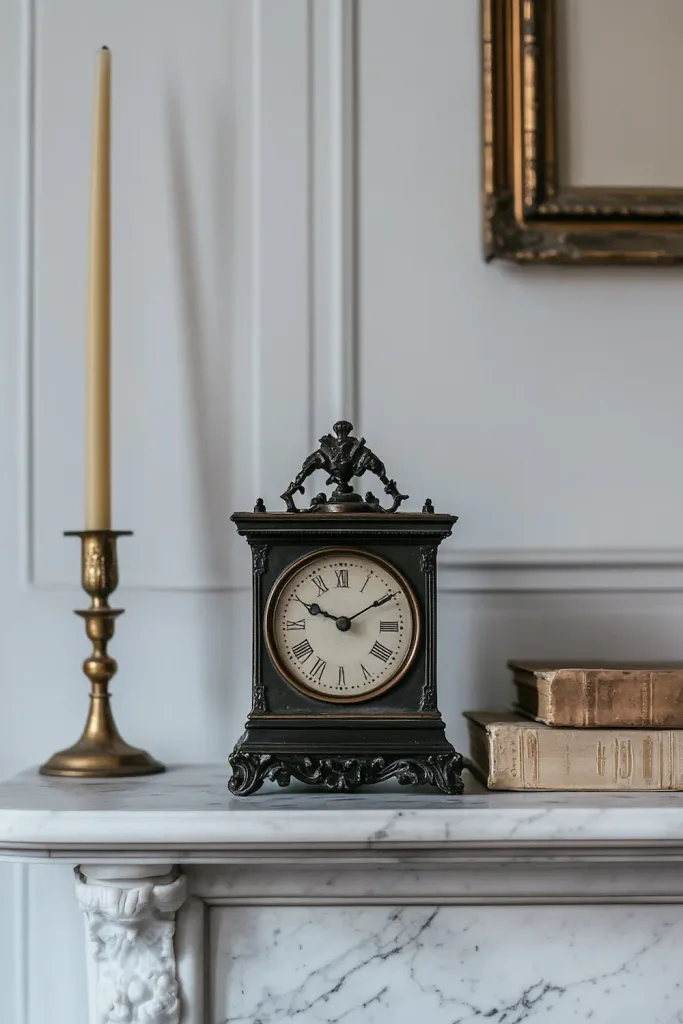
| ➶ Lily’s Home Antique-Style Mantel Clock — Black, Roman Numerals, Silent Quartz (Amazon) |
| An antique-inspired decorative mantel clock in black with large Roman numerals, a distressed clock face, and scroll hands — the closest widely available reproduction to the dark-case clock type shown in Image 4 of this article. Silent non-ticking quartz movement, battery-operated (1 × AA, not included). Dimensions: 11¾” tall × 6½” wide. The black antique-finish case and aged ivory-toned dial with Roman numerals are the specific visual register described in this section. Note: this is a reproduction clock, not a genuine antique. Price listed on Amazon — check current listing · Amazon |
Books and Small Objects: The Personal Layer
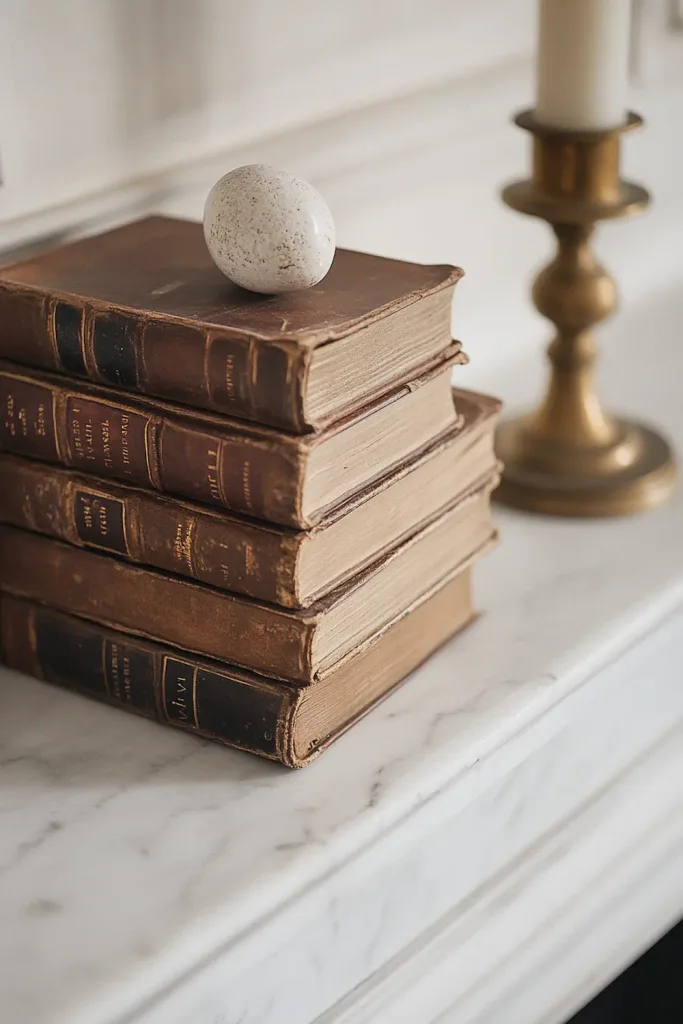
A stack of two to four worn leather-bound books — with their aged spines and covers, in warm tan and brown tones, clearly old and handled — is one of the most specifically personal objects available for a Parisian mantelpiece. Placed as a low horizontal element within the cluster, books contribute a different scale and visual texture from the vertical candlesticks and vases: they are flat, horizontal, and clearly functional objects that happen to be beautiful rather than decorative objects that happen to look like books.
Genuine old books, not decorative fakes
The difference between genuine old books and the bound decorative boxes or faux-leather display objects sold as ‘decorative books’ is immediately visible in a Parisian context. Genuine old books have specific qualities: the spine lettering worn and partially legible, the pages yellowed and slightly irregular at the edges, the covers soft with years of handling. A decorative fake has uniform surfaces, perfectly legible blocked titles, and the visual quality of a prop rather than an object with a history. Genuine old books are available from second-hand book markets and brocantes at very low cost; they do not need to be rare or expensive. The quality that matters is purely visual and tactile.
A small object on top
The small object placed on top of the book stack — visible in Image 2 of this article: a small matte stone egg sitting on the topmost cover — is the most personal element of the mantelpiece arrangement. It can be anything with the right material quality: a small bronze fragment, a worn stone object, a ceramic piece, a smooth pebble from a meaningful place. What it should not be is another decorative accessory purchased for the purpose. The specific quality of these objects is that they are found rather than bought: they arrived from somewhere else, they are kept because they are interesting, and they happen to sit well on a book.
→ How to source and style flowers and botanical material for a Parisian interior: → How to Style Flowers the Parisian Way at Home
→ Affordable decorative objects for the Parisian home across all surfaces, not just the mantelpiece: → Best Parisian Vintage Home Accessories Under €50
Putting It Together: The Complete Arrangement
With the six object categories described — brass candlesticks, ceramic vessels with dried botanicals, a leaning mirror, an antique clock, and books with a small object — the question is how they come together on the shelf. The composition principle from Section 1 applies throughout: asymmetric cluster, deliberate negative space, varying heights.
A practical starting sequence
Begin with the mirror: lean it against the wall above the mantelpiece, slightly left of centre or centred depending on the mirror’s proportions relative to the shelf. This establishes the backdrop. Then place the tallest candlestick to one side, not flanking the mirror but within its reflection zone. Place the second tallest candlestick beside or in front of the first, slightly lower. Add the clock off-centre within the remaining space. Group the ceramic vessels, with their dried botanical stems, on the opposite side of the clock from the candlesticks. Place the stack of books horizontally at the base of the arrangement, with the small stone or bronze object on top. Stand back and assess the negative space: if less than one third of the shelf is visibly empty, remove one object.
The negative space test
The specific test for whether a Parisian mantelpiece arrangement is complete: is at least one third of the shelf surface clearly visible as bare marble? If not, the arrangement is overcrowded and needs objects removed rather than rearranged. The most common mistake in mantelpiece styling is adding more — another vase, another candle, another object — when what the arrangement needs is less. The empty marble is not a gap; it is the element that makes everything else readable.
→ The Parisian Vintage Chic Interior complete guide: → Parisian Vintage Chic Interior: The Complete Style Guide