Best French Vintage Dining Tables & Chairs
The Parisian dining table is rarely surrounded by a matching chair set. Walk into almost any documented Parisian dining room and the chairs differ: a few carved walnut chairs with caned seats, a few simpler bentwood bistro chairs, perhaps one upholstered piece at the head of the table. The table itself — round marble on a carved pedestal, or a long oval in warm walnut — anchors the room, and the chairs around it are gathered rather than ordered as a set.
This article covers the two dining table types most consistent with the Parisian aesthetic, the two principal chair types that surround them, the specific logic of mixing chairs without a table looking unfinished, and the practical scale rules that make a dining room function. Sourcing guidance is given honestly: where a stable, verifiable product exists, it is linked directly; where the correct piece is a one-of-a-kind antique, you are directed to the marketplace where you can find your own best match.
| ⚠ A note on sourcing this article’s furniture: The round marble table and the caned/bentwood chairs shown here are vintage pieces that sell and rotate — a single named Etsy listing for these would risk being inaccurate or unavailable by the time you read this. For these pieces, this article points you to the curated marketplaces (Chairish, Selency) where the closest current match can be found. One Etsy listing is included for the oval walnut table, which is a made-to-order product type rather than a one-off antique, and is more reliably available. No Amazon link is included in this article: a thorough search found no specific, currently verifiable product that genuinely matches the bentwood caned chairs or carved marble table shown in the images — forcing an unrelated Amazon product into the article risked recommending something that does not match what you would actually receive. |
The Round Marble Table: The Most Recognisably Parisian
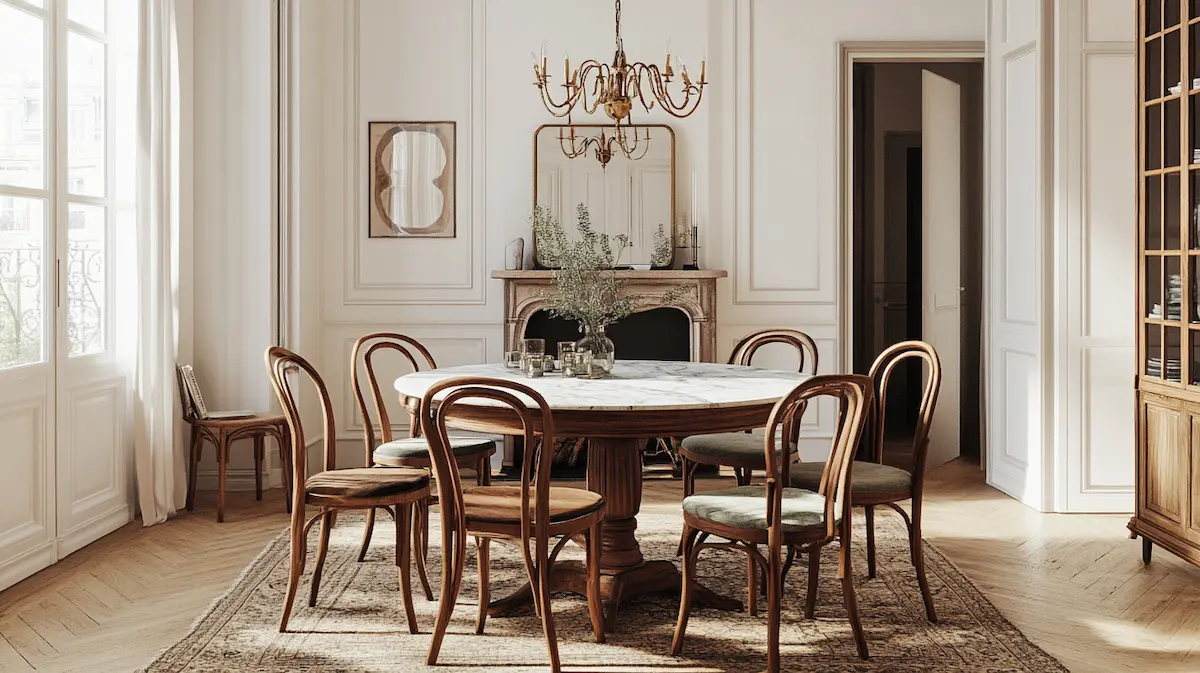
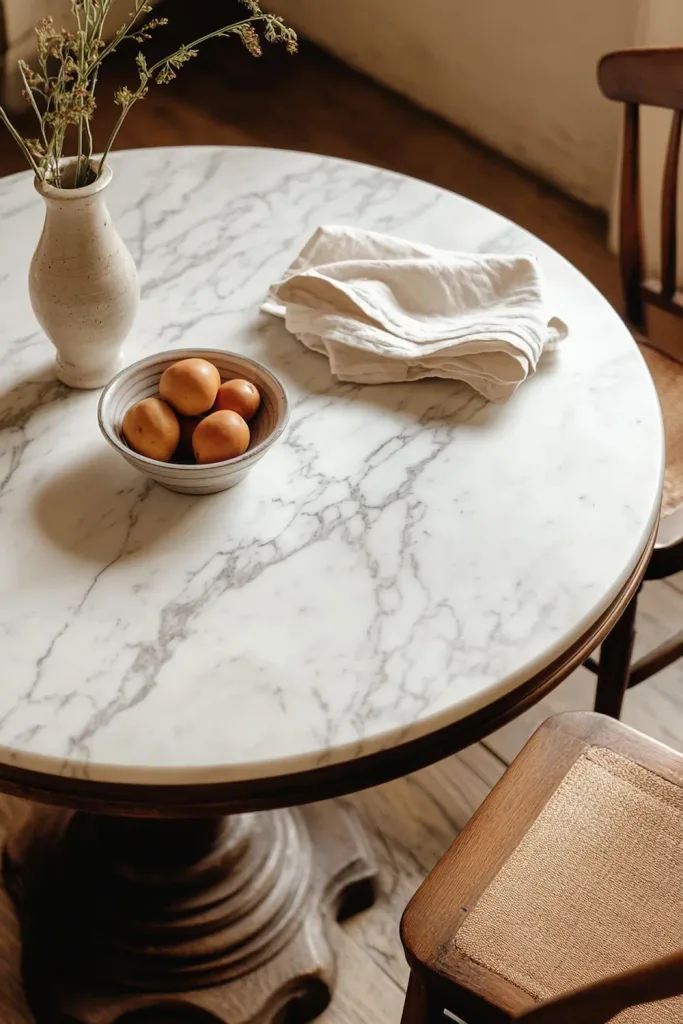
A round table with a white or grey-veined marble top, set on a substantial carved or turned wood pedestal base, is one of the most recognisable single objects in the Parisian dining vocabulary. Its presence in a small Haussmann dining room — as shown in this article’s photographs — is consistent and specific: the marble top is honed rather than glossy, the veining is visible but not dramatic, and the pedestal base beneath is dark, turned or carved wood with real weight and presence.
Honed, not polished
The marble finish that reads correctly in a Parisian context is honed: a matte, slightly chalky surface rather than a glossy, reflective polish. A honed marble top has a soft, slightly cool visual quality that relates to aged plaster walls and worn stone floors; a high-gloss polished marble top reads as more contemporary and more formal, closer to a hotel lobby than a lived-in apartment.
The pedestal base: weight and carving
The base beneath a Parisian marble table is rarely a thin or minimal support. It is typically a substantial turned or carved wood column, sometimes with a tripod foot, sometimes with a more architectural carved base, as shown in this article’s close-up image of the table base. This weight at the base is what allows the table to feel grounded and historic rather than improvised — a thin metal pedestal beneath a marble top reads as a contemporary reproduction rather than a genuinely vintage piece.
| On sourcing this specific table: A round honed-marble table on a carved pedestal of this exact character is a one-of-a-kind antique or vintage find — no single current Etsy listing can be confirmed as a reliable match without risking it being sold out or visually different from what is shown here. See Section 6 for the marketplaces where you can find your own closest match. |
The Oval Walnut Table: The Everyday Alternative
Where the round marble table is the more formal, more architectural choice, the oval walnut table — a warm, slightly worn wood surface on a simple trestle or pedestal base — is the more everyday, more frequently lived-with alternative. Its visual quality depends on the wood itself: the grain should be visible and the surface should show the slight wear of genuine use, rather than presenting a uniform, unmarked factory finish.
Trestle vs. pedestal base
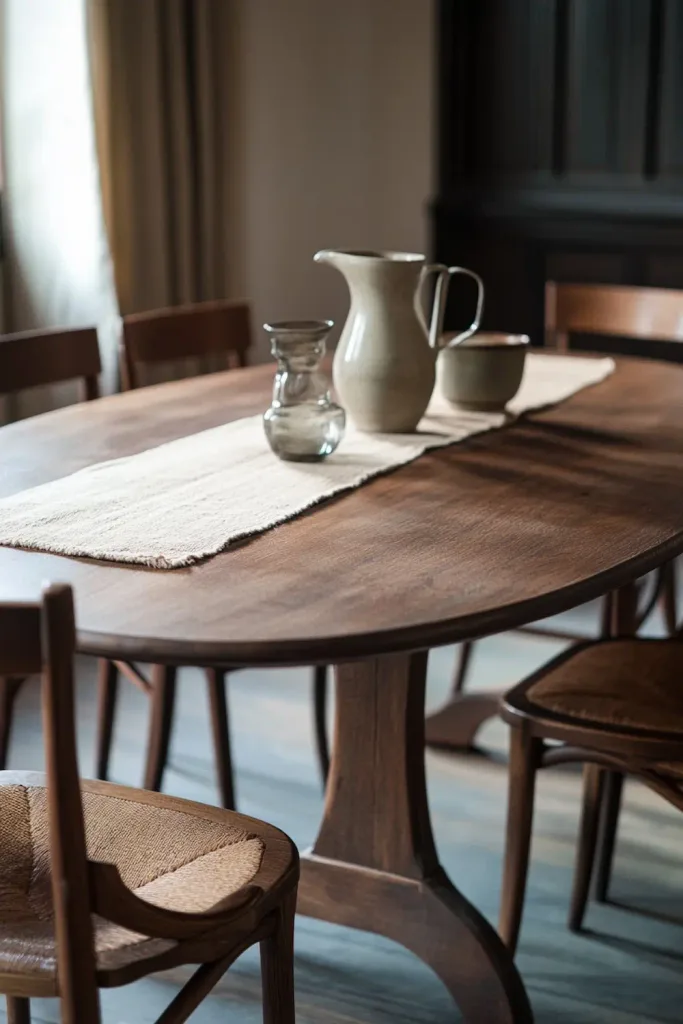
The oval walnut table in this article’s photograph sits on a single curved trestle support — a sculptural, almost architectural single column that splits to meet the tabletop. This is a more contemporary interpretation of the trestle form than the traditional twin-trestle farmhouse table, and reads as more specifically Parisian: simpler, more sculptural, less rustic. A double-pedestal base (two separate column supports, one toward each end of the oval) is the more traditional alternative and equally appropriate.
Surface styling: runner, not full tablecloth
A linen table runner down the centre of an oval walnut table — rather than a full tablecloth covering the wood — is the more typically Parisian approach, since it allows the wood grain to remain visible at the table’s edges. A ceramic jug, a glass vessel, and a small bowl, placed with generous negative space around them, is a sufficient centrepiece; an oval table does not need to be fully dressed to look considered.
| ➶ Walnut Trestle Dining Table — Custom Size, Made to Order (Etsy) |
| A solid walnut dining table with a trestle base, available in custom length and depth, with a matte VOC-free, plant/oil-based finish. This is a made-to-order product rather than a one-off antique, which makes it a more reliably available option than searching for a specific vintage piece. The trestle base style differs from the single curved pedestal shown in this article’s image — this listing’s trestle is a more traditional twin-leg farmhouse-style base with breadboard ends, not an exact visual match — but the warm solid walnut surface and trestle-table category are the correct starting point if you want a new, orderable table rather than a vintage find. Confirm current size options, lead time, and finish directly with the seller before ordering, as these tables are built to order. Price listed in the Etsy shop — check current listing · Etsy · made to order Editorial note: This is the closest stably available product to the oval walnut table shown in Image 5: solid walnut, similar warm tone, trestle-base category. The specific base shape differs (twin-leg trestle rather than the single sculptural curved support in the image), so treat this as a representative starting point rather than an exact visual match. Because it is made to order, confirm current lead times — custom furniture of this kind can take several weeks to build. |
Caned Dining Chairs: The Most Specifically French Chair
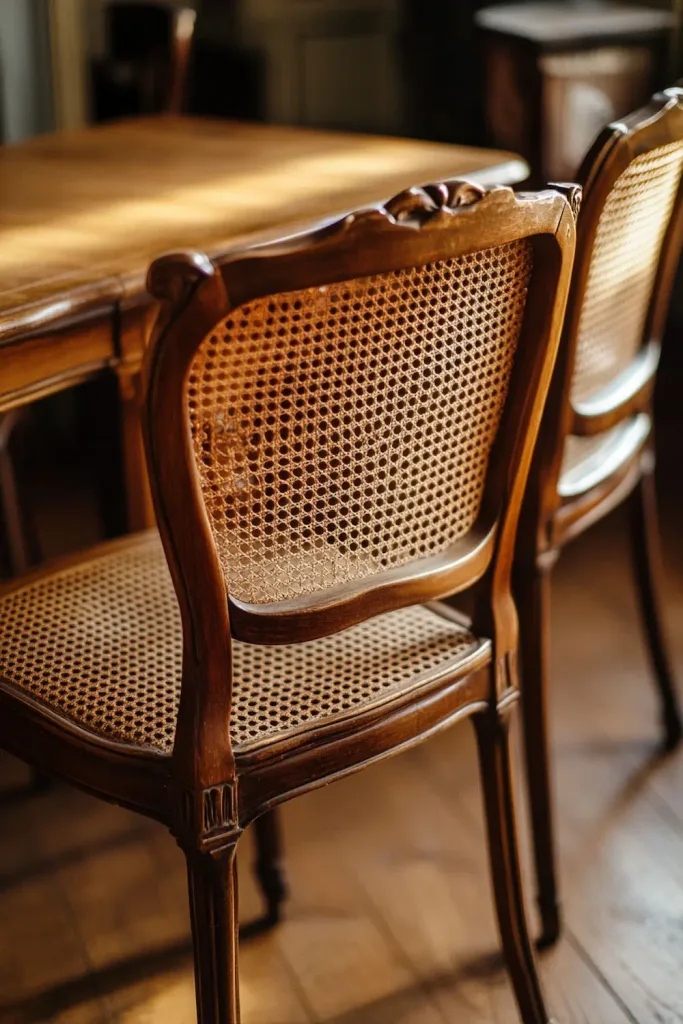
The caned dining chair — a chair with a woven natural cane seat and often a caned back panel, set within a carved or turned wood frame — is one of the chair types most consistently associated with the French interior. The cane itself, aged to a warm honey-brown tone, contributes texture and lightness: a room full of solid upholstered or solid-wood chairs feels heavier than the same room with even two or three caned pieces mixed in.
What to look for in the carving
The carved walnut caned chairs shown in this article’s close-up images have a shaped top rail with a small carved detail (a shell or scroll motif) and cabriole-style front legs — the classic vocabulary of a French provincial dining chair. The cane itself shows visible signs of age and use: slightly darkened in tone, with small repair patches in places, which is consistent with a genuinely old chair rather than a new reproduction.
Condition: small repairs are normal, not disqualifying
Cane seating on a genuinely old chair will often show small areas of repair or replacement — a patch of new cane within an otherwise aged seat, or minor unevenness in the weave. This is normal wear for a material that is, by nature, more fragile than solid wood, and does not indicate a poor-quality piece. A full re-caning is a straightforward and not especially expensive repair if a seat needs full replacement; many specialist upholsterers and some sellers offer this as a service.
| On sourcing caned dining chairs of this type: Carved walnut caned chairs of this specific character (shaped top rail, cabriole legs, aged cane) are vintage pieces sold individually or in small sets that sell quickly and rotate continuously — there is no single stable current Etsy listing that can be confirmed as a reliable match. See Section 6 for the curated marketplaces where genuine examples are consistently available. |
Bentwood Bistro Chairs: The Café Heritage
The bentwood bistro chair — with its curved, steam-bent wood frame in the recognisable Thonet-style silhouette and a round caned or woven seat — carries a different but equally Parisian heritage: the café and bistro rather than the formal dining room. Its lighter, more open frame and the slight give of a caned seat make it a comfortable, informal counterpoint to a heavier carved chair.
The Thonet silhouette
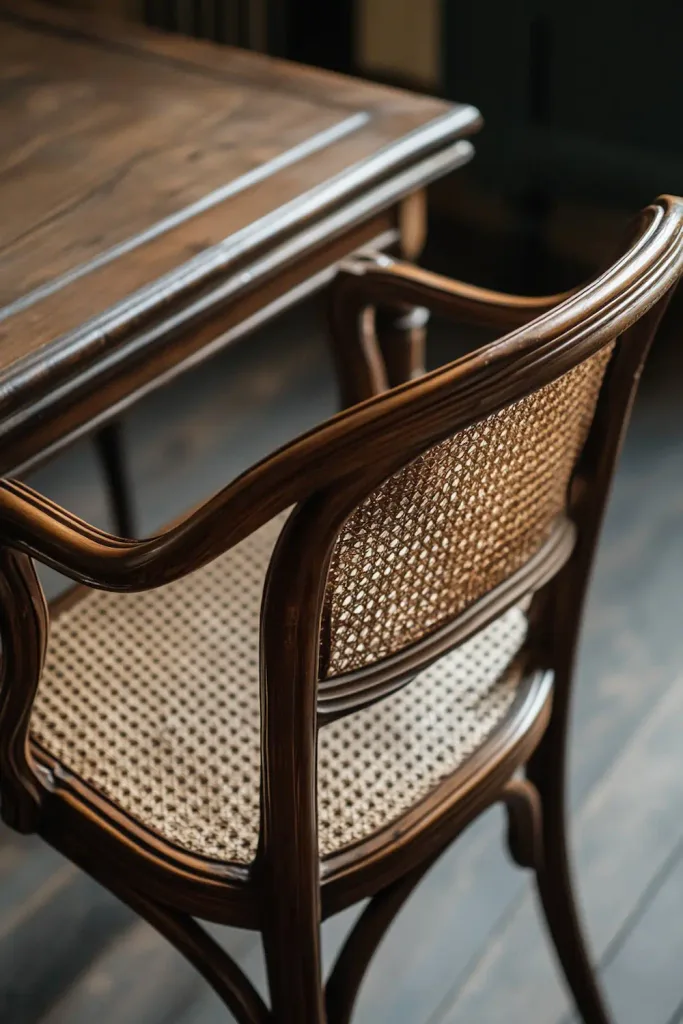
The defining visual feature of a true bentwood bistro chair is the continuous curved line of steam-bent wood that forms the back and, in many designs, sweeps down into the front legs in a single gesture. This silhouette, popularised by the furniture maker Thonet in the 19th century and subsequently produced by many other manufacturers across Europe, is instantly recognisable and remains in production today in various qualities and price points.
Wood tone: dark walnut stain is the most Parisian
Bentwood bistro chairs appear in a range of finishes, from natural beech to dark stains. The dark walnut-stained finish shown in this article’s close-up image is the tone most consistent with the warm, aged-wood Parisian palette; a natural light beech finish reads as more contemporary Scandinavian-café in character. Both are correct chair types; the dark stain simply integrates more easily with the carved walnut pieces.
| → Chairish — Vintage and Antique Thonet-Style Bentwood Chairs |
| Chairish carries a consistently strong and frequently updated selection of genuine vintage and antique Thonet and Thonet-style bentwood chairs with caned seats, sold individually, in pairs, and in larger sets, across a range of production periods and price points. The Bentwood Dining Chairs and Thonet collections allow filtering by quantity (useful if you need a specific number to complete a mixed set) and by price. Detailed condition notes and multiple photographs accompany each listing. Ships within the US; international shipping varies by seller. No affiliate relationship — included because Chairish is the most reliable single source for genuine bentwood caned chairs of the type shown in this article, with accurate condition reporting that a forced single-listing link could not guarantee. Variable — approx. $90 – $400 per chair depending on age and condition · Via Chairish |
Mixing Chairs: No Two the Same, On Purpose
The single most distinctive habit of the Parisian dining table is that the chairs around it are rarely identical. A table surrounded by six matching chairs, all from the same set, reads as furnished in a single transaction. A table surrounded by carved caned chairs, bentwood bistro chairs, and perhaps one upholstered armchair at the head — no two exactly alike — reads as accumulated over years, which is the specific quality this entire site is built around.
What needs to relate, even when chairs differ
As with the bedroom furniture mixing principle, a few things should connect even a deliberately varied set of dining chairs: a similar wood tone family (dark walnut stains together, rather than mixing a near-black ebonised chair with a pale natural beech one), a roughly consistent seat height (within 2–3 cm so the table line reads level), and a shared general scale (avoid mixing one large, heavy armchair with several very slender, delicate side chairs unless the larger piece is deliberately positioned as a single head-of-table seat).
A practical mixing formula
A reliable starting formula for a table seating six: two or three carved caned chairs, two or three bentwood bistro chairs (Section 4), and optionally one upholstered or armchair piece at the head of the table. This is close to the ratio shown in this article’s full-room photograph, where eight chairs at a round table are largely matching bentwood pieces with two slightly different carved chairs mixed in — demonstrating that the mixing can be subtle (mostly one type, with a few different pieces) or more pronounced (genuinely no two alike), and both read as correctly Parisian.
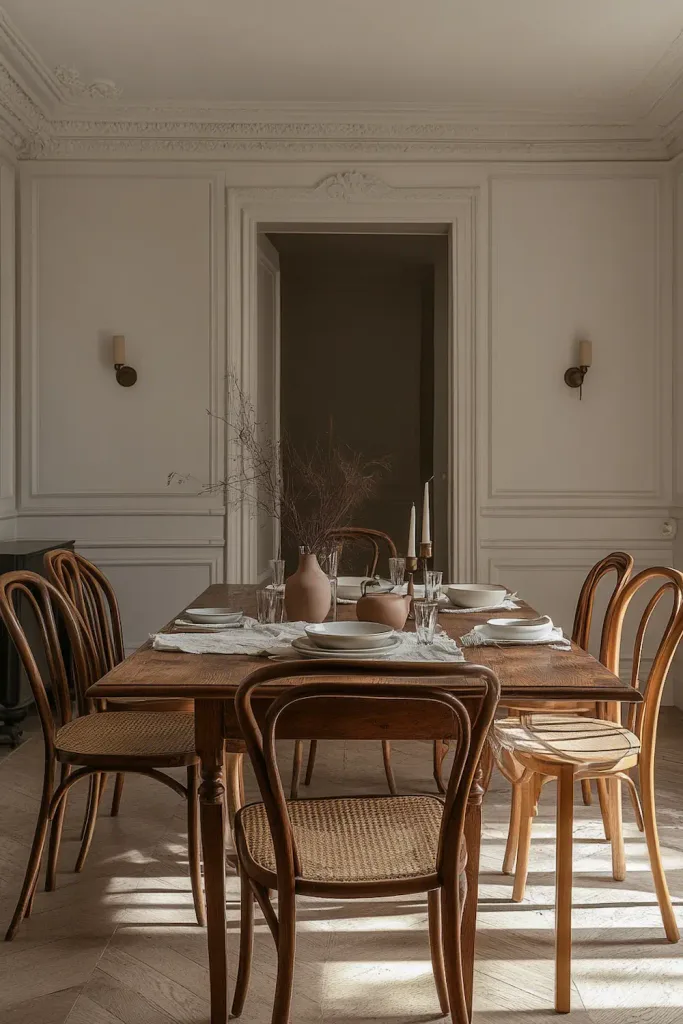
“A dining table surrounded by chairs that all match says: this was bought as a set. A table surrounded by chairs that relate but don’t match says: this was gathered, one good find at a time.”
→ More on the principle of combining old and new, matching and mismatched, throughout a Parisian home: → How to Mix Old and New in a Parisian-Style Home
Where to Find One-of-a-Kind Pieces
For the round marble table, the carved caned chairs, and any individual bentwood pieces beyond what is available on Chairish, the most productive sourcing channels are curated vintage marketplaces and, for European buyers, French-market platforms specifically.
Selency for European buyers
Selency is a French online vintage marketplace with a strong and continuously refreshed selection of marble-top dining tables, carved caned chairs, and bentwood bistro chairs sourced from French apartment clearances and specialist dealers. The tables and chaises categories allow filtering by material and by period. The offer function allows negotiation below the listed price, which is standard practice on the platform.
| → Selency — Vintage Marble Dining Tables and Caned Dining Chairs |
| Selency carries a regularly updated selection of vintage round marble-top dining tables on carved or turned wood pedestal bases, alongside carved walnut caned dining chairs and bentwood bistro chairs, sourced primarily from French households and specialist sellers. The tables and chaises categories can be filtered by material (marbre for marble tables, cannage for caned chairs) and by period. Ships across Europe; given the weight of marble tabletops, always confirm shipping method and cost before purchase, since some require specialist furniture courier services rather than standard parcel delivery. No affiliate relationship — included because Selency is the most productive single European channel for both the marble table and the caned chair types shown throughout this article. Variable — tables typically €300 – €1,500; chairs typically €40 – €180 each depending on condition · Via Selency · Editorial note: Search ‘table marbre ronde’ for the round marble table type, and ‘chaise cannée’ or ‘chaise bistrot’ for the two chair types described. Request additional photographs of the marble surface (to check for chips or significant staining) and of the cane condition before committing to purchase — these are exactly the details that determine whether a piece matches what is shown in this article’s images. |
Physical brocante and vide-grenier
As with rugs and other vintage textiles covered elsewhere on this site, the physical flea market remains one of the most cost-effective channels for genuine French dining chairs specifically — caned and bentwood chairs are common, relatively affordable finds at brocantes because individual chairs (rather than full matching sets) are often undervalued by sellers who assume buyers want a complete set. A buyer specifically looking to build a deliberately mixed collection, as described in Section 5, is well served by this undervaluation.
→ General guidance on evaluating any vintage furniture find, including condition and authenticity: → Parisian Vintage Furniture: What to Look For
Scale: Making a Small Dining Room Work
A genuinely Parisian apartment dining room is frequently a modest size, and getting the table and chair scale right is what determines whether the room feels comfortably furnished or cramped. A few practical guidelines, based on what is directly observable in the full-room photographs referenced throughout this article:
Clearance behind seated chairs
A practical minimum of 90 cm of clear space behind each seated chair allows a person to get up and walk past a seated guest without significant difficulty. Where the room genuinely cannot accommodate this on every side, prioritising clearance on the side with the main walking path (typically between the table and the door) over a side that backs onto a wall is a reasonable compromise.
Table positioning: slightly off-centre is normal
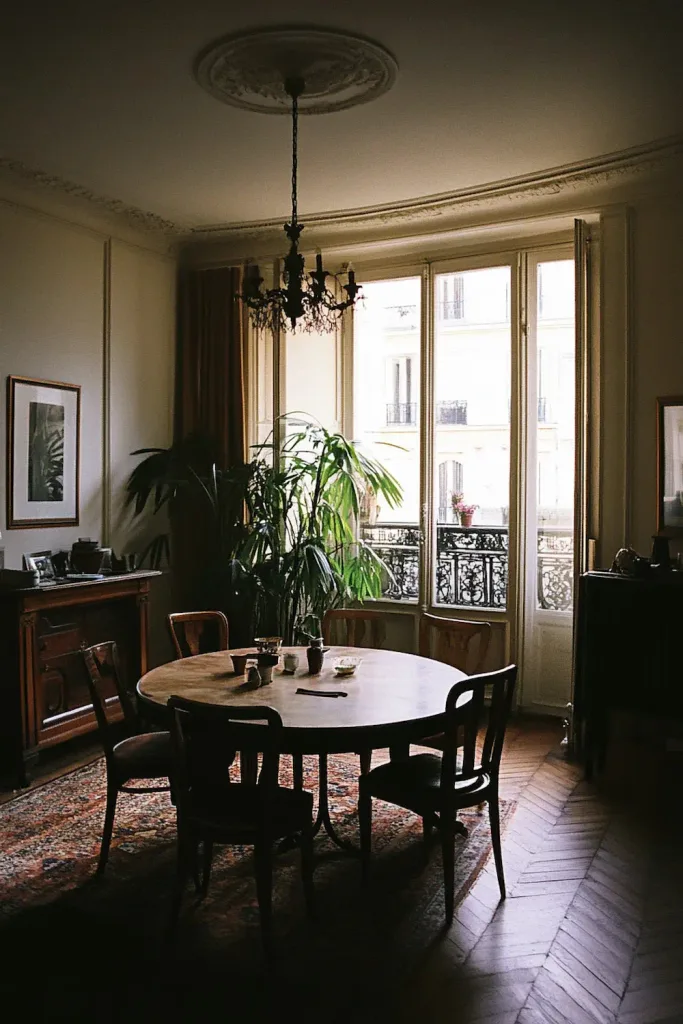
In a room that also needs to accommodate a console, a sideboard, or simply a walking path to a window or door, positioning the dining table slightly off-centre — rather than precisely in the middle of the room — is standard practice and is visible in this article’s full-room photographs. A table positioned to allow a console against one wall, even if this means the opposite side of the table has less clearance, is usually the better overall room solution.
Round vs. rectangular for a small room
A round table, for an equivalent number of seats, generally requires less total floor area than a rectangular table of the same capacity, because it has no corners consuming additional clearance space. For a genuinely small dining room — the scale shown in this article’s first photograph — a round table is frequently the more space-efficient choice, in addition to being the more traditionally Parisian one.
→ How the dining table and chairs fit within the complete Parisian texture approach: → The Art of Layering Textures in a Parisian Interior
→ How a dining setup like this extends into an adjoining Parisian kitchen: → Parisian Vintage Kitchen Ideas: Rustic Meets Refined
“The Parisian dining room is rarely large. It is rarely matched. It is, almost without exception, comfortable to sit in for longer than you planned.”