Parisian Vintage Styling on a Budget
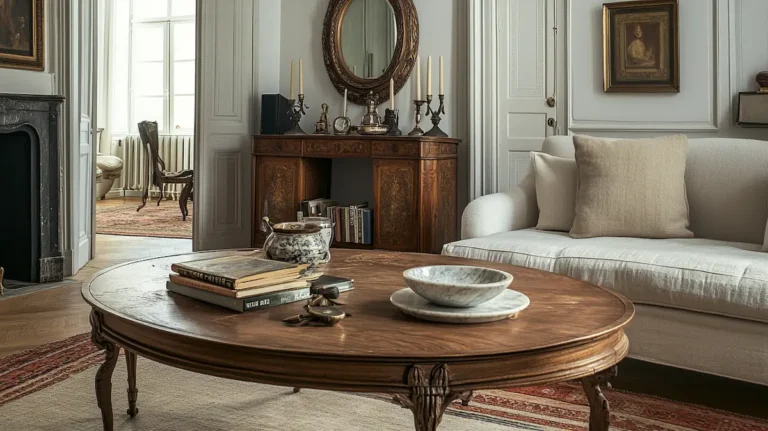
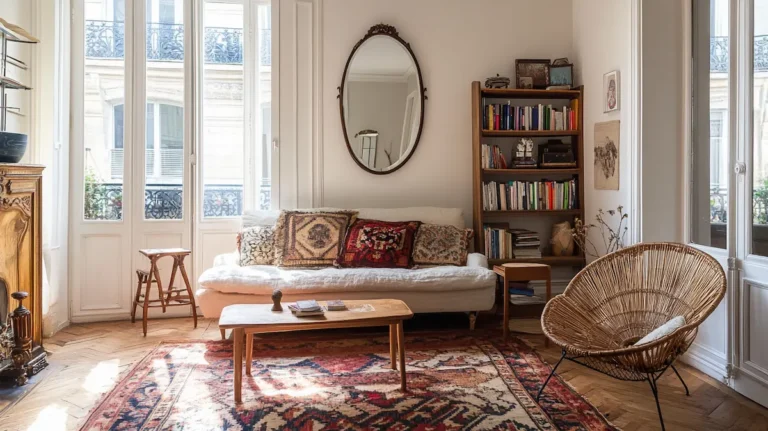
The Parisian interior is not, by nature, an expensive one. The rooms that most convincingly embody the aesthetic — layered, warm, accumulated, with the specific quality of a life lived attentively — are rarely the product of a large decorating budget. They are the product of time, patience, and a clear understanding of what matters and what does not. The budget constraint, properly understood, is not an obstacle to the Parisian aesthetic; it is one of the conditions that produces it.
This article is about working with that constraint deliberately. It covers the highest-return changes available at low cost, the sourcing channels that consistently produce genuine pieces at low prices, the specific categories of object where quality is freely available for almost nothing, and the few areas where spending more is genuinely worth it. Every recommendation is based on what is directly observable and verifiable. No price claims are made that are not clearly framed as approximate and variable.
The Right Mental Framework: What Costs Nothing
Before addressing any specific purchase, it is worth identifying the elements of the Parisian aesthetic that are entirely free. These are not trivial contributions — in many cases they are more impactful than a specific object purchase.
Editing: the free transformation
The most immediately available improvement in any room is the removal of objects that are present by inertia rather than by choice. A Parisian interior is not sparsely furnished — it is selectively furnished. The difference is the deliberateness of each presence. Walk through the room and remove every object that is there because it has always been there, rather than because it has been chosen to be there. Place the removed objects in a box. Assess the room after a week. The objects worth returning will be obvious; the ones that are not will also be obvious.
This editing practice costs nothing and typically produces a more immediate visual improvement than any purchase. It is also a pre-condition for the other changes described in this article: a room that is already cluttered will absorb new additions without registering them.
Rearrangement: moving before buying
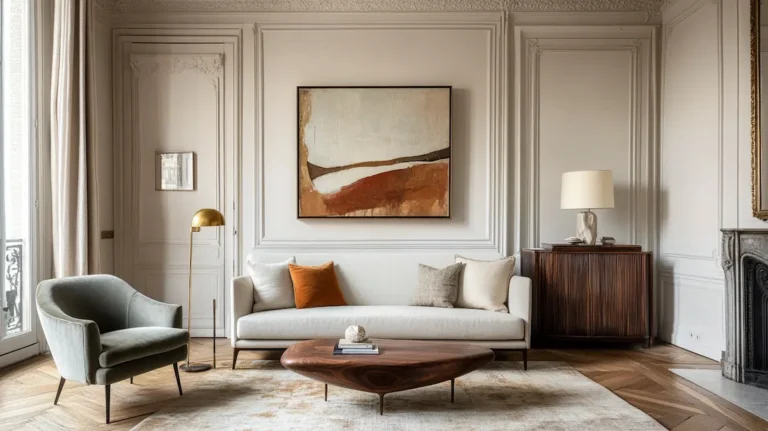
The second free transformation: move furniture before buying any. The most common spatial error in any interior is furniture arranged around the room’s perimeter — sofas and chairs pushed to the walls with the centre empty. Moving the primary seating piece 15–20 cm away from the wall toward the centre of the room changes the room’s character more than almost any single purchase. The space reads as inhabited rather than provisional.
The bulb: five minutes, transformative
Replacing every cool or neutral-white bulb in the room with a 2,200 K or 2,700 K warm white LED equivalent costs between €2 and €5 per bulb and changes the entire register of the space at evening. It is the single highest-return change available in any interior at any budget level. No other purchase — at any price — produces a more immediate improvement in the quality of the room at evening.
“Edit before you add. Move before you buy. Change the bulbs before you change anything else. These three steps cost almost nothing and transform the room more than most purchases.”
Disclaimer & transparency
This article was created with the assistance of AI tools and assembled and edited by a human editor. While care has been taken to ensure accuracy, I cannot personally verify every technical detail. The information provided here is intended as a general guide, not as professional or technical advice. Always verify compatibility with your specific devices and systems before purchasing or installing anything described in this article.
Affiliate disclosure: This site participates in the Amazon Associates Programme and the Etsy Affiliate Programme. If you purchase through some of the links, at no extra cost to you, I may earn a small commission. I only recommend products I believe are genuinely suitable for the use case described.
The Free and Near-Free Sources
The Parisian interior is built from found objects as much as from purchased ones. Understanding where genuine pieces can be found at low or zero cost is as important as knowing what to buy.
The vide-grenier: zero-cost sourcing
The French vide-grenier — a neighbourhood sale where private individuals sell objects from their homes from tables outside their buildings — is the most accessible zero-cost sourcing environment available. Objects that appear at vide-greniers are typically priced at €1–5 for small ceramics, textiles, frames, and small objects; €10–30 for small furniture pieces. The quality is unpredictable, and the productive visit requires patience and early arrival. The Brocabrac app lists vide-greniers and brocantes across France and parts of Belgium and Switzerland; a search by postcode and date finds events within reach.
For readers outside France: equivalent events operate under different names in most European countries. In the Netherlands: rommelmarkt and vlooienmarkt. In Belgium: braderie and kringloopmarkt. In Germany: Flohmarkt. In the UK: car boot sale. The principle is the same; the specific character and quality of objects available varies.
Le Bon Coin: the French Craigslist
Le Bon Coin is a French classified advertisements platform where private sellers list second-hand objects, furniture, and household contents. It is the most productive single online source for inexpensive authentic French objects in France, used by millions of private sellers who are clearing apartments, estates, and houses. The search interface is in French; basic French (or a translation tool) is sufficient to navigate it effectively. For buyers outside France, shipping is generally not offered by private sellers, but the platform is invaluable for buyers who are in France or making a visit.
Emmaus and Ressourceries
The Emmaus charitable network and the Ressourcerie resale shops (found in most Paris arrondissements and many French cities) sell donated household contents at prices well below commercial brocante rates. The inventory is unpredictable and the experience requires patience, but the pieces that appear are genuine French household objects at prices that reflect their origin as donations. Both networks are described in more detail in the companion article on flea markets and brocantes.
→ The complete guide to brocantes, vide-greniers, and low-cost sourcing in Paris: → Flea Markets & Brocantes: Finding Parisian Vintage Gems
| → Le Bon Coin — French Classified Ads for Second-Hand Objects |
| Le Bon Coin is France’s most widely used classified advertisements platform for second-hand objects, furniture, and household contents. Private sellers list objects from apartment clearances, estates, and household surplus at prices set by the seller — typically significantly below commercial brocante rates. The ceramics, mirrors, textiles, and small furniture categories are particularly productive. The interface is in French; a basic knowledge of French or a browser translation tool is sufficient to search and contact sellers. Primarily useful for buyers in France or planning a visit. No affiliate relationship — included because no honest budget sourcing guide can omit it. Variable — set by private sellers Via Le Bon Coin Editorial note: Search by category (Maison & Décoration) and by postcode or region. Filter by price maximum to surface the most accessible pieces. Private sellers typically prefer cash collection and do not offer shipping; budget for transport if buying larger pieces. |
The Highest-Return Budget Purchases
When a purchase is warranted, the question is always: which category of object produces the highest visual return for the money spent? The following ranking is based on the observable visual impact of each category in a Parisian interior context, relative to the prices at which they are available in the low-cost sourcing channels described above.
1. Linen cushion covers: maximum impact per euro
Pre-washed linen cushion covers in natural, stone, or ecru tones are the single highest-return textile purchase available for a Parisian interior on a budget. They transform the surface quality of an existing sofa or chair immediately, without requiring any reupholstery or furniture replacement. A pair of natural linen cushion covers on a synthetic-fabric high-street sofa does not disguise the sofa, but it introduces the correct textile register at the surface where the eye first lands.
The key is washed linen rather than crisp or stiff linen. Pre-washed linen has the softened, slightly rumpled quality of well-used fabric from the moment it is placed. It reads as Parisian; unwashed linen reads as formal. This distinction is important and worth checking before purchase.
2. A large foxed mirror: scale over perfection
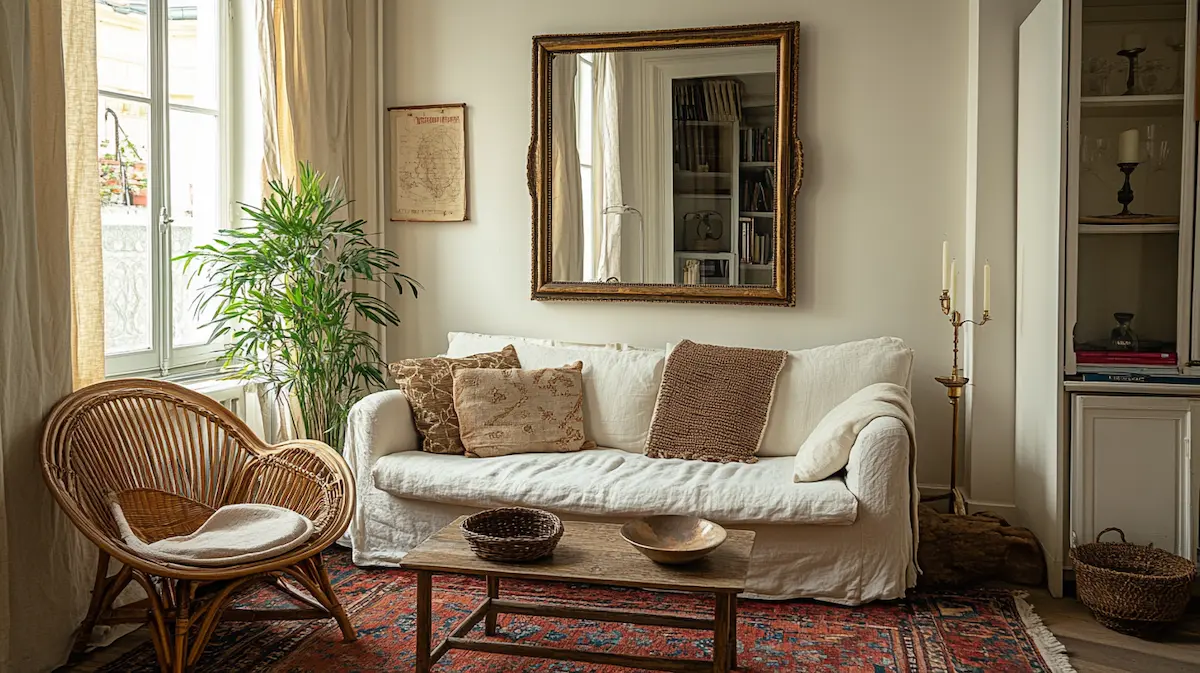
A large mirror with foxed glass in any frame — even a damaged or imperfect one — is worth prioritising over smaller, better-condition pieces. The spatial effect of a large foxed mirror is observable and significant; a small mirror, however beautiful, does not produce the same effect. At vide-greniers and brocantes, large mirrors with damaged frames or with foxed glass are regularly underpriced because buyers in those environments prioritise condition over scale.
A mirror with a damaged frame can be leaned against a wall rather than hung, which avoids the need to repair or rehang it. A mirror with a crack in the glass (other than a safety risk) continues to function as a foxed mirror and can be purchased for almost nothing. Assess safety carefully: a mirror with a single crack from edge to edge that is stable when leaned is not a safety concern; one with loose glass fragments is.
3. Floor-length linen curtains: room transformation at accessible cost
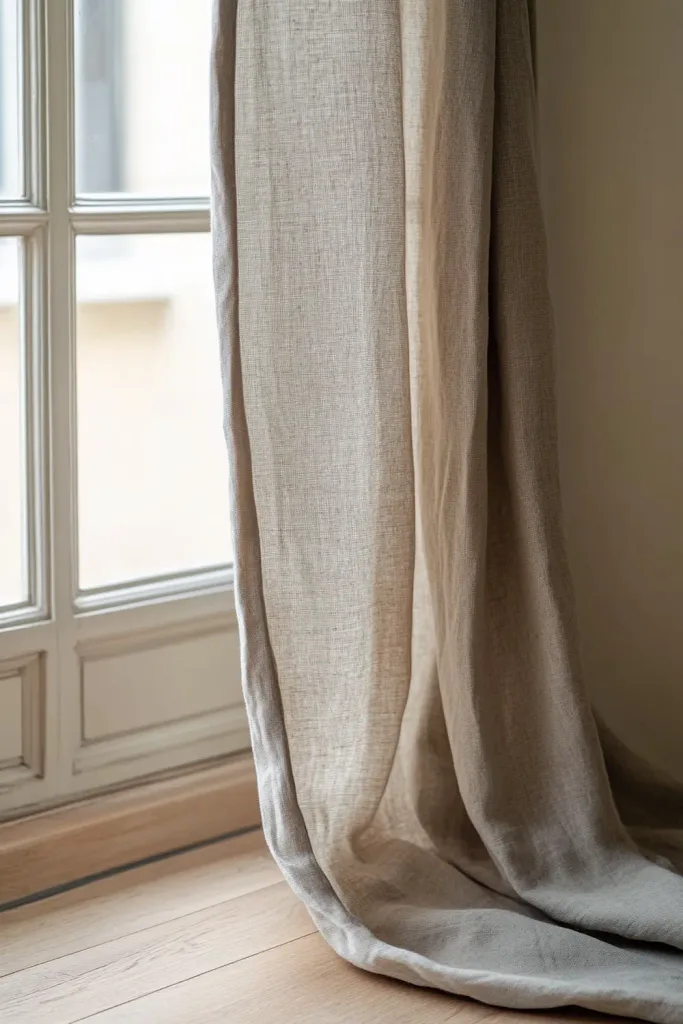
Of all the single changes available in a room, floor-length linen curtains hung from ceiling height have the most dramatic effect on proportion and atmosphere. They make ceilings appear taller, windows appear larger, and the room acquire a specific gravity that shorter curtains and synthetic fabrics do not provide. Ready-made linen curtains in natural or off-white tones are widely available at accessible prices from IKEA (the DYTAG and AINA ranges), H&M Home, and Zara Home. These are not period pieces, but at the correct length and hanging correctly from a rod mounted near the ceiling, they produce the Parisian curtain effect accurately.
The critical detail that determines whether curtain results are correct or not: the rod height. A rod mounted at standard window-frame height produces a curtain that reads as a window dressing. A rod mounted 10–15 cm below the ceiling produces a curtain that reads as an architectural element. The cost of drilling two extra holes in the wall is zero; the visual result is transformative.
| ➶ Pre-Washed Linen Cushion Covers — Amazon |
| Pre-washed linen cushion covers in natural, stone, ecru, and warm grey tones — the highest-return single textile purchase for a Parisian interior on a budget. Available in 45 × 45 cm and 50 × 50 cm sizes; covers only (inner pad not included). The pre-washing produces the softened, slightly rumpled surface quality of well-used linen from the first day. Zip closure. Machine washable. For a Parisian effect: choose natural or stone tones rather than bright white; mix two slightly different tones on the same sofa rather than a uniform set. Approx. €8 – €18 per cover · Via Amazon Editorial note: Two or three pre-washed linen covers on an existing sofa transform its surface quality immediately and for less than €50 total. This is the highest-return budget purchase in the Parisian interior toolkit. Buy covers in two slightly different tones — natural and stone, or ecru and warm grey — rather than a matching set. |
4. The IKEA Method: Upgrading Affordable Furniture
IKEA furniture is not, in its standard form, consistent with the Parisian vintage aesthetic. Its materials, proportions, and finishes are predominantly contemporary and Scandinavian in character. However, several IKEA pieces serve as functional platforms that, with specific modifications, produce results consistent with the aesthetic at a fraction of the cost of period furniture.
The modifications described here are based on directly observable and widely documented practices. No claims are made about the durability or long-term performance of specific paint finishes on specific surfaces — anyone undertaking furniture modification should test on a small area first and research the appropriate primer and topcoat for the specific material.
Console and side tables: paint and hardware replacement
Simple IKEA console and side tables in white or birch — the HEMNES, LOMMARP, and BRIMNES ranges are the most commonly modified — can be repainted in a warm off-white, stone, or dark green tone using chalk paint or furniture paint, and the standard hardware replaced with aged brass or iron pulls and knobs sourced from hardware specialists. The result reads as a painted French country piece from any normal viewing distance. The total cost of a HEMNES console table plus paint and hardware is typically under €100; a genuine French period console in similar condition would be €300–600 at brocante.
Bookcases: paint and object arrangement
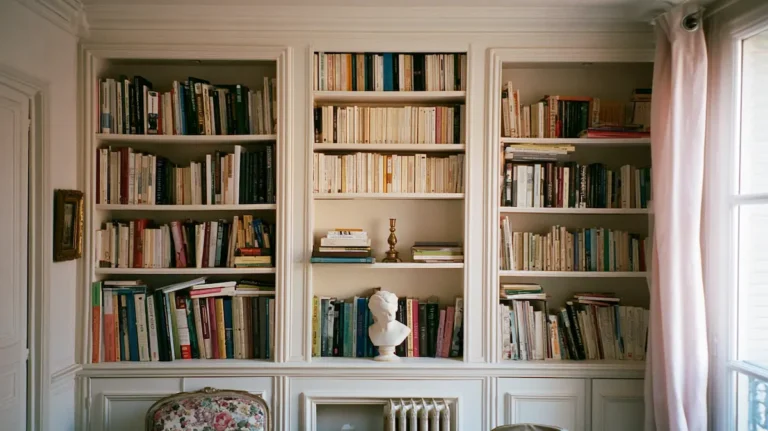
The BILLY bookcase, painted in the same warm off-white as the wall (or in a contrasting dark tone for a more dramatic effect) and arranged with books and objects in the Parisian manner — two-thirds books, one-third objects, spines outward rather than colour-coordinated — reads correctly in a Parisian interior. The painting hides the visible IKEA branding on the interior back panel and integrates the piece into the room. A painted BILLY with well-chosen objects is indistinguishable from a period piece at normal viewing distances.
Beds: linen and headboard
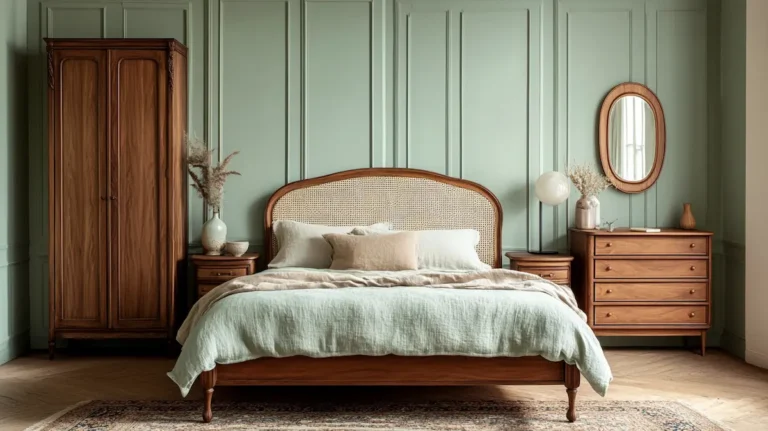
A simple IKEA bed frame in white or natural wood, made with a floor-length linen bedspread in ecru or off-white and a small selection of cushions in varied linen tones, reads as a French interior bed at any viewing distance. The frame’s proportions and materials are secondary to the quality of the bed covering. A well-made linen bed on a plain frame is more Parisian than an ornate bed frame with synthetic bedding.
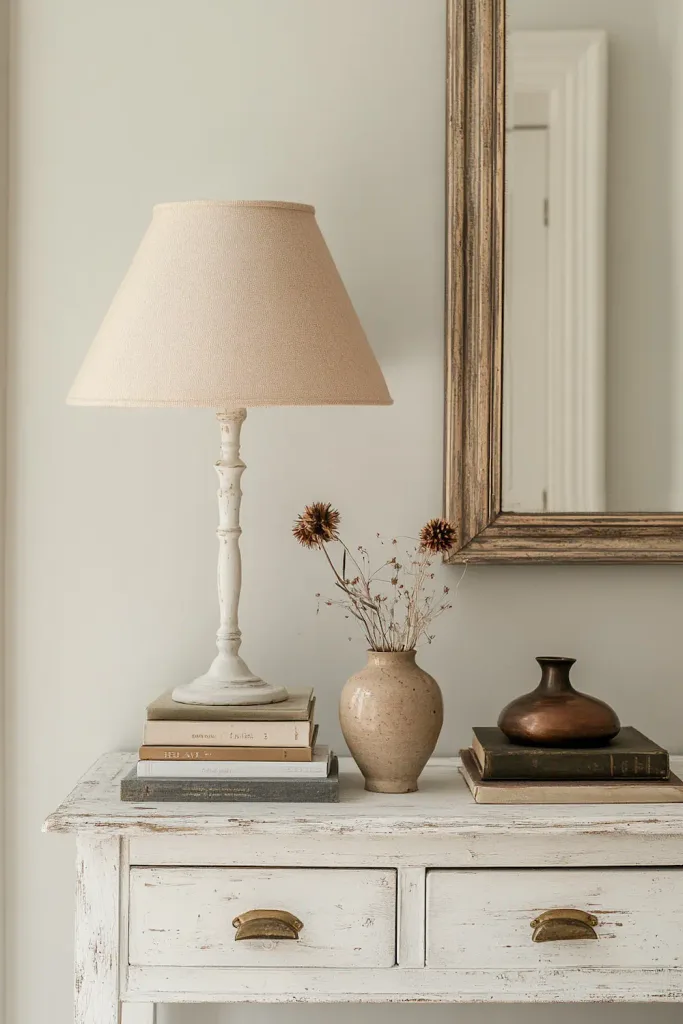
| → Annie Sloan Chalk Paint — Furniture Paint for the IKEA Method |
| Annie Sloan Chalk Paint is a water-based furniture paint with a characteristically matte, slightly chalky finish that requires minimal surface preparation and adheres to most furniture surfaces without priming. It is widely used for the furniture modification approach described in this section. The most relevant colours for a Parisian interior: Old White (warm off-white), Country Grey (warm grey-stone), Versailles (pale sage-grey), and Graphite (deep charcoal). Available in 120 ml, 500 ml, and 1-litre tins. Sold through Annie Sloan stockists across Europe and internationally, and directly from the Annie Sloan website. No affiliate relationship — included because the product is the most widely used and most consistently cited tool for the IKEA furniture modification approach described above. From approx. £12.95 for 120 ml (covers approximately 0.5 m²) · Via Annie Sloan Editorial note: Test on a small, hidden area first. The product adheres to most surfaces without priming, but highly varnished or laminated surfaces (such as some IKEA finishes) may benefit from a light sand before application. Finish with Annie Sloan Clear Wax for durability, or leave unwaxed for a more matte, slightly distressed appearance consistent with the Parisian aesthetic. |
5. The Under-€50 Object Categories
Several of the most visually impactful object categories in a Parisian interior are consistently available for under €50 — and often for far less — in the sourcing channels described in this article. The following categories offer the best combination of visual impact, accessibility, and price reliability.
Brass candlesticks: €1–15 at vide-grenier
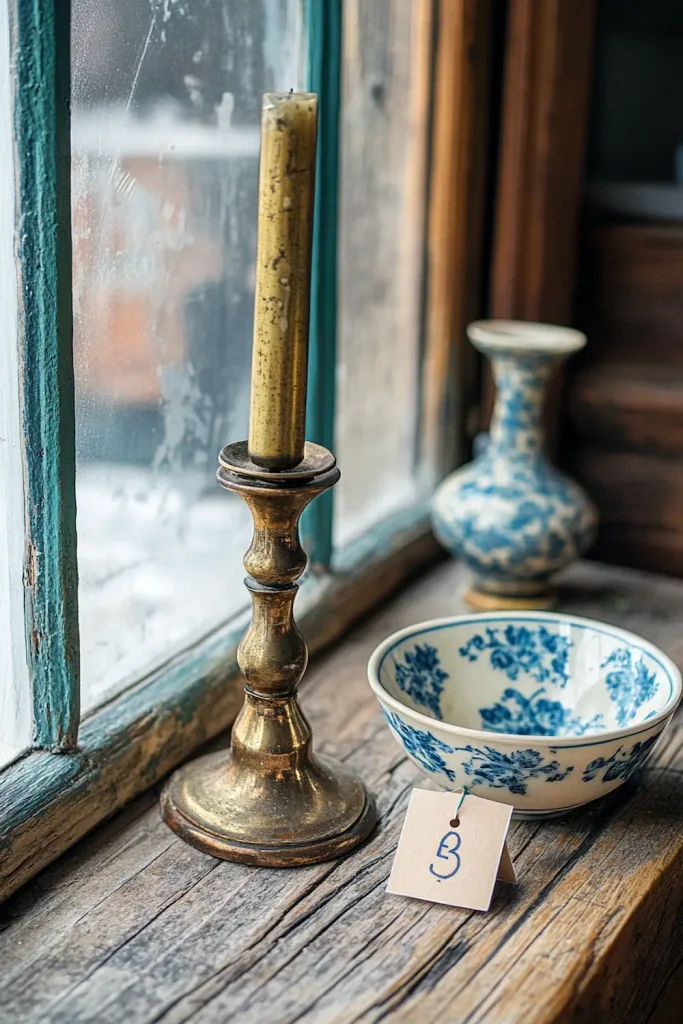
Brass candlesticks of any age are among the most reliably underpriced objects at vide-greniers and brocantes. Small and medium brass candlesticks in good condition regularly sell for €1–5 at neighbourhood sales. Even at commercial brocantes, a pair of interesting brass candlesticks in varied heights rarely exceeds €20–25. The aged-brass quality that the Parisian aesthetic values is freely available at this price point; there is no need to buy new reproduction candlesticks.
Old frames: €2–20 at brocante
Empty frames — gilded, dark wood, simple painted — are among the most abundant and consistently underpriced objects at any brocante or vide-grenier. They have no clear contemporary use in most buyers’ minds, which depresses their price relative to their visual value. A large gilded frame leaning against a wall, empty, costs €5–15 at most brocantes and provides the architectural wall presence of a significant object at almost no cost.
Faience and earthenware ceramics: €2–25
French regional ceramics — Digoin, Sarreguemines, Gien, and similar earthenware in cream and blue-grey patterns — are widely available at brocantes and vide-greniers at prices well below their visual value. A small faience bowl or plate in good condition typically sells for €2–8 at a neighbourhood sale and €8–25 at a commercial brocante. These pieces are the surface objects most immediately associated with the Parisian interior, and they are freely available at low cost.
Vintage linen: €3–20 per piece
Antique French household linen — tablecloths, tea towels, sheets with monograms — is available at brocantes and vide-greniers at prices that reflect their origin as household objects rather than as design items. A monogrammed linen tablecloth that can be used as a throw, a table runner, or cut and sewn into cushion covers regularly sells for €5–15. Its textile quality and the specific aged warmth of old linen is not available new at any price.
→ The complete list of Parisian vintage accessories available under €50, with specific sourcing recommendations: → Best Parisian Vintage Home Accessories Under €50
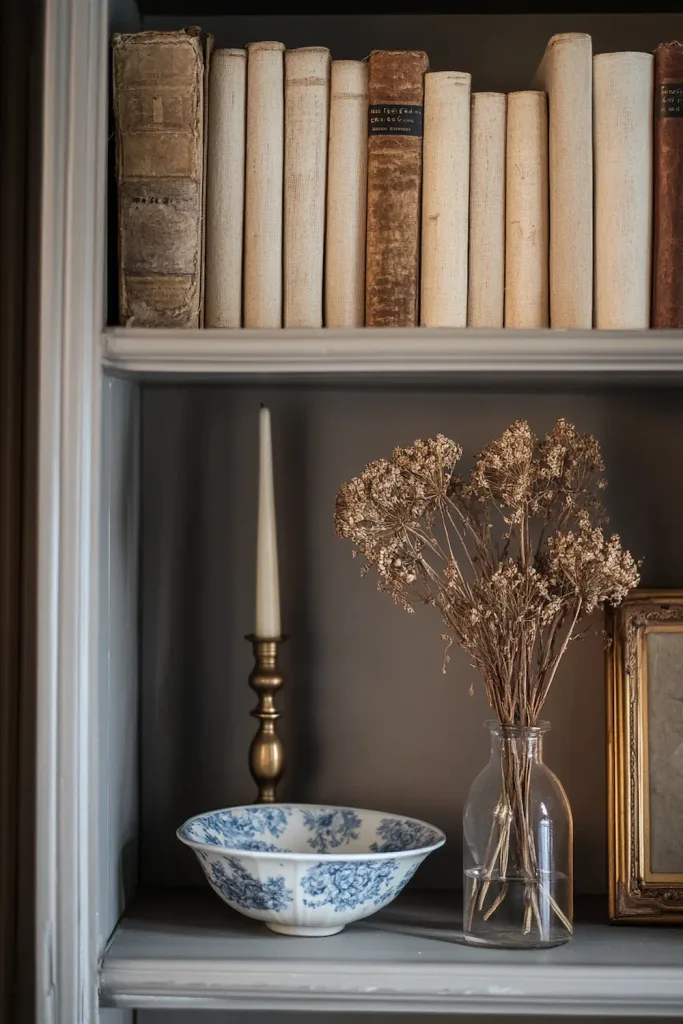
| ➶ Antique French Linen & Monogrammed Textiles — Etsy |
| A curated search for antique and vintage French household linen on Etsy — the most accessible online channel for genuine aged French linen in the tones and weights that define the Parisian interior, for buyers who cannot source in person at brocantes. The search covers monogrammed tablecloths, tea towels, bed linens, and fabric lengths. Pieces sourced by specialist sellers in France and the UK from household clearances and brocantes. Filter by price (set a maximum of €30 per piece) to find the most accessible options; larger pieces at lower prices per unit are typically better value than small accessories. €8 – €45 per item · Via Etsy Editorial note: For buyers outside France who cannot source in person, this is the most direct equivalent of the brocante linen category. A single monogrammed antique linen used as a table runner, a cushion cover, or a throw reference introduces the base-layer textile quality that defines the Parisian interior at a cost well within most budgets. |
What to Spend More On: The Three Exceptions
A budget approach to the Parisian interior does not mean spending as little as possible on everything. There are three categories where spending slightly more produces a result that the low-cost alternative does not approach. Identifying these categories clearly allows budget to be concentrated where it will have the most lasting effect.
Exception 1: The anchor textile
The primary textile of the room — the rug that defines the seating zone, or the curtains if there is no rug — is worth spending more on than other textiles. A genuinely old kilim of 200 × 300 cm from a specialist Etsy seller at €150–250 produces a result that a new printed rug at €40 does not approach. The grounding texture and the warm, complex pattern of a genuine old kilim is the foundational layer that everything else responds to. This is the one textile category where quality is directly tied to cost in a way that is visibly apparent.
Exception 2: The mirror
As described in the section on highest-return purchases, scale and glass quality are the key factors in a mantelpiece or wall mirror. A large foxed mirror from a brocante at €60–120 (slightly damaged frame) produces a visual result that no new reproduction at any price replicates. This is an area where the budget is better spent on one genuinely good piece than on several smaller or newer alternatives.
Exception 3: The anchor lamp
One good table lamp — a ceramic base with a genuine linen shade, properly proportioned, fitted with the correct warm bulb — changes the quality of the room at evening more than several inexpensive alternatives scattered around the same space. The lamp that is always on, that defines the room’s primary light zone at evening, is worth spending €60–120 on rather than €20. The difference in light quality between a cheap synthetic shade and a linen one is immediately visible.
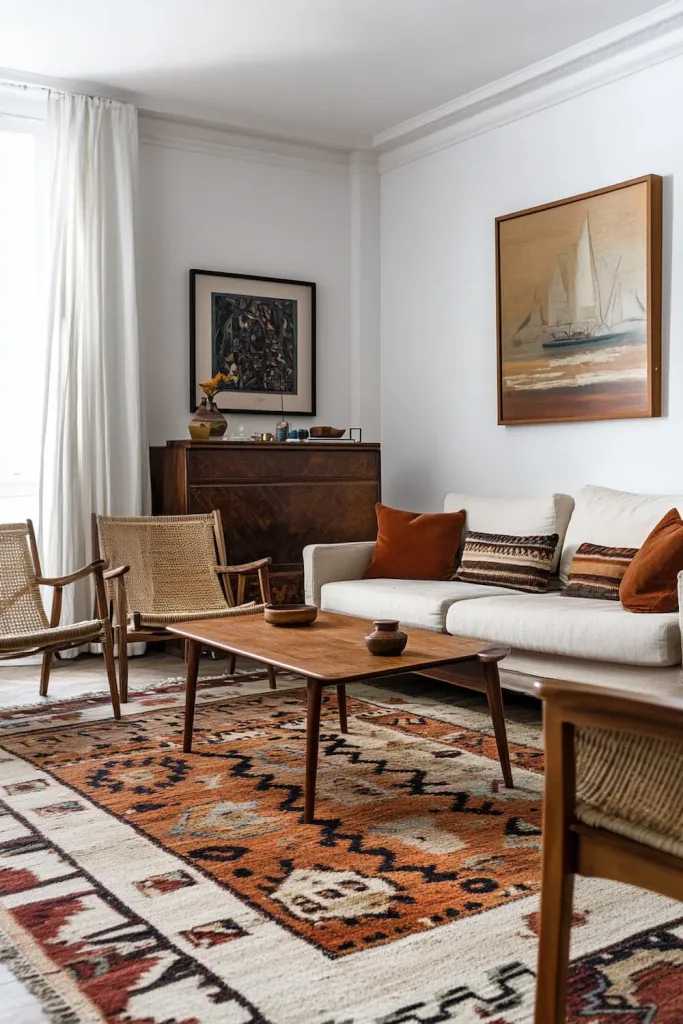
| ➶ Vintage Kilim Rugs — Etsy Specialist Sellers |
| A curated search for vintage and antique kilim rugs on Etsy — the recommended sourcing channel for the anchor rug investment described in this section. Filter by size (200 × 300 cm or larger for a living room seating zone), by age (vintage or antique), and by palette (warm ochre, terracotta, ivory, faded red) for the most appropriate options. Specialist sellers source from Turkey, Afghanistan, and the Caucasus and ship internationally. For a budget approach, look for pieces described as having wear, repairs, or fading — these qualities reduce the price but increase the visual appropriateness for a Parisian interior. €120 – €380 depending on age, size, and condition · Via Etsy Editorial note: The kilim is the one piece in a budget Parisian interior where spending €150–250 is genuinely more efficient than buying a new rug at €60–80. The visual and textural difference is observable and lasting. A kilim with some wear is preferable to a perfect one: the wear reduces the price and increases the faded, receded-palette quality that works best in a Parisian interior. |
The Budget Parisian Interior for Renters
The budget constraint and the renter constraint frequently coincide. When both apply simultaneously — no permanent changes permitted, limited spending available — the approach focuses entirely on objects and textiles: nothing fixed to walls, nothing that requires permission, nothing that cannot be taken when the tenancy ends.
The good news is that the most impactful elements of the Parisian interior in the context of this article are almost entirely portable. Floor-length curtains hung from a tension rod (no drilling required) or from a simple free-standing pole. A large mirror leaning against the wall rather than hung. Rugs on bare floors or on existing carpet. Linen cushion covers on existing furniture. Brass candlesticks and ceramics on surfaces. The edited, accumulated quality of a Parisian interior is not structurally dependent on any permanent modification.
The one element that is difficult to achieve without any wall attachment is the ceiling rod for floor-length curtains. A freestanding curtain pole — available from IKEA (RACKA) and other retailers at modest cost — is a practical alternative that requires no drilling and can be moved or taken when leaving.
→ The complete guide to achieving the Parisian aesthetic with no permanent changes — specifically for renters: → Parisian Vintage Interior for Renters (No Permanent Changes)
Patience as a Budget Strategy
The final and most practically useful observation about building a Parisian interior on a budget is that time is the asset. The rooms that most convincingly embody the aesthetic are those that have been assembled over years rather than months — not because years of spending are required, but because the found object, the vide-grenier discovery, the brocante piece that exactly fits the space, require time to appear.
A budget Parisian interior built over two years of attentive sourcing — one genuinely good piece added every few months, each found rather than purchased at the obvious retail point — will produce a result that a large decorating budget spent in a single month cannot replicate. The accumulated quality, the variety of provenance, the sense that each piece arrived at the right moment — these are the products of patience, not spending.
Begin with the free changes described in Section 1. Add the highest-return low-cost purchases from Section 3. Source the object categories in Section 5 over time from vide-greniers and brocantes. Invest selectively in the three categories described in Section 6 when the right piece appears at the right price. The room that results will be genuinely Parisian — not because of what was spent on it, but because of the attention that was paid.
“The Parisian interior is not built in a day or a week. It is assembled, slowly, from things found and chosen. The budget is not a constraint on this process; it is one of its enabling conditions.”
→ The strategic guide to sourcing authentic vintage pieces over time for a French interior: → How to Source Authentic Vintage Pieces for a French Interior
→ The full Parisian Vintage Chic Interior approach — the aesthetic context for everything in this article: → Parisian Vintage Chic Interior: The Complete Style Guide
→ Budget room makeover ideas using the Parisian vintage approach: → Parisian Vintage Interior on a Tight Budget: Room Makeover Ideas