
Flea Markets & Brocantes: Finding Parisian Vintage Gems
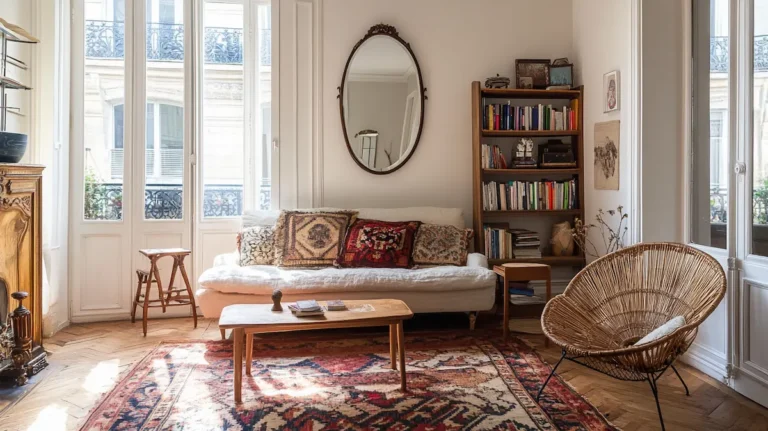
There is something quietly specific about arriving at a Parisian brocante before the city has fully woken up. The stalls are still being arranged, a vendor pours coffee from a thermos, and the best pieces — a gilded mirror with foxed glass, a stack of monogrammed linen, a worn rattan chair — are still there, unhurried. The marchés aux puces and brocantes of Paris are not merely shopping destinations. They are an education in the particular beauty of things that have been used, loved, and set down again. They are where the Parisian interior is assembled, one found object at a time.
This article is the practical guide to that process. It covers which markets to visit and when, how to navigate them productively, what to look for, how to negotiate, and which online channels replicate the same sourcing logic when Paris is not within reach. The companion article on sourcing practice — How to Source Authentic Vintage Pieces for French Interiors — covers the broader strategic approach; this one focuses entirely on the markets themselves.
The knowledge required to use these markets well is covered in its own article. What follows assumes you are ready to go.
The Anatomy of a Parisian Flea Market
The French terms are used interchangeably in conversation, but the distinctions matter for setting the right expectations before you arrive.
A marché aux puces is a large, established market — often with permanent dealer stalls, covered halls, and antique specialists who have occupied the same position for decades. It is a permanent institution of the city, operating on fixed days, with a predictable range of quality and price. The three great Paris puces — Saint-Ouen, Vanves, and Montreuil — each has its own character and specialist strengths.
A brocante is more informal: a periodic market, usually monthly or quarterly, where a mixture of professional dealers and amateur sellers offer estate clearances, attic finds, and accumulated surplus from country houses and Paris apartments. The quality range is wider, the prices are less fixed, and the effort required is greater. A brocante is where the genuine surprises occur.
A vide-grenier (literally “attic clearance”) is the most informal category: a neighbourhood sale, typically one Sunday per year, where private individuals sell from tables outside their buildings. The prices are the lowest. The quality is unpredictable. The occasional find is extraordinary. These are listed on municipal websites and the app Brocabrac.
“The marché aux puces is an education. The brocante is where the surprises occur. The vide-grenier is pure chance. All three are essential to a complete sourcing practice.”
The Essential Paris Markets: A Practical Guide
These are the five markets worth understanding in depth before any visit. Each has a distinct character, a distinct price register, and a distinct specialist strength.
Marché de Saint-Ouen (Porte de Clignancourt, 18e)
The largest and most famous flea market in the world by dealer count: over 3,000 dealers spread across 14 distinct sub-markets, each with its own specialisation. Saint-Ouen is open Saturday, Sunday, and Monday from approximately 9h. The scale is overwhelming on a first visit — approach it by sub-market rather than as a whole.
- • Marché Vernaison is the oldest sub-market and the most atmospheric: narrow alleys, small cabinets, a high density of ceramics, textiles, decorative objects, vintage jewellery, and small furniture. Prices are negotiable; the range of quality is wide.
- Marché Paul Bert and Marché Serpette are the dealers’ dealers: higher prices, higher quality, more authenticated furniture, lighting, and significant decorative pieces. The reference for understanding what genuine quality costs.
- Marché Dauphine is a two-floor covered market with a particularly strong selection of 20th-century decorative arts, Art Déco ceramics, vintage prints, maps, and architectural drawings. Excellent for framed ephemera.
- Marché Jules Vallès is the accessible entry point: lower prices, wider range of quality, more room to find underpriced pieces among the clutter.
Marché de Vanves (Porte de Vanves, 14e)
Saturday and Sunday mornings only, and only until early afternoon when the remaining dealers begin to pack. Smaller than Saint-Ouen, significantly less tourist-heavy, and with a character that feels closer to a genuine neighbourhood brocante than a tourist attraction. Vanves is particularly strong for linens, silverware, small ceramics, frames, and the practical objects of domestic French life. Arrive before 9h; by 11h the best pieces have gone.
Marché d’Aligre (Place d’Aligre, 12e)
A working neighbourhood market with a small but consistently good brocante component operating alongside the food market. Saturday and Sunday mornings. The brocante section here has a more modest scale but a loyal community of local dealers who bring authentic pieces from the 12th arrondissement and the surrounding area. Good for ceramics, small decorative objects, and the occasional textile find at prices below Saint-Ouen.
Marché de Montreuil (Porte de Montreuil, 20e)
The least curated of the major Paris puces and the most demanding to navigate productively. Montreuil mixes genuine antiques with second-hand clothes, tools, electronics, and household surplus. The genuine pieces are there, but finding them requires more time and a better eye than the other markets. For the experienced buyer, Montreuil offers the best ratio of quality to price in the Paris flea market circuit.
Brocante de Breteuil and Quartier Libre (periodic, multiple locations)
Paris hosts dozens of periodic brocantes throughout the year, typically announced two to three weeks in advance via the city’s cultural calendar and the app Brocabrac. The brocantes along the Avenue de Breteuil, in the Marais, and in the 6th and 7th arrondissements attract dealers from the surrounding regions and consistently offer the category of object most relevant to a Parisian interior: period ceramics, silver, textiles, frames, and small furniture.

→ The complete guide to what to look for at these markets, by object category: → Parisian Vintage Furniture: What to Look For
How to Work a Brocante Productively
The productive brocante visit is not a shopping trip. It is a looking session. The buyers who find the best pieces are not the ones with the longest wish lists; they are the ones who arrive with full attention and no fixed agenda.
The early arrival
The single most important practical discipline. At any brocante of quality, the best pieces are assessed, priced, and often sold within the first hour of trading. Experienced dealers and private collectors arrive before the official opening. A 10h arrival is, in practice, a second-chance arrival — useful for objects that were overlooked in the first pass, but not for the pieces that will define a room.
For the first year of building a sourcing practice, arrive at or before the official opening time of every market you attend. The discipline is inconvenient. The reward is significant.
The slow circuit
Walk the entire market once before stopping at any stall. This gives you the full range of what is available before you commit attention or money to any single piece. The stall that seemed exceptional in the first ten minutes often seems less so after you have seen the rest — and vice versa. The best pieces at a brocante are almost never at the first stall.
The handling rule
Touch everything that interests you. Turn ceramics upside down to read the mark. Open drawers to assess the joinery. Sit in chairs to feel the frame. Hold textiles up to the light. The information available through physical handling is entirely absent from any photograph and is the primary basis for quality assessment. A dealer who discourages handling of their stock is, in most cases, a dealer whose stock does not reward close examination.
The negotiation norm
Negotiation is entirely normal at brocante and is expected by every dealer. The standard opening offer is 15–20% below the marked price. Present it as a question, not a demand: “C’est votre meilleur prix?” (Is that your best price?) is the conventional opener. If buying multiple pieces from the same vendor, negotiate the lot — dealers prefer to move several items together and will price accordingly.
Do not negotiate aggressively on pieces that are clearly well priced. The long-term relationship with a good dealer — built over multiple visits and honest interest in their stock — is worth more than any single discounted purchase.
The end-of-day moment
At brocantes (as distinct from the permanent dealers at Saint-Ouen), prices soften noticeably in the final hour before closing. Sellers do not want to pack pieces back into the van. A piece that was firmly priced at 11h may be available at 60% of that price at 16h. If you saw something in the morning that you considered but left, return at the end of the day.
“Negotiation is a conversation about value, not a contest. The dealer who sells you something beautiful at a fair price is the dealer you will buy from again. That relationship is worth more than the difference.”
What to Look For: The Objects That Define the Parisian Interior
Not everything at a brocante belongs in a Parisian interior. The selective eye is what separates an interesting room from a cluttered one. The following categories are the objects that consistently contribute most to the layered, accumulated quality of a genuinely French interior:
- • Gilded and painted frames: even without artwork, old frames add immediate depth and scale to a wall arrangement. The foxing, the wear, the slight asymmetry of the gilding — these are features, not defects.
- French linen: monogrammed tablecloths, tea towels, hemp grain sacks, dowry sheets. The weight and warmth of genuine old linen is irreproducible. This category is consistently underpriced at brocante.
- Faïence and earthenware: Gien, Sarreguemines, Digoin, Choisy-le-Roi — these French regional ceramics are the correct surface objects for a Parisian interior. Learn to read the marks. Quality pieces at brocante are regularly sold at a fraction of their value.
- Old mirrors with foxed glass: the foxing is the point. A mirror with completely clear, modern glass reads as a reproduction. The age-spotted, slightly uneven surface of a genuinely old mirror is irreplaceable.
- Silver-plated serving pieces: gravy boats, cake stands, sugar bowls, entree dishes. Mix freely. The slight darkening of the silver at the edges is evidence of decades of use and polishing.
- Rattan and wicker: bistro chairs, armchairs, consoles, baskets. The material has been central to the Parisian interior for 150 years and remains one of the most photogenic and practically useful categories.
- Typography and ephemera: old posters, maps, botanical prints, sheet music pages, pages from illustrated encyclopaedias. These are the paper layer of the Parisian interior, and they are almost always underpriced.
- Brass and bronze hardware: candlesticks, door knockers, drawer handles, small decorative objects. The aged gold of genuinely old brass is a specific quality that no new finish replicates.

→ The detailed quality-reading guide for furniture specifically — joints, patina, hardware, construction: → Parisian Vintage Furniture: What to Look For
Practical Preparation: What to Bring, What to Know
The difference between a productive brocante visit and a frustrating one is almost entirely a matter of preparation. These are the practical elements that experienced buyers treat as non-negotiable:
- • Cash in small denominations: €10 and €20 notes are the correct currency for most brocante transactions. Many permanent dealers at Saint-Ouen now accept cards, but at brocantes and vide-greniers, cash remains expected and gives significant negotiating leverage.
- A measuring tape: the single most important practical tool. Know the specific dimensions of the spaces in your home before you arrive — ceiling heights, floor areas, doorway widths. The best piece in the market is worthless if it will not fit through the door.
- A large, sturdy tote bag: for carrying smaller purchases and for keeping both hands free to handle objects. A bag with a zip or secure fastening is preferable in crowded markets.
- Good shoes and layers: markets involve two to four hours of standing and walking on uneven surfaces in all weathers. Comfort is not optional.
- The Brocabrac app: the most complete directory of brocantes, vide-greniers, and antique fairs in France. Essential for finding periodic markets in Paris and the surrounding Ile-de-France region that are not listed in standard tourist guides.
- A sourcing notebook or folder: photograph, dimension, and price every piece you consider seriously, whether you buy it or not. The patterns that emerge from six months of notes are more valuable than any single purchase.
The Etsy Channel: Curated Brocante Finds for International Buyers
For buyers outside France — or for those who want to supplement physical market visits with a continuous sourcing channel — Etsy occupies a specific and genuinely useful position in the sourcing hierarchy. Not as a substitute for the brocante experience, but as a parallel channel for the categories of authentic French vintage piece that travel well: textiles, ceramics, small objects, and decorative accessories.
The quality of Etsy sourcing is entirely dependent on identifying the right specialist sellers. The following three are the most reliable and most relevant to the Parisian vintage interior:
| ➶ MyVintageFrenchHouse — Vintage French Linens, Enamelware & Brocante Objects |
| A British seller based in France who sources directly from French brocantes and ships worldwide, duties paid to the US. The shop covers vintage French linens and cushions, enamelware and kitchenalia, religious memorabilia, brass hardware, candlesticks, oyster plates, and pressed glassware. Stock rotates continuously — following the shop and checking weekly is more productive than searching for specific items. The enamelware and brass sections carry pieces with the specific aged quality that no new manufacture replicates. Variable by item · Via Etsy (MyVintageFrenchHouse) Editorial note: This is the closest thing to a curated online brocante stall available in English. Items move quickly and stock is never the same twice. Bookmark the shop and check it weekly rather than searching for specific pieces — the finds come to you. |
| ➶ Vintagefrenchlinens — Authentic French Linen, Majolica & Breton Ceramics |
| A specialist linen and antiques seller based in Brittany, with a curated selection across fine French bed linens, monogrammed dowry sheets, Boutis coverlets, asparagus and artichoke majolica, Breton stoneware, and kitchen ceramics. Ships worldwide. The asparagus and artichoke majolica section is among the best-curated available online — these French regional ceramics are precisely the objects that belong on the surfaces of a Parisian interior. Note that shipping costs to the US have increased; check before ordering. Variable by item · Via Etsy (Vintagefrenchlinens) Editorial note: Monogrammed dowry linens are one of the most characteristically Parisian textile objects — personal, aged, impossible to reproduce convincingly. A piece found here, used as a cushion cover or a table runner, contributes the quality of accumulated personal history that a new textile simply cannot provide. |
| ➶ FrenchVintageShop — Authentic French Objects from Paris |
| A Paris-based seller specialising in authentic vintage French objects: enamel signage, handcrafted antique stools, vintage bird plates and ceramics, billiard balls and game objects, and architectural salvage pieces. Strong on objects with a specifically French regional identity — the kind of piece that reads as genuinely Parisian rather than generically vintage. Excellent review profile for accuracy of description and condition reporting. Variable by item · Via Etsy (FrenchVintageShop) Editorial note: French enamel signage — an original BUREAU door sign, a vintage dairy sign, a pharmacy cross in enamel — placed deliberately in a Parisian interior provides the specific urban-industrial note that complements period furniture without competing with it. One or two pieces are enough; three or more becomes a collection rather than a room. |

→ The complete guide to buying vintage online for a French interior — platform by platform, category by category: → Best Online Shops for Parisian Vintage Interior Finds
The Curated Online Platforms: Selency, Emmaus, and Beyond
Beyond Etsy’s marketplace model, two platforms serve the same sourcing logic as the physical brocante: curated, affordable, and continuously updated. Neither carries an affiliate relationship — they are included because no honest guide to Parisian vintage sourcing can omit them.
Selency: the digital brocante
Selency is a French online marketplace for vintage and second-hand design objects, heavily used by French interior designers and private buyers who know the market. The curation is stronger than Etsy — sellers must pass a quality review before listing — and the selection leans toward the 20th century: Art Déco objects, mid-century French furniture, 1950s and 1960s ceramics and lighting, and vintage textiles. For the Parisian interior’s mid-century counterpoint pieces, Selency is the most productive single channel available online.
| → Selency — Curated French Vintage Design & Objects |
| A French-language marketplace for vintage and second-hand design objects, curated for quality and focused on the 20th century. The selection is strong on Art Déco pieces, mid-century French ceramics and lighting, vintage rattan furniture, and decorative objects from the interwar period. The search and filter tools are excellent. The platform ships across Europe and internationally on request. Variable by item · Via Selency Editorial note: Use Selency for the mid-century and interwar pieces that give a Parisian interior its temporal complexity — the 1950s French ceramic lamp, the Art Déco bronze, the 1960s rattan armchair. These are the pieces that prevent the room from becoming a period museum, and Selency has a better selection of them than almost any other platform. |

Styling What You Find: The Parisian Approach to Placement
The difference between a room furnished with beautiful brocante finds and a room that feels genuinely Parisian is not the quality of the objects. It is how they are placed. The French approach to arrangement has a few consistent principles that apply regardless of the specific objects involved.
Cluster, do not scatter
Three faïence bowls grouped on a single shelf have more impact than one on every shelf. Height variation within the cluster matters: use books, small boxes, or a wooden plinth to stagger levels. The grouping reads as intentional; the scatter reads as incomplete.
Frame everything
Old frames do not require artwork. Fill them with aged mirrors, pressed botanicals collected on a walk, pages from a French novel, or simply leave them empty and slightly overlapping on a wall. A collection of old frames, hung without alignment or uniformity, is one of the most characteristically Parisian wall treatments available.
Mix ages and origins freely
A 19th-century faïence bowl beside a 1960s rattan chair beside a contemporary linen cushion — this is the Parisian way. No single period dominates the room; it accumulates across time. Pieces chosen simultaneously from the same source have a coherence that reads, correctly, as having been assembled rather than found.
Let the patina remain
The foxed mirror, the worn edge, the slightly bent candlestick — do not restore these. The patina is the evidence of a life lived alongside the object, and that evidence is what gives it power in a room. Cleaning is appropriate; stripping, repainting, and refinishing are almost always a mistake.
“A room assembled over years from genuine finds has a quality that cannot be produced in a single afternoon of shopping, however carefully chosen the pieces. That quality is time, made visible in objects.”

→ For the complete approach to developing the eye that makes all of this possible: → How to Develop a Parisian Eye for Interior Design
The sourcing practice described in this article does not fill a room quickly. It is not designed to. It is designed to fill a room well — with pieces that arrived at the right moment, through genuine attention, from the full range of what was available at that particular morning in that particular market. The rooms that result from this practice are not finished. They are always, in the best sense, in the process of becoming more themselves.
For the full context of what you are sourcing for, return to the category pillar: Parisian Vintage Chic Interior: The Complete Style Guide. For the complete sourcing strategy — how to develop the practice across all channels over time — the companion article covers the approach in full.
→ The complete strategic guide to building a Parisian interior sourcing practice: → Best Parisian Vintage Home Accessories Under €50