The Complete Baby Nursery Design Guide
A nursery is one of the few rooms in a home that must be finished before it is occupied. Unlike a living room or a bedroom, which can be arranged gradually — a piece added here, a colour changed there — a nursery has a deadline. It must be functional and safe on the day it is first used, which is also the day you will be least able to think clearly about its arrangement. Planning it well in advance, and understanding what actually matters before what merely looks appealing, is the most useful thing this guide can offer.
This article is the starting point for the entire Baby Nursery Design category. It covers the key decisions every nursery design requires — style direction, colour, furniture, lighting, layout, and safety — and links out to depth articles on each of those topics. All observations are based on what is directly visible in well-documented nursery interiors and verified product specifications. No aesthetic claim is presented as developmental fact.
Why the Nursery Deserves a Design Approach, Not Just a Shopping List
The dominant approach to nursery design is additive: choose a theme, buy the furniture set, order the matching accessories. This approach produces rooms that read as assembled rather than designed — rooms where every element belongs to the same retail range and nothing has been considered in relation to anything else.
The alternative is to think about the nursery as a room first and a baby’s room second. The room has dimensions, a light source, a floor, walls, and a ceiling. It will be occupied by an adult for many hours each day — feeding, settling, reading — before the child is old enough to form preferences of their own. A room that works for the adult who spends time in it is a room that will also work for the child who grows into it.
This reframing changes what to prioritise. Instead of a theme, you look for a palette that is genuinely calming to adult eyes. Instead of matching furniture, you look for individual pieces that are each well-made and will last through childhood. Instead of novelty lighting, you look for controllable light at the right height for a nursing chair at 3 a.m. The theme becomes an afterthought when the underlying decisions are right.
"The nursery that works best is not the one that looks most complete at the baby shower. It is the one that is still working well — practically and visually — three years later."
→ What Is a Nursery Style? How to Choose the Right Look
Style Families: Classic, Modern, and Boho — and How to Choose
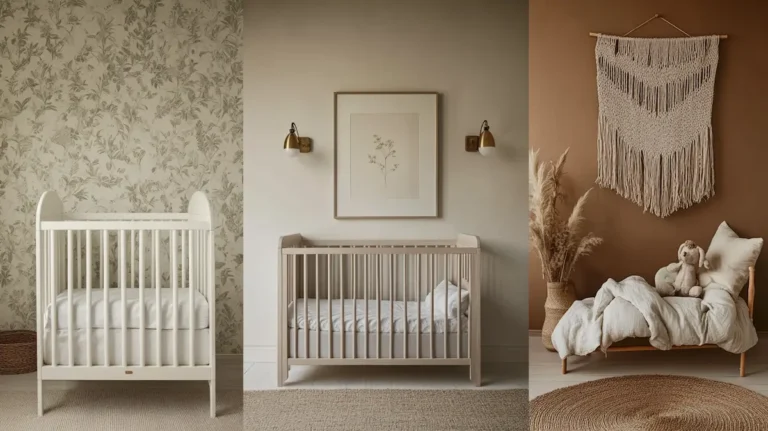
Nursery design in current practice falls broadly into three style families. Understanding their visual logic helps clarify which is a genuine fit for a specific home and which is merely fashionable at a given moment.
Classic
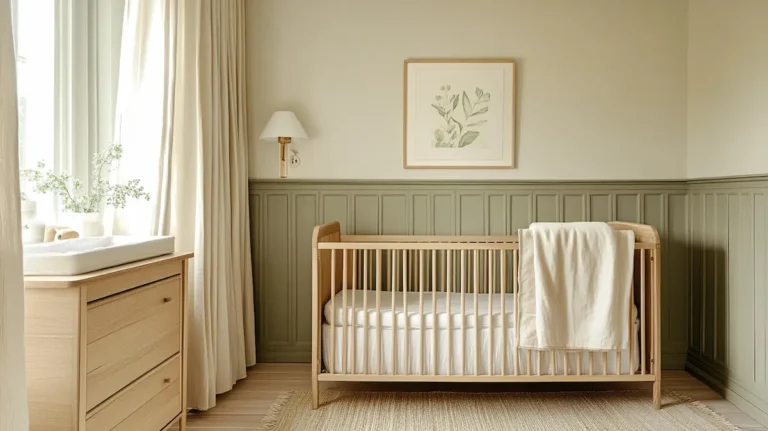
The classic nursery draws on the vocabulary of traditional European children’s rooms: painted furniture in white or soft muted tones, patterned wallpaper in small-scale botanical or toile designs, brass or ceramic hardware, and a colour palette built around warm whites, soft greens, and dusty blues. The visual reference is a room that could have existed in a well-maintained European apartment forty years ago. The appeal is that it ages gracefully — the classic nursery that is still functioning as a bedroom at age seven does not look dated in the way that a novelty-themed nursery does.
Modern
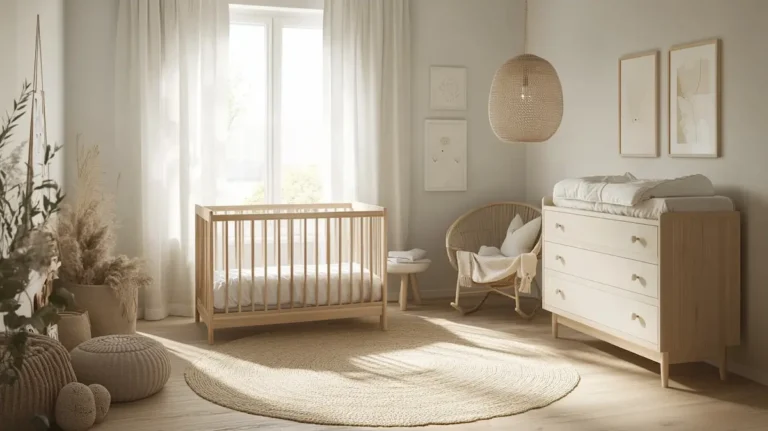
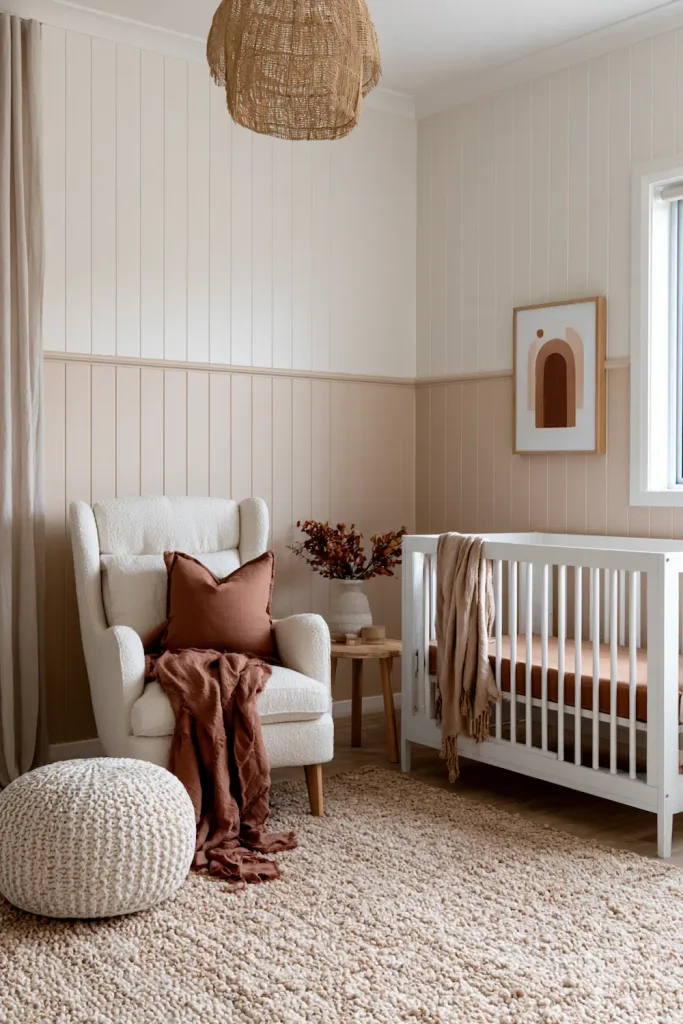
The modern nursery works from a reduced palette and a preference for natural materials: undyed linen, natural oak, hand-thrown ceramics in neutral glazes, and walls in warm off-white or pale clay tones. The visual register is closer to adult Scandinavian or Japanese-influenced interiors than to conventional nursery decor. This approach requires confidence in restraint — the room will look incomplete to eyes trained on conventionally furnished nurseries — but produces a space that reads as genuinely calm and that transitions easily to a child’s bedroom as the child grows.
Boho
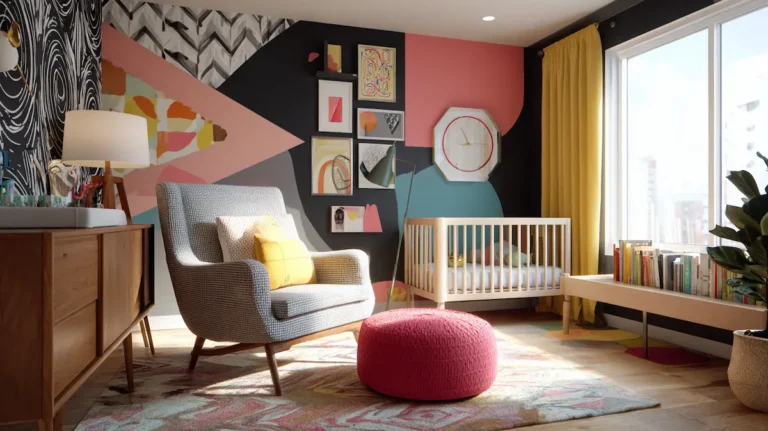
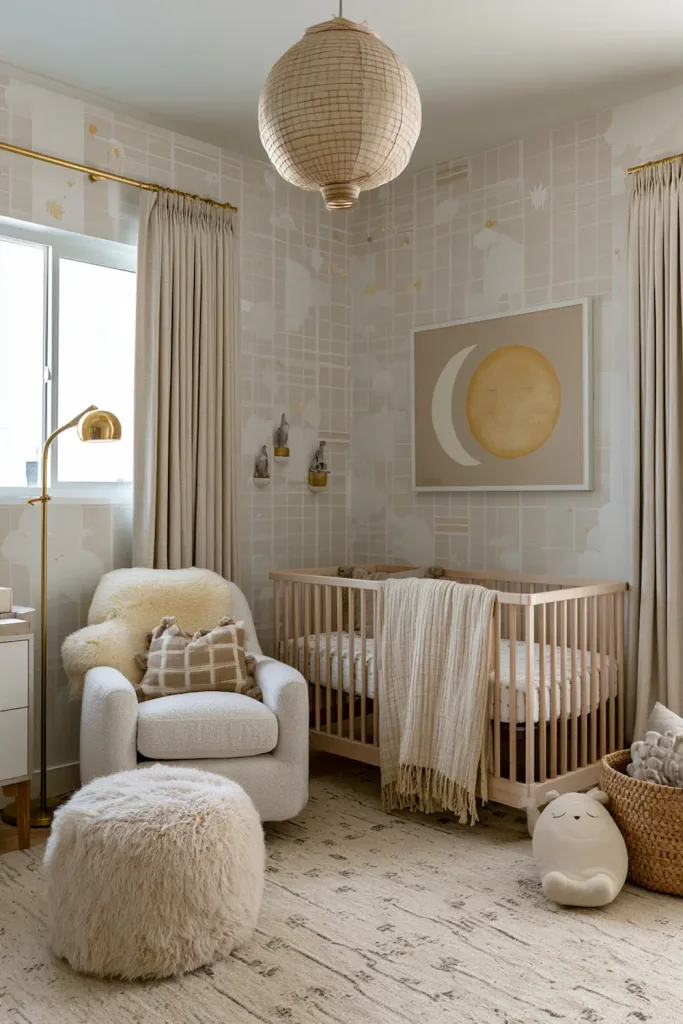
The boho nursery draws on layered textiles, macramé, rattan, and a warmer, more eclectic palette — terracotta, rust, ochre, warm sand. Its visual logic is accumulative: rugs layered over each other, wall hangings alongside framed prints, woven baskets used as storage. The appeal is tactile richness. The practical challenge is that the layering that reads as relaxed when done well reads as cluttered when done carelessly, and the boho aesthetic offers fewer natural edit points than the classic or modern approaches.
Most successful nurseries are not pure expressions of one family. A modern palette with a classic cot. A boho rug in an otherwise clean contemporary space. The useful question is not which label to commit to, but which elements from each tradition are genuinely consistent with the rest of the home.
→ Nursery Design Trends: Classic vs Modern vs Boho
Colour: What Actually Makes a Nursery Feel Calm
Colour in the nursery is the decision with the greatest visible impact and the most persistent misconception attached to it. The misconception is that a calm nursery requires pale, desaturated colour across all surfaces — that muted is always better, and bright is always overstimulating.
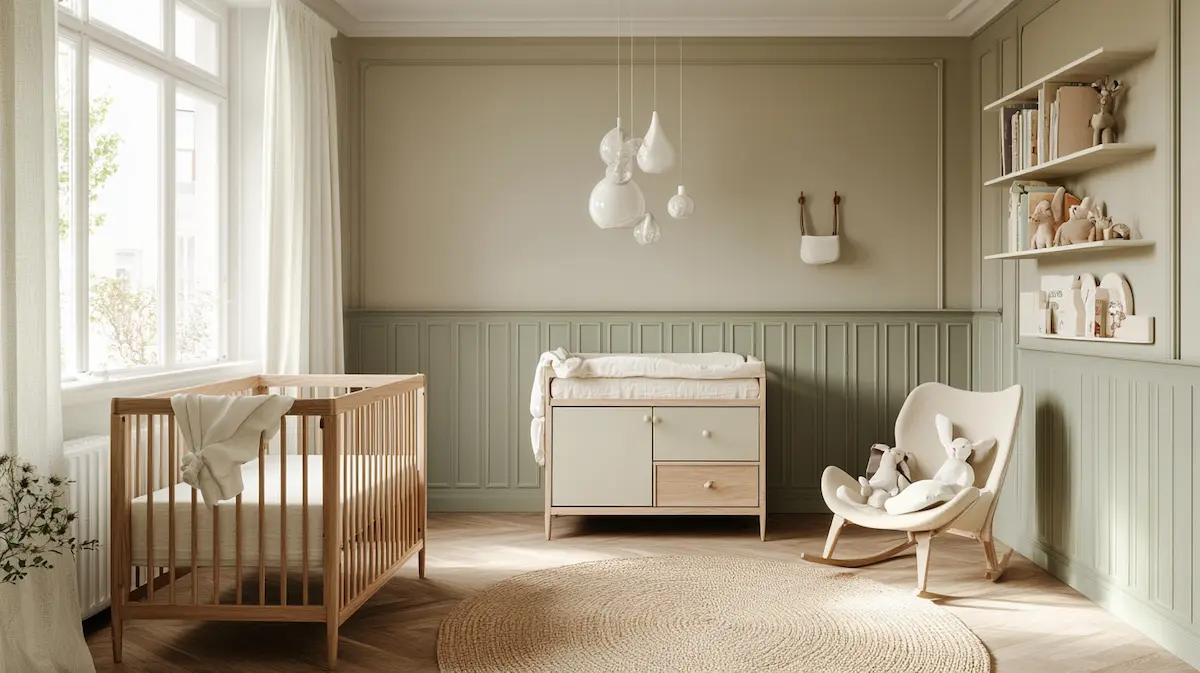
What is consistently visible in well-documented nursery interiors is more specific: the rooms that read as genuinely calm share a quality of colour temperature coherence rather than uniform paleness. A nursery with warm off-white walls, a warm sage green wainscoting, and warm oak furniture reads as calm not because everything is pale, but because the undertones of all the colours belong to the same temperature family. A room where the wall is a cool grey-white, the cot is a warm cream, and the rug is in a warm terracotta reads as restless in comparison — not because any individual element is wrong, but because the undertones conflict.
Building a coherent palette
The most reliable way to build a coherent nursery palette is to identify the underlying temperature of each surface material — warm (yellow, red, or orange undertones) or cool (blue, green, or grey undertones) — and to ensure that the majority of the dominant surfaces share the same temperature. This does not require that everything is the same colour. It requires that the colours are drawn from the same temperature family.
The practical application: test paint samples on the actual wall (not on a card) at different times of day and against the other dominant surfaces in the room — the flooring, the cot, the curtain fabric. The relationships between colours matter more than any colour in isolation.
The role of a single stronger colour
A nursery that is all pale — all warm whites and soft naturals with no point of stronger colour — can read as undercooked rather than calm. A single element in a more saturated or deeper tone anchors the room visually: a painted accent wall in a deep sage or dusty blue, a rug in a warm terracotta, a single piece of furniture in a muted forest green. The function of this stronger element is to give the lighter surfaces something to contrast against.
→ The Psychology of Calming Colours in a Baby's Room
Furniture: The Four Pieces That Do the Work
A nursery requires fewer pieces of furniture than most parents plan to buy. The following four are the ones that do the actual work of the room. Everything else is secondary.
The cot
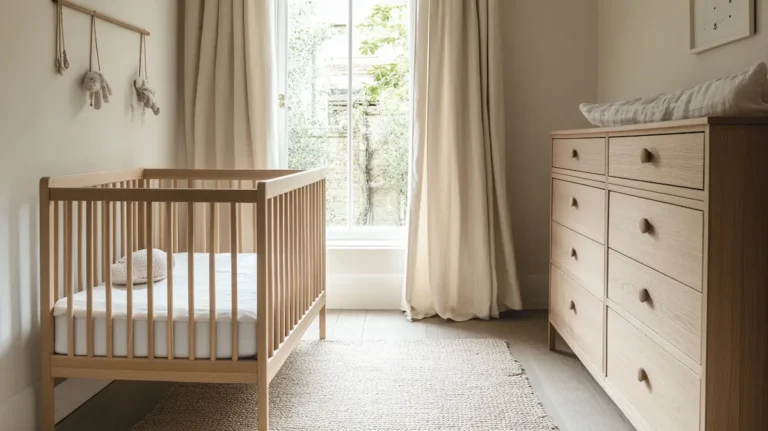
The cot is the centrepiece of the nursery and the purchase that will receive the most scrutiny. The decision that matters most is not aesthetics but size and longevity: a convertible cot that transitions to a toddler bed, and eventually to a small single bed, is a significantly better investment than a conventional cot that is outgrown by twenty-four months. Natural solid wood — oak, beech, or birch — ages with the room and continues to read correctly as the nursery transitions to a child’s bedroom.
The dresser and changing station
A full-sized dresser with a changing mat on top is more useful than a dedicated changing table. It provides storage that remains relevant when the child outgrows nappies, and its surface height is more practical for the majority of adults who will be using it. The changing mat sits on top and is removed when no longer needed. The dresser remains.
The nursing chair
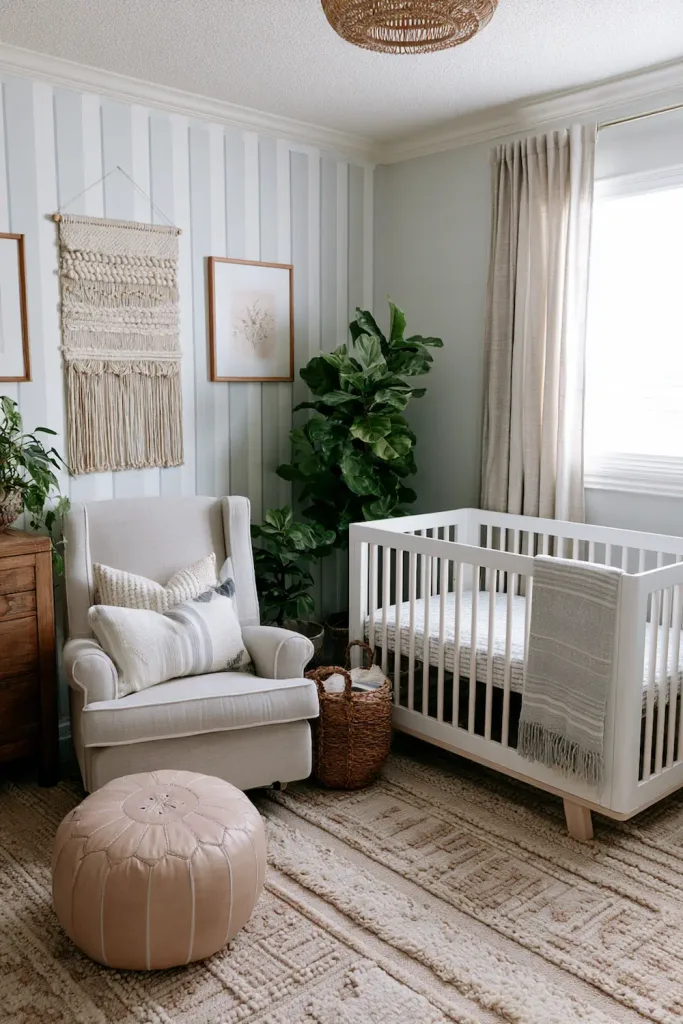
A nursing chair — or any comfortable, supportive chair with good armrests — is used more hours than any other piece of furniture in the nursery. The most important qualities are seat height (the floor should be reachable with flat feet), arm width and height (narrow enough to feed from either side comfortably), and the ability to rise from it easily when holding a sleeping baby. Upholstered options in washable performance fabrics are more practical than anything delicate. A footstool or small ottoman adds significantly to comfort during long night feeds.
Storage
A nursery generates a larger and faster-growing volume of small objects than almost any other room. Open shelving, deep drawers, and large lidded baskets — particularly for the floor-level items that a crawling and then walking child will interact with — are more functional than furniture with many small compartments. The storage that works in a nursery for a newborn is not the same storage that works when the child is eighteen months old. Building in flexibility from the outset — drawers that can be reorganised, shelves at adjustable heights — saves significant practical difficulty.
Safety: The Non-Negotiable Foundation
Safety in nursery design is not a separate category from design. It is a design constraint that shapes every decision — product selection, furniture placement, textile choices, and paint specification. Understanding the primary safety categories before purchasing anything avoids the most common and costly mistakes.
The sleep environment
The cot mattress is the most safety-critical purchase in the nursery. It must be firm, flat, and fit the cot with no gap larger than two finger-widths at any edge. A gap between mattress and cot frame is a suffocation hazard. Second-hand cots are widely used, but a second-hand mattress should be replaced: the deformation and contamination that develop in a used mattress increase the risk of suffocation and infection in a way that is not visible and cannot be cleaned away.
Bumpers, pillows, duvets, and sleep positioners do not belong in the cot with a baby under twelve months. This applies to all bumper types, including mesh. The current consensus from paediatric safety organisations is that the risks of cot bumpers outweigh their benefits for infants who cannot yet reposition themselves.
Furniture anchoring
All freestanding furniture — dressers, bookshelves, wardrobes — must be anchored to the wall before the child is mobile. A dresser that is stable when a newborn is in the room is not stable when a two-year-old uses its drawers as a climbing frame. Anti-tip furniture straps are inexpensive, widely available, and non-negotiable for any piece of furniture taller than the child’s centre of gravity.
Air quality and materials
Low-VOC or zero-VOC paint is standard for nurseries for practical reasons: the room is small, windows may be closed at night, and a newborn spends the majority of their first months breathing its air. Most major paint brands now offer full ranges in low-VOC formulations without significant price premium. Solid wood furniture off-gasses less formaldehyde than particleboard; if particleboard furniture is used, allowing it to air thoroughly before the room is occupied reduces initial off-gassing significantly.
→ Nursery Safety Essentials Every Parent Should Know
Layout: Placing the Furniture the Room Actually Needs
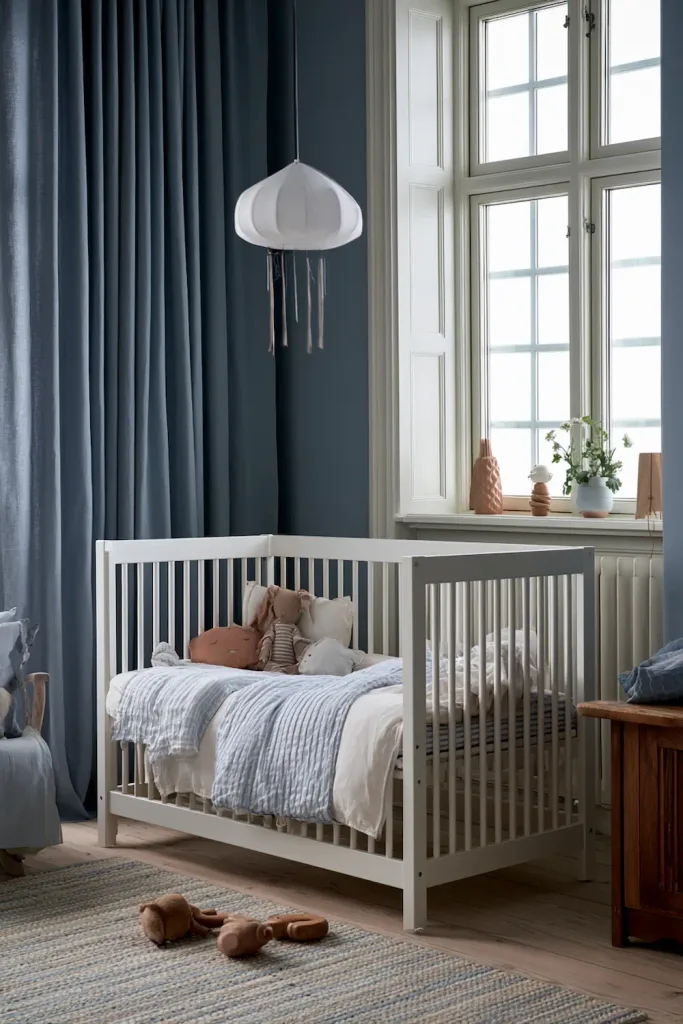
The layout of a nursery is determined by three fixed factors — the position of the window, the position of the door, and the dimensions of the room — and three primary furniture pieces: the cot, the dresser/changing station, and the nursing chair. Getting the sequence right matters more than any individual furniture choice.
The cot position
The cot should not be placed directly under a window or in direct line with a radiator or air vent. Draughts and temperature fluctuation disrupt sleep and present comfort and safety issues regardless of the external temperature. The best position is typically against an interior wall — one that shares no exterior exposure — where temperature is most stable. If no interior wall position is available, positioning the cot away from the window and with the window covered by a lined or blackout curtain is the practical alternative.
The changing station position
The dresser with changing mat should be placed where there is clear floor space on both sides for an adult to stand and where a nappy bin or waste container can sit within arm’s reach. Proximity to the door is useful when the room is dark and the changing station is being used at night — a clear, short path between the door and the changing station reduces the risk of tripping over a floor-level obstacle in low light.
The nursing chair
The nursing chair should be positioned so that the adult using it is facing into the room rather than toward a blank wall. The chair position determines what the adult looks at for accumulated hours of night feeds and daytime settling. A window with a view — even a limited one — is preferable to a wall. A position where the cot is visible from the chair is practically useful when settling a child who is almost but not quite asleep.
Small nurseries and dual-purpose rooms
A nursery in a small room, or a nursery that must coexist with another function — a guest room, a home office — requires prioritising by use frequency. The cot, the changing station, and the nursing chair are used daily, multiple times per day. The guest bed or the office desk is used occasionally. Design the nursery functions first and fit the secondary function around them, not the reverse. In genuinely small spaces, a mini cot or space-saving cot-bed buys meaningful additional floor area without compromising sleep safety.
→ How to Plan a Nursery Layout (Even in a Small Room)
Lighting: Three Types, One Room
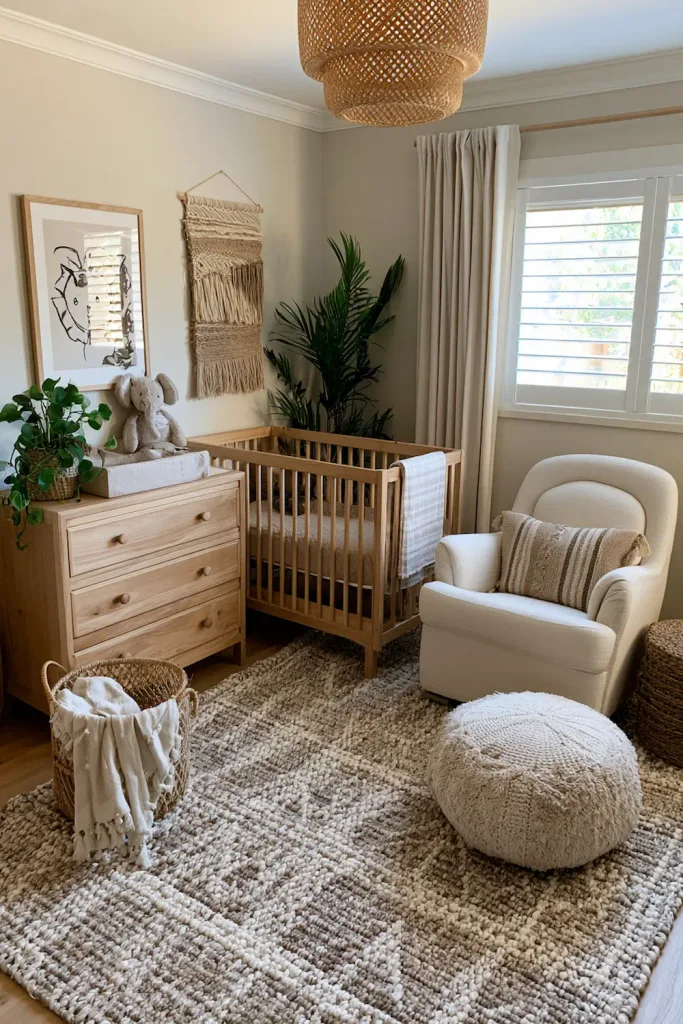
Nursery lighting is one of the most practically consequential decisions in the room and the one most frequently addressed as decoration rather than function. A nursery requires three distinct lighting types, each serving a different need. A room with only one type — typically an overhead light — will fail at least two of these needs.
Ambient light for daytime
Daytime overhead or ambient lighting should be controllable — ideally on a dimmer — and positioned to illuminate the room without creating glare over the cot. A ceiling pendant or a pair of wall sconces with warm bulbs (2700K or below) and a diffusing shade that does not create a point of bright light visible from a lying position in the cot is the correct specification. The light should be dimmable from the doorway, so that entering the room at night to check on a sleeping child does not require navigating in complete darkness.
Task light for the changing station
The dresser/changing station requires a direct light source at the correct height for the adult changing a baby — typically a table lamp or a wall-mounted reading light positioned so that the changing surface is well lit without the light being directed into the baby’s eyes from below. A bulb at eye level for a supine infant creates significant discomfort; a lamp positioned to illuminate the changing surface from the side or above avoids this.
Night light for feeds and settling
A night light that emits warm amber or red-spectrum light at very low intensity is the most functional option for the nursing corner. Cool white or blue-spectrum light at night suppresses melatonin production in both the feeding adult and the child, making return to sleep harder after a night feed. A warm amber plug-in night light, or a rechargeable lamp with a warm colour setting, placed near the nursing chair at floor level or just above it provides enough light to feed and check on a baby without disrupting the sleep cycle for either party.
Textiles: The Layer That Changes the Room’s Feel
The textiles in a nursery — the curtains, the rug, the bedding, the chair upholstery — collectively determine more of the room’s sensory character than any individual piece of furniture. They are also the layer that is most practically demanding: nursery textiles are washed frequently, often at high temperatures, and subjected to a sustained level of spill, soil, and mechanical stress that tests their material quality quickly.
Curtains and blackout
Floor-length linen or cotton curtains with a blackout lining are the most practical and visually effective window treatment for a nursery. The blackout function — complete darkness for day-time naps — is non-negotiable for most parents. A separate blackout blind behind the curtain achieves the same result while allowing the curtain to be lighter in fabric weight. The curtain colour and texture should be drawn from the palette already established in the room; a heavy floral curtain in a room designed around natural linen reads incorrectly and dominates the wall surface it occupies.
The rug
A rug in a nursery serves both acoustic and practical functions: it reduces the echo and sound transmission that hard flooring amplifies, and it provides a softer surface for the period when the child begins to pull themselves up, roll, and eventually crawl. A flat-weave or low-pile rug is more practical than a high-pile option for this stage: easier to clean, less likely to become a trip hazard as the child becomes more mobile. The rug should be large enough to extend beyond the reach of the furniture — a rug that is sized only to fit under the cot, for instance, misses the floor area where the child will spend the most active time.
Bedding
For a baby under twelve months, the bedding that belongs in the cot is a single fitted sheet on the mattress and nothing else. Cellular blankets, sleeping bags, and swaddling cloths are used outside the cot for warmth. The design of the fitted sheet — its colour, its fabric, its pattern — matters in the same way that any visible textile in the room matters. Ivory, cream, and undyed cotton read correctly in almost any nursery palette.
What to Leave Out
The most consistent characteristic of nurseries that read well — that feel genuinely calm, genuinely designed, and genuinely prepared rather than merely purchased — is restraint. Not in the sense of spending less, but in the sense of editing more. The objects, furniture, and decorative elements that are left out of a well-designed nursery are as important as what is included.
Novelty furniture and accessories are the most common source of visual clutter in a nursery. A lamp shaped like a cartoon character, a cot with an elaborate themed headboard, a rug that represents a city map: each of these makes the room feel dated within eighteen months and contributes nothing to the functional or aesthetic quality of the space. The child does not notice the theme. The adult does, every time they enter the room at 3 a.m.
Matching furniture sets in the sense of all-in-one nursery packages — cot, dresser, wardrobe, side table, all in the same finish and from the same range — produce rooms that read as assembled rather than designed. The visual consistency that a matching set offers is easier to achieve by selecting individual pieces in compatible materials and tones. The practical advantage is that individual pieces can be replaced independently as they are outgrown or as preferences change.
Excessive wall decoration — gallery walls, large stencilled murals, multiple overlapping prints — competes with the room’s ability to read as calm. One or two framed prints or a single piece of artwork, scaled correctly for the wall they occupy, reads correctly. A wall covered in small mismatched frames reads as agitated regardless of how charming each individual element might be.
Objects bought specifically for display without function or meaning — decorative objects purchased because they fit the colour palette, not because they have any particular relationship to the child or to the family — contribute to the feeling of a room that has been styled rather than lived in. The nursery that reads as genuinely personal is the one where the objects have a reason to be there beyond filling a visual gap.
"Remove the last thing you added. Then assess. If the room is better without it, you have made the correct decision. If it is worse, you know it earned its place."
Where to go next
This guide covers the primary decisions in nursery design. Each of the Layer 1 articles below develops one of these decisions in full depth — covering the research, the practical detail, and the specific choices that this article can only introduce.
→ What Is a Nursery Style? How to Choose the Right Look
→ Nursery Design Trends: Classic vs Modern vs Boho
→ The Psychology of Calming Colours in a Baby's Room
→ Nursery Safety Essentials Every Parent Should Know
→ How to Plan a Nursery Layout (Even in a Small Room)