Best Parisian Bedroom Furniture Sets
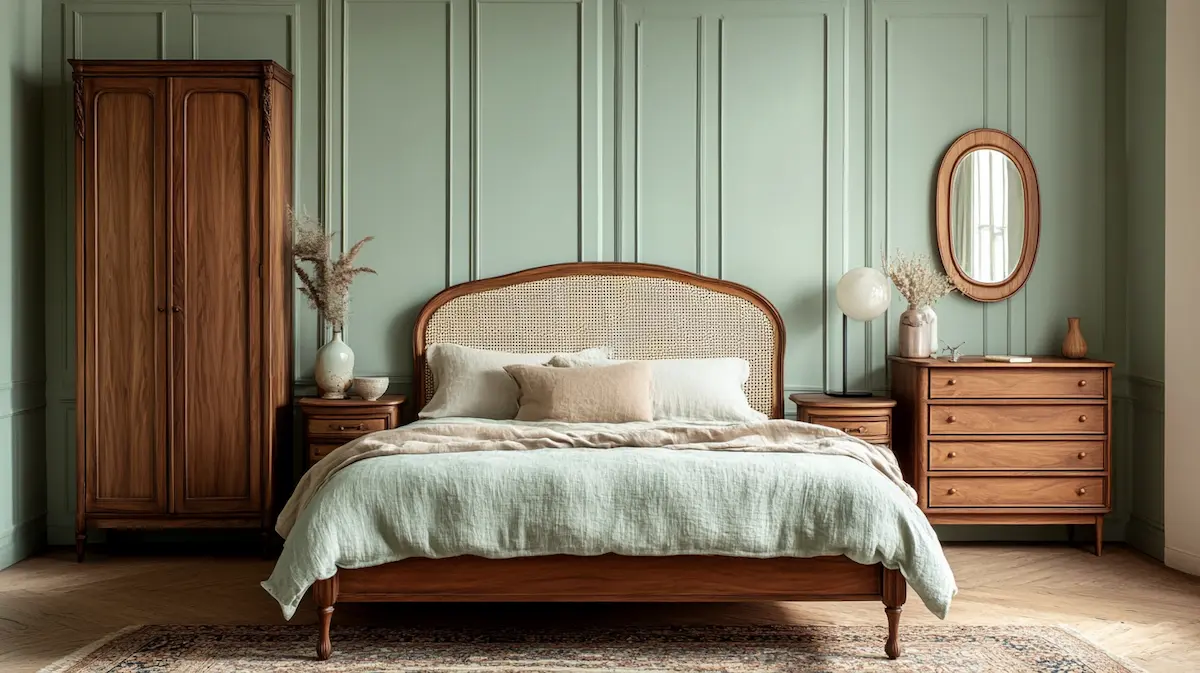
The phrase ‘furniture set’ is slightly misleading in a Parisian context. The Parisian bedroom is rarely furnished with a matched set purchased as a single unit — bed, two nightstands, and dresser from the same manufacturer, in the same finish, with the same hardware. It is furnished with pieces that relate through material and tone without matching exactly: a carved walnut bed, a pair of nightstands that are similar but not identical, an armoire from a different period and a different wood. This is not a compromise. It is the specific quality that makes a Parisian bedroom read as accumulated rather than purchased.
This article covers the core furniture pieces of the Parisian bedroom — bed frame, bedside table pair, armoire, and commode — with guidance on how to source and combine them, and specific product options where a genuinely representative one exists.
| ⚠ A note on sourcing one-of-a-kind furniture: Several pieces in this article — the antique armoire, the commode, and certain carved bed frames — are genuinely one-of-a-kind antiques. Rather than link to a single Etsy listing that may sell or change before you read this, this article directs you to the specific curated marketplaces (Chairish, Selency, specialist antique dealers) where this exact type of piece is consistently available, so you can find the closest current match yourself. Etsy affiliate links are used only for items that are more standardly available or restockable. |
The Principle: Related, Not Matched
The defining furnishing principle of the Parisian bedroom is that pieces relate to each other through material, tone, and general period rather than through being part of a single manufactured collection. A bed frame in dark carved walnut, bedside tables in a slightly lighter oak, and an armoire in yet another wood tone can work together in a Parisian bedroom provided they share a general warmth and a general sense of age. A bedroom furnished entirely from one manufacturer’s matching collection — same wood, same finish, same hardware on every piece — reads as showroom rather than lived-in.
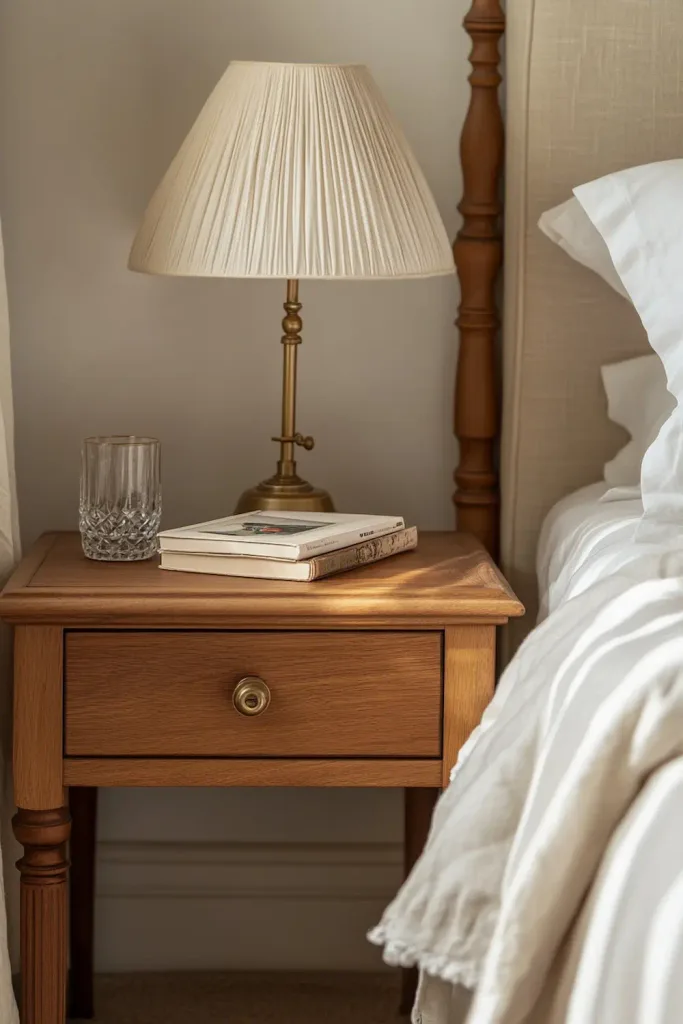
This is the quality directly visible across the real bedroom photographs referenced in this article: the bedside table pair (Images 2 and 5) are two different pieces, from two different sources, in two different wood tones — one a richer mahogany-toned three-drawer chest with ring pulls, the other a simpler lighter oak single-drawer table with a brass knob. Neither matches the other exactly. Both work in a Parisian bedroom context because they share the same general material warmth and the same general age.
What ‘relates’ means in practice
Pieces relate when they share: a similar wood tone family (warm walnut, oak, or fruitwood — not mixing a very dark espresso-stained piece with a very light blonde oak piece), a similar general age or styling (genuinely vintage or antique pieces together, rather than one antique piece beside one obviously contemporary flat-pack piece), and compatible hardware metal (brass with brass, aged iron with aged iron — not mixing bright chrome handles with antique brass ones).
“A matched bedroom set says: I bought this all at once. A related but unmatched bedroom says: I found this, and this, and this, over time, and they belong together because I chose them with the same eye.”
→ What to look for when sourcing any piece of Parisian vintage furniture: → Parisian Vintage Furniture: What to Look For
The Bed Frame: Carved Walnut as the Anchor
The bed frame is the largest single object in the room and the piece most worth investing consideration in. A carved walnut headboard — with shell, scroll, or floral carved detail at the centre top, a gently curved top rail, and a warm aged wood tone — is the most consistently documented Parisian bed type. It anchors the room: every other piece of furniture relates to it rather than the reverse.
Headboard height and form
A correctly scaled Parisian bed headboard is typically 100–130 cm from the top of the mattress to the top of the headboard — tall enough to be a genuine visual presence behind the pillows, not so tall that it dominates a room with a lower ceiling. The carved detail, where present, is usually concentrated at the centre top of the headboard (a shell or floral motif) and along the top rail (a gentle scroll or moulded edge), with the main panel of the headboard left plain to let the wood grain itself be the visual interest.
Wood tone: warm walnut, not dark espresso stain
The correct wood tone for a Parisian carved bed is a warm, naturally aged walnut or oak tone — medium-to-dark brown with visible grain and a slight reddish or golden warmth, not a uniform, opaque dark espresso stain that obscures the grain entirely. The warmth and grain visibility is what allows the headboard to read as a genuine aged wood object rather than as a piece finished to look dark.
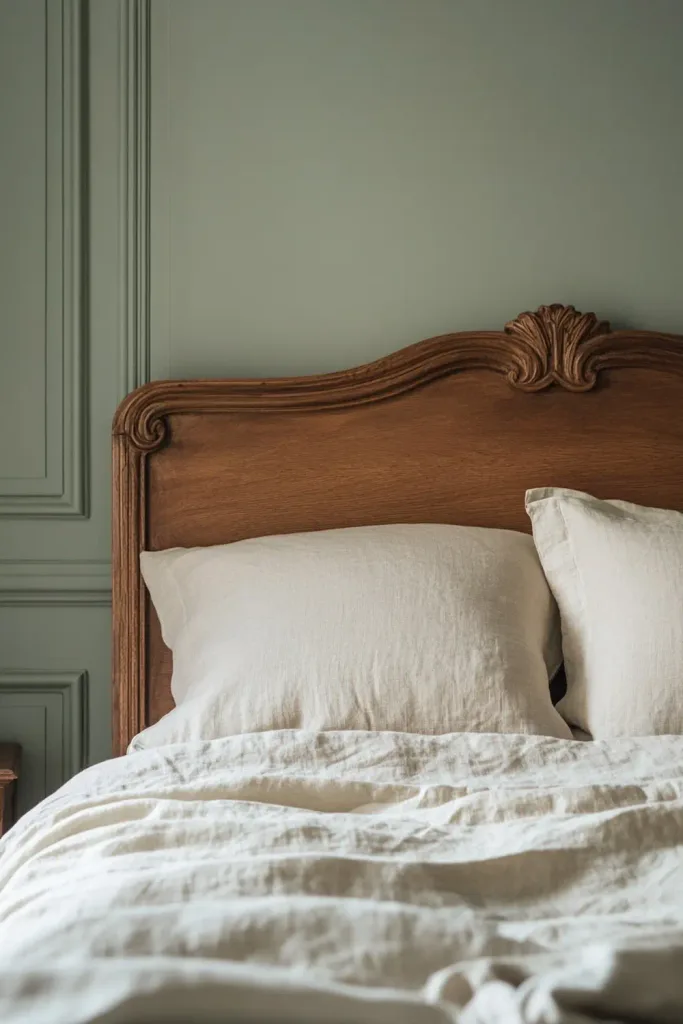
| ➶ Antique French Walnut Bed — Carved Detail, Full Size, Art Nouveau Era (Etsy) |
| A genuine antique French bed in walnut, circa 1910, with a tall headboard (66.5” / approx. 169 cm) featuring gentle curves and carved decorative detail at the top in a rococo-influenced pediment. Good, original finish, with minor noted wear (one chip on a side rail). Accommodates a Full-size mattress. This is a genuine one-of-a-kind antique piece — the specific carved motif (the listing features carved rose detail rather than the shell motif shown in this article’s image) will not be an exact match, but the type — genuine antique French carved walnut headboard with period detail — is the correct category. If this specific listing has sold, search ‘antique French walnut bed carved’ on Etsy or consult the curated marketplaces in Section 6 for comparable current pieces. Price listed in the Etsy shop — check current listing · Etsy · genuine antique · circa 1910 Editorial note: This is a genuine antique French carved walnut bed — the correct category of piece for the headboard shown in this article’s image, though the specific carved motif differs (carved roses rather than a shell). As with all one-of-a-kind antiques, treat this as representative of the type rather than an exact visual match. Confirm current condition, mattress size compatibility, and shipping logistics directly with the seller — antique bed frames are large and shipping costs can be significant. |
| → Chairish — Antique and Vintage French Carved Bed Frames |
| Chairish maintains a consistently updated selection of genuine antique and vintage French carved bed frames in walnut and oak, across a range of styles from Louis XV to Art Nouveau to French Provincial. The French Beds category, filtered by material (walnut, oak) and by size, is the most productive search for a piece matching the carved headboard style shown in this article. Detailed condition notes and multiple photographs per listing. Ships within the US; international shipping varies by seller — confirm before purchase given the size and weight of bed frames. No affiliate relationship — included because Chairish is the most reliable single source for genuinely varied antique French bed frames with accurate condition reporting. Variable — approx. $600 – $3,500 depending on period and condition · Via Chairish Editorial note: For a bed frame closely matching the shell-carved walnut headboard shown in this article: filter Chairish’s French beds category by walnut and browse current listings for shell, scroll, or floral carved pediment detail. Given the size and shipping complexity of bed frames, always confirm dimensions against your mattress size and your room’s doorway/stairwell access before purchasing. |
The Bedside Table Pair: Related, Not Identical
As established in Section 1, the Parisian bedside table pair does not need to match. The two real bedroom photographs referenced in this article (Images 2 and 5) show exactly this: a richer three-drawer walnut chest with ring pulls on one side of the bed, and a simpler single-drawer oak table with a brass knob and turned legs on the other. Both are genuinely vintage, both are warm wood tones, and both work in the same room — this is the mix-don’t-match principle in practice, not a styling inconsistency to correct.
What needs to relate, even when the pieces differ
Even in a deliberately mixed pair, a few things should be consistent: the general height (within 5–10 cm of each other, so lamps and books sit at a similar level), the general wood warmth (both pieces in the walnut/oak/fruitwood family, not one warm wood beside one cool grey-painted piece), and the hardware metal (brass with brass — a ring pull and a round knob can coexist if both are brass; a brass pull beside a chrome one will not relate).
Sourcing two different but compatible pieces
Building a deliberately mixed pair is, in practice, often easier and more affordable than sourcing a matched pair: each piece can come from wherever the best individual example is found — one from an estate sale, one from an online vintage marketplace — without needing to wait for or pay a premium for a documented matching set. The two real images in this article are the proof of concept: neither piece needed to match the other for the result to read as considered.
| → Fireside Antiques — Vintage and Antique French Bedside Chests |
| Fireside Antiques is a US-based specialist antique dealer with a curated selection of genuine French and European bedside chests and nightstands across multiple periods — including the warm walnut three-drawer chest type with ring-pull hardware shown in this article. Detailed provenance and condition notes are provided for each piece, along with the kind of close-up photography needed to assess wood tone and hardware accurately before purchase. Ships within the US; consult directly for international shipping. No affiliate relationship — included because Fireside Antiques is a specialist dealer whose detailed cataloguing makes it possible to find genuinely compatible (rather than identical) pieces for a deliberately mixed bedside pair. Variable — typically $200 – $900 per piece · Via Fireside Antiques Editorial note: Browse the bedroom category for individual chests and nightstands rather than searching for a ‘pair’ — the mix-don’t-match approach means sourcing each side of the bed separately. Look for two pieces in the same general wood tone (walnut or oak) and within 5–10 cm of each other in height; they do not need to be the same design. |
The Armoire: The Tallest, Most Architectural Piece
The armoire — a tall, narrow, freestanding wardrobe with a pair of panelled doors and, frequently, a shaped or arched cornice at the top — is one of the most specifically French furniture forms and one of the most architecturally significant pieces in a Parisian bedroom. Its height (commonly 180–220 cm) and its presence against a wall give it a near-architectural role: it is closer to a built-in element than to a piece of furniture that could be easily replaced.
Two armoire styles, both correct
The real photographs referenced in this article show two genuinely different but equally valid armoire types. The first (a darker, more heavily carved piece with a scrolled cornice, shown against a Haussmann wall with elaborate plaster cornicing) reads as more formally antique and more ornately Parisian. The second (a lighter oak piece with a simpler arched ‘chapeau de gendarme’ cornice and plain panelled doors, shown beside a more pared-back white-painted door) reads as more provincial and more restrained. Both are correct; the choice depends on whether the rest of the room leans toward grand Haussmann formality or toward a simpler, more rustic French Provincial register.
The chapeau de gendarme cornice
The arched, shaped cornice at the top of many French armoires — sometimes called a ‘chapeau de gendarme’ (gendarme’s hat) because of its resemblance to a French police or military cap — is one of the most recognisable and most specifically French architectural details in bedroom furniture. Its presence (visible in both Images 1 and 4 of this article, in different scales of curve) is a strong visual signal of authenticity, whether the piece is a genuine antique or a well-made reproduction.

| A note on armoire sourcing: Genuine antique armoires are large, heavy, one-of-a-kind objects, and shipping logistics (door widths, stairwells, freight cost) are a significant part of the purchase decision — more so than for almost any other furniture category in a Parisian interior. Always confirm the piece’s exact dimensions against your doorways and stairwells, and get a firm shipping quote, before committing to purchase. |
| → Selency — Vintage and Antique French Armoires (European Market) |
| Selency is a French online vintage marketplace with a consistently strong selection of genuine antique and vintage French armoires across regional styles and periods — from the more ornate Haussmann-era carved pieces to the simpler French Provincial oak armoires with arched cornices. The armoires category allows filtering by wood (chêne for oak, noyer for walnut) and by period. Ships across Europe; given the size of armoires, confirm shipping cost and method (some require specialist furniture couriers) before purchase. No affiliate relationship — included because Selency is the most productive single European channel for both armoire styles shown in this article’s images. Variable — typically €250 – €2,000 depending on period, wood, and condition · Via Selency Editorial note: For the more ornate, darker carved armoire style (Image 1): search ‘armoire ancienne sculptée’ or filter by walnut. For the simpler oak provincial style with the chapeau de gendarme cornice (Image 4): search ‘armoire provinciale chêne’. Always request additional photographs of the cornice and door panel detail before committing, since this is exactly the detail that determines whether a piece matches the style you want. |
| → Inessa Stewart’s Antiques — Country French Armoires (US Specialist Dealer) |
| Inessa Stewart’s Antiques is a US-based specialist dealer in genuine French antique furniture, with a consistently well-documented selection of country French armoires across periods including Louis XV, Louis XVI, and Louis XIII styles, sourced directly from French provinces. Detailed historical and construction notes accompany each piece, including specific cornice styles (the chapeau de gendarme detail is frequently called out by name). No affiliate relationship — included because the depth of documentation makes it possible to understand exactly what style and period of armoire you are looking at before purchasing, which is particularly valuable for a piece this significant in both cost and presence. Variable — typically $1,800 – $6,000+ depending on period and provenance · Via Inessa Stewart’s Antiques Editorial note: Use the detailed period and construction documentation on this site to understand the visual vocabulary of French armoires even if you ultimately purchase elsewhere — the specific terminology (chapeau de gendarme cornice, fielded panel doors, cabriole feet) will help you describe what you are looking for to other dealers or search more effectively on marketplaces like Selency or Chairish. |
The Commode: Storage With a Leaning Mirror Above
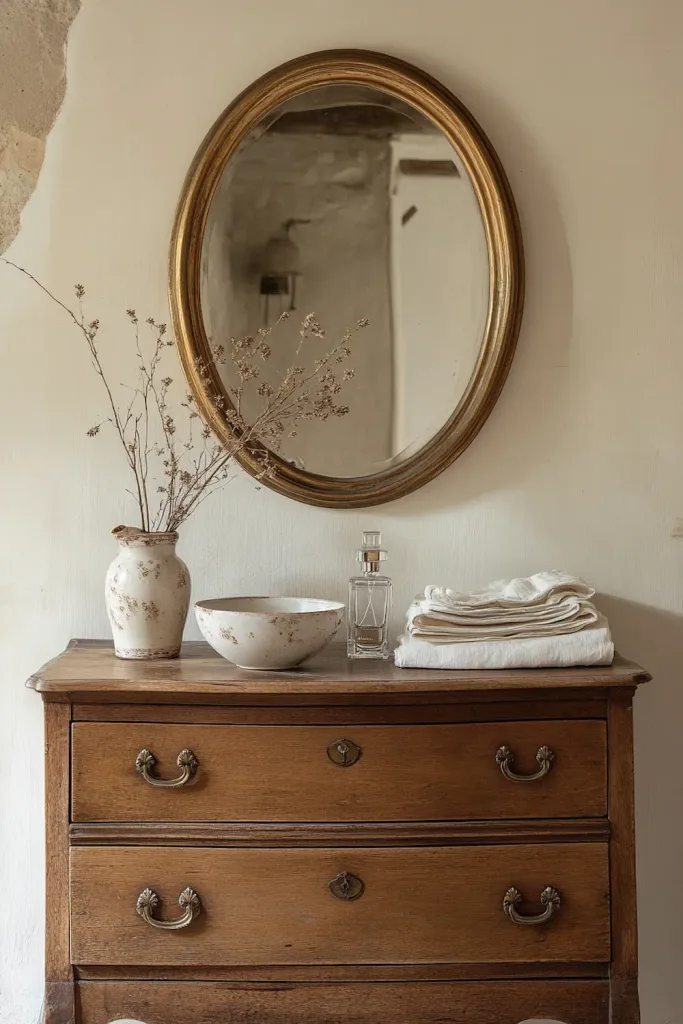
The commode — a chest of drawers, often with a gently curved or bombe-style front and brass hardware — is the third major case piece in the Parisian bedroom, typically used either as an alternative to or in addition to the armoire for clothing storage, and very often as the surface beneath a leaning mirror, as shown in the image referenced in this section.
The leaning mirror: not hung
One of the most specifically Parisian styling choices visible in the photograph referenced here is that the oval gilt mirror above the commode is leaning against the wall rather than hung from it. This is a deliberate and recognisable Parisian convention: it reads as more casual, more provisional, and more in keeping with the accumulated quality described throughout this article. A large, heavy mirror leaned rather than hung also avoids the need for wall-anchored hanging hardware, which is useful in rented accommodation — though a leaning mirror of this scale and weight should always be secured against tipping (see the safety note below).
Surface styling
The commode top in the referenced image is styled with a small, considered group of objects: a weathered ceramic vase, a shallow bowl, a glass perfume bottle, and folded linen. This is a useful template for any Parisian commode surface — a small number of objects in related warm, weathered materials, with generous negative space around them, rather than a crowded surface.
| ✱ Safety note on leaning mirrors: A large mirror leaned against a wall rather than hung should always be secured against tipping — anti-tip straps or brackets (available from furniture safety suppliers) anchored discreetly to the wall are recommended, particularly in a household with children or pets. This is a straightforward and inexpensive precaution that preserves the casual leaning look while addressing the genuine tipping risk of an unsecured heavy object. |
| → Chairish — French Commodes and Bombe Chests |
| Chairish carries a consistently strong selection of genuine French commodes, including the curved bombe-front style with brass hardware shown in the referenced image, across a range of periods and price points. The French Chests of Drawers / Commodes category, filtered by material and by ‘bombe’ or ‘curved’ in the search, is the most productive route to this specific style. No affiliate relationship — included because Chairish offers the most consistent access to genuine French commodes with detailed condition photography, which matters for assessing wood tone and hardware before purchase. Variable — approx. $400 – $2,200 depending on period and condition · Via Chairish Editorial note: Pair a commode of this type with a separately sourced leaning mirror (oval, gilt frame, foxed glass for the most period-correct look) rather than searching for the two as a set — the leaning-mirror-above-commode arrangement in a genuine Parisian bedroom is almost always two independently sourced pieces, not a matched vanity set. |
Putting It Together: Scale and the Complete Room
With the bed, bedside pair, armoire, and commode individually considered, the final question is how they sit together in the room without crowding it. Scale and clearance matter as much as the individual pieces.
Clearance around the bed
A practical minimum of 60–70 cm of clear walking space on each side of the bed allows comfortable movement and bedmaking. Where an armoire or commode shares a wall with the bed, leave enough clearance for the relevant doors or drawers to open fully — armoire doors typically need 60–80 cm of swing clearance, and this should be checked against the specific piece’s door width before final placement.
Bedside table height relative to the mattress
The bedside table surface should sit at approximately the same height as the top of the mattress, or very slightly above it — this keeps a glass of water or a lamp at a comfortable reach from a seated or lying position. For a typical bed height of 55–65 cm (mattress top), a bedside table of 55–70 cm height is correct; taller pieces require an extra step to reach the surface, shorter pieces require reaching down.
→ The complete Parisian bedroom approach — layout, textiles, and lighting beyond furniture: → Complete Parisian Vintage Bedroom Makeover Guide
→ Velvet seating and accent pieces for the Parisian bedroom or an adjoining reading corner: → Best Velvet Furniture for a Parisian Vintage Home
“The Parisian bedroom is never finished in a single afternoon of furniture shopping. It is the bed you found first, the nightstand that came later from somewhere else entirely, and the armoire that arrived last because it took the longest to find the right one.”