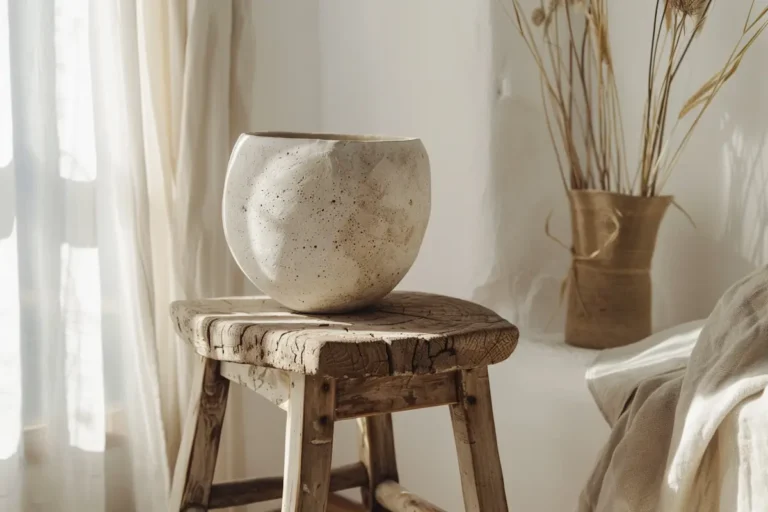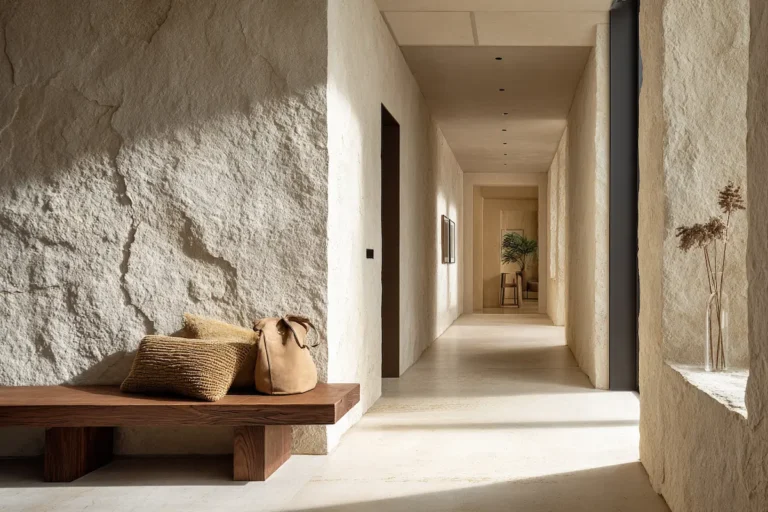
5 Artisanal Decor Styles That Create Calm Interiors Without Feeling Bare
Introduction: Why Calm Interiors Need Character
There’s a common misconception that calm interiors are created by removing as much as possible. White walls, empty surfaces, clean lines — and somehow, that should feel peaceful. But more often than not, it ends up feeling unfinished. Or worse, a little cold.
True calm doesn’t come from emptiness. It comes from balance.
In a well-designed space, every object has a reason to be there. Not because it fills a gap, but because it adds something subtle: texture, warmth, or a quiet sense of presence. This is where artisanal decor becomes essential. Pieces that feel made rather than manufactured bring a kind of depth you can’t replicate with standard, mass-produced items.
Within Crafted Minimalism, this idea is even more important. When you intentionally keep a space minimal, each object carries more visual weight. A single handcrafted bowl, a textured ceramic vase, or a woven element can completely shift the atmosphere of a room.
If you’ve read Creating Calm Without Emptiness, you already know that calm interiors rely on layering — not clutter, but meaningful variation. And as explored in Artisanal Materials in Crafted Minimalism, materials play a defining role in how a space feels.
In this article, I’ll show you how to use artisanal decor as statement elements — not to decorate more, but to create more with less.
Disclaimer: This post may contain affiliate links. This means that if you click on one of these links and make a purchase, we may earn a small commission—at no extra cost to you.
All images featured in this article are AI-generated to illustrate the aesthetic and mood of the interior style. The products linked are carefully selected items that, in our view, most closely match the look and feel of these designs.
As an Etsy affiliate and Amazon Associate, we earn from qualifying purchases. We only recommend products we genuinely believe align with the style and atmosphere presented in our AI-created interiors.
What Is Artisanal Decor (and Why It Feels Different)
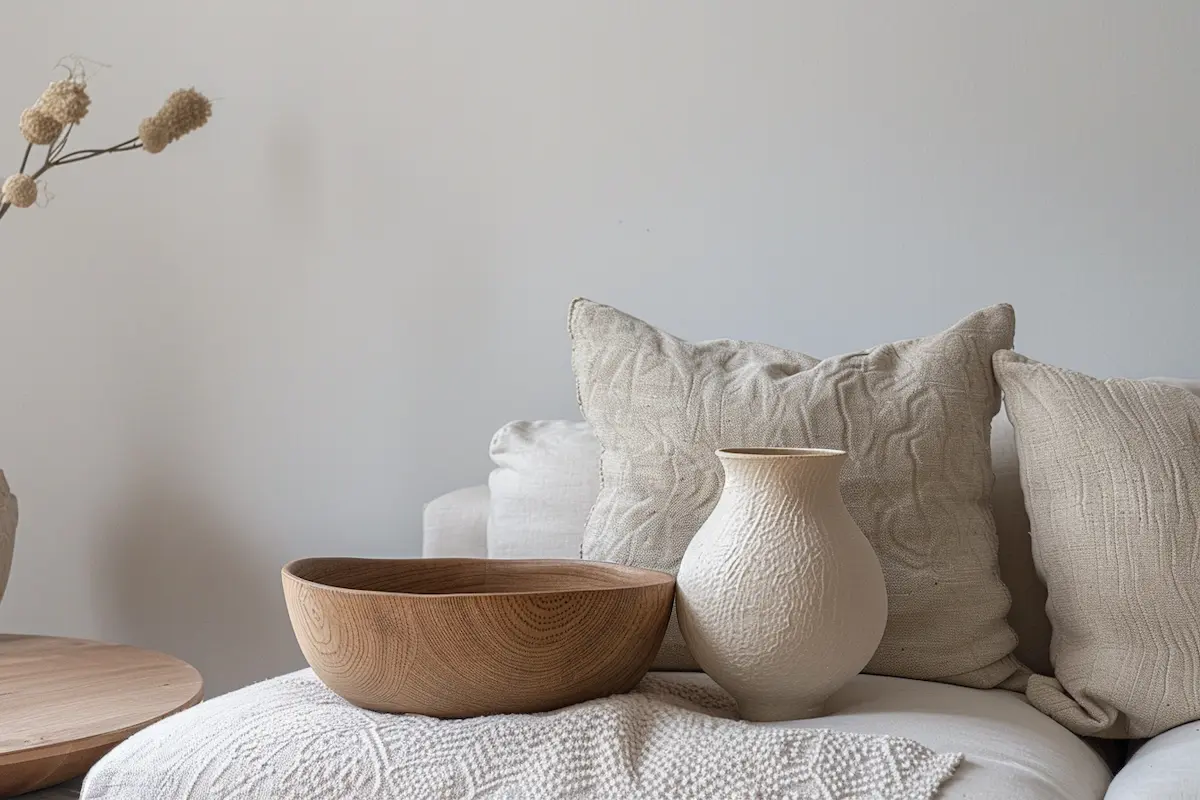
Artisanal decor isn’t defined by a specific style — it’s defined by how something is made, and more importantly, how it feels in a space.
Where mass-produced decor often looks uniform and predictable, artisanal pieces carry subtle irregularities. A slightly uneven edge. A visible grain in the wood. A glaze that doesn’t sit perfectly smooth. These imperfections aren’t flaws — they’re what give an object presence.
In calm interiors, that presence matters.
Instead of relying on bold colors or complex shapes, artisanal decor creates visual interest through material and texture. A handmade ceramic vase doesn’t need a pattern to stand out. A woven basket doesn’t need contrast colors to feel layered. The depth is already there, just in a quieter way.
This is also where artisanal decor differs from traditional “luxury” decor. Luxury often aims for perfection — polished surfaces, symmetry, flawless finishes. But in a calm, crafted interior, that perfection can actually feel distant. Artisanal pieces, on the other hand, feel approachable. Human. Grounded.
And that grounded feeling is exactly what makes a space calming.
By choosing decor that shows how it was made, you introduce a subtle rhythm into the room. Light hits textures differently. Shadows become softer. Surfaces feel more layered, even when the color palette stays neutral.
It’s not about adding more — it’s about choosing pieces that naturally hold attention without demanding it.
Style 1: Hand-Carved Wooden Objects

There’s something about hand-carved wood that immediately changes the feeling of a space. It doesn’t try to stand out — but it does. Quietly. Naturally.
In calm interiors, wood is often the element that brings everything back to earth. Especially when it’s left raw or minimally treated, you can see the grain, the irregularities, the subtle shifts in tone. These details create depth without adding visual noise.
Hand-carved wooden objects take this one step further. They’re not just natural — they’re shaped by hand. That means no two pieces are exactly the same, and that uniqueness is exactly what makes them work so well as statement decor in a minimal setting.
Instead of filling a surface with multiple small items, one sculptural wooden bowl or object is often enough. It draws the eye, but in a soft way. It adds warmth, but without heaviness. And most importantly, it creates contrast against smoother materials like stone, linen, or plaster.
What makes this style especially powerful within Crafted Minimalism is the balance it creates. The space stays calm, but never flat.
One piece that perfectly captures this feeling is this Natural Edge, Cherry Hand Turned Wooden Bowl. The organic edge, visible grain, and slightly imperfect form make it feel more like a sculptural object than a functional item. It’s exactly the kind of piece that doesn’t need styling around it — it is the styling.
Why I chose this piece:
It highlights everything that makes artisanal decor powerful: material honesty, subtle imperfection, and a quiet presence that anchors the entire space without overwhelming it.
Style 2: Textured Ceramics & Clay Pieces
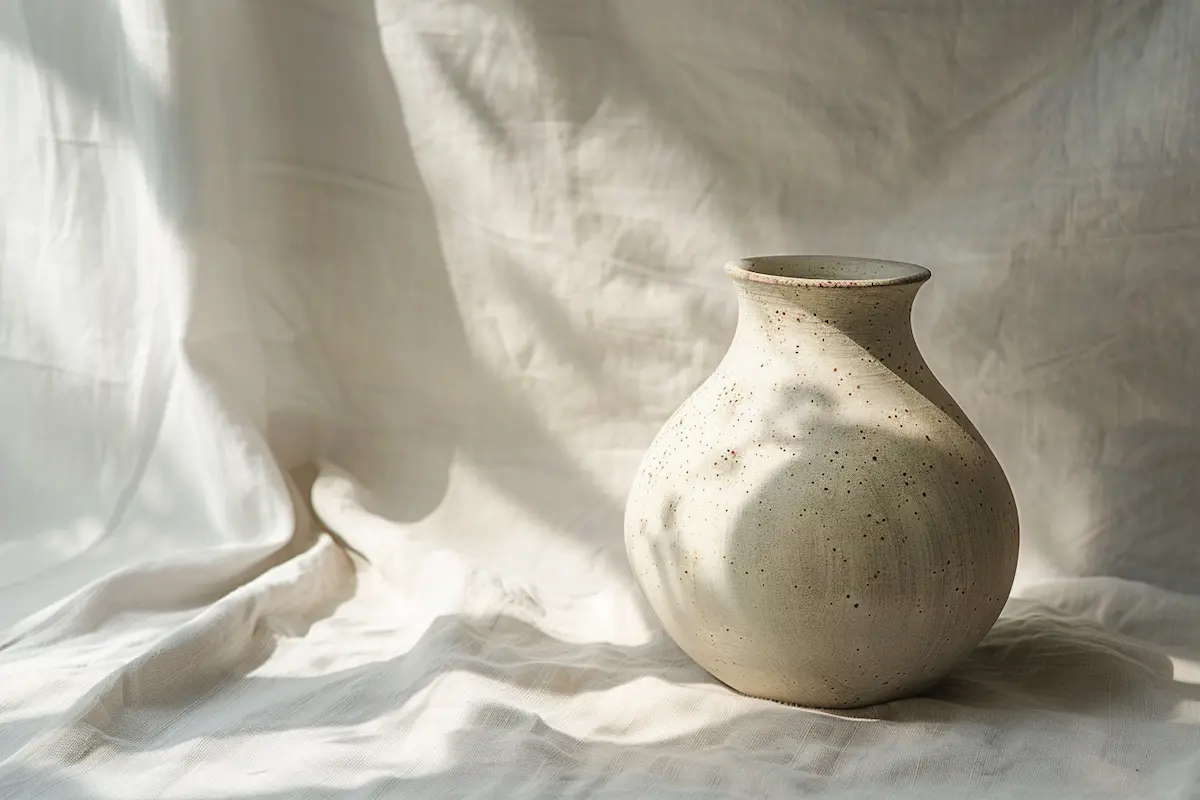
Where wood brings warmth, ceramics introduce a different kind of depth — one that feels softer, more tactile, and slightly more refined without losing its raw edge.
Textured ceramics work beautifully in calm interiors because they interact with light in a subtle way. Instead of reflecting it like glossy surfaces, they absorb and diffuse it. This creates a more muted, calm atmosphere where nothing feels too sharp or overwhelming.
What makes artisanal ceramic pieces stand out is their imperfection. Slightly uneven rims, irregular silhouettes, or a glaze that varies in tone — these details give each piece a quiet individuality. And just like with wood, that individuality becomes more noticeable (and more valuable) in a minimal setting.
A single ceramic vase on a shelf or table can be enough to shift the entire mood of a space. Especially when paired with other natural materials like linen or stone, it creates a layered look without adding visual clutter.
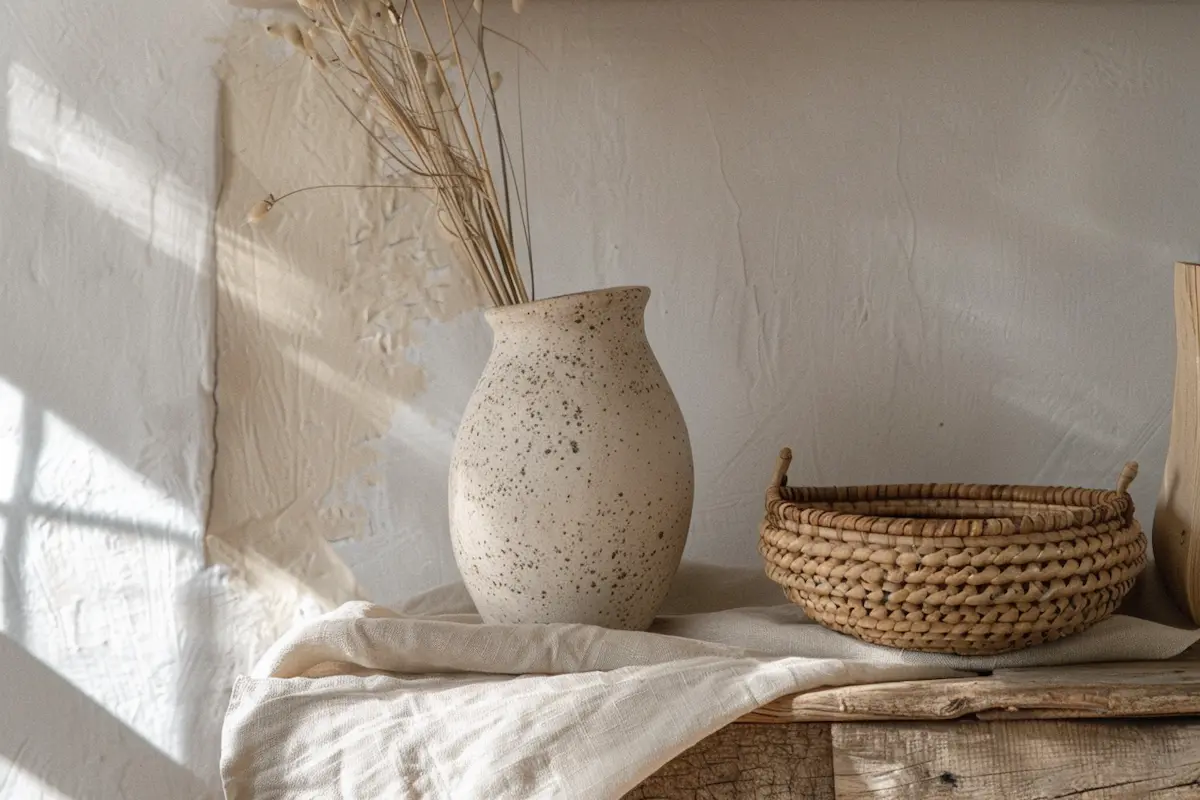
One piece that captures this perfectly is this large speckled vase. The subtle speckled finish adds texture without introducing contrast that would disrupt the calm palette. Its soft, rounded shape keeps the look organic and approachable, while still feeling curated.
Why I chose this piece:
It’s a perfect example of how ceramics can add depth without demanding attention. The texture is visible, but not loud. The shape is simple, but not generic. Exactly the balance you want in a calm, crafted interior.
Style 3: Woven & Natural Fiber Decor
Style 4: Stone & Mineral Decor Accents
Where woven materials add lightness, stone does the opposite — it grounds a space.
Stone and mineral decor bring a sense of permanence that’s hard to achieve with any other material. There’s a quiet heaviness to it. Not overwhelming, but stabilizing. In calm interiors, that grounded feeling is essential. It creates contrast, anchors lighter elements, and gives the space a subtle sense of structure.
What makes stone particularly powerful within Crafted Minimalism is its natural imperfection. Veining, color variations, small irregularities — these details ensure that even the simplest shape feels visually rich. You don’t need ornamentation when the material itself already tells a story.
This is also why stone works so well as a statement element. A single tray, object, or small sculptural piece can carry enough visual weight to define an entire surface. Especially when paired with softer materials like linen or wood, it creates a balanced composition that feels both calm and complete.
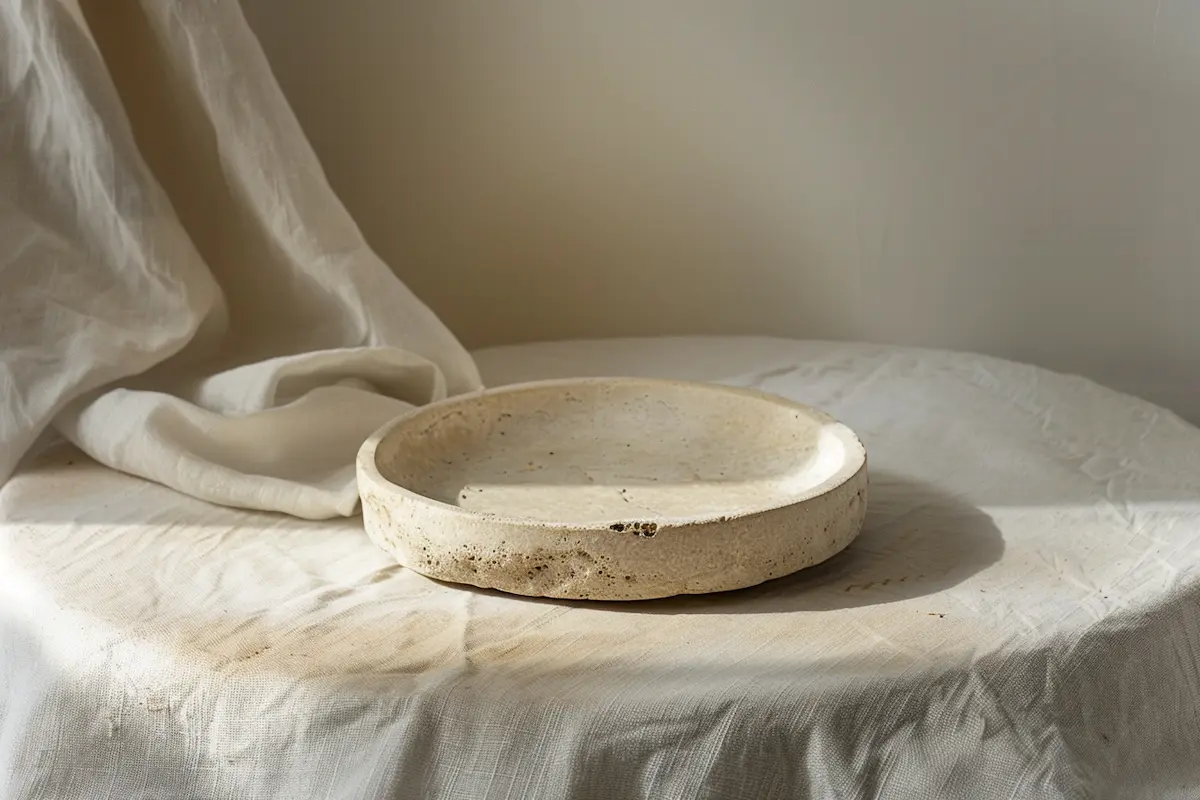
A piece that captures this beautifully is this beige travertine bowl. The soft, neutral tones combined with natural veining give it depth without contrast, making it ideal for calm interiors. It feels solid and refined at the same time — exactly the balance you want in a crafted space.
Why I chose this piece:
It brings weight without heaviness and texture without distraction. The material speaks for itself, allowing the rest of the space to remain minimal while still feeling complete.
Stone rarely stands completely alone in an interior. Combining Wood and Stone explores how it pairs naturally with wood.
Style 5: Soft Textile Layers (Linen, Wool, Raw Fabrics)
If stone grounds a space, textiles are what make it feel lived in.
Soft materials like linen, wool, and raw cotton don’t just add comfort — they change how a space feels on a sensory level. They absorb sound, soften light, and introduce movement in the most subtle way. In calm interiors, this is often the missing layer that turns a space from minimal to inviting.
What makes artisanal textiles different is their texture. Slightly wrinkled linen, loosely woven wool, or fabrics with visible fibers all create depth without relying on color or pattern. And within Crafted Minimalism, that’s exactly what you want: variation that feels natural, not designed.
Textiles also play an important role in balancing harder materials. When combined with wood, stone, or ceramics, they prevent the space from feeling too rigid. Instead, everything starts to feel more relaxed, more human.
The key is to keep it understated. One or two well-chosen pieces — a linen cushion or a soft throw — are often enough. Overlayering can quickly shift the space away from calm and into clutter.
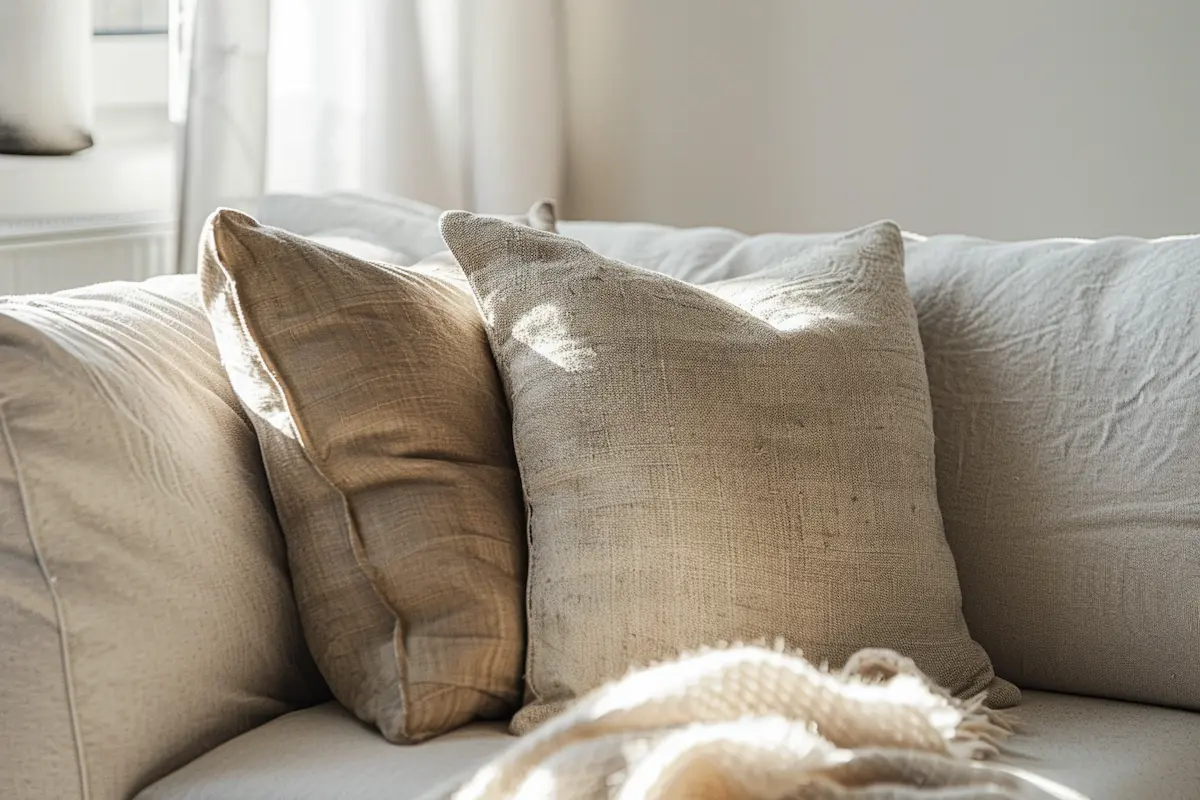
A piece that captures this softness perfectly are these linen pillow covers. The subtle woven structure and muted tone make it blend effortlessly into a calm interior, while still adding that essential layer of warmth and tactility.
Why I chose this piece:
It’s a perfect example of how textiles should function in a crafted space: not as decoration, but as a quiet enhancer of everything around it.
How to Style Artisanal Decor Without Clutter
The biggest mistake in calm interiors isn’t adding too little — it’s adding without intention.
Artisanal decor only works when it has space to be seen. These pieces rely on texture, material, and subtle variation. If you place too many items together, that nuance disappears, and everything starts to feel visually heavy instead of calm.
Start by thinking in terms of composition, not decoration.
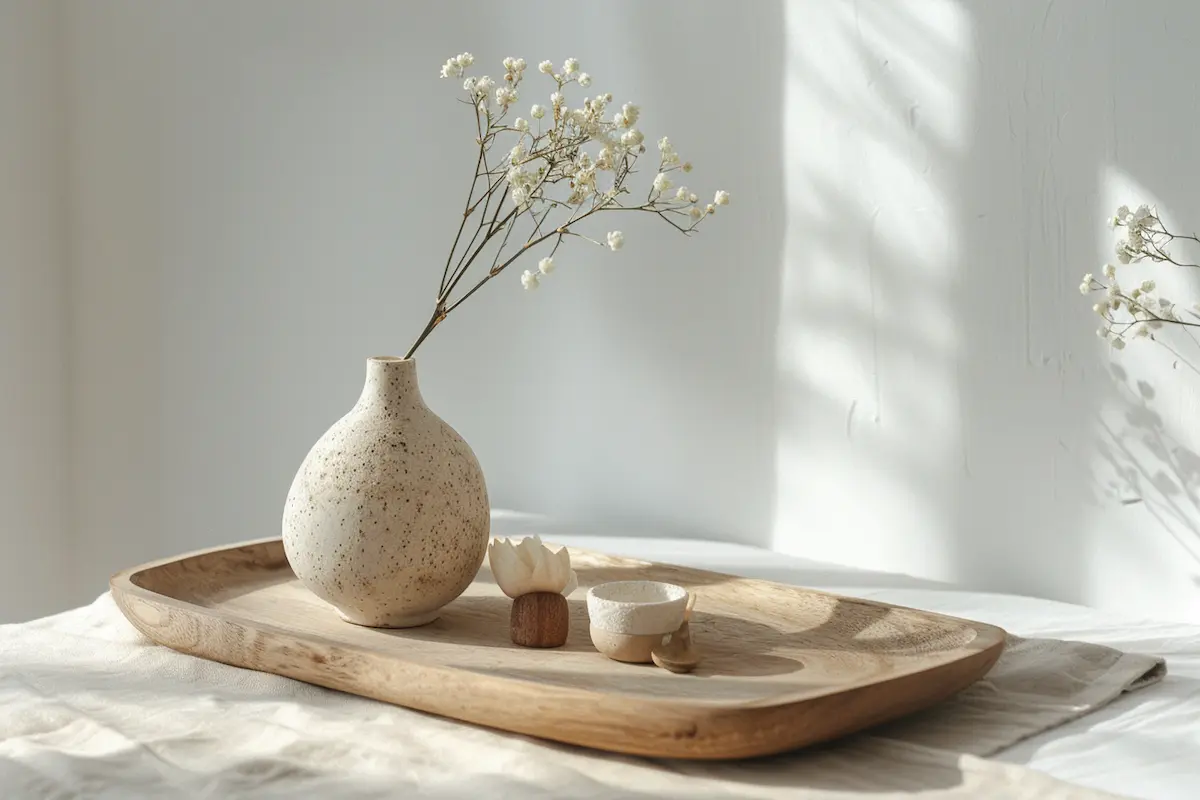
Instead of filling a surface, create small groupings. A wooden object paired with a ceramic piece, or a stone tray combined with a textile element. Keep the palette consistent, and let variation come from material rather than color.
Negative space is just as important as the objects themselves. Leaving areas empty allows each piece to stand out without competing for attention. This is where the principles of Crafted Minimalism come to life — not through minimalism alone, but through intentional restraint.
Also pay attention to height and proportion. Combining a low, heavy object with something taller or lighter creates balance without adding complexity.
Simple rule to follow:
If everything feels important, nothing is.
Common Mistakes in Calm Interiors
Even with the right pieces, calm interiors can easily lose their effect if the balance isn’t right.
One of the most common mistakes is adding too many small decor items. Individually, they might fit the style, but together they create visual noise. Calm interiors rely on clarity — a few strong pieces will always work better than many subtle ones competing for attention.
Another issue is keeping everything too similar. When materials, textures, and tones are all the same, the space can start to feel flat. Contrast doesn’t have to come from color — it can come from the difference between smooth and rough, soft and solid.
Perfection is another trap. When everything is placed too precisely, the space can feel staged rather than lived in. Artisanal decor is meant to feel natural, not arranged down to the millimeter.
And finally, ignoring texture altogether. Without it, even the most minimal space can feel empty instead of calm.
Conclusion: Calm Interiors Are Built, Not Emptied
Calm interiors aren’t created by removing everything — they’re created by choosing better.
Artisanal decor plays a quiet but defining role in that process. Each piece adds something subtle: texture, weight, softness, or warmth. Not in a way that demands attention, but in a way that makes the entire space feel more complete.
Within Crafted Minimalism, this is what makes the difference between a space that feels empty and one that feels intentional.
If you take one thing from this:
choose fewer pieces, but choose ones that feel made — not manufactured.
That’s where calm begins.