Circadian Lighting Explained (Simple Guide)
Most people know that the kind of light you have in the evening is different from the kind that works in the morning — but few know exactly why, or what to do about it practically. This guide explains the principles of circadian lighting in plain language: what the circadian rhythm is, how light affects it, what color temperature means and why it matters, and how smart lighting makes it straightforward to put the right light in the right place at the right time.
What the Circadian Rhythm Is — Without the Jargon
The term circadian comes from the Latin circa dies, meaning ‘approximately a day’. The circadian rhythm is simply the body’s internal roughly-24-hour cycle — a biological timing system that influences when we feel alert, when we feel drowsy, when our body temperature rises and falls, and many other processes that change predictably across the course of a day.
This cycle exists in virtually all living organisms — not just humans. For humans, it is regulated primarily by light: specifically, by the amount and quality of light the eye receives throughout the day. Light is not the only input (regular mealtimes, physical activity, and social timing also play a role), but it is the dominant environmental signal that keeps the internal clock synchronized with the external day-night cycle.
What happens when the cycle is disrupted
When the light environment at home does not match the natural day-night cycle — for example, when someone is exposed to bright, cool light at 22:00, or works in dim, warm light throughout the day — the internal clock can receive conflicting signals. The practical effects people commonly experience in these circumstances include finding it harder to fall asleep at the expected time, feeling less alert during the day, or waking feeling less refreshed. However, it is important to note that many factors affect sleep and alertness, and lighting is just one of them.
This guide focuses on what lighting can realistically do: create an environment that does not actively work against the natural day-night cycle. It does not claim to fix sleep problems or guarantee specific outcomes.
"Circadian lighting is not about optimizing the body. It is about not inadvertently fighting the body's own timing system with the light in your home."
Disclaimer & transparency
This article was created with the assistance of AI tools and assembled and edited by a human editor. While care has been taken to ensure accuracy, I cannot personally verify every technical detail. The information provided here is intended as a general guide, not as professional or technical advice. Always verify compatibility with your specific devices and systems before purchasing or installing anything described in this article.
Affiliate disclosure: This site participates in the Amazon Associates Programme and the Etsy Affiliate Programme. If you purchase through some of the links, at no extra cost to you, I may earn a small commission. I only recommend products I believe are genuinely suitable for the use case described.

Color Temperature: The Mechanism Behind Circadian Lighting
The primary way that light quality affects the circadian rhythm is through color temperature — specifically, the presence or absence of blue-spectrum wavelengths in the light. Natural daylight at noon contains a high proportion of blue-spectrum light and measures approximately 5,500–6,500K (Kelvin). Natural light at sunrise and sunset contains much less blue-spectrum light and measures approximately 2,000–2,500K. The body’s light-sensing cells in the eye are particularly sensitive to the blue-spectrum range, and this blue-spectrum content is the primary signal they use to communicate ‘daytime’ to the internal clock.
Artificial light can contain varying amounts of blue-spectrum content depending on its color temperature. A standard cool-white LED at 5,000K or above contains significant blue-spectrum content — similar to daylight. A warm-white bulb at 2,700K or below contains much less. This is why the color temperature of your lighting at different times of day is the practical lever that circadian-aware lighting design focuses on.
The Kelvin scale in plain language
| Kelvin range | Natural equivalent | Visual quality | Circadian signal |
| 1,500–2,200K | Candlelight / fire | Very warm amber | Evening / rest signal — low blue-spectrum content |
| 2,700–3,000K | Incandescent bulb | Warm white | Gentle evening — the standard ‘warm white’ of older homes |
| 3,500–4,000K | Early morning / overcast | Neutral white | Transitional — neither strongly alerting nor relaxing |
| 4,500–5,000K | Clear afternoon sky | Cool white | Alerting daytime signal — higher blue-spectrum content |
| 5,500–6,500K | Noon sunlight | Bright daylight | Strong daytime signal — highest blue-spectrum content |
One important clarification: the relationship between color temperature and the circadian system is described here at a basic level. The actual biology involves specific photoreceptor cells (ipRGCs — intrinsically photosensitive retinal ganglion cells) and is more complex than a simple ‘blue light = bad’ narrative sometimes presented in popular media.
Blue-spectrum light is normal and useful during the day. The relevant question is whether the light environment at any given time of day is appropriate for that time — not whether blue light should be avoided entirely.
→ How to use these principles to set up focus lighting and relaxation lighting specifically: → Smart Lighting for Relaxation and Focus
What Smart Lighting Adds to Circadian Lighting
Understanding the principles of circadian lighting and having the right bulbs at home are two different things. Traditional incandescent bulbs, which produced a naturally warm 2,700K light, were reasonably well-suited to evenings but too dim and too warm for productive daytime use. Standard LED replacements resolved the brightness and efficiency issues but fixed the color temperature at a point that works for neither daytime focus nor evening relaxation particularly well.
Smart tunable-white bulbs resolve this by allowing the same fixture to operate at different color temperatures depending on the time of day. Combined with scheduling and automation, they make the daily light transition happen automatically — without requiring anyone to remember to change the lights, and without requiring a manual adjustment every morning and evening.
The three things smart lighting enables for circadian rhythm support
- Automatic daily arc: A scheduled transition from morning neutral-white to daytime cool-white to evening warm-white, timed to the day’s natural rhythm, running without manual input. The lights simply match the time of day.
- Gradual transitions: A sudden switch from cool to warm (or vice versa) is perceptible and slightly jarring. Smart bulbs can transition gradually over 10–30 minutes, making the change invisible in real time.
- Location-specific settings: Different rooms have different needs at different times. A home office may need cool-white focus lighting at 10:00 while the bedroom is already warming toward sleep-friendly tones at 21:00. Smart bulbs allow per-room settings rather than a single whole-home compromise.
What smart lighting cannot do
Smart lighting adjusts the color temperature and brightness of artificial light in your home. It does not replicate the full spectrum and intensity of natural daylight. It does not replace exposure to natural light. And it does not guarantee specific sleep outcomes — sleep quality is affected by many factors beyond lighting, including room temperature, noise, stress, physical activity, and individual variation. The most helpful framing is: circadian-aware lighting removes one potential obstacle to natural sleep timing; what it does or does not achieve beyond that depends on the individual and their full sleep environment.
The Practical Daily Arc: What Circadian Lighting Looks Like in a Home
Translating the principles above into a practical lighting setup means deciding what color temperature and brightness to use at different times of day, and which rooms need which settings. The following is a reasonable starting framework — adjust it to your own schedule and preferences.
A practical starting framework
| Time of day | Rooms | Color temperature | Brightness | Notes |
| 06:00–07:30 | Bedroom, bathroom | 2,200K → 3,500K gradually | 0% → 50–60% | Wake gradually; avoid jumping straight to cool white |
| 07:30–09:00 | Kitchen, living area | 3,500–4,000K | 70–80% | Morning routines; functional tasks |
| 09:00–17:00 | Home office or work area | 4,500–5,000K | 80–100% | Focus and concentration support if working from home |
| 17:00–19:00 | Kitchen, dining area | 3,000–3,500K | 60–70% | Cooking, eating; transitioning from workday |
| 19:00–21:00 | Living area | 2,700–3,000K | 40–50% | Relaxed evening; conversation; light reading |
| 21:00 onwards | Living area, bedroom | 2,200–2,500K | 20–30% | Genuine evening wind-down; pre-sleep preparation |
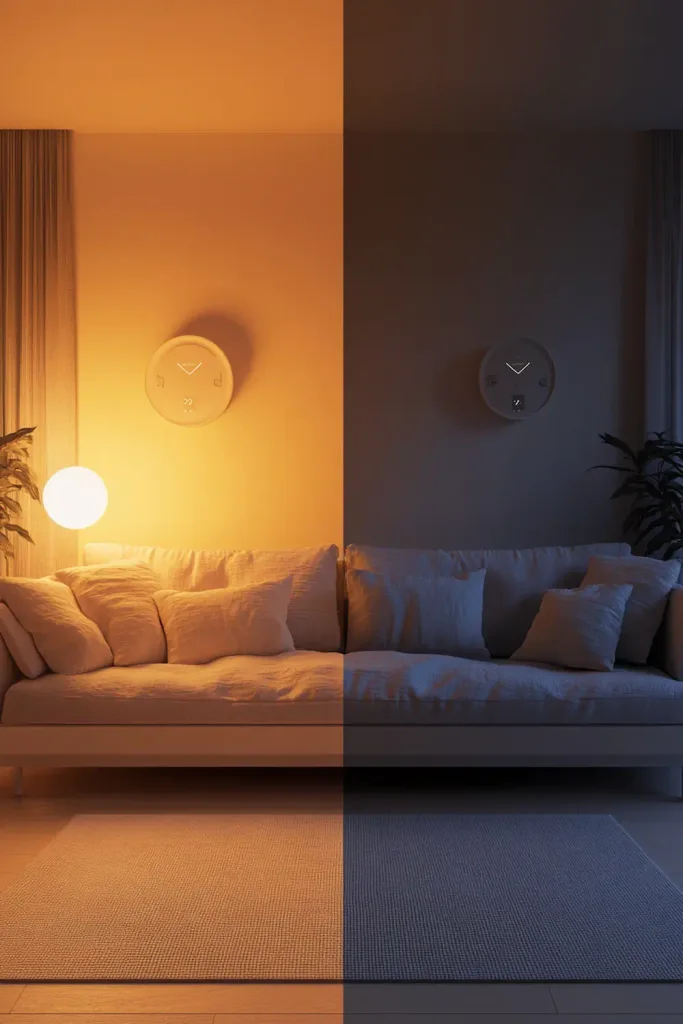
This is a guide, not a prescription. The exact times and temperatures that work best vary between individuals and households. The first step is simply to shift your evening lighting below 3,000K — even without automation, even without smart bulbs, even just by switching to a warmer bulb in the main lamp you use in the evening.
"You do not need a complete smart lighting system to implement the most important circadian lighting adjustment. You need a warm bulb in the room where you spend your evenings, and the habit of using it instead of overhead lighting after 19:00."
→ How to implement a consistent daily lighting rhythm across the whole home: → How to Use Lighting to Create Daily Rhythm
The Products: What You Need to Make This Work
Implementing circadian-aware lighting at home requires bulbs that can adjust their color temperature. Fixed-color-temperature bulbs — including most standard LEDs and most basic smart bulbs — cannot do this. The key specification to check is ‘tunable white’, ‘adjustable color temperature’, or a stated Kelvin range.
The minimum requirement: a tunable white bulb
The minimum hardware for the arc described in §4 is a smart bulb with tunable white capability — the ability to shift across the warm-to-cool range. Two options at different price and ecosystem commitment levels:
| ⟶ TP-Link Tapo L535E — Matter Smart Bulb, Tunable White (2,500K–6,500K), 2-Pack · Affiliate link Matter-certified smart bulb with a tunable white range from 2,500K warm amber to 6,500K cool daylight, plus full color. At 1,100 lumens and CRI >90. No hub required. Works with Alexa, Google Home, Apple HomeKit, and SmartThings. The Tapo app supports time-based scheduling, including the gradual color temperature transitions needed for the daily arc. The 2-pack covers two rooms — bedroom and living area, or living area and kitchen — at a per-bulb cost below most single-unit alternatives. ~€28 for 2-pack · Via Amazon Note: Check the fitting before purchasing — the L535E uses E26/A19 format, standard in North America. European homes typically use E27, which is the same physical size and fits E26 sockets. GU10 fittings (recessed spots) require a different Tapo product. |
| ⟶ GE CYNC Smart LED Light Bulbs — Tunable White 2,000K–7,000K, Wi-Fi + Bluetooth, A19 (2-Pack) GE’s CYNC tunable white bulb with an unusually wide 2,000K–7,000K range — covering from very warm candlelight to bright daylight. No hub required: connects directly via Wi-Fi and Bluetooth. Compatible with Alexa and Google Home. GE includes circadian preset schedules in the CYNC app described as being ‘optimized for your sleep/wake cycle’. Like the Tapo, the schedule feature handles the daily arc automatically once configured. ~€20–28 for 2-pack · Via Amazon Note: Compatible with Alexa and Google Home. Apple HomeKit support is not listed for this specific model — check the current product page if HomeKit compatibility is required. The 2,000K lower end means it can produce a warmer amber than the Tapo’s 2,500K minimum. |
The ecosystem option: a hub-based system
| → Philips Hue White Ambiance Starter Kit — Bridge + 2 Bulbs + Dimmer Switch · Editorial recommendation — no commercial relationship The Philips Hue White Ambiance range covers 2,200K–6,500K tunable white. The starter kit includes the Hue Bridge (required for full scheduling and automation), two A19 bulbs, and a wireless dimmer switch. The Hue app supports ‘natural light’ scheduling, which automatically adjusts the color temperature of all connected bulbs through the day based on sunrise and sunset times at your location. The Bridge processes these automations locally, making them reliable regardless of internet connectivity. ~€85–100 (includes Bridge) · Via Amazon Note: The Hue ecosystem is included because its built-in ‘natural light’ scheduling feature directly automates the circadian arc described in §4, without requiring manual routine configuration. The Bridge is an additional upfront cost but enables local processing of automations. |
The free starting point: your screen’s color temperature
Before changing any hardware, there is one free, immediate step that addresses the most common circadian lighting problem: the blue-spectrum light from screens and monitors. The software
f.lux (free for Windows, macOS, and Linux) automatically reduces the blue-spectrum content of your screen display as the evening progresses, shifting the screen’s color toward warmer tones. It is not a substitute for adjusting room lighting — screen time affects the eyes differently from ambient room lighting — but it is a useful and free starting point that requires no hardware.
| → f.lux — Free Software for Screen Color Temperature Adjustment · Editorial recommendation — no commercial relationship f.lux is free software that adjusts the color temperature of your computer display based on the time of day and your location, automatically reducing blue-spectrum content in the evening. Available for Windows, macOS, and Linux. It requires no hardware purchase and takes about two minutes to set up. It operates silently in the background once configured. Note: both iOS and Android have built-in equivalents (Night Shift on iOS, Night Light on Android) that do the same thing at the system level. Free · Via justgetflux.com Note: This is an editorial recommendation — no commercial relationship. f.lux is included as the lowest-barrier starting point for anyone who wants to begin reducing evening blue-spectrum exposure before investing in smart bulbs. The built-in Night Shift (iOS) and Night Light (Android/Windows) functions are equivalent and already installed on most devices. |
⟶ Warm-spectrum bulbs specifically curated for bedroom use: Best Warm Light Bulbs for Relaxation
⟶ Bedroom lighting setups designed to support better sleep: Best Bedroom Lighting for Better Sleep
Common Questions About Circadian Lighting
Does circadian lighting make a noticeable difference?
Many people who adjust their evening lighting to below 3,000K notice that the room feels noticeably more relaxing and that settling down for the evening feels easier. This is a reported subjective experience and will vary between individuals. Lighting is one of several environmental factors that affect sleep readiness, and its effect relative to other factors (temperature, noise, stress, screen time, irregular schedules) varies between people.
Do I need expensive equipment?
No. The most impactful single change is to place a warm white bulb (standard 2,700K, no smart features required) in the main lamp you use in the evening, and to use that lamp instead of ceiling lighting after around 19:00. A standard warm-white LED bulb costs a few euros. A smart tunable-white bulb that automates the full daily arc costs €12–18 per bulb. The f.lux software for screens is free.
What about blue-light-blocking glasses?
Blue-light-blocking glasses are a separate product category that this article does not cover. They address the same concern (reducing blue-spectrum light in the evening) through a different mechanism. Whether they are effective is a question for health professionals and reviewers who have tested them specifically — this guide focuses only on the home lighting environment.
What about morning light — does that matter too?
Morning light exposure — ideally natural light, but cool-white artificial light in its absence — is indeed important for the circadian clock, particularly for people who wake in darkness for much of the year. Morning light helps establish the timing of the daily cycle and supports alertness earlier in the day. This is one of the reasons that the gradual wake light automation described in the companion articles uses a cool-to-neutral white spectrum, not a warm one.
What Circadian Lighting Actually Means in Practice
Circadian lighting, stripped of its technical language, means using light at home in a way that does not actively conflict with the body’s natural day-night cycle. In practice, that means one primary change: ensuring your home is significantly warmer in color temperature in the evening than it is during the day.
The simplest version of this requires no smart home equipment at all — just a warm-white lamp in the room where you spend your evenings, used instead of overhead lighting. The automated version — smart tunable-white bulbs that shift automatically through the day — makes the change consistent and invisible. Both are improvements on the common default of a home lit at the same cool-neutral color temperature at all times.