What Is a Nursery Style? How to Choose the Right Look
The phrase “nursery style” is used loosely — sometimes to mean a visual aesthetic, sometimes a furniture collection, sometimes a colour palette, sometimes all three at once. This article uses it to mean something more specific: the set of visual decisions that give a nursery a consistent character. Not a theme, not a mood board assembled from trending images, but a set of decisions about colour, material, furniture form, and decorative register that hold together coherently when the room is occupied by a real family living a real life.
Choosing the right style for a nursery is not primarily an aesthetic decision. It is a practical one: the nursery style that will still be working well — visually and functionally — when your child is three years old is not necessarily the one that looks most appealing on a planning spreadsheet. This article covers the main style families, how to assess which is consistent with your home, how to navigate the specific practical constraints of a nursery, and how to make the decision without committing irrevocably to something you cannot change.
What “Style” Actually Means in the Context of a Nursery
Style in interior design is the consistent application of a set of visual principles across the elements of a room: the choice of colours, the forms of the furniture, the weight and texture of the textiles, and the character of the decorative objects. A room has a style when these elements are in conversation with each other — when the forms of the furniture are consistent with the weight of the textiles, when the colour palette is consistent with the material character of the objects.
A room does not have a style when its elements are selected independently from different visual registers and assembled without a governing principle. This produces a room that reads as ‘busy’ or ‘incoherent’ without the occupants being able to identify why. In a nursery, this incoherence is particularly common because the purchasing decisions are made in a short window, under pressure, from a large number of competing retail sources — each with its own aesthetic agenda.
Disclaimer & transparency
This article was created with the assistance of AI tools and assembled and edited by a human editor. While care has been taken to ensure accuracy, I cannot personally verify every technical detail. The information provided here is intended as a general guide, not as professional or technical advice. Always verify compatibility with your specific devices and systems before purchasing or installing anything described in this article.
Affiliate disclosure: This site participates in the Amazon Associates Programme and the Etsy Affiliate Programme. If you purchase through some of the links, at no extra cost to you, I may earn a small commission. I only recommend products I believe are genuinely suitable for the use case described.
Style vs theme
The distinction between style and theme is important in nursery design. A theme is a representational concept — jungle, woodland, space, under the sea — applied through printed fabrics, illustrated wallpaper, and shaped objects. A theme produces visual consistency at the surface level, but the underlying decisions about form, proportion, material, and colour are often not addressed. A themed nursery can read as coherent at the macro level — everything has a matching forest print — while being incoherent at the structural level: the furniture is the wrong proportion for the room, the lighting does not function at night, the textiles are decorative rather than practical.
A nursery with a considered style, by contrast, addresses the underlying decisions first: the proportion and finish of the furniture, the quality and washability of the textiles, the warmth and controllability of the light. The decorative layer — the prints on the wall, the animals on the mobile, the colour of the blanket — sits on top of this structure and can be changed as the child grows. The structure itself remains.
“Choose the style that works for the room as a room. The decorative layer can follow the child. The furniture and the palette cannot be easily changed after the first year.”
The Four Main Style Families
Current nursery design practice falls into four broad style families. Each has a distinct visual logic, a characteristic set of material and colour preferences, and a specific set of practical implications. Understanding all four makes the choice between them more legible.
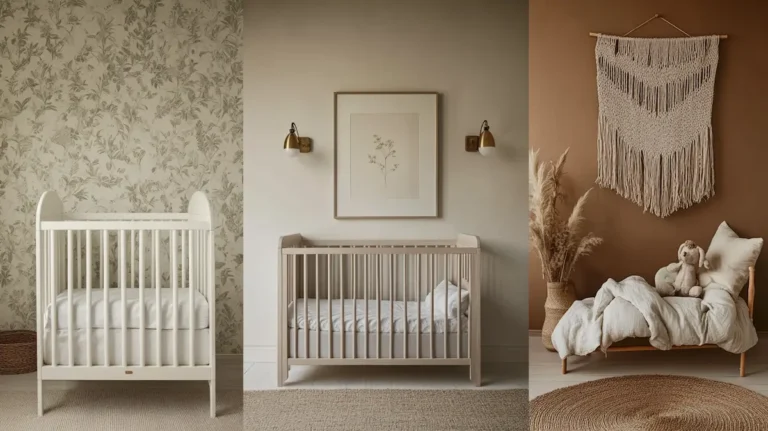
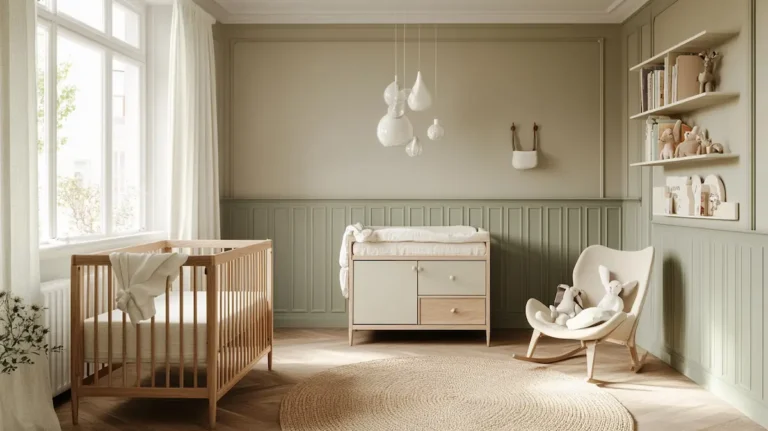
Classic
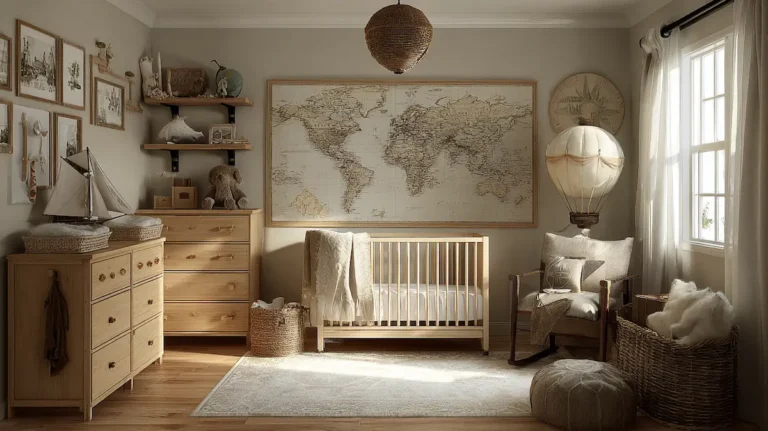
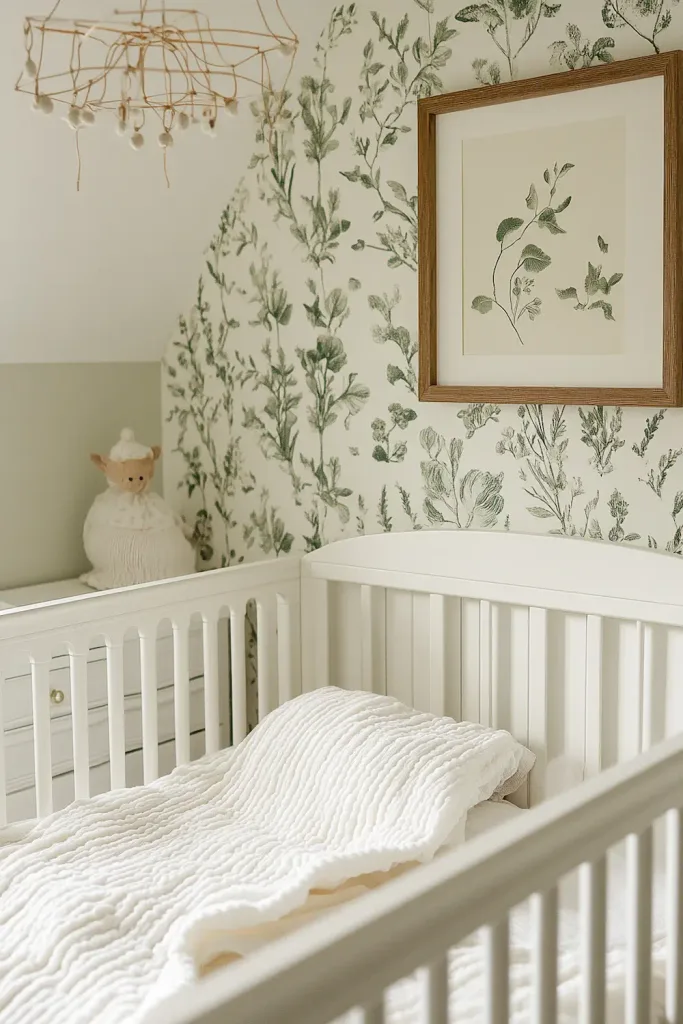
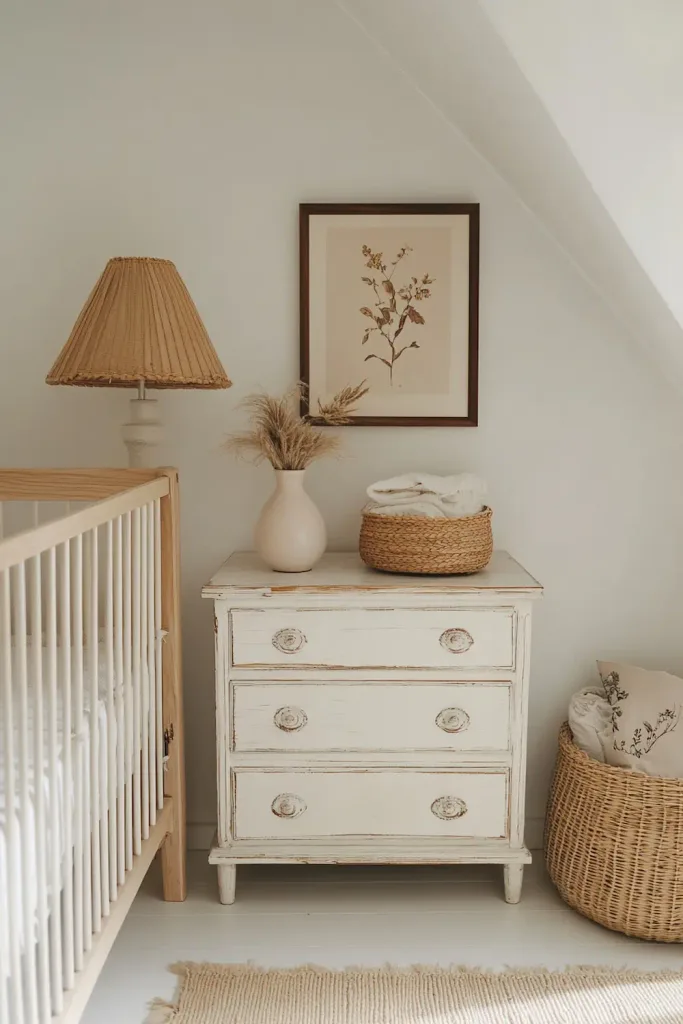
Visual character: Painted furniture in white or soft pastels, traditional cot forms with curved spindles or turned legs, small-scale patterned wallpaper (botanical, toile, or nursery-specific prints), brass or ceramic hardware, framed illustration prints. The palette typically works around warm whites, soft sage, dusty blue, or rose.
What it does well: The classic nursery ages gracefully. The visual vocabulary draws on forms that have been in continuous domestic use for generations, which means that a well-executed classic nursery does not look dated in the way that a novelty-themed nursery does. It also transitions relatively easily to a child’s bedroom at age four or five without wholesale redecoration.
What it requires: Individual pieces of genuine quality — a painted dresser with properly fitting drawers, a cot with solid construction, wallpaper hung without bubbling or mismatched seams. The classic style is unforgiving of poor execution because the visual register is familiar enough that deviations from quality are immediately visible.
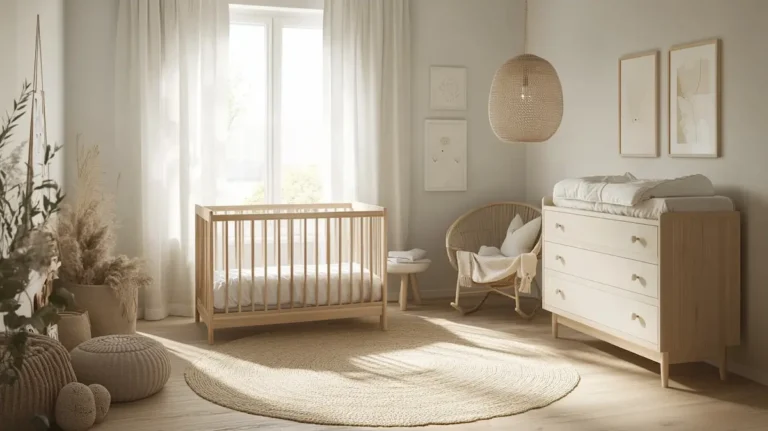
Modern
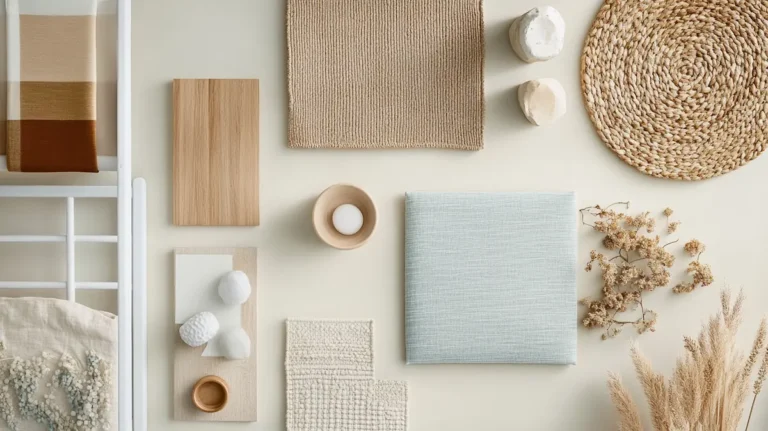
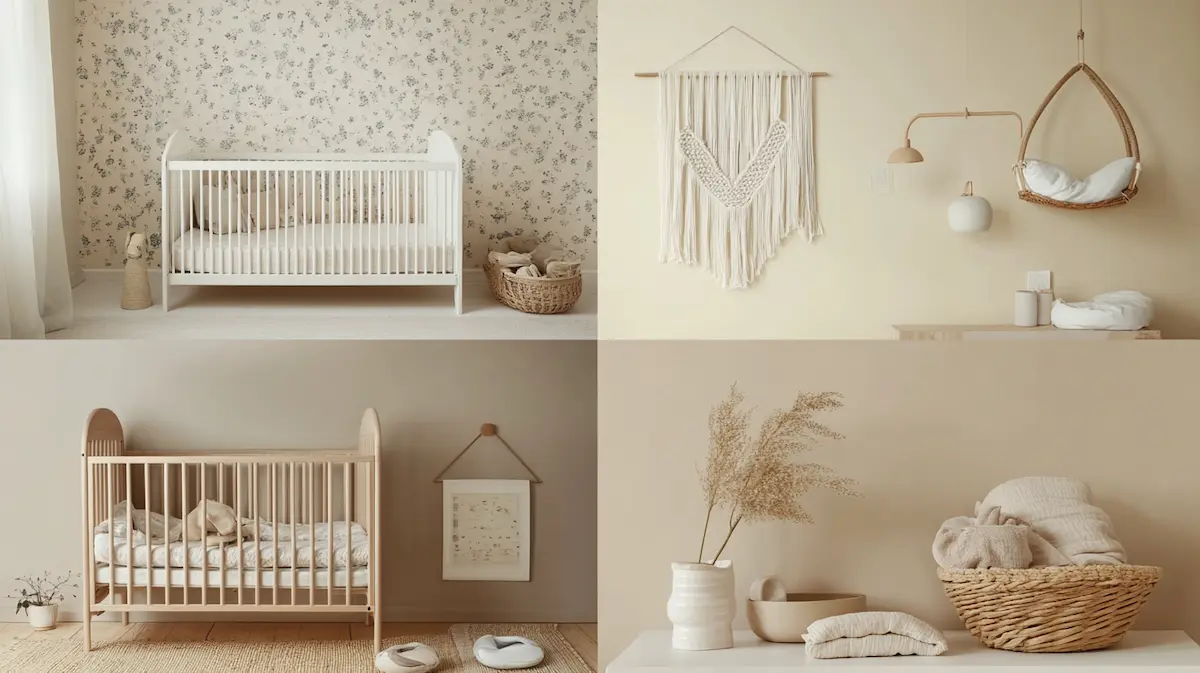
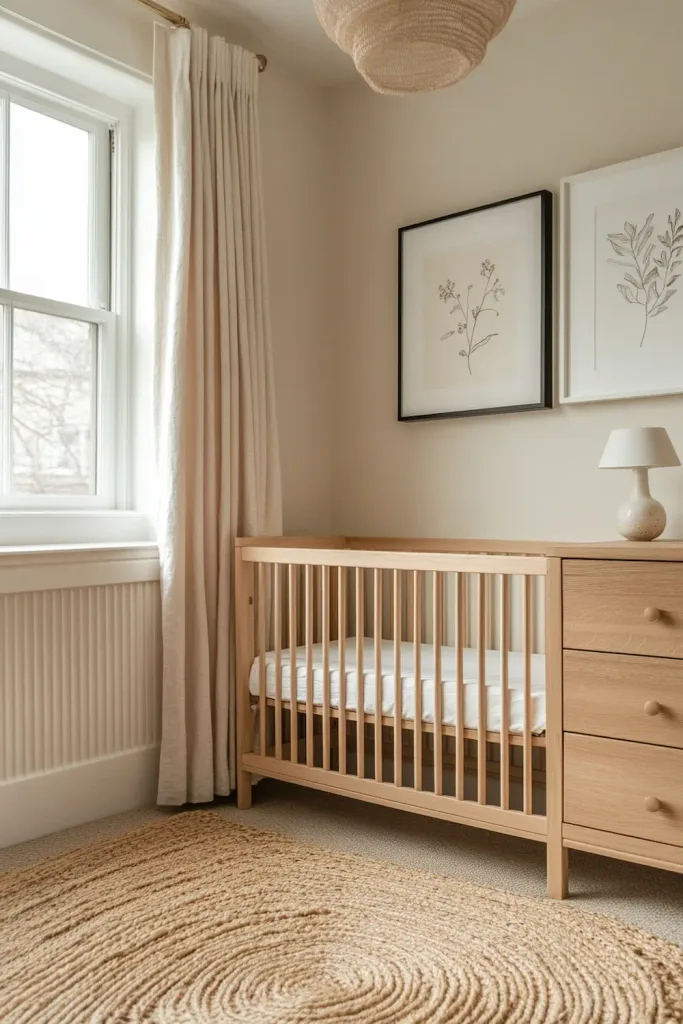
Visual character: Natural solid wood furniture (oak, beech, birch) in simple geometric forms, walls in warm off-white or pale clay, undyed or lightly washed linen for textiles, hand-thrown ceramics in neutral glazes, minimal decorative objects. The palette is typically warm neutral — sand, oatmeal, warm white, natural wood tones — with one or two muted accent colours.
What it does well: The modern nursery reads as genuinely calm in a way that requires no effort to maintain. Because the decorative layer is light — few prints, few objects, little pattern — the room does not become visually fatiguing. It also transitions easily to adult use as a guest room, or to a school-age child’s bedroom, without any redecoration.
What it requires: Confidence in restraint and willingness to resist the purchasing pressure that nursery retail generates. The modern nursery will look intentionally sparse to eyes trained on conventionally furnished nurseries. It also requires that the individual pieces are each well-made — because there are few of them, each is clearly visible, and quality differences are not hidden by volume.
Boho
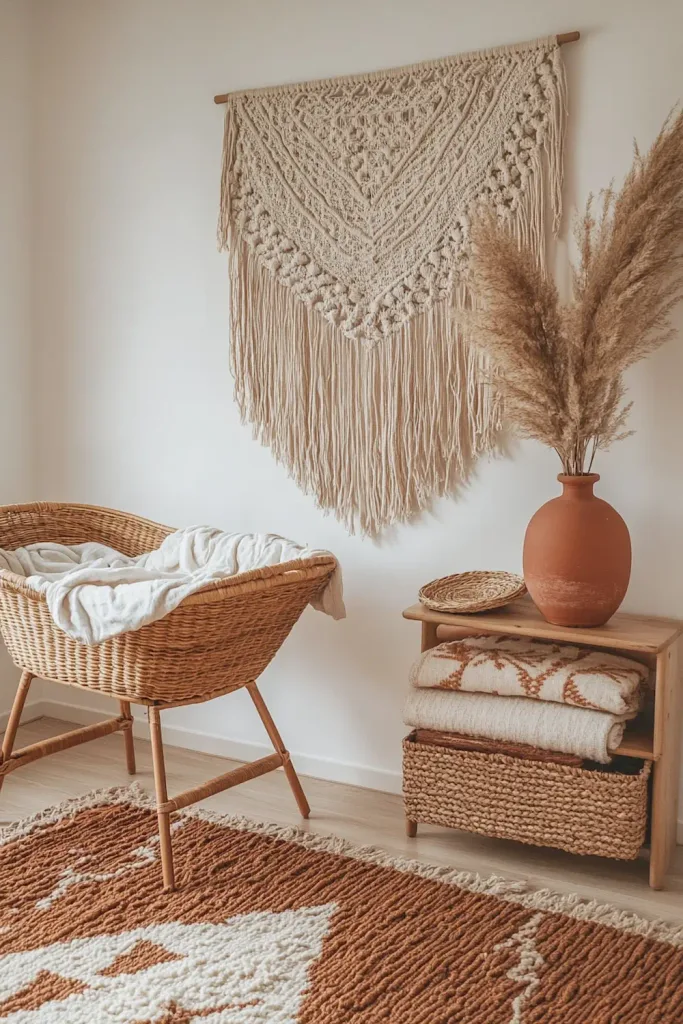
Visual character: Layered textiles (woven rugs, macramé, embroidered cushions), rattan and natural basketry, dried botanicals, a warmer and more eclectic colour palette — terracotta, rust, ochre, warm sand — and a higher overall visual density. Wall hangings, multiple framed pieces, and baskets used as visible storage are characteristic.
What it does well: The boho nursery is the most tactilely rich of the four families. The layered textiles provide genuine sensory warmth, and the use of natural materials — rattan, woven cotton, dried plant material — gives the room a quality of material variety that more restrained approaches do not achieve. For adults who find the modern approach too spare, the boho nursery provides warmth without the formal register of the classic.
What it requires: A more demanding edit. The layering that reads as relaxed and intentional when done with restraint reads as cluttered when the edit is loose. The boho aesthetic has fewer natural visual stopping points than the classic or modern approaches — it is easier to overfill. The practical implication: set a rule for yourself before you begin (one wall hanging, two rugs maximum, baskets of one type only) and hold to it.
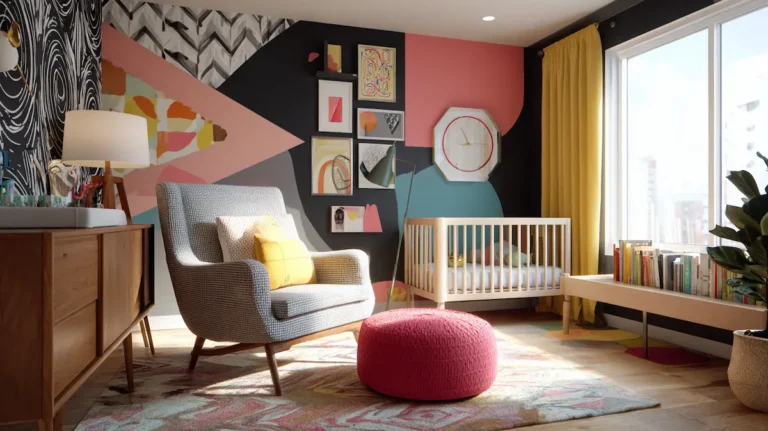
Eclectic
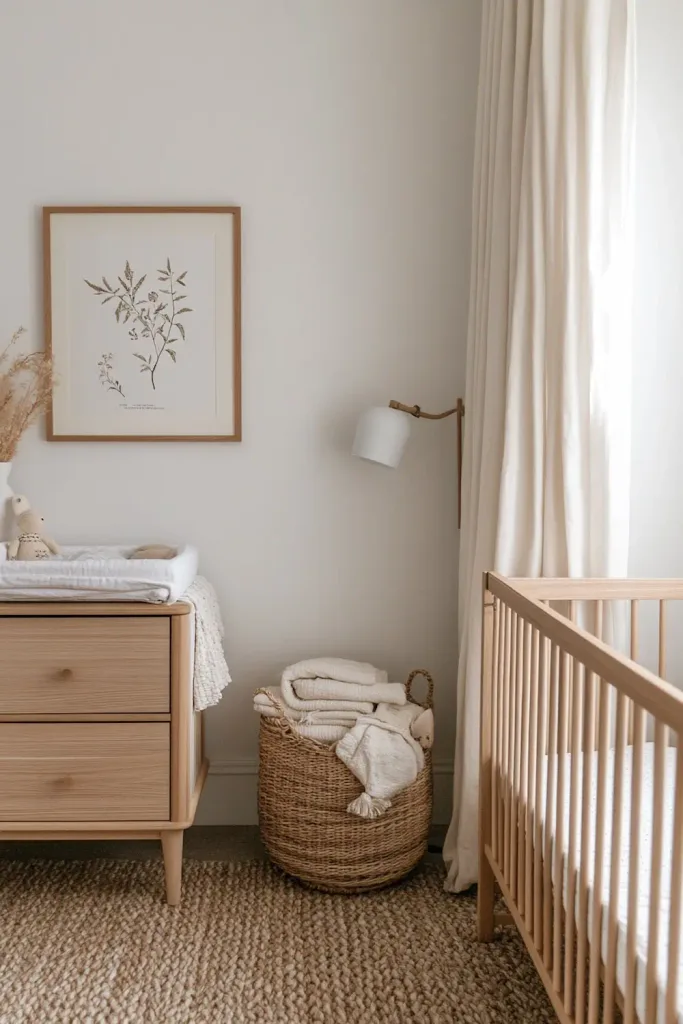
Visual character: A deliberate combination of elements from more than one style family, unified by a coherent palette and a consistent material register rather than by stylistic consistency. A vintage ceramic lamp on a modern oak dresser. A classic toile print alongside a natural linen curtain. An antique mirror above a simple painted chest.
What it does well: The eclectic nursery is the most flexible of the four families and the most likely to produce a room that reads as genuinely personal rather than as the output of a single retail range. It accommodates inherited or gifted pieces that do not belong to any single aesthetic, and it allows the room to accumulate character over time rather than arriving complete on day one.
What it requires: A clear governing principle that is not style but something else — typically palette. An eclectic nursery works when all its disparate elements share a colour temperature, a material register (all natural materials, or all painted surfaces), or a level of finish (all aged and worn, or all clean and new). Without this governing principle, eclectic becomes incoherent.
→ Nursery Design Trends: Classic vs Modern vs Boho
How to Read Your Own Home
The most reliable way to choose a nursery style is not to look at nursery inspiration images in isolation, but to look at the rooms in your home that you find most successful — the rooms that feel right to be in, that you return to, that you have been willing to spend time in without wanting to change them — and to identify what those rooms have in common.
Most people cannot articulate this immediately. But most people can identify a set of specific things they find appealing in a room and a set of things they find uncomfortable. The nursery style that is right for you is the one whose underlying visual logic matches the logic of the rooms you already inhabit comfortably.
Three questions to ask before choosing
- What is the material register of your home? Look at the dominant surfaces in your most-used rooms. Are the materials primarily natural — wood, stone, linen, cotton, ceramics — or primarily finished — painted, lacquered, powder-coated, laminate? The nursery that works best is usually one whose material register is consistent with the rooms on either side of it. A home of natural materials and worn surfaces will absorb a classic or eclectic nursery more naturally than a modern minimalist one.
- What is your tolerance for visual complexity? Some people find a room with many objects, multiple patterns, and layered textiles stimulating and warm. Others find the same room overwhelming. The boho nursery is a high-visual-complexity environment; the modern nursery is a low-visual-complexity one. Your honest answer to this question is more useful than any inspiration board.
- How much maintenance are you prepared to do? The classic nursery requires careful upkeep — white painted furniture shows marks, patterned wallpaper shows tears and scuffs. The modern nursery in natural wood and washable linen is significantly more forgiving. The boho nursery, with its layered textiles and abundance of woven surfaces, requires frequent laundering and dusting. The nursery style that will still look as intended eighteen months from now is the one whose maintenance demands you can genuinely meet.
The colour personality test
Colour is the most immediately visible element of a nursery style and the decision most influenced by external suggestion rather than personal preference. Instagram images and retailer mood boards consistently skew toward the most currently fashionable palette, which changes faster than any parent can repaint a room.
The more reliable test: walk through the rooms of your home and note the colours that are present in the rooms where you spend the most time voluntarily — not where you work or where you must be, but where you choose to be. The palette of those rooms is a reliable indicator of the palette that will feel genuinely comfortable in a nursery you will be spending significant time in each day.
→ The Psychology of Calming Colours in a Baby’s Room
Mixing Registers: When It Works and When It Does Not
Most real nurseries are not pure expressions of a single style family. Budget constraints, inherited pieces, gifts, and the practical requirements of the room all introduce elements that belong to different aesthetic registers. The question is not whether to mix, but how to mix in a way that reads as intentional rather than accidental.
What makes a mixed nursery work
Mixed-register nurseries that read well share a governing constraint that is not stylistic. The most common and most reliable is palette: all the disparate elements share a colour temperature (all warm, all cool, or all neutral), even when their forms and materials are very different. A vintage ceramic lamp (classic register) on a modern oak dresser (modern register) works because both belong to a warm neutral palette. The same lamp in vivid cobalt blue on the same dresser reads as incoherent, because the colour temperature of the lamp breaks the governing principle.
The second reliable constraint is material register: prioritising natural, unfinished, or aged materials over finished, synthetic, or novelty ones. A rattan bassinet (boho), an oak dresser (modern), and a painted wooden toy box (classic) sit together because all three are natural materials in muted tones. A plastic changing unit in the same room breaks the register, not because it is modern but because it belongs to a different material category entirely.
When mixing does not work
Mixing fails when there is no governing principle — when elements are selected from different visual registers for reasons that are specific to each element (a gifted cot, a sale-price dresser, a wallpaper that was available in the right size) without any consideration of their relationships. The result is a room where each element is defensible in isolation but the whole does not add up.
The practical remedy: before bringing a new element into a partly complete nursery, hold it against the dominant elements already in the room (or photograph it against them) and ask the palette question and the material question. If both are answered consistently, the element belongs. If either answer is inconsistent, look for an alternative before committing.
→ How to Mix Vintage and New Pieces in a Nursery
The Practical Constraints That Shape the Style Decision
Every nursery has practical constraints that the style decision must accommodate. Treating these as separate from the aesthetic decision is a mistake: the most successful nursery styles are the ones where the aesthetic and the practical are considered together from the beginning.
The room itself
The size, orientation, and existing features of the room constrain the style choice more than most parents account for when planning. A small north-facing room with limited natural light is not the right environment for a dark painted wall, a patterned wallpaper in a dense repeat, or a boho aesthetic that depends on layered textiles for warmth. The same room, painted in a warm off-white with a single botanical print and natural wood furniture, will read as larger, lighter, and calmer than a heavily decorated version.
Conversely, a large south-facing room with generous proportions can absorb a more complex aesthetic — a patterned wallpaper, a richer palette, more visual layering — that would overwhelm a smaller space. The style question and the room question must be answered together.
The existing home
A nursery does not exist in isolation. It is entered from a corridor or landing, and the visual jump between the aesthetic register of the rest of the home and the aesthetic register of the nursery is immediately perceptible. A vigorously themed or richly decorated nursery in an otherwise minimalist home reads as incongruous in a way that affects the whole apartment or house, not just the nursery.
The most integrated result comes from treating the nursery as an extension of the home’s existing aesthetic vocabulary, modified for the practical needs of a child’s space. This does not mean the nursery must be identical to the living room — it should be quieter, softer, and more practical — but it should be recognisably part of the same visual world.
Longevity
The nursery that is designed only for a newborn will require significant redecoration within two years. The style decision that serves you best is the one that works for a newborn, for a crawling eight-month-old, and for a walking, talking, book-requesting two-year-old. This is not a constraint that limits the style families available — all four can be designed for longevity — but it does constrain the decorative layer: novelty prints, character-licensed accessories, and age-specific mobiles all have a shorter useful life than a well-chosen palette and a piece of solid wood furniture.
→ Nursery Safety Essentials Every Parent Should Know
→ How to Plan a Nursery Layout (Even in a Small Room)
Making the Decision: A Working Method
The following sequence is a practical method for arriving at a style decision that is anchored in your actual home and your actual preferences rather than in an aggregated version of current retail trends.
Step one: Audit your home
Before opening a single inspiration image, walk through your home and photograph the details of the rooms you use most comfortably: the corner of the sofa you always sit in, the kitchen shelf where things accumulate, the bathroom shelf, the bedside table. Look at the colours, the materials, the objects. This is your visual vocabulary. The nursery style that is consistent with it will require less effort to maintain and will feel more genuinely like your home.
Step two: Identify one governing principle
Choose one governing principle that all elements of the nursery must satisfy. The most robust options are colour temperature (all warm, or all cool, or all neutral), material register (all natural, or all painted), or visual density (minimal, or rich). Write this principle down. Apply it to every purchase decision. When you are uncertain about an element, return to the principle.
Step three: Choose the furniture first
The furniture — the cot, the dresser, the nursing chair — is the hardest to change after the nursery is complete. The decorative layer — prints, textiles, objects — is the easiest. Make the furniture decision with the governing principle in hand and with a clear understanding of the room’s dimensions. Get the furniture right before addressing anything else.
Step four: Leave the decorative layer deliberately incomplete
The most useful thing you can do when designing a nursery is to leave the decorative layer intentionally incomplete on the day the room is first used. A wall with one framed print and space for more. A shelf that is half-occupied. This approach has two advantages: it removes the pressure to have everything finished before the baby arrives, and it leaves room for the room to accumulate — for a gift from a grandparent, a print found on holiday, a ceramic made by a friend — in the way that rooms that are genuinely lived in always do.
“A nursery that is completely finished on day one has nowhere left to go. A nursery with room left in it has a future.”
Where to go next
Style choice is the starting point. The articles below develop each of the decisions this article introduces: the specific visual logic of the three main style families, how colour temperature works in practice, what safety constraints shape all the decisions above, how to manage layout in a small or dual-purpose room, and how to mix vintage and new pieces when the governing principle requires it.
→ The Complete Baby Nursery Design Guide
→ Nursery Design Trends: Classic vs Modern vs Boho
→ The Psychology of Calming Colours in a Baby’s Room