
Lighting Mistakes That Ruin a Calm Home
Most lighting problems in a home are not about having the wrong fixtures or the wrong design. They are about defaults — the color temperature that was set when the bulb was installed and never changed, the single ceiling light that serves an entire room at all hours, the bedroom that is still at full overhead brightness at 22:00. These are not expensive problems to fix. But they are consistent ones, and they have a larger effect on how a home feels than most people realize until they change them.
Disclaimer & transparency
This article was created with the assistance of AI tools and assembled and edited by a human editor. While care has been taken to ensure accuracy, I cannot personally verify every technical detail. The information provided here is intended as a general guide, not as professional or technical advice. Always verify compatibility with your specific devices and systems before purchasing or installing anything described in this article.
Affiliate disclosure: This site participates in the Amazon Associates Programme and the Etsy Affiliate Programme. If you purchase through some of the links, at no extra cost to you, I may earn a small commission. I only recommend products I believe are genuinely suitable for the use case described.
Color Temperature Mistakes
Color temperature — the warm-to-cool spectrum of light measured in Kelvin — is the single most impactful lighting variable in a home. Most color temperature problems are defaults that were never deliberately chosen: the bulbs that came with the apartment, the LEDs bought purely on lumen output, the cool-white strip lights that were convenient and never replaced. The good news is that they are inexpensive to fix.
| 01 | Using cool-white light in the evening |
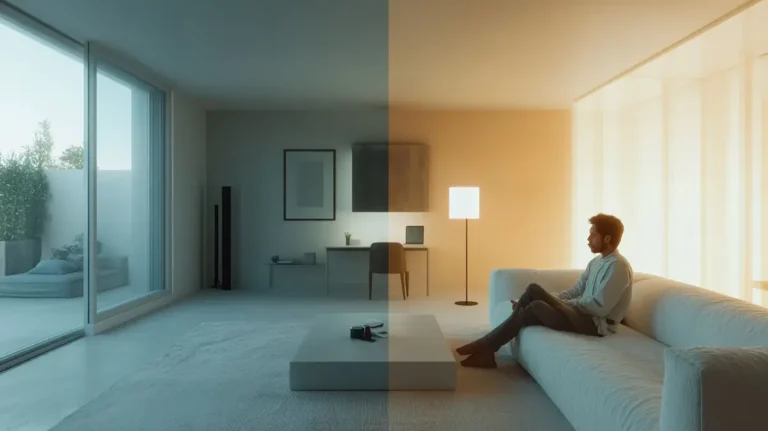
| What it looks like: The main living area and bedroom are lit at 4,000K or above after 19:00 — the same color temperature as a well-lit office. The room looks clear and functional but never quite settles into feeling like an evening. Why it matters: Cool-white light contains more blue-spectrum wavelengths, which the eye registers as a daytime signal. A living room that stays at this temperature into the evening creates an environment that does not support the body’s natural shift toward rest. The room looks fine in photographs but does not feel like a place to wind down. The fix: Replace the main lamps in living and bedroom areas with warm-white bulbs (2,700K or below) and use these as the primary evening light source. If you have a smart tunable-white bulb, schedule it to shift below 3,000K automatically after 19:00. | |
| 02 | All rooms at the same color temperature |
| What it looks like: Every room in the home is lit with identical neutral-white LEDs at a fixed color temperature, regardless of the room’s purpose or the time of day. The kitchen, the bedroom, and the living room all feel the same. Why it matters: A home that uses light appropriately creates a sensory distinction between spaces and between times of day. A bedroom and a home office have different purposes; treating them identically with light undermines the physical and psychological distinction between rest and work. The fix: Set different default color temperatures per room: warmer (2,700K) in bedrooms and living areas; neutral-to-cool (3,500–4,500K) in kitchens and workspaces. With smart tunable-white bulbs, this distinction can be automated by room and time. | |
The fix for both mistakes above is a tunable-white bulb. The Tapo L535E covers the full range required, at a per-bulb cost below most alternatives:
| ⟶ TP-Link Tapo L535E — Matter Smart Bulb, Tunable White 2,500K–6,500K (2-Pack, E27/A19) · Affiliate link Matter-certified smart bulb with adjustable color temperature from 2,500K warm amber to 6,500K cool daylight. At 1,100 lumens and CRI >90, it covers the evening warm-down and morning focus-mode equally well. No hub required — connects directly via Wi-Fi. Compatible with Alexa, Google Home, Apple HomeKit, and SmartThings. The 2-pack covers two rooms — typically living area and bedroom — at the per-bulb cost that makes replacing all fixed-temperature bulbs practical. Why this product: This product directly addresses Mistakes 01 and 02: it replaces fixed-temperature bulbs with a full tunable range that can be set per room and scheduled per time of day. Verify the E27 fitting for European homes (E26/A19 is North American standard but physically fits E27 sockets). ~€28 for 2-pack · Via Amazon |
→ The specific settings for relaxation and focus lighting, and how to schedule them: → Smart Lighting for Relaxation and Focus
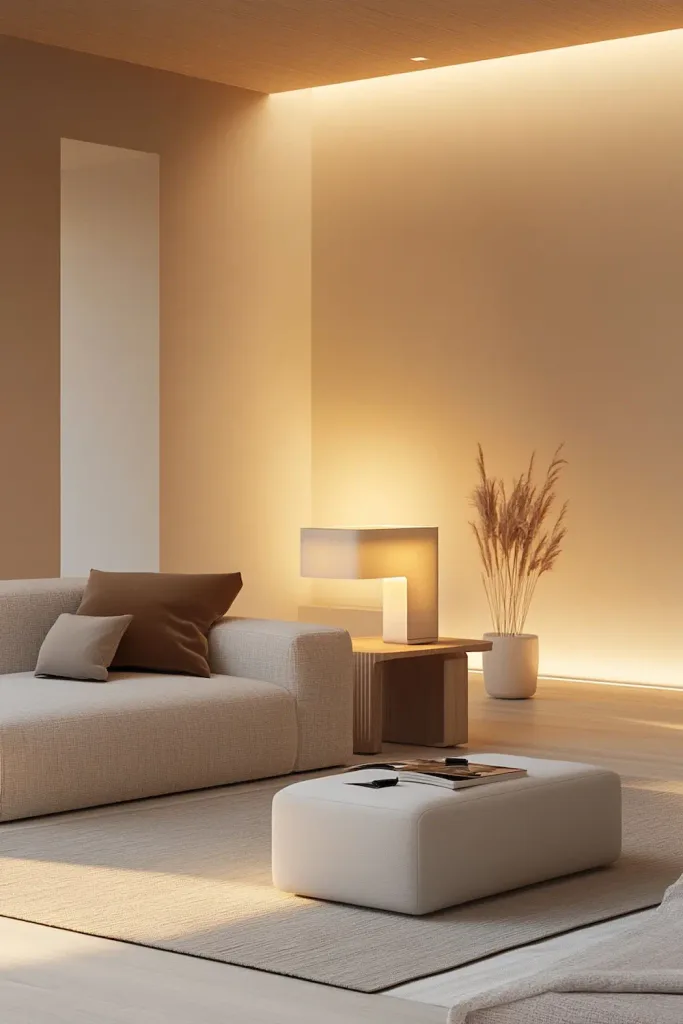
Fixture and Source Mistakes
Beyond color temperature, the placement and type of light sources in a room determine whether the light feels supportive or creates visual fatigue. These mistakes are about how light is distributed, not just what color it is.
| 03 | One ceiling light as the only source in a room |
| What it looks like: A room is lit by a single overhead fixture — typically a central ceiling rose or a flush ceiling lamp — that provides all the light from a single high point. Shadows fall consistently downward; the room looks uniformly lit in photographs but feels flat and institutional in person. Why it matters: A single high-point light source creates a high contrast ratio between lit and shadow areas at human height. This makes faces, furniture surfaces, and room textures look flat and creates visual fatigue over extended periods. It also means brightness cannot be modulated without making the entire room brighter or dimmer simultaneously. The fix: Add one or two floor or table lamps to create multiple lower light sources. The goal is not more light in total — it is light at more positions and heights. Two table lamps at low output often produce a warmer, more comfortable room than a single overhead at the same total lumen output. | |
| 04 | No light at eye level or below |
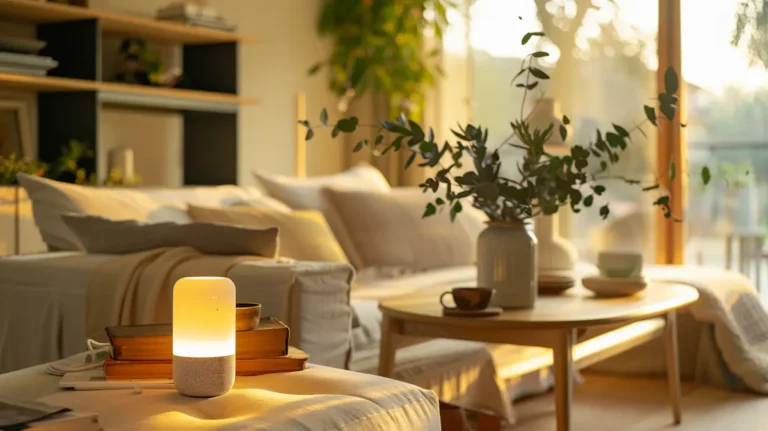
| What it looks like: All light sources in a room are at ceiling height or in ceiling-mounted fixtures. Nothing at floor level, table height, or wall level. The room is bright overhead and relatively dim at the level where people’s eyes and faces are. Why it matters: Light from above simulates outdoor daylight — which is appropriate during the day but not for an evening room. Light at eye level and below simulates firelight and candlelight — lower, more directional, more intimate. Rooms with no low-level light sources tend to feel either overly functional (ceiling too dominant) or simply dim (nothing at eye level). The fix: Add a floor lamp or one or two table lamps with shades that direct light sideways and downward rather than upward. A lamp with an opaque shade that directs light downward creates a visible pool of warm light — one of the most effective single additions to a poorly lit room. | |
For adding a smart tunable-white source at table or floor lamp height — the IKEA TRÅDFRI white spectrum bulb works well in standard floor and table lamp fittings and can be controlled via the IKEA Home Smart app:
| ⟶ IKEA TRÅDFRI LED Bulb E27 806 lumen — Smart Wireless Dimmable/White Spectrum Globe IKEA’s Zigbee-based smart tunable white bulb in E27 globe format. Adjustable between warm and cool white tones. Dimmable wirelessly via remote or via the DIRIGERA hub and IKEA Home Smart app, which also connects to Amazon Alexa, Apple HomeKit, and Google Home. The globe format works well in both floor lamp and table lamp fittings. 806 lumens is appropriate for a lamp being used as a secondary source alongside an existing ceiling fixture. Why this product: This is an editorial recommendation — no commercial relationship. The TRÅDFRI is included specifically for Mistakes 03 and 04 because its globe format suits standard floor and table lamp fittings, its price makes adding multiple secondary sources practical, and its tunable white capability means it can serve both daytime and evening configurations. Requires the DIRIGERA hub (sold separately) or a compatible TRÅDFRI gateway for scheduling and ecosystem integration. ~€8–12 per bulb at IKEA · Via IKEA |
Smart Bulb Mistakes
Smart bulbs introduce a new category of specific mistakes — problems that do not exist with traditional bulbs and that are responsible for many of the ‘my smart home lighting is annoying’ experiences that make people give up on the technology.
| 05 | Smart bulbs in ceiling fixtures with accessible wall switches |
| What it looks like: Smart bulbs are installed in a ceiling fitting. When someone switches the wall switch off — which everyone in the household will do at some point — the bulb loses power, disconnects from the network, and becomes unresponsive to app commands until the switch is physically turned back on. Why it matters: Smart bulbs need a constant power supply to remain connected to the network. A wall switch cutting that power is the single most common cause of the frustrating experience of a smart bulb that is ‘online’ in the app but not responding to commands. In a shared household, this happens constantly. The fix: Install smart bulbs in floor and table lamps rather than ceiling fixtures where possible — lamps whose physical switches can be left permanently on. For ceiling fixtures where you want smart control, replace the wall switch with a smart switch that keeps the circuit live while still providing physical control. | |
| 06 | Using dimming-only smart bulbs for a color temperature shift |
| What it looks like: A smart bulb was purchased for the purpose of creating a calmer evening atmosphere. It can dim but not adjust its color temperature — it dims a fixed 4,000K neutral-white to 10%, producing a dim cool-white light rather than the warm amber that makes an evening room feel settled. Why it matters: A smart bulb that can only dim does not address the main issue with evening lighting, which is color temperature, not brightness alone. A dim cool-white is not the same experience as a warm amber at the same brightness. The right feature for this use case is specifically ‘tunable white’ — the ability to adjust color temperature. The fix: When purchasing smart bulbs for relaxation or evening use, verify the specification for ‘tunable white’, ‘adjustable color temperature’, or a stated Kelvin range. A product that says ‘dimmable’ and ‘warm white’ without a Kelvin range may be fixed at a single warm temperature — useful but less flexible than a tunable-white bulb. | |
For Mistake 05 — ceiling fixtures where smart bulbs are already installed and a wall switch override is needed:
| ⟶ Philips Hue Dimmer Switch V2 — Wireless, No-Wire Installation, 4-Button A wireless dimmer switch that installs over or beside an existing wall switch using adhesive and a magnetic wall plate — no wiring required. The four buttons control on, dim up, dim down, and off (plus scene cycling on long press). It mounts directly over the existing wall switch or in a separate position beside it. Most importantly: it communicates via Zigbee directly with Hue bulbs, meaning it provides physical control without cutting power to the smart bulb — the bulb stays live and connected at all times. Why this product: This product specifically addresses Mistake 05 in a Philips Hue setup: it gives every household member a physical control without using the wall switch that cuts power. Requires Philips Hue bulbs and a Hue Bridge (sold separately). If you do not have a Hue system, the Aqara Wireless Mini Switch (compatible with more ecosystems via an Aqara hub) is an alternative to check for your specific setup. ~€25–30 · Via Amazon |
→ Why circadian lighting requires tunable white and what that means in practice: → Circadian Lighting Explained (Simple Guide)
Automation and Daily Rhythm Mistakes
Smart lighting’s most useful feature is not remote control — it is automation: the ability to have the right light at the right time without remembering to change it. These mistakes prevent that potential from being realized.
| 07 | Setting up lighting automation once and never calibrating it |
| What it looks like: A lighting schedule was set up when the smart bulbs were first installed, using default settings or rough estimates for timing and brightness. The schedule runs, but the timing is slightly off, the brightness is 10% too high for the intended purpose, or the color temperature shift does not happen gradually enough. Nobody adjusted it because it works well enough. Why it matters: A lighting automation that is 90% right is better than no automation — but the 10% gap is felt every day. An evening light that is slightly too bright, or a morning ramp that moves too fast, accumulates into a persistent mild friction. The value of automation is that it removes this friction permanently, but only if the calibration is completed. The fix: Spend one week actively noticing whether each scheduled lighting event is producing the right result. Adjust one parameter at a time — brightness first, then color temperature, then timing — until each transition is invisible. The calibration investment is a few evenings of attention; the return is years of correct lighting without further thought. | |
| 08 | No transition — abrupt switches between lighting modes |
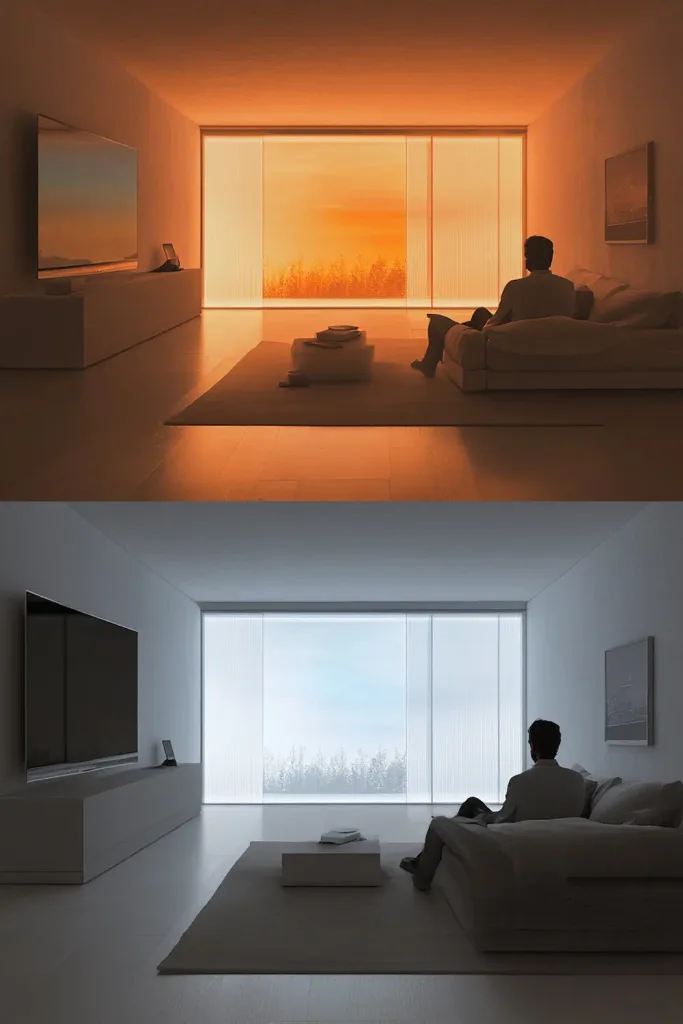
| What it looks like: A lighting automation shifts from daytime cool-white to evening warm-amber at exactly 19:30 — instantly, all at once. The room flips from one mode to the other in a single visible change. It is correct in effect but jarring in execution. Why it matters: The body registers abrupt environmental changes more strongly than gradual ones. An instant color temperature shift from 4,500K to 2,700K is noticeable, slightly disorienting, and keeps the automation in conscious awareness rather than allowing it to become invisible. A 15–20 minute gradual transition achieves the same endpoint without the jolt. The fix: Configure any color temperature shift to occur over 15–20 minutes minimum. Most smart bulb apps and ecosystem hubs support gradual transitions — look for a ‘duration’, ‘transition time’, or ‘fade’ setting when configuring the automation. The correct transition is one you do not notice happening. | |
→ How to use lighting to create a consistent daily rhythm with gradual transitions: → How to Use Lighting to Create Daily Rhythm
Bedroom Lighting Mistakes
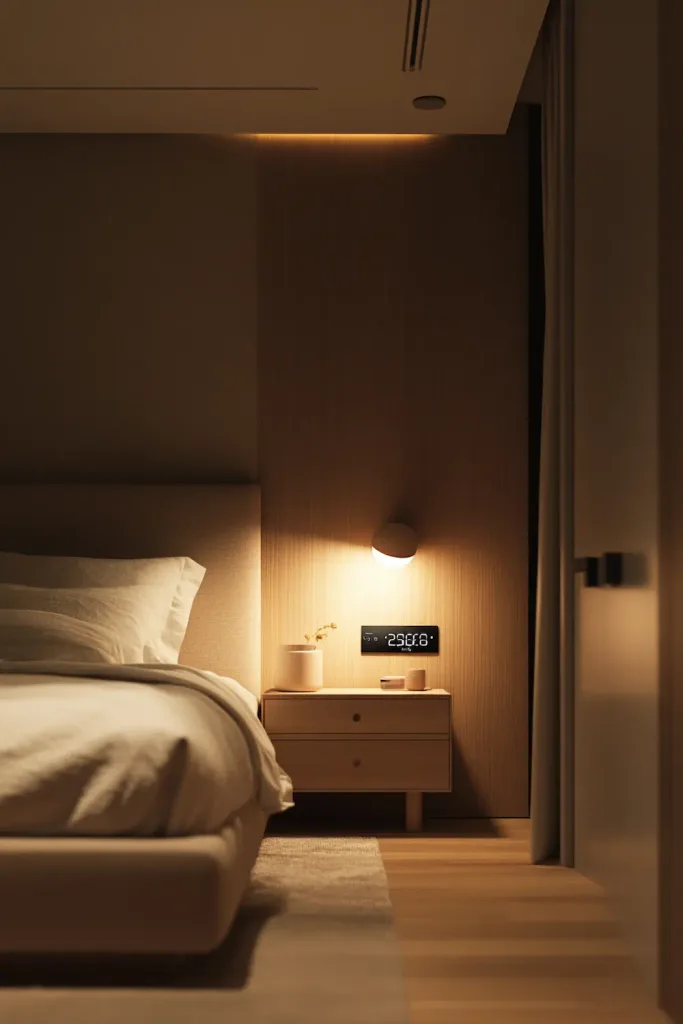
The bedroom is the room where lighting has the most direct relationship with rest quality — and the room where lighting mistakes are most consistently made, because most bedrooms are designed for function (getting dressed, overhead illumination) rather than for the environment they need to be in the two hours before sleep.
| 09 | Overhead lighting as the main bedroom source at night |
| What it looks like: The main light in the bedroom is an overhead ceiling fixture. It is switched on for practical tasks (getting dressed, finding things) and remains on while the room is occupied in the evening. The bedroom is a bright, overhead-lit space until the moment the light is switched off and the room goes completely dark. Why it matters: An overhead ceiling fixture produces exactly the kind of light that creates a daytime signal — high, directional, typically bright. Using it as the primary light source in a bedroom while preparing for sleep means the room is sending the wrong environmental signal at the wrong time. Switching from full overhead bright to complete darkness is also a jarring transition with no gradual element. The fix: Establish a bedside lamp or two as the primary bedroom light source for the final hour or two before sleep. Keep these at warm amber (2,200–2,700K) and low brightness. Use the overhead only for practical tasks — getting dressed, cleaning — and switch to the bedside sources at least 60 minutes before sleep. | |
The Nine Mistakes in One View
The nine mistakes in this article share a common characteristic: they are all defaults. None of them was deliberately chosen as the wrong approach to lighting. They accumulated through convenience, through installation that was never adjusted, through smart home setup that was never calibrated. The fixes are correspondingly simple — not replacements of entire systems, but adjustments to the parameters that determine how the same hardware performs.
| Mistake | Category | Fix complexity | Cost |
| 01 — Cool white in the evening | Color temp | Low — replace one bulb | €12–28 per bulb |
| 02 — Same color temp everywhere | Color temp | Low — set per-room defaults | Existing smart bulbs, if tunable |
| 03 — One overhead as sole source | Fixtures | Low — add one lamp | €15–60 for a floor or table lamp |
| 04 — No light at eye level | Fixtures | Low — add a bedside or table lamp | €15–60 |
| 05 — Smart bulbs losing power via switch | Smart setup | Medium — add a switch cover or smart switch | €15–30 for a physical button |
| 06 — Dimming-only smart bulbs | Smart setup | Low — replace with tunable-white spec | €14–18 per bulb |
| 07 — Automation never calibrated | Automation | Low — one week of active attention | Free — configuration only |
| 08 — Abrupt color temp transitions | Automation | Low — set transition duration to 15–20 min | Free — configuration only |
| 09 — Overhead as main bedroom source | Bedroom | Low — establish bedside as primary source | €10–20 per bulb |
"Most lighting problems in a home are not expensive to fix. They are simply defaults that were never changed. The home you want to come back to is usually one or two bulb changes away."
For the principles behind what makes light right at different times of day: Smart Lighting for Relaxation and Focus and Circadian Lighting Explained (Simple Guide). For readers ready to invest in a complete smart lighting system rather than individual adjustments:
⟶ A curated guide to the best smart lighting systems for a genuinely calm home: Best Smart Lighting Systems for a Calm Home