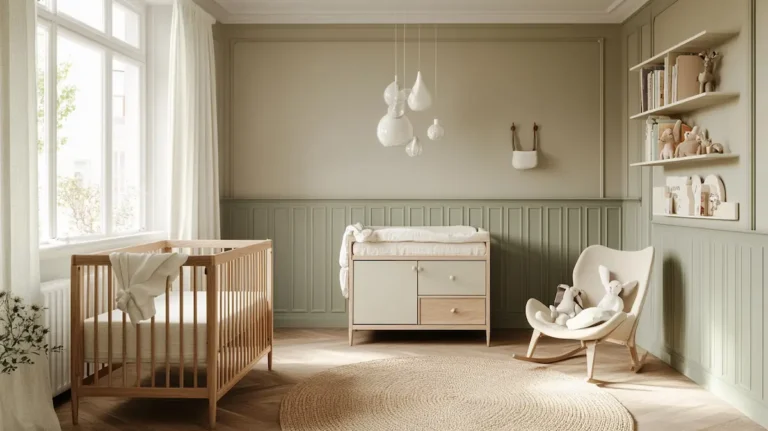
How to Mix Vintage and New Pieces in a Nursery
The One Rule That Decides What Can Be Vintage
Mixing vintage and new in a nursery is not a styling preference applied evenly across every object in the room. It is a safety-first sorting exercise, followed by a styling decision. Before any aesthetic question, every nursery item falls into one of two categories: items where age and history are an asset, and items where current safety certification is non-negotiable regardless of how beautiful the vintage alternative looks.
The dividing line is simple and worth committing to memory: anything the baby sleeps on, sleeps in, or is fed in must be new and currently certified. Anything the baby does not directly touch, sleep on, or rely on structurally can be genuinely vintage. A vintage dresser used purely for storage is a styling choice.
A vintage cot is a safety risk, regardless of how charming it looks, because cot safety standards (bar spacing, drop-side mechanisms, mattress fit) have changed substantially since most vintage cots were made.
If you have not yet settled on a style direction, What Is a Nursery Style? How to Choose the Right Look covers the visual logic of mixing eclectic registers in more depth — this guide applies that same thinking specifically to the vintage-and-new sorting problem.
Every safety claim in this article follows the standards covered in full in Nursery Safety Essentials Every Parent Should Know; read that guide first if you have not already, since it explains why the categories below are drawn where they are.
Always New: The Crib
The crib is the least negotiable item in this entire guide. Cot safety standards have changed substantially in the last three decades: bar spacing maximums were tightened, drop-side mechanisms were banned in the US in 2011 and are strongly discouraged across Europe, and mattress-fit tolerances are now far stricter than older standards required. A vintage cot — however beautiful, however much it belonged to a grandparent — cannot be verified as meeting current standards without documentation that most vintage pieces simply do not have.
The honest workaround for parents who want the vintage look without the vintage risk: choose a new crib with a simple, traditional silhouette — turned spindles, a low-profile rail, a warm natural wood finish — that reads as vintage-inspired without being an actual vintage object. The Babyletto Hudson is a widely available example of this approach: a genuinely new, GREENGUARD Gold-certified crib with a silhouette restrained enough to sit comfortably in a vintage-and-new nursery.
| Babyletto Hudson 3-in-1 Convertible Crib, Washed Natural A new, GREENGUARD Gold Certified convertible crib in sustainably sourced New Zealand pine, with a low-profile silhouette, turned-out feet, and four adjustable mattress heights. Converts to a toddler bed and daybed with the included kit. ~$300–350 │ Amazon (Affiliate): View product → |
Always confirm any new crib carries current certification for your country (in the US: ASTM/CPSC compliance and JPMA certification; in the EU/UK: EN 716), and never substitute a vintage or inherited cot regardless of its condition or sentimental value.
Always New: The Mattress
The mattress deserves its own section because it is the single most consequential safety decision in the nursery, and it is also the item most frequently inherited or reused without a second thought. A mattress carries deformation and contamination from its previous use that cannot be cleaned away and is not visible on inspection. This applies even when the crib itself is new — a new crib with an old mattress is still an old mattress.
This guide does not link to a specific mattress, because mattress fit depends entirely on the exact internal dimensions of your specific crib. What matters is the principle: buy new, buy a mattress sized precisely for your crib model, and confirm a snug fit with no more than a two-finger gap at any edge.
Genuinely Vintage: Dressers, Chests, and Storage Furniture
Storage furniture is the most forgiving category in the entire nursery for genuine vintage sourcing. A dresser, a chest of drawers, or a low cabinet used for clothing and supplies carries no sleep-safety implication, and a well-made vintage piece is frequently sturdier than a comparable new flat-pack alternative. The two checks that matter here are structural, not stylistic: every joint should be solid with no looseness or cracking, and the piece must be anchored to the wall with an anti-tip strap once mobile, exactly as a new piece would be.
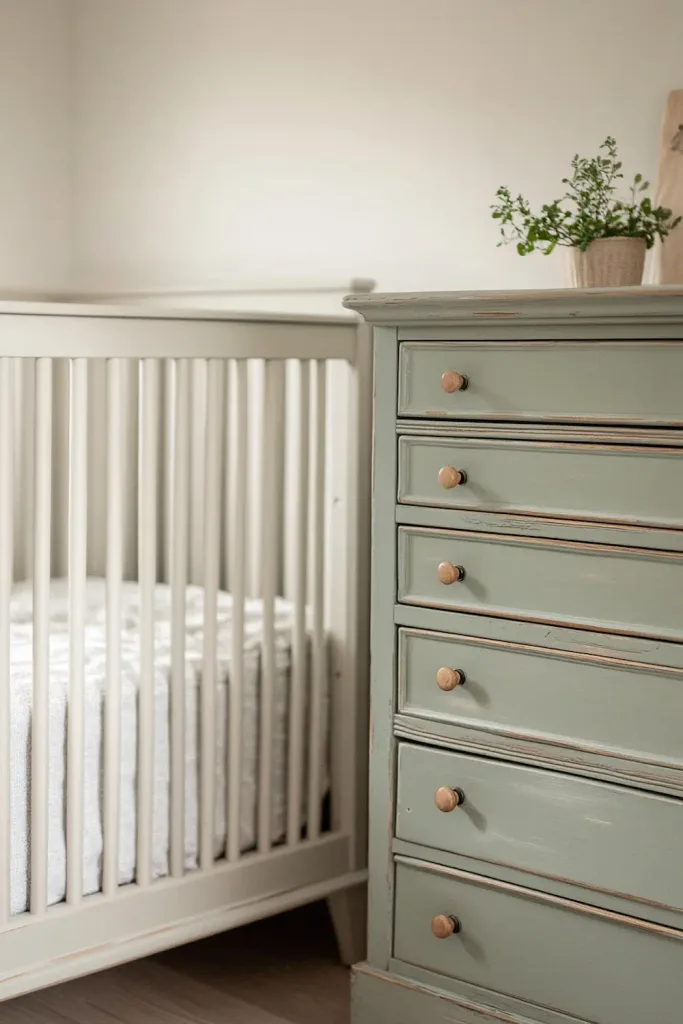
Vintage dressers are also where the room’s personality lives. A painted chest with a slightly worn finish, a brass-handled piece with real patina, or a simple mid-century chest in solid wood all do the same storage job as a new flat-pack equivalent, while contributing the texture and history that an all-new room cannot replicate.
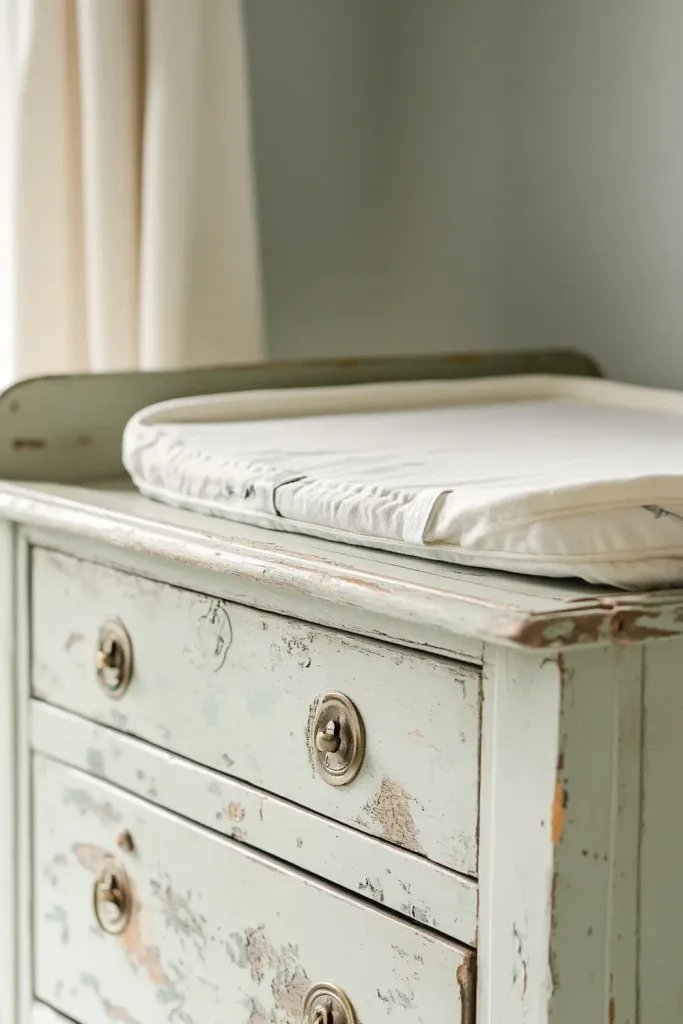
Our dedicated guide to How to Source Safe Second-Hand Baby Furniture covers the full structural checklist for vintage and secondhand dressers, chests, and changing units in far more depth than we can here.
Whatever piece you find, the anti-tip strap below is the one purchase that makes any vintage storage piece nursery-appropriate. It works on furniture and walls of essentially any material, with no drilling into either.
| QDOS Zero-Screw Furniture Anti-Tip Kit A no-drill anti-tip anchor that secures freestanding furniture to drywall using a small adhesive disc on the furniture side and patented SecureHooks on the wall side — holds up to 200 lbs without screwing into either the furniture or the wall. Ideal for anchoring a vintage piece without damaging an irreplaceable finish. ~$20–25 per kit (2 straps) │ Amazon (Affiliate): View product → |
If a vintage piece is precious enough that you do not want any adhesive on it at all, screwing the included hardware into a wall stud and the rear interior panel of the furniture (rather than its visible finish) is the alternative — check the product’s installation guide for both methods before deciding.
Genuinely Vintage: Mirrors, Lamps, and Small Decorative Objects
Mirrors, table lamps, decorative dishes, and small objects on a shelf are the lowest-risk, highest-reward category for vintage sourcing in the entire nursery. None of them touch the baby directly, none of them carry a structural safety standard, and all of them contribute the layer of texture and warmth that makes a nursery feel collected rather than purchased as a set.
The one consistent safety check for vintage lighting: have any vintage lamp’s wiring inspected or rewired by a qualified electrician before use, since old wiring insulation can degrade in ways that are not visible from outside the cord. A vintage lamp base with new, certified wiring is both safe and genuinely vintage — the two are not in conflict.
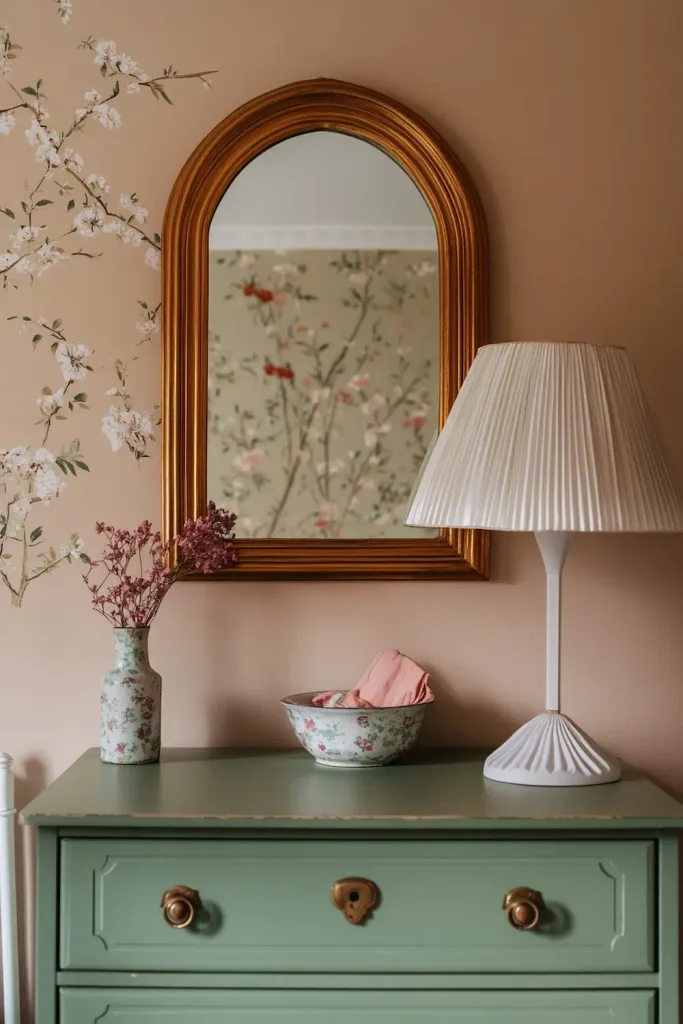
For mirrors specifically, leaning rather than mounting is both the safer installation method (no wall anchor required, no risk of a poorly mounted heavy mirror) and the more authentically vintage styling choice — a leaned mirror reads as found and placed, not installed.
| Chairish Vintage Mirror Collection A continuously updated, hand-curated marketplace category of genuinely vintage and antique mirrors, including arched, gilded, and simple wood-framed pieces suitable for leaning against a nursery wall. Because individual listings are one-of-a-kind and sell quickly, we link to the curated category rather than a single piece that may no longer be available. Varies by piece, typically $80–400 │ Chairish: View product → |
Always New: The Nursing Chair
The nursing chair sits in a slightly different category from the crib: there is no equivalent regulatory standard the way there is for cots, but the practical case for buying new is still strong. A nursing or glider chair is used for thousands of hours in the first year, often while holding a sleeping baby, and the structural reliability of its gliding or reclining mechanism matters more here than almost any other furniture decision in the room. A vintage glider’s mechanism may have worn components that are not visible until they fail mid-motion.
If a vintage rocking or glider chair has been fully inspected and reupholstered by a professional, with the mechanism specifically checked, it is a reasonable choice. For most parents, a new chair with a certified, warrantied gliding mechanism is the lower-risk option, and current designs are available in upholstery and forms quiet enough to sit comfortably in a vintage-leaning room.

| Babyletto Kiwi Recliner and Swivel Glider, Performance Cream Eco-Weave A new glider recliner with a quiet, hidden manual recline, smooth swivel, and a restrained wingback silhouette that sits comfortably in a vintage-leaning room rather than reading as overtly modern. GREENGUARD Gold and CertiPUR-US certified; upholstered in a water-repellent, stain-resistant eco-performance fabric. ~$500–600 │ Amazon (Affiliate): View product → |
Our dedicated guide to Best Nursing Chairs & Gliders for a Baby Room covers several more new chairs across a range of silhouettes and budgets, for parents who want options beyond the single recommendation above.
Genuinely Vintage: Rugs and Textiles
Rugs sit in a middle category: they are not structural and they do not touch the baby’s sleep environment directly, but they do need to meet a practical bar — flat enough to avoid becoming a trip hazard, and clean enough (ideally professionally cleaned before use) to be appropriate for a room where a crawling baby will eventually spend significant time at floor level. A genuinely vintage flat-weave rug, professionally cleaned, meets both of these without difficulty.
Vintage curtains and bedding are a different matter: bedding inside the cot must be new for the same contamination reasons that apply to the mattress, but curtains, a vintage quilt used as a wall hanging rather than in the cot, or a vintage textile draped over a chair are all genuinely vintage-appropriate.
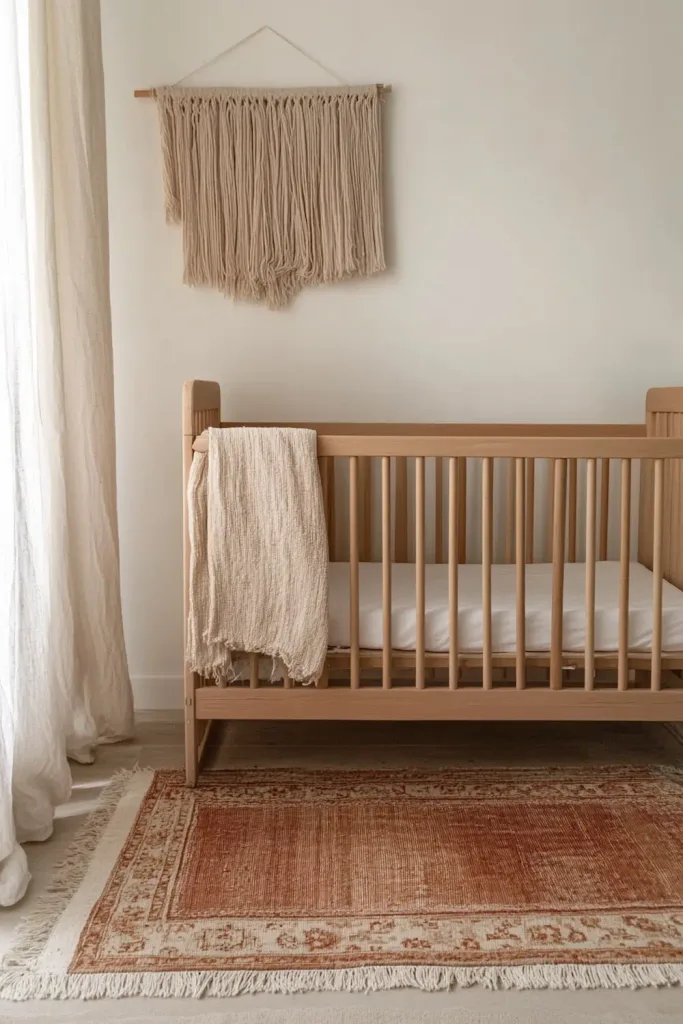
| Etsy Vintage Flat-Weave Wool Rug Collection A continuously updated category of genuinely vintage flat-weave and kilim-style wool rugs from independent sellers, in a range of sizes and muted colourways suitable for a nursery floor. Because individual rugs are one-of-a-kind, we link to the curated category rather than a single listing that may no longer be available. Always have a vintage rug professionally cleaned before placing it in a nursery. Varies by piece, typically $90–250 │ Etsy (Affiliate): View product → |
How to Place a Vintage and a New Piece Side by Side
Once the safety sorting above is done, the remaining question is purely visual: how to place a genuinely vintage object next to a genuinely new one so the room reads as collected rather than mismatched. Two principles do almost all of the work.
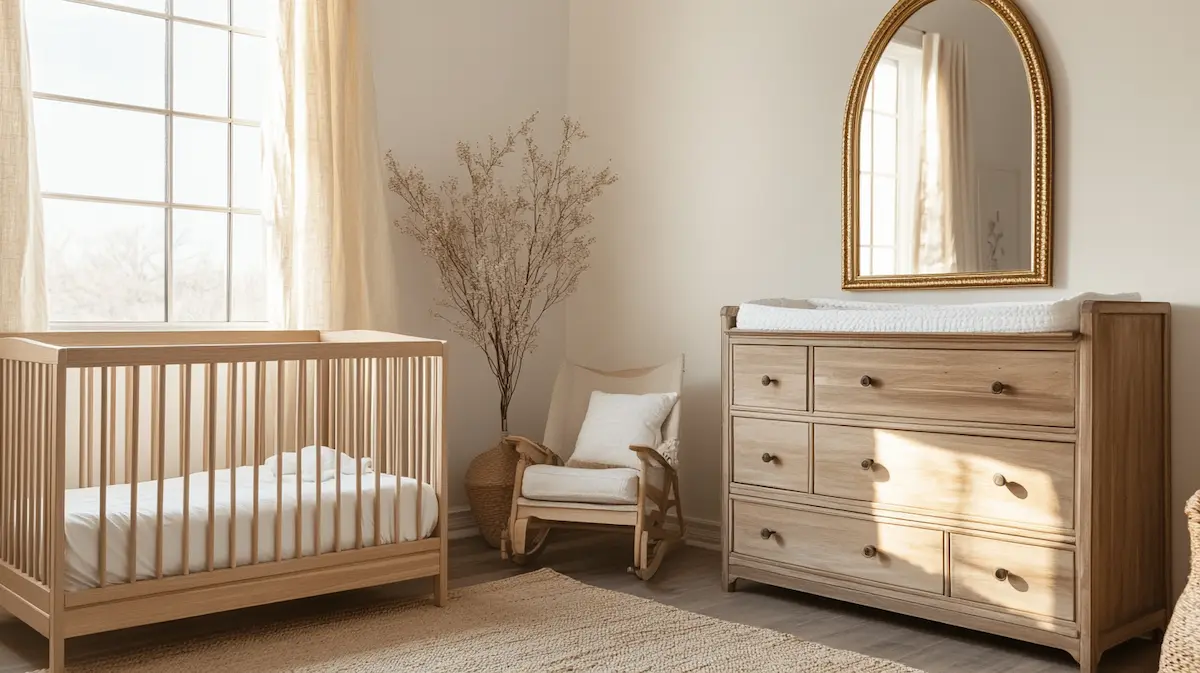
First, match material warmth rather than matching era. A new natural-oak crib and a vintage painted chest both read as warm and natural, even though one is decades old and one was bought last month — what unifies them is that neither is glossy, synthetic, or cold-toned. A new piece in a cool grey laminate next to a warm vintage wood piece will read as mismatched regardless of how good each individual piece is.
Second, let the new pieces do the structural, safety-critical work, and let the vintage pieces do the textural, decorative work. The crib, the mattress, and the chair anchor the room’s function; the mirror, the lamp, the rug, and the small objects on a shelf anchor the room’s personality. When the split lands roughly along these lines, the mix reads as intentional rather than accidental.
Where each of these pieces should physically sit in the room — vintage and new alike — is covered in full in our How to Plan a Nursery Layout (Even in a Small Room), which applies regardless of whether your furniture is new, vintage, or a mix of both.
If you have not yet settled on which pieces your nursery actually needs before deciding which of them to source vintage, start with Nursery Furniture: What You Really Need.
The Finished Room
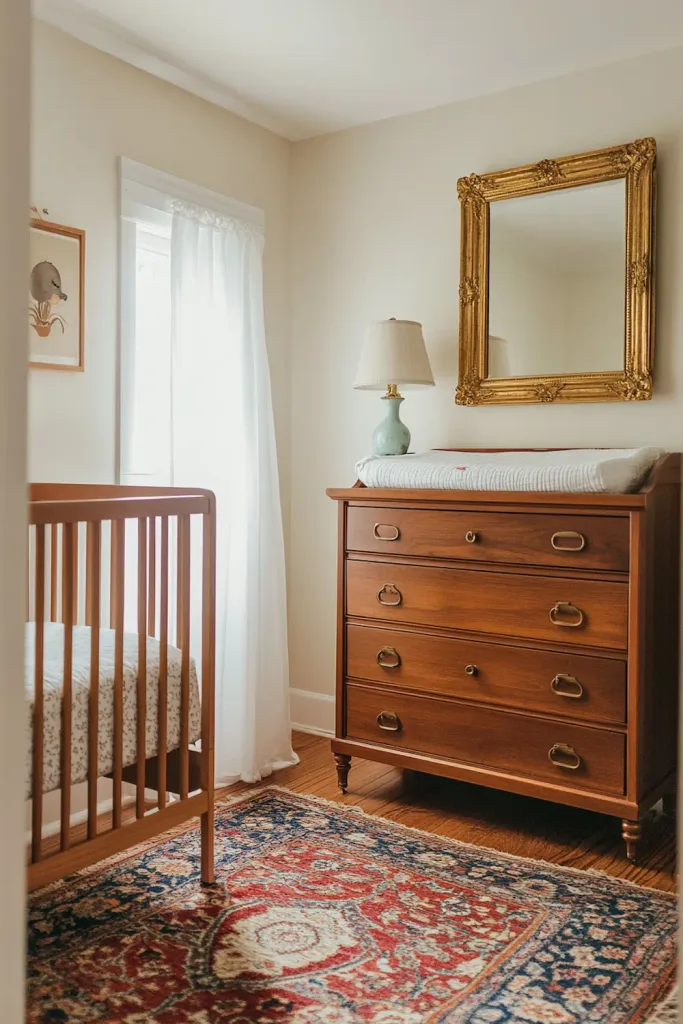
Put together, the approach above produces a nursery that is new exactly where current safety standards require it — the crib, the mattress, the chair’s mechanism — and genuinely vintage everywhere that history and character can safely live: the dresser, the mirror, the lamp, the rug, the small objects that make a room feel collected rather than purchased as a single matching set. None of it requires choosing between safety and character. It requires sorting the room correctly before making a single purchase.
If you are assembling an entire nursery from scratch rather than mixing in a few vintage pieces, our Complete Nursery Makeover Guide: Living with a Newborn walks through the same vintage-and-new sorting logic applied to a full room, start to finish.
Continue Exploring Baby Nursery Design
This article is part of our Baby Nursery Design collection. For the foundational style thinking behind the eclectic mixing approach covered here, start with What Is a Nursery Style? How to Choose the Right Look.
For the full safety framework that determines what can and cannot be vintage, see Nursery Safety Essentials Every Parent Should Know.
For where each piece of furniture should physically go, vintage or new, see How to Plan a Nursery Layout (Even in a Small Room).
For a complete list of what a nursery actually needs before deciding what to source vintage, see Nursery Furniture: What You Really Need.
For the full structural checklist on assessing secondhand and vintage furniture safely, see How to Source Safe Second-Hand Baby Furniture.
For new crib options beyond the single model recommended here, see Best Convertible Cribs for a Nursery.
For more new nursing chairs across a range of silhouettes and budgets, see Best Nursing Chairs & Gliders for a Baby Room.
And for the same vintage-and-new approach applied to an entire nursery from scratch, see Complete Nursery Makeover Guide: Living with a Newborn.
A Note on This Guide
This article was created with AI-assisted research and writing, then reviewed and edited by a human before publishing. Product information reflects what was publicly available and verifiable at the time of writing; prices, availability, and exact colourways may change after publication, so please confirm current details on the retailer’s site before purchasing.
Some links in this article are affiliate links, which means we may earn a small commission if you make a purchase through them, at no additional cost to you. We only recommend products we believe genuinely fit the look and the safety standard we are describing. This article also includes non-affiliate links to retailers and marketplaces we have no financial relationship with, included purely because they fit the brief.
This article does not replace the manufacturer’s safety instructions, current consumer product safety standards in your country, or guidance from a paediatrician or qualified safety inspector. Always verify that any crib, mattress, or nursing chair meets current certification standards in your country before use, have any vintage electrical item inspected by a qualified electrician, and never use a vintage cot, vintage cot mattress, or any vintage item with a known recall regardless of its condition or sentimental value.