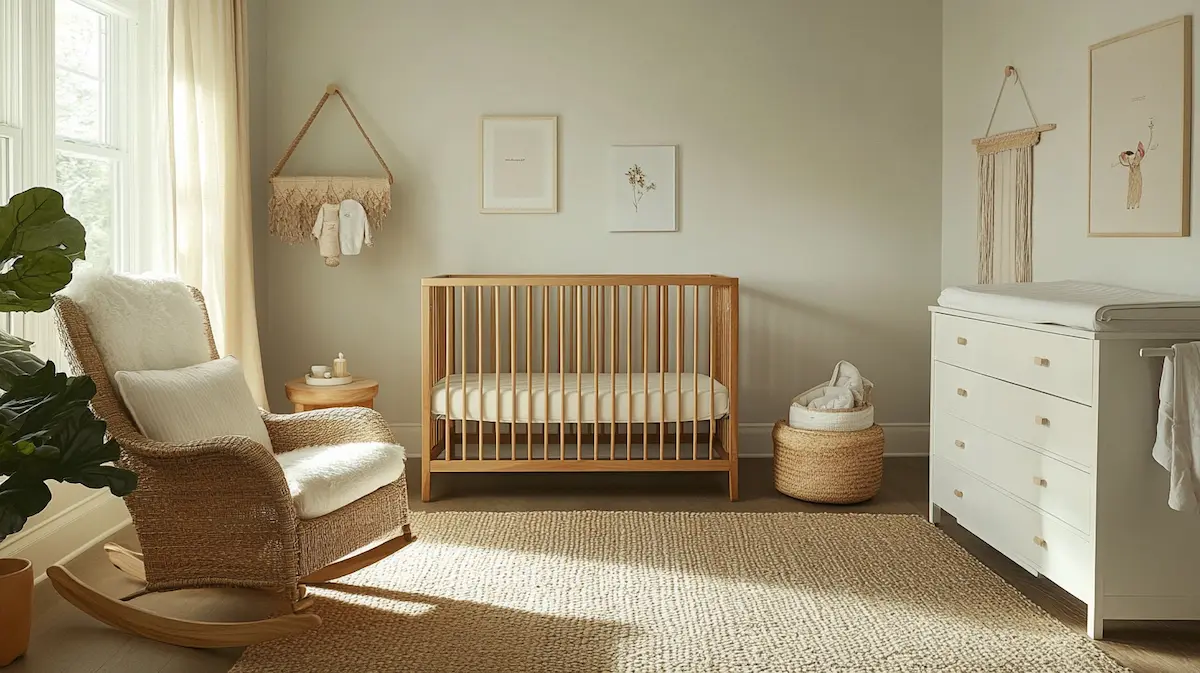
Nursery Furniture: What You Really Need
The nursery furniture market is enormous and enthusiastic about selling you things you do not need. Matching sets with six pieces. Dedicated changing tables that are outgrown before the baby is walking. Storage units with a dozen small compartments that are impossible to organise in the dark with one hand. The gap between what retailers present as essential and what a nursery actually requires to function well is significant.
This guide covers the five pieces of furniture that genuinely do the work of a nursery, what to spend on each, and everything that is genuinely optional. It also includes specific products for each essential piece — chosen because their specifications can be verified, because they represent a considered approach to each category, and because they will still be appropriate when the child is three years old, not just three months.
A note on the selection method: every product linked in this article is chosen because its specific dimensions, materials, certifications, or design features are verifiable from the manufacturer’s own product page. No product is included on the basis of general popularity alone. Links are to brand or retailer pages (editorial) or, in two cases, to Amazon with affiliate disclosure where this is the most accessible route to the product.
The Five Pieces That Do the Work
A nursery needs five categories of furniture to function: somewhere to sleep, somewhere to change, somewhere to store clothing, somewhere to feed, and a surface for the nighttime essentials within arm’s reach of the feeding chair. Everything else — the wardrobe, the bookshelf, the floor lamp, the decorative ottoman — is secondary and can be added, substituted, or omitted without affecting the room’s ability to do its job.
This is not a minimal-at-all-costs argument. It is a sequencing argument: buy these five pieces first, install them, and live in the room before adding anything else. The optional items that will genuinely improve the room become obvious after a week of actual use. The ones that seemed appealing in a shop become obviously unnecessary.
1. The Crib: The One Non-Negotiable New Purchase
The crib is the purchase that cannot be deferred or substituted, and it is the one piece in this guide that should always be new and currently certified. Cot safety standards have changed substantially in the past three decades — bar spacing, mattress fit tolerances, and the prohibition of drop-side mechanisms — and a vintage or inherited crib cannot be verified as meeting current requirements without documentation that most vintage pieces do not have.
What to look for
The single most useful specification is convertibility: a crib that converts to a toddler bed, and ideally to a small single bed, with included conversion kit is a different financial proposition from a standard crib that is outgrown by twenty-four months. The difference in price between a standard and a convertible crib is typically €50–150; the difference in useful life is two to four years of additional use from the same piece of furniture.
The second specification is mattress height adjustment: two or more height settings allow the mattress to be lowered as the baby becomes mobile, which is a safety requirement, not a preference. Any new crib with only one fixed mattress height is a significant inconvenience by six months.
Material honesty matters more here than in most other nursery furniture categories because the crib is the most visible piece in the room and is examined at close range during every feed and settle. A solid wood crib in natural beech or pine reads correctly in almost any nursery palette; a particleboard crib with a printed wood-effect foil reads correctly in photographs and incorrectly in person.
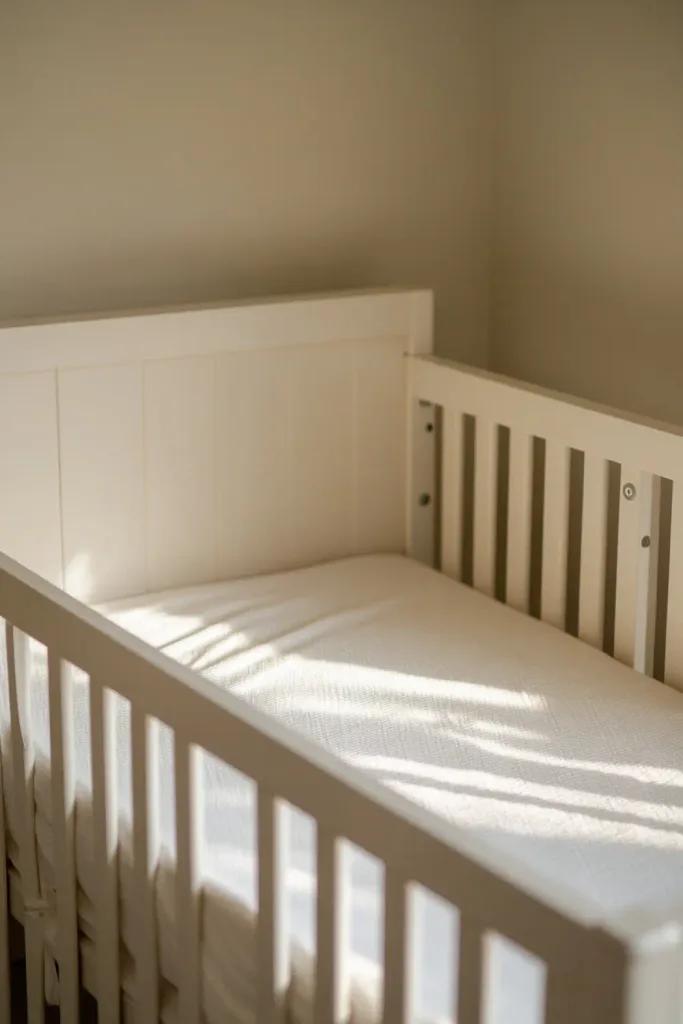
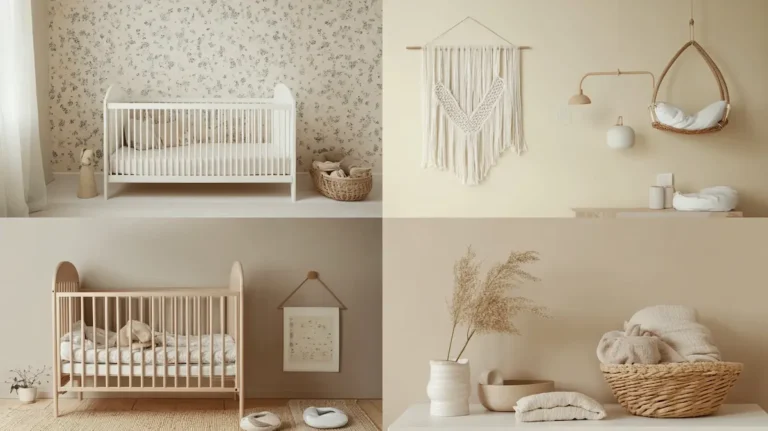
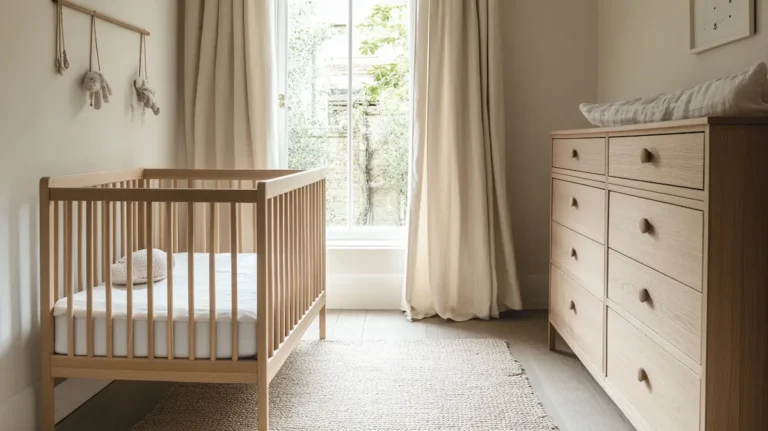
The IKEA SUNDVIK is the most accessible genuinely convertible crib available in Europe and widely available internationally. It is made in solid beechwood, converts to a toddler bed with the included conversion kit, has two mattress height positions, and meets current EU safety standards (EN 716). Its white finish is correct in any nursery palette and its silhouette is restrained enough that it does not date. At its price point, it is the most straightforward recommendation in this guide.
| IKEA SUNDVIK Crib Solid beechwood, white finish. Converts to toddler bed (conversion kit included). Two mattress height positions. Meets EU safety standard EN 716. Mattress dimensions 60 × 120 cm (sold separately). Available in white and grey. From approx. €130 / £110 │ IKEA: View product → |
For parents who want options at higher price points or in different materials, our dedicated guide to Best Convertible Cribs for a Nursery covers a wider range including solid oak and certified options.
For the specific structural checks that make a second-hand dresser or wardrobe safe and appropriate, see our guide to How to Source Safe Second-Hand Baby Furniture — but note that the crib itself is the one item in the nursery where new is the only appropriate specification.
2. The Dresser: More Useful Than a Changing Table
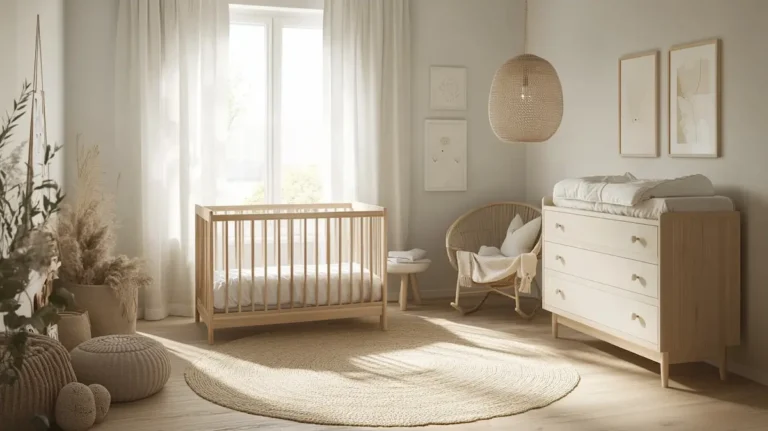
A full-sized dresser with a changing mat on top is more useful than a dedicated changing table in almost every nursery context. A dedicated changing table is a single-function piece of furniture that is outgrown by the time the child is walking; a dresser is a storage piece that remains relevant throughout childhood. The surface height of a standard dresser (typically 85–90 cm) is approximately correct for most adults as a changing surface.
The changing mat sits on top of the dresser secured by a non-slip mat underneath it. When the baby no longer needs nappy changes, the mat is removed and the dresser continues as a child’s clothing storage piece. The dresser that is bought as a changing station is the dresser that is still in use at age seven — which is a different financial equation from a dedicated changing table purchased for eighteen months of use.
What to look for
Drawer depth matters more than drawer count. Deep, wide drawers that can accommodate folded clothing without being stuffed are more practical than many shallow drawers with small compartments. A dresser with three to four large drawers will serve a nursery better than one with six small drawers, because large drawers can be accessed with one hand while holding a baby.
Stability is non-negotiable: every dresser used in a nursery must be anchored to the wall with an anti-tip strap before the baby is mobile. This is not optional and is not a reflection of the dresser’s inherent quality — it applies to all freestanding dressers regardless of their weight or construction. Check that the piece you choose has a solid rear panel suitable for a strap anchor before purchasing.

The most important buying principle for the dresser: choose a piece you would be happy to keep in a child’s bedroom at age six. If the piece looks too nursery-specific — decorated with nursery motifs, too small for a growing child’s clothing volume, or in a material that will not age well — it will need to be replaced as the child grows. A plain, well-proportioned dresser in white-painted solid wood or natural oak reads correctly at every age.
The dresser is also the piece most suited to vintage sourcing in the entire nursery, since it carries no sleep-safety implication. For the full approach to mixing vintage and new, see our guide to How to Mix Vintage and New Pieces in a Nursery
3. The Glider or Nursing Chair: The Most-Used Piece in the Room
The nursing chair or glider is used more hours during the first year than any other piece of furniture in the nursery. It is where feeds happen, where settling happens, where night checks happen, and where a tired adult sits for accumulated weeks of night hours. A chair that is not comfortable enough, not supportive enough, or not easy to stand from while holding a sleeping baby is a daily inconvenience for twelve months or more.
The specifications that matter most are seat height (feet should rest flat on the floor without the hips tilting forward), arm height and width (wide enough for a comfortable feeding position on both sides), back support (adequate lumbar and upper-back support for an adult leaning slightly back during a feed), and the ability to stand from the chair while holding a sleeping baby without twisting or gripping a surface for support. A gliding or rocking mechanism adds a soothing quality that a static chair does not have, and a recline mechanism adds significantly to comfort during long night feeds.
What to look for
The most useful practical features in a nursing chair are: a smooth, quiet gliding or rocking mechanism (a chair that makes noise during settling will undo the settling); an upholstery that is wipeable or machine-washable (essential for a chair used during feeding); and a mechanism for returning the chair to an upright position easily when standing with a baby. Power recline, where available, adds significant convenience at night when operating anything manually is an effort.
Arm width is frequently overlooked in shopping comparisons. A chair with narrow arms is uncomfortable for breastfeeding and bottle-feeding on the side where the arm constrains the position. Sit in the chair at the shop if possible and test the arm position for both sides. If buying online, look for reviews specifically mentioning arm width relative to feeding position.

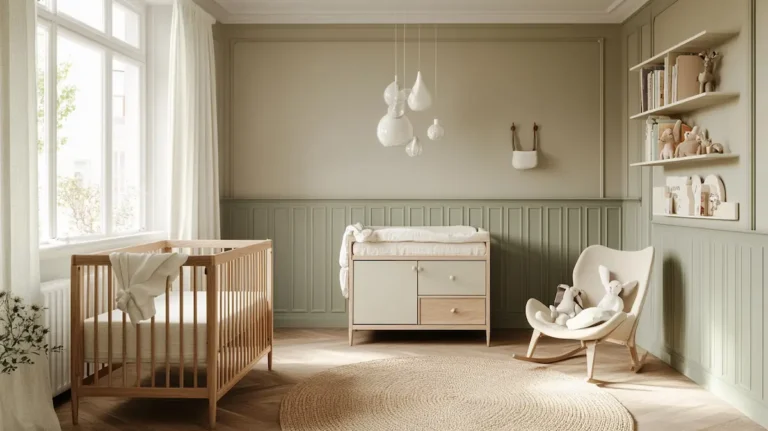
The Babyletto Kiwi Recliner and Swivel Glider is the single most-referenced nursing chair across independent nursery design communities for a specific combination of reasons: its wingback silhouette reads correctly in a room of any aesthetic (not overtly ‘nursery’ in character); its manual recline is quiet; it swivels 270 degrees; its performance eco-weave fabric is stain-resistant and water-repellent. It is the chair that is still appropriate in the room when it is a child’s bedroom rather than a nursery.
| Babyletto Kiwi Recliner and Swivel Glider — Performance Cream Eco-Weave Wingback glider with quiet manual recline, 270-degree swivel, and stain/water-resistant eco-performance fabric. GREENGUARD Gold and CertiPUR-US certified. Seat dimensions 22″D × 22″W, seat height 20.5″H. Fully reclined length 64″. FSC-certified wood frame. Available in multiple fabric options. From approx. $500 / €480 │ Babyletto: View product → |
For a wider comparison across price points, silhouettes, and rocking versus gliding mechanisms, see our dedicated guide to Best Nursing Chairs & Gliders for a Baby Room.
4. The Side Table: Small, Overlooked, Genuinely Necessary
A small surface within arm’s reach of the nursing chair is one of the most genuinely useful pieces in the nursery and one of the least planned for. During night feeds, the ability to put down a glass of water, a phone, a muslin cloth, or a burp cloth without standing up or stretching across the room is a quality-of-life difference that compounds across hundreds of night feeds.
The specification is simple: a surface at approximately arm height when seated (between 55 and 65 cm from the floor for most standard nursing chair seat heights), stable enough not to tip if reached for in darkness, and small enough not to take up significant floor space beside the chair. A round side table of approximately 40 cm diameter in natural wood is the most practical and visually neutral option. It requires no specific product recommendation — any solid, stable side table at the correct height from any source is correct.
5. Storage: A Dresser Is Usually Enough to Start
The dresser described in Section 2 provides the primary storage in a nursery and is sufficient for the clothing and supplies of a newborn. Secondary storage — for larger items, for equipment not in daily use, for the growing volume of toys and books that accumulates rapidly after the first year — is a genuine need but not an immediate one.
The most practical secondary storage options for a nursery are: a wall-mounted shelf above the dresser at adult reach height (not within reach of the crib), for nappy supplies and spare bedding; a large lidded basket or woven bin for laundry or floor-level toy storage; and a narrow wardrobe if clothing volume or room layout requires one. All of these can be added after the room is in use, based on what actual experience shows is needed.
What to leave out until you know you need it
Dedicated nappy storage units. Standalone changing tables. Six-piece matching nursery furniture sets where three of the six pieces are decorative rather than functional. Cube storage shelving in a room where the baby cannot yet reach or use it. A wardrobe before the dresser’s capacity is actually exceeded. Floor-level toy storage before the child is mobile. All of these can be purchased later; none of them is needed in the first weeks.

When secondary storage becomes genuinely necessary — typically around six to twelve months — our guide to Best Baby Wardrobes & Storage Solutions covers wardrobes, cube storage, and wall-mounted solutions that work within a nursery’s visual register.
For parents who prefer the visual coherence of a matched set and want to compare crib-and-dresser combinations from a single brand, our guide to Best Nursery Furniture Sets (Crib + Dresser Combos) reviews the sets that are genuinely worth buying together, and the ones where the individual pieces represent better value.
Where to Put It All
The five pieces above need to be placed before any of them are purchased. The crib’s placement requirements — away from the window, away from direct heat sources, not beneath wall-mounted objects — constrain its position in the room more than any other piece. The dresser needs clear bilateral floor access. The nursing chair needs to face into the room with clear floor paths to the crib on both sides.
Drawing the room to scale on graph paper with cut-out furniture templates before purchasing — a twenty-minute exercise — identifies layout conflicts that would otherwise only become apparent after delivery. It is the single most practical step a parent can take before buying any nursery furniture.
Our dedicated guide to How to Plan a Nursery Layout (Even in a Small Room) walks through the full planning sequence, including the scale drawing method, specific clearance requirements for each piece, and strategies for small and dual-purpose rooms.
Five Pieces, One Functional Room
A crib with two mattress heights and a conversion kit. A full-sized dresser with deep drawers and an anti-tip strap. A glider or nursing chair with a recline mechanism and wipeable upholstery. A small side table at arm height beside the chair. Secondary storage added after the first weeks of actual use. That is the furniture a nursery needs to function well from the first day. Everything else is optional, and the first weeks of use will make clear exactly which optional things are genuinely worth adding.
| This article was produced with AI-assisted research and writing, then reviewed and edited before publishing. Product specifications (crib dimensions, certifications, conversion kit inclusion, chair seat dimensions) are sourced directly from manufacturer product pages and are accurate at time of writing; verify current specifications before purchasing, as products may be updated or discontinued. The IKEA SUNDVIK crib link is editorial (non-affiliate). The Babyletto Kiwi Recliner link is editorial (non-affiliate, linking to the Babyletto brand page directly). No affiliate links are used in this article. Safety guidance in this article (anti-tip strap requirement, new crib requirement, mattress fit) is consistent with current paediatric safety guidance. Refer to the Nursery Safety Essentials article for the full safety framework and to the relevant national authority in your country for current regulatory requirements. |